
The Science Behind Red Sunrises and Sunsets Explained
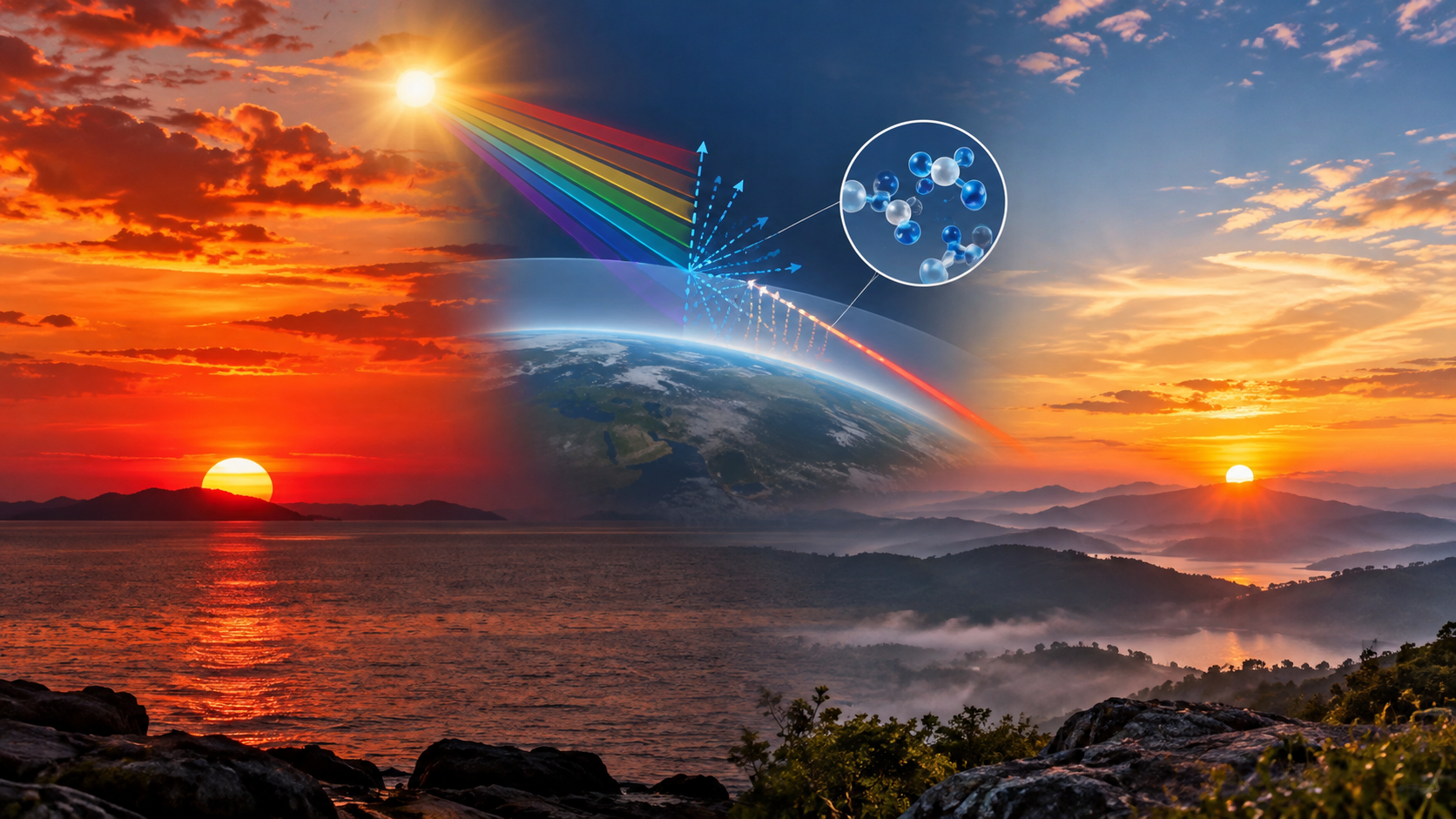
Have you ever stopped during dawn or dusk to admire a fiery crimson horizon? The science behind red sunrises and sunsets involves sunlight, atmospheric gases, aerosols, and the angle of incoming solar rays. Sunlight appears white, but it contains a broad range of visible wavelengths. Each color has a different wavelength and interacts with the atmosphere differently.
As sunlight travels through Earth’s atmosphere, air molecules scatter shorter wavelengths more strongly than longer wavelengths. This process changes which colors reach your eyes directly. You can explore Earth’s atmosphere and related processes through NASA’s Earth Science Division.
The effect becomes especially noticeable when the Sun sits close to the horizon. At these times, sunlight travels through a longer atmospheric path before reaching an observer. This gives scattering more time to remove blue and violet light from the direct beam.
In this guide, we explore why sunsets and sunrises look red. We also examine unusual sunset colors, morning-sky weather folklore, and red skies at night.
Why do sunsets and sunrises look red?
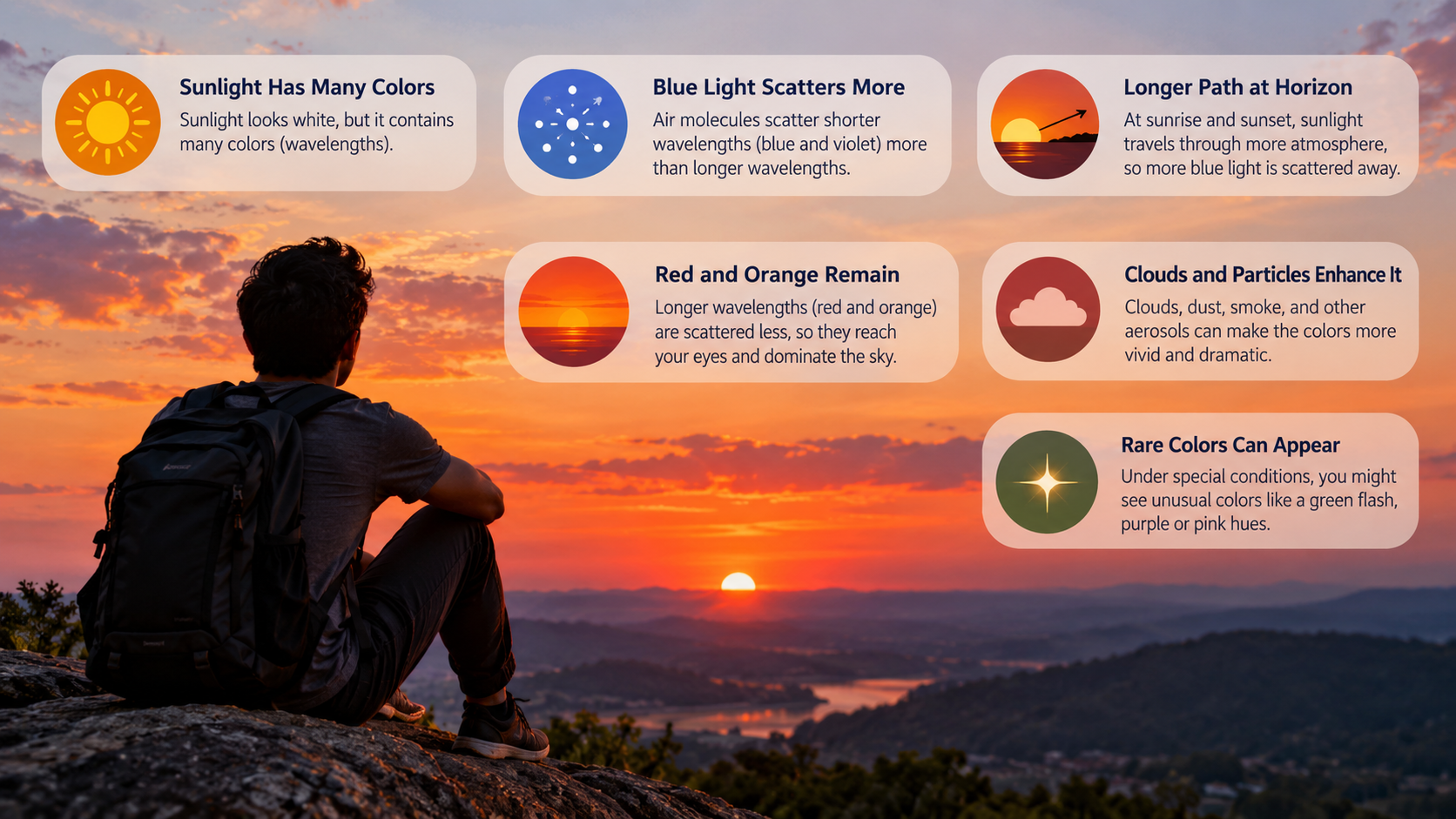
Sunsets and sunrises often look red because sunlight travels through more atmosphere when the Sun sits near the horizon. This longer path increases the amount of scattering that sunlight experiences before reaching your eyes. Earth’s atmosphere contains mostly nitrogen and oxygen molecules. These molecules scatter shorter wavelengths, especially blue and violet light, more efficiently than longer wavelengths.
During midday, sunlight usually travels through a shorter atmospheric path. Much of the visible spectrum can therefore reach the ground together. This makes the Sun and surrounding sky appear relatively bright and less red.
At sunrise and sunset, the situation changes. Blue light becomes scattered away from the direct path between the Sun and observer. Longer wavelengths, including red and orange, remain more prominent in the direct sunlight.
Clouds can amplify the effect by reflecting and scattering this warm-colored light. Dust, smoke, and other aerosols can also change the appearance of the horizon. The exact color depends on atmospheric conditions, cloud height, and particle concentration.
The Role of Atmospheric Path Length
Atmospheric path length plays a major role in the science behind red sunrises and sunsets. When the Sun appears overhead, its rays enter the atmosphere along a relatively direct route. The amount of atmosphere that sunlight crosses is therefore smaller than it is near sunrise or sunset.
As the Sun approaches the horizon, its rays enter at a much shallower angle. The sunlight then travels through a considerably longer distance within the atmosphere before reaching an observer. This gives air molecules more opportunities to scatter shorter wavelengths.
Rayleigh scattering affects blue and violet wavelengths particularly strongly. These wavelengths are redirected in many directions instead of remaining in the original solar beam. Red and orange wavelengths experience much less Rayleigh scattering.
The result is a direct beam with proportionally more warm-colored light. Clouds near the horizon can then reflect this light, producing bright orange, pink, or red patterns.
The exact intensity varies with atmospheric conditions. Haze, dust, smoke, humidity, and cloud cover can all influence the final appearance.
What is the rarest color of sunset?
There is no scientifically established single “rarest” sunset color because sunset appearance depends heavily on atmospheric conditions and observation location. However, green flashes are among the most unusual and fleeting optical effects associated with sunrise and sunset. A green flash can appear for only a few seconds when the upper edge of the Sun is disappearing below the horizon or emerging above it.
The phenomenon results from a combination of atmospheric refraction and wavelength-dependent scattering. Earth’s atmosphere bends different wavelengths of light by slightly different amounts. Under favorable conditions, this separation becomes visible near the solar disk.
A green flash can be easier to observe over a distant, unobstructed horizon. Ocean horizons often provide suitable conditions because they can offer a clear line of sight. Very clean air and stable atmospheric layers can improve visibility. For capturing fleeting horizon effects, advanced smartphone camera technology can also help preserve subtle colors and details.
Other unusual sunset colors include deep purple, pink, and even unusual yellow or orange shades. Aerosols from dust, smoke, volcanic activity, or pollution can influence these colors. These unusual colors can make sunsets particularly interesting subjects for indoor and outdoor photoshoot techniques when planning photography around changing light.
How Thermal Inversions Create Mirages
Temperature inversions can contribute to unusual sunset and sunrise appearances. A temperature inversion occurs when warmer air sits above cooler air near the surface. This arrangement can create strong changes in air density with altitude.
Those changes affect how light travels through the atmosphere. Refraction can bend sunlight along a curved path and sometimes produce optical effects known as atmospheric mirages. Under suitable conditions, observers may see distorted or stretched images of the Sun.
A green flash can sometimes occur alongside these atmospheric effects. However, a temperature inversion is not required for every green flash. The phenomenon depends on several factors, including atmospheric clarity, refraction, the observer’s horizon, and the position of the Sun.
Mirages can make the solar disk appear unusually flattened or distorted near the horizon. This can enhance the visibility of brief color separation at the upper edge.
These effects are especially noticeable when the horizon remains unobstructed. Ocean viewpoints are popular because distant horizons provide favorable viewing conditions.
The combination of refraction and scattering helps explain why some sunsets produce unusual optical effects that last only seconds.
Why do sunrise and sunset appear reddish?
Sunrise and sunset appear reddish because Earth’s atmosphere scatters different wavelengths of sunlight by different amounts. The process begins when solar radiation enters the atmosphere at a low angle. This creates a longer path through the air compared with midday sunlight.
Nitrogen and oxygen molecules produce Rayleigh scattering, which affects shorter wavelengths strongly. Blue and violet light therefore scatter away from the original direction more efficiently. Longer wavelengths, particularly red and orange, remain more concentrated in the direct beam.
Red light has a wavelength of roughly 620 to 750 nanometers. Its longer wavelength makes it less susceptible to Rayleigh scattering than blue light. This does not mean red light completely avoids scattering. It simply scatters less under the same conditions.
Aerosols can further change the colors that observers see. Dust, smoke, sea salt, and other particles interact with sunlight through additional scattering processes. Large particles can produce broader and more complex color effects.
Clouds also matter because they reflect and scatter sunlight. Their altitude and position can determine whether they appear orange, pink, red, or purple.
Aerosols and Particulate Matter Amplification
Aerosols can dramatically influence the appearance of a sunrise or sunset. These tiny particles include dust, smoke, sea salt, and other suspended material. Their size, concentration, and composition determine how they interact with incoming sunlight.
Rayleigh scattering mainly involves individual gas molecules. Larger aerosol particles can produce different scattering behavior, sometimes described through Mie scattering. This can alter the balance of colors reaching an observer.
Fine particles from smoke or volcanic eruptions may produce particularly vivid red and orange sunsets. Large amounts of atmospheric material can also reduce visibility and make the Sun appear dimmer.
However, more particles do not automatically produce a more beautiful sunset. Heavy pollution can create a hazy appearance and reduce the clarity of distant objects. The type of particles matters as much as their quantity.
Clouds can further amplify warm colors when they are positioned above or near the setting Sun. High clouds may catch sunlight after the Sun has disappeared from the surface horizon.
This combination of aerosols, clouds, and atmospheric scattering explains why no two sunsets look exactly alike.
Is there any science behind red sky in the morning?
There is some science behind the traditional saying, “Red sky at morning, sailor’s warning,” but it should not be treated as a reliable weather forecast by itself. The idea works best in regions where weather systems generally move from west to east.
A red morning sky can occur when sunlight illuminates clouds or airborne particles toward the eastern horizon. If weather systems are approaching from the west, the sky may appear red before those systems reach the observer. In some situations, this can indicate changing weather conditions.
However, the color alone cannot determine whether rain or storms will arrive. Atmospheric circulation varies by location, season, and weather pattern. Local geography can also influence how clouds and weather systems move.
The traditional saying therefore reflects an observation that can sometimes correspond with approaching weather. It does not provide a dependable prediction on its own.
Modern forecasting uses satellite observations, radar, pressure patterns, wind measurements, humidity, and numerical weather models. These tools provide much more information than sky color alone.
A red morning can be interesting evidence of atmospheric conditions, but it should be interpreted alongside other weather information.
Why is the sky red at 3am?
A red sky at 3am usually does not come from sunlight because the Sun is below the horizon. Instead, the glow may come from artificial light pollution, especially when clouds, fog, or airborne particles scatter light back toward the ground.
Cities produce large amounts of upward-directed light from streets, buildings, vehicles, signs, and industrial facilities. Low clouds can reflect this light downward, creating a bright glow across the night sky. The effect can appear orange, yellow, pink, or red depending on the light sources and atmospheric conditions. When viewing these nighttime effects on a phone, dark mode can make the display more comfortable in low-light conditions.
Older sodium-vapor lighting can produce strong yellow-orange tones. Modern LED lighting has a broader range of colors, so the resulting skyglow can look different from place to place.
Clouds usually make artificial skyglow much more noticeable. Clear nights can appear darker because there are fewer surfaces available to scatter artificial light back toward observers.
Snow, fog, dust, and haze can also increase the visibility of artificial illumination.
Therefore, a red sky at 3am is usually an atmospheric lighting effect rather than a form of natural twilight. The exact appearance depends on local lighting, cloud cover, particles, and weather conditions.
Frequently Asked Questions
Do air pollution and smog make sunsets look better?
Light aerosol pollution can sometimes intensify red and orange colors by scattering sunlight, but heavy smog usually reduces visibility and dulls the sunset. This reflects the science behind red sunrises and sunsets, where particle concentration and size influence how sunlight is scattered.
Why are sunrises usually less colorful than sunsets?
Sunrises are not necessarily less colorful than sunsets. Their appearance depends on clouds, humidity, dust, aerosols, and atmospheric conditions, all of which influence the science behind red sunrises and sunsets and determine how strongly different wavelengths of sunlight are scattered.
Why do clouds turn bright pink during twilight?
Clouds can appear bright pink when they catch sunlight that has traveled through a long atmospheric path, allowing shorter blue wavelengths to scatter away while red and orange light remains. This is a key part of the science behind red sunrises and sunsets.
Conclusion
The science behind red sunrises and sunsets highlights how basic atmospheric physics transforms our everyday horizons into awe-inspiring spectacles. From the fundamental mechanics of Rayleigh scattering to the optical refraction behind a rare green flash, atmospheric properties dictate every shift in hue. Sunlight’s journey through miles of air naturally filters out short blue wavelengths, letting deep, warm colors reach our eyes at dawn and dusk.
Beyond mere visual beauty, these vivid colors offer practical insights into upcoming weather, barometric pressure shifts, and local air quality. Even mysterious nighttime glows tell a compelling story of cloud altitude and surface illumination interacting in the dark.
Next time you step outside at dawn or dusk, take a moment to look closely at the horizon. Notice the subtle gradients, cloud reflections, and tonal shifts as the sun moves. Armed with this knowledge, you can now appreciate the dynamic atmospheric laboratory working high above you every single day.