
What Is Activation Energy? The Ultimate Scientific and Practical Guide
Have you ever wondered why a matchstick does not ignite on its own inside the box? It needs friction to start burning. In science, this initial spark represents activation energy, the minimum energy barrier that molecules must cross before undergoing a transformation. According to the National Institute of Standards and Technology, understanding these fundamental chemical thresholds allows researchers to predict reaction rates, design advanced materials, and develop life-saving industrial processes.
Every day, countless chemical processes happen quietly around you. Rust forms on iron, engines burn fuel, and your body digests lunch. None of these events could occur without overcoming an essential thermodynamic hurdle. Understanding this concept unlocks a clearer view of both microscopic chemistry and daily human performance. Energy technologies such as tidal energy and underwater turbines provide another example of how scientists work with energy in the physical world.
This comprehensive guide answers the most critical questions surrounding energy thresholds. We explore exact scientific definitions, review core syllabus requirements for Class 12 chemistry, and break down tangible real-world examples. Additionally, we examine how modern psychologists apply this chemical principle to human habits, and we look into proven methods used to lower energy barriers.
What is meant by activation energy?
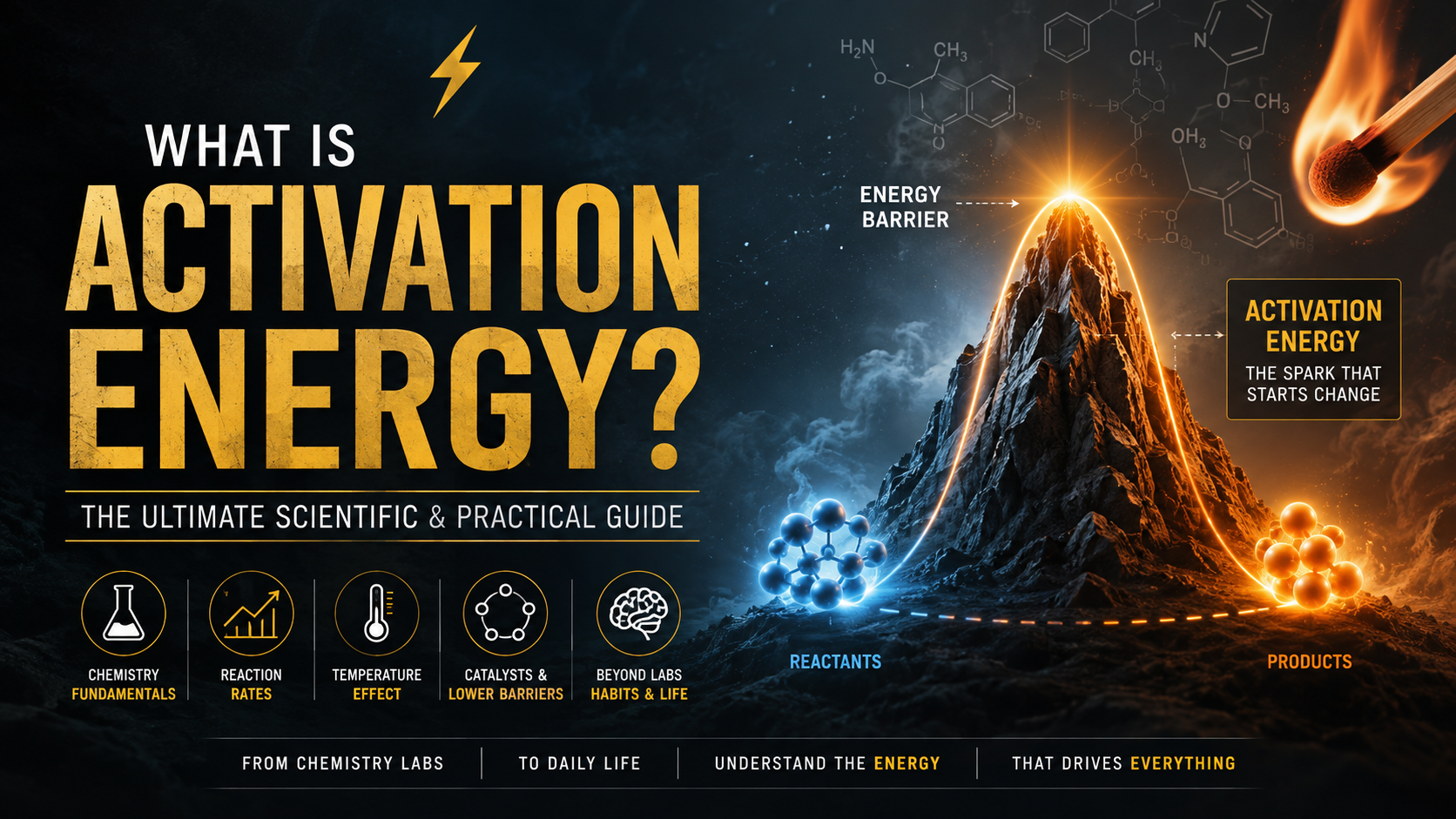
Activation energy is the minimum energy required by reacting particles to reach the activated complex and begin a chemical reaction. Reactants cannot always form products simply because their particles collide. The particles must collide with enough energy and a suitable orientation.
During a reaction, existing bonds may weaken while new bonds begin to form. This process requires the particles to reach a high-energy state called the transition state. Activation energy represents the energy barrier that separates the reactants from this state.
Svante Arrhenius introduced the concept while developing his explanation of how temperature affects reaction rates. His work helped establish the relationship between temperature and the number of particles capable of reacting.
A useful analogy is a hill between two valleys. Reactants occupy one valley, while products occupy another. The reaction can proceed only when particles gain enough energy to cross the hill. Therefore, a higher activation energy generally means fewer successful collisions at a given temperature.
The Significance of the Transition State
The transition state is a short-lived, unstable arrangement of atoms that occurs near the highest-energy point of a reaction pathway. At this stage, reactant bonds may be stretching or breaking while new product bonds begin forming.
The transition state is important because molecules must reach it before the reaction can continue toward products. Activation energy measures the energy difference between the reactants and this high-energy state along a particular reaction pathway.
Think of a ball rolling between two valleys. It cannot move into the second valley unless it first reaches the top of the hill. The height of that hill represents the energy barrier.
The transition state itself cannot normally be isolated because it exists for an extremely short time. However, chemists can study its properties using experimental data and theoretical models.
Catalysts are especially important here. They provide a different reaction pathway with a lower-energy transition state. As a result, more particles can cross the barrier at the same temperature.
What is activation energy class 12th?
For Class 12 chemistry, activation energy ($E_a$) is commonly explained as the difference between threshold energy and the average energy of reacting molecules. It is a key concept in the chemical kinetics chapter.
Activation energy helps explain why reactions occur at different rates. A reaction with a larger energy barrier generally has fewer molecules capable of reacting at a particular temperature. Therefore, its reaction rate is usually lower when other conditions remain comparable.
The concept is closely connected with the Arrhenius equation:
$k = A e^{-E_a/RT}$
Here, $k$ is the rate constant, $A$ is the frequency factor, $E_a$ is activation energy, $R$ is the gas constant, and $T$ is absolute temperature.
Students may also determine activation energy using rate constants measured at different temperatures. A common method uses the relationship between ln(k) and 1/T. Understanding the equation and its variables is important for numerical problems and board examinations.
Calculating Values with Maxwell-Boltzmann Curves
Maxwell-Boltzmann distribution curves help Class 12 students understand how molecular energy varies within a sample. At any temperature, molecules do not all possess the same kinetic energy.
Only a fraction of particles have enough energy to overcome the activation energy barrier. These particles can participate in effective collisions when their orientation is also suitable.
When temperature increases, the distribution changes. A larger fraction of molecules then possesses energy equal to or greater than $E_a$. This increases the number of successful collisions and usually increases the reaction rate.
The graph therefore provides a visual explanation of temperature effects on chemical kinetics. It also shows why a relatively small temperature increase can sometimes produce a significant change in reaction speed.
Students should remember that temperature does not simply make every molecule move faster by the same amount. Instead, it changes the energy distribution across the population of molecules.
Which is the best definition of activation energy?
The most precise definition of activation energy is the minimum energy barrier that reacting particles must overcome to reach the transition state during a chemical reaction. This definition is more accurate than describing it simply as “starter energy.”
Activation energy is represented as an energy difference on a reaction-coordinate diagram. For a particular reaction pathway, it describes the barrier between the reactants and the transition state. The size of this barrier strongly influences reaction speed.
A reaction can be thermodynamically favorable and still occur slowly if its activation energy is high. This distinction is important because reaction spontaneity and reaction rate are not the same thing.
For example, some substances may be capable of undergoing a favorable chemical change but remain stable for long periods. They lack sufficient energy to cross the reaction barrier at an appreciable rate.
Activation energy therefore helps explain reaction behavior across organic, inorganic, physical, and biological chemistry. It also explains why catalysts can accelerate reactions without changing the overall energy difference between reactants and products.
Standardized IUPAC Guidelines for Chemical Kinetics
The International Union of Pure and Applied Chemistry (IUPAC) provides standardized terminology for chemical kinetics and reaction-rate concepts. In experimental chemistry, activation energy is commonly obtained from how a reaction rate constant changes with temperature.
For an Arrhenius-type reaction, plotting ln(k) against 1/T produces a relationship whose slope can be used to determine activation energy. The mathematical relationship is:
ln(k) = ln(A) − $E_a$/RT
From the slope, activation energy can be calculated when the required experimental conditions are satisfied.
This approach is useful because scientists do not need to observe the transition state directly. Instead, they can use measurable reaction rates at different temperatures to estimate the energy barrier.
It is also important to avoid treating activation energy as a universal constant for a substance. Its value depends on the specific reaction pathway and conditions. Different pathways can have different activation energies.
What is activation energy in psychology?
In psychology and behavioral discussions, activation energy is sometimes used as a metaphor for the effort needed to start an action. The idea compares behavioral resistance with the energy barrier found in chemical reactions.
Starting a difficult task may require more mental effort than continuing it once momentum develops. For example, opening a textbook and studying for five minutes may feel difficult initially. After starting, continuing for another twenty minutes can become easier.
This idea is often discussed alongside procrastination, motivation, habit formation, and behavioral friction. However, psychological activation energy is not the same scientific quantity as chemical activation energy. It is a metaphor rather than a measured thermodynamic property.
A practical strategy is to reduce the effort required to begin. Preparing study materials beforehand, removing distractions, or setting a very small first task can make starting easier.
The concept can therefore provide a useful behavioral analogy. However, claims about specific psychologists establishing a formal psychological version of activation energy should be treated carefully.
Overcoming Behavioral Inertia and Procrastination
Behavioral inertia describes the tendency to remain with an existing activity or state rather than initiate a new one. Procrastination can become harder to overcome when the first step feels complicated, unpleasant, or uncertain.
One practical approach is to reduce the size of the starting action. Instead of planning to study for two hours, begin by opening the required chapter and reading one page. Instead of planning a long workout, start by putting on exercise clothes.
Other useful strategies include:
- Preparing necessary materials in advance.
- Removing obvious distractions.
- Setting a specific start time.
- Breaking large tasks into smaller actions.
- Creating an easy first step.
These methods do not literally lower chemical activation energy. They reduce behavioral friction, making an action easier to initiate.
Once a person begins, progress may create momentum. This can make the remaining task feel less demanding. The approach is especially useful for repetitive activities where starting is consistently harder than continuing.
Can you give me an example of activation energy?
A familiar example of activation energy is starting a campfire. Wood can remain exposed to oxygen without immediately burning. Combustion requires the material to reach a sufficiently high temperature for the necessary chemical reactions to begin. For another perspective on how energy is produced and used, see how to calculate your home’s solar energy needs.
When you apply a flame, the added heat helps overcome the activation energy barrier. Once combustion begins, the reaction releases heat. That heat can then help sustain further combustion.
A car engine provides another useful example. Fuel and oxygen must be present in the cylinder, but combustion requires an ignition source. A spark from the spark plug provides energy that helps initiate the combustion process.
The same principle applies to many chemical reactions. Reactants may be capable of forming products, but their particles still need sufficient energy to reach the required transition state.
These examples show why activation energy is important in everyday chemistry. Heat, sparks, or other energy sources can initiate reactions, while catalysts can provide alternative pathways that reduce the required energy barrier.
Biological Examples in Cellular Respiration
Biological systems contain many examples of reactions that require controlled energy input. Glycolysis, the first major stage of glucose breakdown, includes an initial energy-investment phase.
During this stage, cells use two ATP molecules to phosphorylate glucose-related molecules. These reactions help prepare and destabilize the six-carbon molecule for later steps in the pathway.
The two ATP molecules are not simply providing “activation energy” in the strict chemical sense. Instead, ATP phosphorylation changes the molecules involved and helps drive specific biochemical reactions.
Later steps of glycolysis generate ATP and NADH. Under standard conditions, glycolysis therefore produces more ATP than it initially consumes, resulting in a net gain of two ATP molecules per glucose molecule.
This example shows how living cells manage energy barriers through coupled reactions, enzymes, and energy-rich molecules. Biological chemistry is highly controlled, allowing reactions to proceed efficiently under relatively mild cellular conditions.
How to lower activation energy?
The standard way to lower the activation energy of a chemical reaction is to use a catalyst. A catalyst provides an alternative reaction pathway with a lower activation-energy barrier.
Catalysts do not change the overall thermodynamic difference between reactants and products. They also do not change the equilibrium position of a reversible reaction. Instead, they increase the rates at which the forward and reverse reactions occur.
Biological catalysts called enzymes perform the same general role in living organisms. They bind substrates at active sites and help create conditions that favor the transition state. This can make biochemical reactions occur rapidly at physiological temperatures.
Industrial chemistry also uses catalysts to improve reaction efficiency. Metals and metal compounds can participate in catalytic processes used to manufacture fuels, chemicals, fertilizers, and other products. Improving overall household efficiency also involves choosing technologies such as energy-efficient LED bulbs that reduce electricity consumption.
Lower activation energy means a greater proportion of particles can overcome the reaction barrier at the same temperature. This can allow industrial processes to operate under less demanding conditions. Similar efficiency principles apply outside chemistry, including ways to maximize energy efficiency in your yard and reduce household energy use.
However, catalysts do not make every reaction instantaneous. Their effectiveness depends on the reaction, catalyst, temperature, concentration, and other conditions.
How Enzymes Facilitate Complex Biochemical Reactions
Enzymes lower activation energy by providing a favorable environment for specific chemical reactions. Their active sites bind particular substrate molecules and help position them for productive interactions.
This positioning can increase the likelihood of effective collisions. Enzymes can also strain certain bonds, stabilize transition-state structures, and create favorable chemical environments around the reacting molecules.
As a result, reactions that would proceed extremely slowly without enzymes can occur rapidly inside living cells. This is essential because biological systems operate under relatively mild temperatures and pressures.
Enzymes are highly specific, although their specificity varies among different enzyme systems. Their activity can also depend on factors such as temperature, pH, substrate concentration, and inhibitors.
Importantly, enzymes do not change the overall energy difference between reactants and products. They lower the activation-energy barrier by providing a different reaction pathway.
This principle explains why enzymes are essential to processes such as digestion, DNA replication, cellular respiration, and metabolism. Without enzymatic catalysis, many biochemical reactions would be too slow to support normal cellular activity.
FREQUENTLY ASKED QUESTIONS
What is the standard unit of measurement for activation energy?
In the International System of Units (SI), activation energy is measured in joules per mole (J/mol) or kilojoules per mole (kJ/mol). In non-SI scientific contexts, researchers frequently use kilocalories per mole (kcal/mol). These units quantify how many thousands of joules one mole of reacting substances must absorb to reach the transition state successfully during a chemical process.
Can activation energy ever be zero or negative?
Yes, activation energy can occasionally be zero or negative in specialized reaction dynamics. Radical recombination reactions, where two highly reactive free radicals join together, often have zero activation energy because no existing chemical bonds require breaking. Negative values occur when reaction rates decrease as temperatures rise, typically observed in complex multi-step barrierless gas-phase reactions.
How does temperature affect activation energy?
Temperature does not directly change the activation energy barrier itself; instead, it changes the kinetic energy of reacting particles. Raising temperature causes molecules to move faster, increasing collision frequency. More importantly, higher temperatures dramatically expand the proportion of colliding molecules that possess enough kinetic energy to overcome the constant activation barrier.
What is the core difference between activation energy and net reaction energy?
Activation energy represents the temporary energy barrier required to start a reaction, whereas net reaction energy ($\Delta H$) measures the overall difference between reactant and product energy levels. A reaction can release massive amounts of net heat (exothermic), yet still require substantial initial activation energy to get started.
CONCLUSION
Understanding activation energy provides a vital window into the physical laws governing our universe. From the basic definition of atomic collisions to advanced Class 12 kinetics equations, this thermodynamic concept explains why chemical reactions occur at specific rates. It helps scientists predict reaction behavior, allows industrial chemists to create faster synthetic pathways, and reveals how biological enzymes sustain living organisms.
Beyond chemistry, applying this principle to human psychology offers a practical mental model for personal growth. By actively reducing the friction needed to begin meaningful daily tasks, you can bypass procrastination and build lasting, positive routines.
Whether you are balancing kinetic equations for an exam or attempting to establish better personal habits, remember that starting is always the hardest part. Once you supply the initial energy required to clear that opening barrier, the rest of the process flows naturally. Embrace these insights to master your studies and optimize your daily routines.