Understanding How Noise Cancellation Works in Modern Audio Devices
Have you ever wondered how headphones silence airplane engines or office chatter? Understanding how noise cancellation works reveals the clever science behind modern audio devices. Active noise cancellation uses microphones and digital processors to reduce unwanted ambient sounds before they reach your ears.
According to the Acoustical Society of America, sound manipulation plays an important role in controlling unwanted environmental noise. Active noise cancellation uses a principle called destructive interference to reduce external sounds.
This article explains the science behind noise cancellation in simple terms. It also covers its limitations, safety, benefits, and everyday uses. You will learn why some sounds are easier to cancel than others. You will also discover what to consider before buying noise-cancelling headphones.
What Is Noise Cancellation and How Does It Work?
Understanding how noise cancellation works starts with the basic properties of sound waves. Noise cancellation is an audio technology that reduces unwanted sounds around you. Sound travels through the air as pressure waves with peaks and valleys.
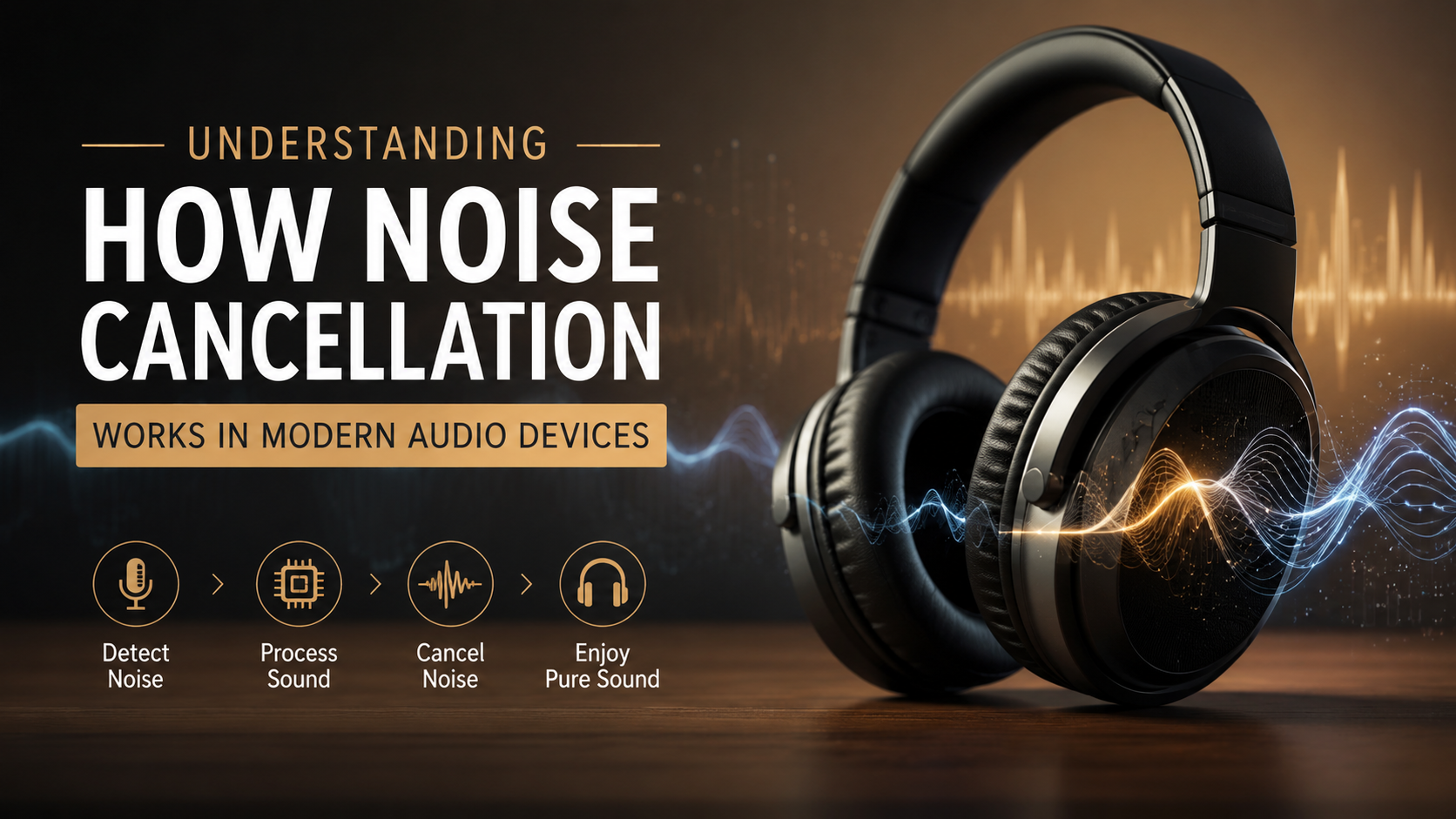
Active noise cancellation, or ANC, uses small microphones to detect surrounding sounds. A digital signal processor then analyzes the captured sound. It creates a second sound wave with the opposite phase.
When the original sound and inverse wave meet, destructive interference occurs. Their opposing pressure patterns reduce the overall sound energy. This process happens continuously and within a very short time.
ANC works especially well with predictable sounds. Examples include airplane engines, air conditioners, and train noise. These sounds usually contain steady, low-frequency patterns.
Passive isolation also plays an important role. Ear cups and ear tips physically block some external noise. Combining passive isolation with ANC provides stronger overall noise reduction.
The Role of Microphones and Processors
Microphones and processors are essential to understanding how noise cancellation works in modern headphones. External microphones monitor sounds around the listener. Some models also use internal microphones to monitor sound inside the ear cup.
The digital signal processor analyzes these signals in real time. It then creates an opposing waveform designed to reduce the detected noise. This process repeats continuously as the surrounding sound changes.
The microphones and processor must work extremely quickly. Even small delays can reduce cancellation effectiveness. Advanced ANC systems use carefully tuned algorithms to improve timing and accuracy.
Some headphones use feedforward, feedback, or hybrid ANC systems. Feedforward microphones monitor external noise before it reaches the ear. Feedback microphones monitor the sound closer to the listener.
This technology reduces unwanted background noise without requiring higher music volumes. As a result, users can enjoy clearer audio in many noisy environments.
Is 100% Noise Cancellation Possible?
Understanding how noise cancellation works also explains why complete silence is difficult to achieve. Reaching 100% noise cancellation is not currently possible with consumer headphones. ANC can reduce many unwanted sounds dramatically, but it cannot remove every sound.
Active noise cancellation works best with steady, predictable, low-frequency sounds. Airplane engines, air conditioners, and constant road noise are good examples. Their consistent patterns give the processor enough information to create an effective inverse wave.
Sudden and unpredictable sounds are much harder to cancel. Voices, clapping, sirens, and sharp noises can change rapidly. Their frequencies and wave patterns may shift before the system can respond accurately.
Passive isolation also has physical limitations. Ear cups and ear tips can block some external sound. However, they cannot completely seal every sound pathway.
ANC performance also varies between headphone designs. Ear shape, fit, microphone placement, and processing quality all matter. A poor seal can reduce noise reduction even when the internal technology is advanced.
Therefore, modern ANC headphones should be viewed as noise-reduction devices, rather than perfect silence machines.
Limitations With High Frequencies
High-frequency sounds create particular challenges for active noise cancellation. Their wavelengths are shorter, and their patterns can change rapidly. This makes accurate phase matching more difficult.
Human voices demonstrate this limitation clearly. Speech contains many changing frequencies and irregular patterns. ANC may reduce some vocal sounds, but it rarely removes conversations completely.
Sudden noises create another challenge. A shout, horn, or dropped object may happen too quickly for the system to cancel effectively. Some of the original sound can reach the listener before the processor responds.
This limitation is important when considering how noise cancellation works in everyday environments. ANC does not perform equally well across every frequency range.
Modern headphones can still reduce some higher-frequency sounds. They achieve this through a combination of active noise cancellation and passive isolation.
The physical design of the headphones also matters. Well-fitting ear cups or ear tips provide additional sound reduction. Together, passive isolation and active processing offer broader background noise reduction.
What Does Noise Cancellation Work Against?
Active noise cancellation works primarily against continuous and predictable low-frequency sounds. These sounds usually follow patterns that the headphones can detect and analyze effectively.
Common examples include airplane engines, train movement, traffic rumble, and computer fans. Air conditioners and other mechanical equipment can also create ideal conditions for ANC.
The microphones continuously monitor the surrounding environment. The processor identifies unwanted sound patterns and generates an opposing waveform. This process helps reduce the perceived intensity of the original noise.
Low-frequency sounds are especially suitable for ANC because they often remain relatively consistent. Their longer wavelengths also give the system more time to process changes.
This makes noise-cancelling headphones particularly useful during travel. They can reduce engine rumble on airplanes, trains, and buses. They can also make focused work more comfortable in noisy environments, especially when paired with music that can support memory and focus.
However, ANC does not remove every sound equally. Sudden noises and complex sounds can remain noticeable. The best results usually come from combining active noise cancellation with passive sound isolation.
Targeting Steady Low Frequencies
Steady low-frequency sounds create a consistent baseline that ANC systems can track. Their predictable patterns make it easier for processors to generate suitable inverse waves.
For example, an airplane engine produces continuous background noise. The headphones can monitor this sound and continuously adjust their anti-phase signal.
The same principle applies to air conditioners, ventilation systems, and some traffic noise. These sounds tend to change more gradually than speech or sudden impacts.
ANC does not need to make the inverse signal perfect to be useful. Even partial cancellation can significantly reduce perceived background noise. This can make music and spoken audio easier to hear.
The headphone fit also affects performance. A good seal improves passive isolation and supports the overall cancellation effect. Poorly fitting headphones may allow more external noise to enter.
As a result, steady low-frequency noise remains the strongest target for ANC technology. This explains why noise cancellation often feels most impressive on airplanes and during long commutes.
Is Noise Cancellation Safe for Your Ears?
Using noise-cancelling headphones at appropriate listening levels is generally considered safe. In some situations, ANC may even help users listen more comfortably at lower volumes.
Background noise can encourage people to increase their music volume. This habit can expose the ears to excessive sound levels for long periods. ANC reduces some background noise, which may make lower listening levels more practical.
However, noise cancellation itself does not make loud listening safe. Excessive volume can still damage hearing over time. Users should therefore keep listening levels moderate and take regular breaks.
Some people experience a mild feeling of pressure when ANC is enabled. Others may notice slight discomfort or dizziness. These sensations can vary between individuals and usually relate to how the brain perceives reduced low-frequency sound.
ANC headphones should also be used responsibly in public spaces. Strong noise reduction can make it harder to hear traffic, alarms, or other important environmental sounds.
For these reasons, safe listening habits remain essential, even when using advanced noise-cancelling technology.
Protecting Hearing Through Lower Volumes
Listening at lower volumes is one of the most important ways to support long-term hearing health. Loud sounds can damage sensitive structures inside the inner ear when exposure is excessive or prolonged.
ANC can make lower-volume listening easier in noisy environments. Users may not need to compete with airplane engines, traffic, or office chatter by increasing their music volume.
A comfortable listening level should remain the priority. Turning ANC on should not be treated as permission to listen at maximum volume.
Good habits include taking regular listening breaks and avoiding unnecessarily loud settings. Users should also choose headphones that fit comfortably and provide suitable passive isolation.
Noise cancellation can therefore support healthier listening habits when used correctly. Its main benefit is reducing background noise, not making high-volume listening harmless.
If you experience persistent ringing, discomfort, or changes in hearing, consider speaking with a qualified healthcare professional. These symptoms should not be ignored.
What Are the Disadvantages of Noise-Cancelling Headphones?
Noise-cancelling headphones offer major benefits, but they also have some drawbacks. Understanding these limitations can help you decide whether ANC suits your needs. Keeping headphones clean and well maintained can also support their long-term usability, so proper headphone cleaning and maintenance is worth considering.
First, ANC headphones often cost more than comparable standard headphones. Their microphones, processors, batteries, and additional circuitry increase manufacturing costs.
Battery life is another consideration. Active noise cancellation requires electronic processing, which consumes power. Wireless models may need frequent charging when ANC is used regularly.
Some users also experience a mild pressure sensation or discomfort. Others simply dislike the feeling of being isolated from their surroundings.
Strong noise reduction can create safety concerns in certain situations. Walking near traffic while blocking environmental sounds may reduce awareness of vehicles, cyclists, or warnings.
Some ANC systems can also produce a faint hiss or slightly change the perceived sound. The effect varies between models and listening environments.
Key disadvantages include:
- Higher purchase costs than many conventional headphones.
- Battery consumption from continuous ANC processing.
- Limited cancellation of voices and sudden sounds.
- Reduced environmental awareness in some situations.
- Possible audio artifacts or mild pressure sensations.
Battery Consumption and Cost Factors
Active noise cancellation requires continuous electronic processing. The microphones must monitor surrounding sounds, while the processor calculates adjustments in real time.
This process consumes battery power. Wireless headphones may therefore provide different battery performance with ANC enabled or disabled.
Battery capacity and hardware efficiency vary between models. Premium headphones often use more advanced processors and optimized power management.
Cost is another factor worth considering. ANC headphones contain additional microphones, processing hardware, and related components. These features can increase the final retail price.
However, higher cost does not automatically mean better noise cancellation. Headphone fit, microphone design, software algorithms, and tuning all influence real-world performance.
Before buying, consider where you will use the headphones most often. Frequent travelers may value strong engine-noise reduction. Office users may prioritize comfort and voice handling.
Comparing battery life, ANC performance, comfort, and price can help you choose a model that fits your needs.
Frequently Asked Questions
Can noise cancellation work without playing any music?
Yes, you can use active noise-cancelling headphones purely for silence. Many people wear them in noisy offices or during flights simply to block out ambient sound without listening to audio tracks, helping them focus or sleep better.
Do noise-cancelling headphones block human voices completely?
No, they do not block human speech entirely. Because speech features dynamic, mid-to-high frequencies and rapid variations, active systems struggle to cancel voices completely, though they muffle conversations into faint murmurs.
Does turning on noise cancellation affect audio quality?
It can slightly alter sound perception in some models. The phase-inversion process sometimes introduces a faint background hiss or subtly colors the bass response, though top-tier brands minimize this artifact effectively.
Can noise-cancelling headphones be wired, or must they be wireless?
They can be both. While most modern noise-cancelling headphones connect via Bluetooth, many models also include a wired cable option that still powers the active cancellation circuitry through an internal battery.
Conclusion
Understanding how noise cancellation works reveals the clever engineering behind modern audio devices. Microphones detect surrounding sounds, while processors create opposing waves to reduce unwanted noise.
ANC works particularly well against steady, low-frequency sounds. Airplane engines, air conditioners, and continuous traffic rumble are common examples. Sudden sounds and human voices remain more difficult to cancel.
Noise cancellation can also support better listening habits. By reducing background noise, it may help users enjoy audio at more comfortable volume levels, whether they listen to music through YouTube Premium or Spotify Premium.
However, ANC has limitations. It can increase cost and battery consumption. Some users may also experience mild pressure or reduced awareness of their surroundings.
Choosing the right headphones depends on your environment and listening habits. Consider ANC performance, passive isolation, comfort, battery life, and sound quality before making a purchase.
With realistic expectations, noise-cancelling headphones can make travel, work, and everyday listening much more comfortable.