
What is the Best Place to Keep Your Savings Safely?
Finding the right spot for your hard-earned cash is one of the most important financial decisions you will ever make. When you want the best places to keep your savings safely, you must balance security with growth. According to the Federal Deposit Insurance Corporation, traditional banking institutions offer unmatched protection for your principal balance. Whether you are building an emergency fund or saving for a major milestone, knowing where to park your funds prevents unnecessary financial stress. This comprehensive article explores the safest vehicles, smart money rules, high-yield accounts, and structured monthly saving schemes designed to keep your wealth secure.
What Is the Safest Place to Keep Savings Money?
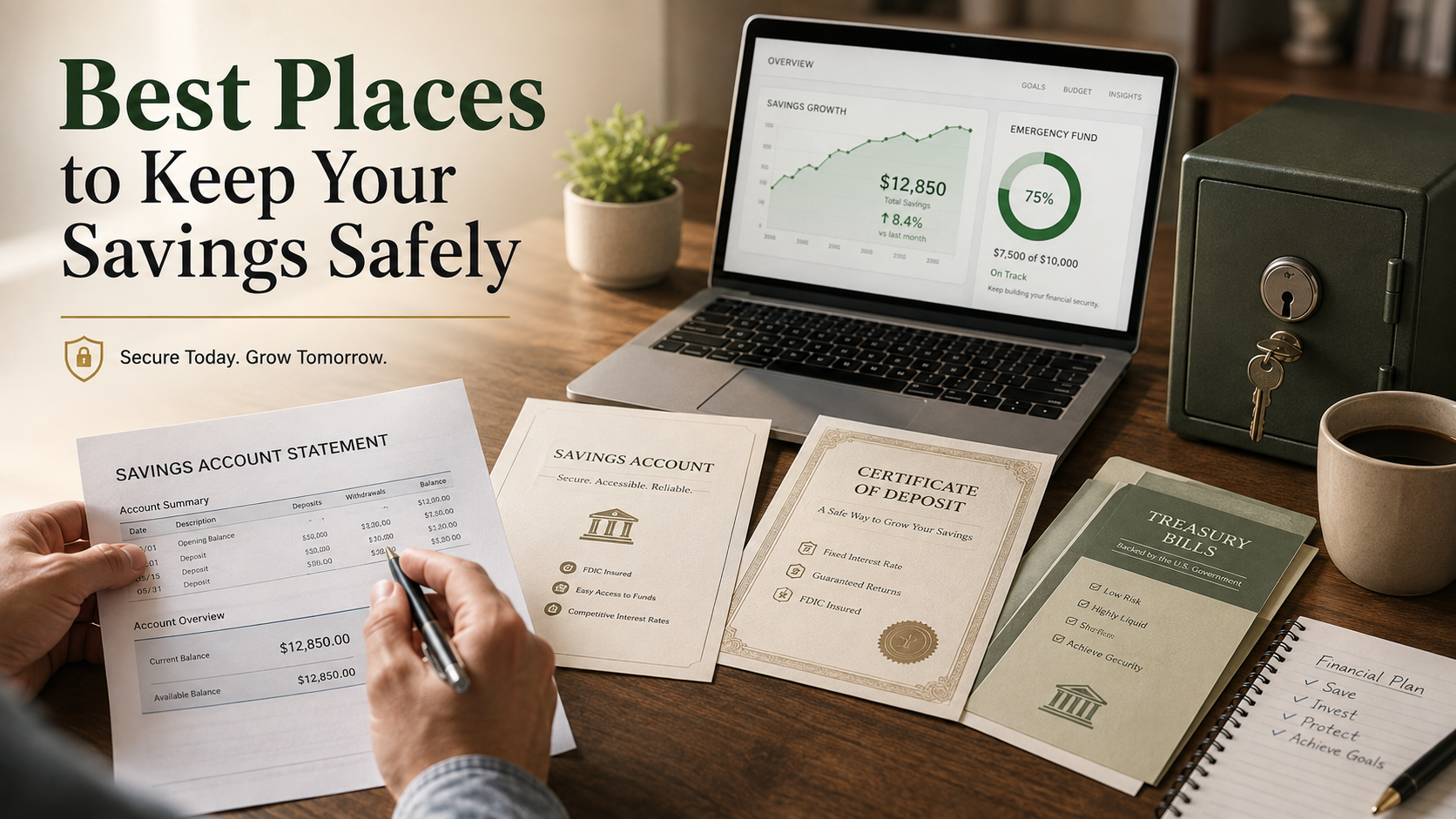
When security is your top priority, federally insured deposit accounts are among the safest places to keep savings. In the United States, FDIC-insured banks protect eligible deposits up to applicable coverage limits. NCUA-insured credit unions provide similar protection for eligible deposits. This coverage helps protect your money if a covered financial institution fails.
Traditional savings accounts, money market deposit accounts, and certificates of deposit can all provide this type of protection when offered by an insured institution. However, federal insurance does not protect unlimited amounts. You should understand the applicable coverage limits and account ownership rules before depositing large sums.
These accounts also keep your money separate from market investments. Your balance does not normally rise or fall with stock prices. They can therefore work well for emergency funds, short-term goals, and cash you cannot afford to lose.
For maximum safety, verify that your bank or credit union is federally insured. Also, keep your balance within applicable insurance limits whenever possible.
Maximizing Protection Through Federal Insurance Coverage
Federal deposit insurance can provide an important layer of protection for your savings. However, simply having several accounts at the same bank does not automatically multiply your coverage. Insurance limits generally depend on the depositor, ownership category, and institution.
If you have more money than the applicable insurance limit, consider spreading eligible deposits across separately insured institutions. Different ownership categories may also receive separate coverage under applicable rules.
Before moving money, check the current FDIC or NCUA coverage rules. Your bank or credit union can also explain how your accounts are categorized. This matters because account structures can affect how much of your money receives insurance protection.
For example, keeping excess cash at multiple qualifying institutions may help you remain within applicable coverage limits. You should not assume that every financial product offered by a bank is insured. Stocks, bonds, mutual funds, and other investments generally do not receive FDIC or NCUA deposit insurance.
The goal is simple: understand where your money sits, determine whether it is insured, and stay within the relevant limits.
What Is the 7-7-7 Rule for Money?
The 7-7-7 rule for money is not a universally standardized financial rule. Different personal finance sources use the term to describe different saving or budgeting approaches. Therefore, you should verify which version a particular source means before applying it to your finances.
Some versions use three separate financial priorities. These may include building savings, preparing for long-term goals, and allowing money for personal spending. The broader idea is to divide your financial resources deliberately instead of treating all available money as spendable.
A structured approach can help you build better habits. It can also reduce the risk of ignoring emergency savings while focusing entirely on retirement or investments. However, there is no single percentage allocation that works for everyone.
Your income, debt, expenses, emergency fund, and financial goals should determine your actual allocation. Someone with expensive debt may need a different approach from someone with stable income and substantial savings.
Use the 7-7-7 concept as a budgeting framework, rather than a guaranteed formula for building wealth.
Applying the Three-Part Framework to Daily Finances
If you use a three-part savings framework, start by identifying your most important financial priorities. Emergency savings should generally come before aggressive long-term investing when you have little accessible cash.
You can then divide your monthly surplus between short-term savings and long-term financial goals and discretionary spending. The exact percentages should reflect your circumstances rather than an arbitrary formula.
For example, you might direct part of each paycheck toward an emergency fund. Another portion could support retirement or other long-term investments. The remaining amount could cover planned personal spending.
Automation can make this process easier. Schedule transfers shortly after receiving your income so saving happens before unnecessary spending.
Review the allocation regularly as your income and expenses change. A new job, major purchase, debt repayment, or family responsibility may require adjustments.
The main benefit is consistency. A simple framework gives each dollar a purpose and helps prevent short-term spending from consuming money intended for future goals.
Where Is the Safest Place to Keep a Lot of Money?
Keeping a large amount of money requires more planning than choosing a standard savings account. The first priority should be determining how much protection your deposits receive. Large balances can exceed standard federal insurance limits, creating additional exposure if everything is held at one institution.
For substantial cash holdings, you may consider several options. These can include multiple federally insured bank accounts, insured cash sweep arrangements, Treasury bills, and other appropriate short-term government securities.
Treasury bills are short-term U.S. government securities. They are generally considered very low-risk because they are backed by the U.S. government. However, they are investments rather than bank deposits, so they do not receive FDIC insurance.
Money market mutual funds are another option, but they are also investments. Their balances are not protected by FDIC or NCUA deposit insurance. They can therefore behave differently from insured bank deposit accounts.
For large sums, the right strategy depends on safety, liquidity, taxes, and time horizon. Avoid assuming that a product is insured simply because a bank or financial institution sells it.
Utilizing Treasury Bills for Government-Backed Security
U.S. Treasury bills can be useful when you want to hold significant cash outside a traditional deposit account. They are short-term government securities with maturities ranging from several weeks to one year.
Treasury bills are backed by the U.S. government’s ability to meet its obligations. This makes them widely regarded as one of the lower-risk options for preserving capital over short periods.
However, Treasury bills are not identical to savings accounts. You purchase a security and generally hold it until maturity or sell it before maturity. Their prices can vary if you sell before maturity.
They also do not provide the same instant account access as a regular savings account. You should therefore consider when you will need the money before choosing a maturity period.
For large cash balances, Treasury bills can complement insured bank deposits. For example, you might keep your emergency cash in an insured savings account while using short-term Treasury bills for money you will not need immediately.
The key is matching the investment with your cash-flow needs and time horizon. Safety does not mean every option works equally well for every purpose.
Where Is the Best Place to Keep Savings?
The best place to keep savings depends on when you need the money and how much access you require. There is no single account that is automatically best for everyone.
For emergency savings and short-term goals, a high-yield savings account can offer a useful combination of accessibility and interest earnings. These accounts may pay more interest than traditional savings accounts, although rates can change over time.
If you do not need immediate access to your money, a certificate of deposit may be another option. CDs generally provide a fixed interest rate for a specific term. You can also compare CDs with other savings and investment choices using FD vs mutual fund returns. In exchange, withdrawing money early may result in a penalty.
Traditional savings accounts can still be useful when convenience and branch access matter more than maximizing interest. The difference in rates should be weighed against account requirements and fees.
When comparing accounts, look beyond the advertised interest rate. Check the annual percentage yield, minimum balance requirements, withdrawal restrictions, fees, and insurance status.
Your savings strategy should also separate emergency money from long-term investments. Cash needed soon should not depend on stock-market performance.
Choosing Between Flexible Savings and Fixed Certificates
High-yield savings accounts and certificates of deposit serve different purposes. Comparing FD and mutual fund returns can also help you understand how deposit-based savings options differ from market-linked investments when choosing the right place for each portion of your savings.
A high-yield savings account generally provides easier access to your money. You can usually make withdrawals or transfers when needed, subject to the account’s terms and applicable rules. The interest rate can change over time.
A CD typically requires you to keep your money deposited for a specified term. In return, you may receive a fixed interest rate for that period. Early withdrawal can result in a penalty, depending on the account.
Consider a savings account for your emergency fund and near-term expenses. A CD may suit money you know you will not need until a specific future date.
You can also use both options. Keep immediately accessible savings in a high-yield account and place some longer-term cash into CDs.
Before opening either account, compare rates, fees, terms, minimum deposits, and insurance coverage. The highest advertised rate is not always the best choice if the account has restrictions that do not fit your needs.
Best Bank Investment Plans
Bank investment plans can help you pursue long-term financial goals, but they are fundamentally different from insured savings accounts. Investment products can include mutual funds, bonds, stocks, structured products, and professionally managed portfolios. Comparing SIPs and fixed deposits can help you understand how different options balance potential returns and risk. Their potential returns come with varying levels of risk.
The right investment strategy depends on your time horizon, financial goals, and tolerance for losses. Money needed for an emergency or near-term purchase generally should not be placed in volatile investments.
For long-term goals such as retirement, diversified investments may provide greater growth potential than keeping all your money in cash. However, market values can fall, sometimes significantly.
Banks may offer investment services, but the fact that an investment is sold through a bank does not make it federally insured. FDIC insurance generally covers eligible deposits, not market investments.
Before selecting an investment plan, understand its fees, risks, expected time horizon, and underlying assets. Avoid choosing a product simply because a bank employee recommends it.
A suitable portfolio should reflect your broader financial plan. Diversification can reduce concentration risk, but it cannot eliminate investment losses or guarantee returns.
Diversifying Your Portfolio for Balanced Growth
Diversification means spreading your investments across different assets rather than relying heavily on one investment. It can help reduce the impact of a poor performance from a single company, sector, or asset class.
A diversified portfolio might contain a combination of stocks, bonds, and other suitable investments. The appropriate mix depends on your financial goals and risk tolerance.
You can also diversify within an asset class. For example, stock exposure can be spread across different companies, industries, and geographic markets. Bond investments can vary by issuer, maturity, and credit quality.
However, diversification does not guarantee profits. A broad portfolio can still decline during a major market downturn. Its main purpose is to reduce concentration risk and create a more balanced exposure to different sources of return.
Review your portfolio periodically rather than reacting to every short-term market movement. Your allocation may need adjustment as your goals, income, or time horizon changes.
For long-term investors, diversification can provide a more disciplined approach to investing. It is generally more reliable than trying to predict which single investment will perform best.
Best Monthly Saving Scheme
Choosing among the Best Places to Keep Your Savings Safely also means finding a savings method you can maintain consistently. A monthly savings scheme turns saving into a regular financial habit. Understanding short-term and long-term savings goals can help you decide how much to save and where to keep it. Instead of deciding how much to save each month, you set a predetermined contribution and automate the process.
You can use this approach with a savings account, recurring deposit, or another suitable savings product. The right choice depends on your country, financial institution, interest rates, account terms, and personal goals. Always check whether the product provides applicable deposit insurance or other protections.
Regular contributions can help your savings grow steadily over time. They also reduce the temptation to spend money that you intended to save. When comparing the Best Places to Keep Your Savings Safely, consider more than the interest rate.
Check the maturity period, withdrawal rules, minimum contribution, fees, penalties, and insurance status. For short-term goals, prioritize liquidity and capital safety. For longer-term goals, investments may offer greater growth potential but also involve market risk.
A monthly savings plan works best when the contribution fits your budget. Consistent saving is usually more sustainable than an unrealistic target that you cannot maintain.
Automating Deposits to Build Effortless Saving Habits
Automation can make saving easier by removing repeated decisions from your monthly routine. You can schedule a recurring transfer from your primary account to a dedicated savings account after receiving your income.
This approach supports the pay-yourself-first strategy. Instead of saving whatever remains after spending, you set aside your planned amount first. This can help you make steady progress toward emergency funds and short-term and long-term financial goals.
When reviewing the Best Places to Keep Your Savings Safely, consider accounts that support automatic transfers. Start with an amount you can comfortably maintain. If your income or expenses change, adjust the transfer to protect your cash flow.
You can also create separate accounts for different goals. One account could hold your emergency fund, while another supports a planned purchase or annual expense.
Review your automated transfers regularly. Check the account’s interest rate, fees, withdrawal conditions, and insurance status. Remember that automation does not replace a budget. You still need to monitor spending, debt, and overall financial progress.
The goal is to make saving easier to repeat. A consistent automated contribution can turn saving into a long-term habit and help you choose the Best Places to Keep Your Savings Safely.
Frequently Asked Questions
What Is the Difference Between a Savings Account and a CD?
When comparing the Best Places to Keep Your Savings Safely, a savings account offers more flexibility than a certificate of deposit (CD). You can usually deposit or withdraw money from a savings account when needed, while its interest rate may change over time. A CD requires you to keep your money deposited for a fixed period. In return, it may provide a guaranteed interest rate. Early CD withdrawals can result in penalties. Savings accounts generally suit emergency funds, while CDs can work well for planned expenses.
Are Online Banks Safe for Holding Large Savings?
When considering the Best Places to Keep Your Savings Safely, online banks can be a secure option. The key factor is whether the institution carries appropriate federal deposit insurance. In the United States, eligible deposits at FDIC-insured banks receive protection within applicable limits. Credit unions may provide NCUA insurance instead. Online banks can also offer competitive interest rates because they often have lower operating costs. Before depositing a large amount, verify the institution’s insurance status and understand the applicable coverage limits. Do not assume every financial product offered online is insured.
How Much Money Should I Keep in a Liquid Savings Account?
Choosing the Best Places to Keep Your Savings Safely also means deciding how much money should remain easily accessible. A common guideline is to keep around three to six months of essential living expenses in an emergency fund. Your personal situation may require more or less. Consider your income stability, household expenses, debt, and job security when setting the target. Keep this money in a liquid account where you can access it without selling investments or paying an early withdrawal penalty. The purpose is to cover unexpected expenses without disrupting your long-term financial plans.
Can I Lose Money in a High-Yield Savings Account?
Among the Best Places to Keep Your Savings Safely, a federally insured high-yield savings account can provide strong protection for eligible deposits. However, the statement that you can never lose money needs an important qualification. Federal deposit insurance protects eligible deposits within applicable coverage limits, but not every financial product labeled as a savings product is insured. Interest rates can also change, affecting how quickly your balance grows. Unlike stocks or mutual funds, an insured savings deposit is not directly exposed to daily market price fluctuations. Always verify the institution’s insurance status and applicable coverage limits.
Conclusion
Choosing the Best Places to Keep Your Savings Safely requires more than selecting the account with the highest advertised interest rate. You should consider security, accessibility, insurance coverage, fees, and your financial timeline before making a decision. Federally insured savings accounts can provide a strong foundation for emergency funds and short-term goals. CDs may suit money you can leave untouched for a fixed period. Treasury bills and diversified investments may serve different long-term purposes. The right approach is to match each portion of your money with its specific purpose. Review your current savings strategy, automate regular contributions, and keep your cash in suitable financial vehicles.