
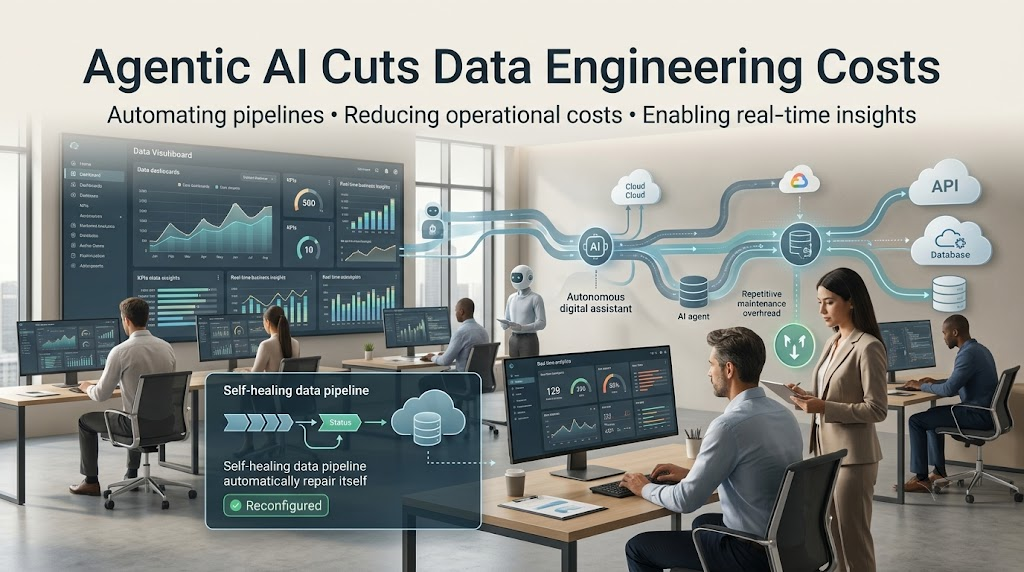
Agentic AI Cuts Data Engineering Costs While Boosting Real-Time Insights
Modern enterprises face a growing challenge: data volumes are increasing rapidly while operational budgets remain under pressure. Agentic AI cuts data engineering costs by helping organizations automate complex data workflows, reduce manual maintenance, and improve pipeline efficiency. Traditional data pipelines often require continuous monitoring, troubleshooting, and expensive engineering resources to remain reliable. As data environments become more complex, businesses need smarter ways to manage infrastructure, maintain data quality, and deliver insights faster.
Agentic AI cuts data engineering costs by introducing autonomous software agents that can design, monitor, repair, and optimize data pipelines with minimal human intervention. These intelligent systems help companies reduce maintenance efforts while allowing engineers to focus on strategic projects.
The impact goes beyond cost savings. Agentic AI helps businesses transform raw data into actionable insights faster. By automating repetitive workflows, improving data reliability, and enabling real-time processing, organizations can make smarter decisions with greater speed and confidence.
Autonomous AI agents can monitor systems, identify issues, and optimize workflows with minimal human intervention. This shift allows data teams to spend less time fixing repetitive problems and more time focusing on strategic initiatives. As organizations adopt AI-powered automation, technologies such as machine learning, intelligent agents, and generative AI are becoming essential for improving business processes and operational efficiency. Research from McKinsey on artificial intelligence adoption and business transformation highlights how organizations are using AI to improve productivity, automate workflows, and create new business value.
The True Cost of Traditional Data Engineering Before Agentic AI Automation
Enterprise data infrastructure is expensive to build and maintain. Data teams often spend significant time managing routine tasks instead of creating new capabilities.
Pipeline failures, broken integrations, and changing data formats create constant challenges. When an upstream API changes or a database schema evolves, downstream reports and dashboards can fail unexpectedly.
Traditional workflows require engineers to manually investigate problems. They must locate errors, rewrite code, test fixes, and restore damaged processes. This reactive cycle slows innovation and increases operational costs.
Many organizations also face hidden expenses caused by poor data quality. Incorrect reports, delayed insights, and inconsistent records can affect important business decisions.
Manual data management increases the risk of human error. It can also create compliance challenges when organizations must maintain accurate and traceable information.
Agentic AI provides a different approach. Instead of waiting for failures, autonomous systems continuously analyze data workflows. They identify unusual behavior, predict potential issues, and improve pipeline performance before problems become major disruptions.
How Agentic AI Accelerates Real-Time Data Insights and Business Decisions
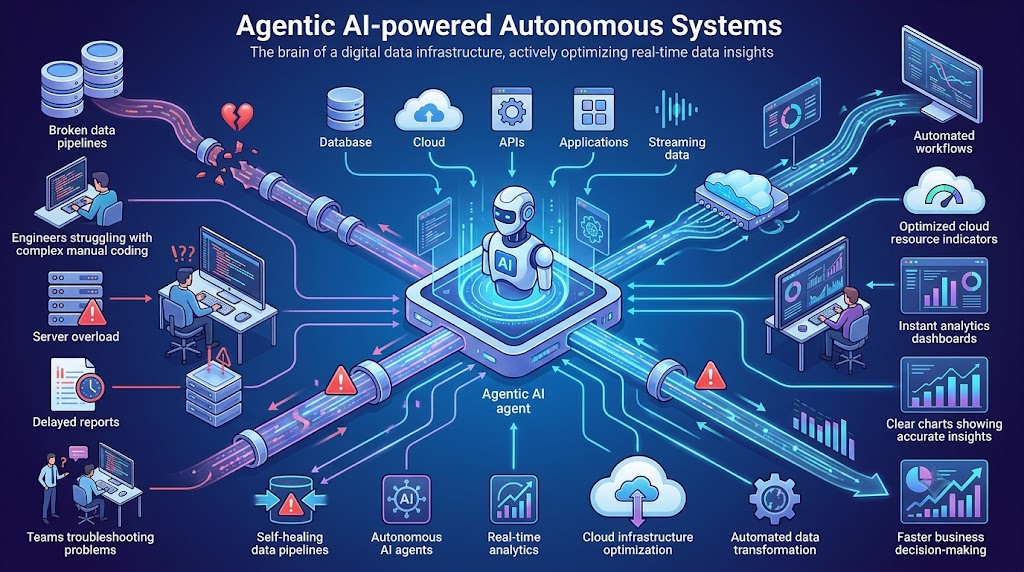
Autonomous AI agents are transforming modern data engineering operations. Unlike traditional automation tools, agentic systems can analyze situations, understand context, and take intelligent actions.
These systems do more than follow fixed instructions. They can investigate failed workflows, identify root causes, and create solutions based on changing conditions.
By automating repetitive engineering tasks, Agentic AI reduces operational overhead. Teams spend less time maintaining existing systems and more time developing valuable data products.
Key cost-saving benefits include:
- Automated pipeline maintenance: AI agents monitor workflows and resolve common issues automatically.
- Reduced engineering workload: Teams spend fewer hours on repetitive debugging and manual updates.
- Improved reliability: Self-healing systems reduce downtime and improve data availability.
- Optimized cloud usage: Intelligent scaling helps prevent unnecessary infrastructure expenses.
This approach allows businesses to build more flexible and resilient data environments. Instead of managing constant failures, engineers can focus on innovation, analytics, and business growth.
Automated Pipeline Repair and Schema Evolution
Data sources change frequently. APIs update, database structures evolve, and new fields appear without warning. Traditional pipelines often break when these changes occur.
Agentic AI helps solve this problem through self-healing data pipelines. Autonomous agents detect unexpected changes and analyze their impact across the data environment.
When a schema change occurs, an AI agent can update extraction logic, test new transformations, and adjust workflows automatically. This reduces downtime and prevents engineers from manually repairing every issue.
The result is a more adaptable data infrastructure. Businesses can respond quickly to changing requirements without increasing engineering costs.
Self-healing capabilities are especially valuable for large enterprises with complex data ecosystems. They improve reliability while reducing the operational effort required to maintain critical systems.
Intelligent Infrastructure Scaling
Data workloads often change throughout the day. Sudden increases in traffic, seasonal demand, or business events can create unexpected processing requirements.
Traditional infrastructure management often relies on manual monitoring and scheduled scaling. This approach can lead to wasted resources or performance problems.
Agentic AI enables dynamic infrastructure optimization. Intelligent agents analyze workload patterns and automatically adjust computing resources based on current needs.
Benefits include:
- Lower cloud costs: Agents reduce unnecessary spending by managing idle resources.
- Better performance: Systems receive additional capacity during high-demand periods.
- Improved efficiency: Resources are matched with actual workload requirements.
By continuously optimizing infrastructure, Agentic AI helps organizations maintain reliable performance while controlling expenses.
Accelerating Real-Time Insights for Smarter Decisions
Reducing costs is only one advantage of autonomous data systems. Agentic AI also improves how quickly businesses access valuable information.
Traditional batch processing often delays insights by hours or days. Decision-makers may rely on outdated reports when responding to customer behavior, market changes, or operational issues.
Autonomous agents accelerate data processing by continuously collecting, cleaning, and validating information. They help organizations move closer to real-time analytics.
With faster insights, businesses can improve critical operations. Marketing teams can adjust campaigns quickly. Fraud systems can detect unusual activity immediately. Executives can monitor important performance indicators without waiting for scheduled reports.
Real-time data processing creates a stronger competitive advantage. Companies can respond faster, identify opportunities earlier, and make decisions based on current information.
How Agentic AI Reduces Data Silos Through Autonomous Integration
Enterprise data is often spread across multiple platforms, applications, and legacy systems. These disconnected environments make it difficult for businesses to create a complete view of their operations.
Traditional data integration requires custom connectors, manual coding, and significant engineering time. Connecting new systems can take weeks or even months.
Agentic AI simplifies data integration by allowing autonomous agents to understand different data sources and create connections automatically. These systems can analyze documentation, identify API structures, and generate secure integration workflows.
By reducing manual integration efforts, organizations can unify their data faster. Teams gain access to more complete information without relying heavily on external consultants or lengthy development cycles.
Autonomous integration also improves flexibility. When new applications or platforms are introduced, AI agents can adapt existing workflows with minimal disruption.
This capability helps businesses create a connected data ecosystem. Instead of managing isolated systems, companies can build a unified foundation for analytics, automation, and artificial intelligence.
The result is faster access to reliable information and improved decision-making across departments.
Implementing Agentic AI Safely in Your Enterprise Data Stack
Adopting autonomous AI does not mean giving up control over enterprise data systems. Successful implementations require strong governance, security measures, and careful deployment strategies.
The most effective approach uses a human-in-the-loop framework. This allows organizations to gradually increase automation while maintaining oversight.
Many companies begin by deploying AI agents as monitoring tools. In this stage, agents identify issues, suggest improvements, and provide recommendations for engineers.
After proving reliability, organizations can expand agent responsibilities. They may allow AI systems to handle routine fixes, optimize workflows, or manage specific operational tasks.
Important safeguards include:
- Access controls: Limit what AI agents can modify or manage.
- Audit tracking: Maintain detailed records of automated actions.
- Security policies: Protect sensitive enterprise information.
- Human approval workflows: Review important changes before deployment.
This balanced approach creates trust while reducing operational risk. Organizations gain the benefits of autonomous systems without sacrificing security or compliance.
How Agentic AI Reduces Data Engineering Costs Through Automation
Agentic AI reduces data engineering expenses by automating repetitive tasks that traditionally require significant manual effort. These tasks include pipeline monitoring, debugging, schema updates, and infrastructure optimization.
Traditional data engineering teams often spend valuable time responding to failures. Engineers must identify problems, write fixes, test changes, and restore normal operations.
Autonomous AI agents change this process. They continuously analyze workflows, detect anomalies, and apply solutions based on system conditions.
These capabilities help businesses reduce operational costs in several ways:
- Fewer hours spent on routine maintenance.
- Reduced downtime from pipeline failures.
- Lower cloud infrastructure waste.
- More engineering time available for innovation.
Instead of focusing primarily on system maintenance, data teams can work on advanced analytics, machine learning projects, and business improvements.
By combining automation with intelligent decision-making, Agentic AI creates a more efficient and scalable data engineering environment.
Frequently Asked Questions About How Agentic AI Cuts Data Engineering Costs
Can Autonomous Agents Handle Complex Data Transformations?
Yes, autonomous agents can manage many complex data transformation tasks when properly configured. Modern AI systems can understand business requirements, analyze datasets, and generate transformation logic.
For example, AI agents can create SQL queries, combine information from different sources, and clean inconsistent data formats. Additionally, they can validate results using predefined quality rules, ensuring transformed datasets remain accurate and useful for downstream applications.
However, organizations should still maintain appropriate controls. Human review remains essential for highly sensitive data processes or complex business decisions. In addition, Agentic AI works best when combined with strong data governance. Clear rules, validation systems, and continuous monitoring help ensure reliable results.
Ultimately, when implemented correctly, autonomous agents improve transformation speed while maintaining high data quality standards.
What Is the Difference Between Traditional ETL Tools and Agentic AI?
Traditional ETL tools depend on predefined workflows created by developers. These systems follow fixed rules for extracting, transforming, and loading data.
Although ETL platforms remain valuable, they often struggle with unexpected changes. For instance, if a source system changes its structure, engineers typically need to manually update the pipeline.
By comparison, Agentic AI introduces a more adaptive approach. Intelligent agents can analyze problems, understand context, and adjust workflows automatically.
The main differences include:
- Traditional ETL: Rule-based, predictable, and dependent on manual updates.
- Agentic AI: Adaptive, reasoning-based, and capable of autonomous optimization.
As a result, Agentic AI is particularly valuable for modern enterprises with constantly changing data environments. Moreover, by reducing manual intervention, autonomous systems create more resilient and efficient data operations.
Is It Safe to Let AI Manage Enterprise Data Pipelines Automatically?
Yes, AI-managed data pipelines can be safe when organizations implement proper governance and security practices.
In most cases, businesses do not immediately provide unrestricted access to autonomous agents. Instead, they introduce automation gradually.
A common approach begins with observation. AI agents monitor systems, identify problems, and recommend solutions. Afterward, human engineers review these recommendations.
Once confidence increases, organizations can allow agents to perform approved tasks automatically.
Security measures should include:
- Strict permissions and access controls.
- Continuous monitoring.
- Detailed activity logs.
- Compliance reviews.
Together, these safeguards ensure organizations maintain control over critical data systems. Therefore, Agentic AI should support engineering teams rather than replace responsible oversight. A carefully managed approach enables businesses to achieve automation benefits while protecting valuable information.
How Does Real-Time Data Processing Benefit Businesses?
Real-time data processing allows organizations to respond quickly to changing conditions. Instead of waiting for daily or weekly reports, businesses can analyze information as events happen.
Consequently, this speed improves decision-making across multiple areas. Marketing teams can adjust campaigns based on current customer behavior. Likewise, financial systems can identify suspicious activity faster, while operations teams can respond immediately to performance issues.
Agentic AI further enhances real-time processing by automating data collection, validation, and enrichment.
Key benefits include:
- Faster business decisions.
- Improved customer experiences.
- More accurate operational monitoring.
- Quicker responses to market changes.
Furthermore, organizations that use real-time analytics gain greater visibility into their operations. As a result, they can identify opportunities earlier and respond to challenges more effectively. Ultimately, in competitive markets, faster access to accurate information becomes a significant business advantage.
Conclusion
The future of data engineering is becoming increasingly autonomous. As data volumes continue to grow, organizations no longer need to rely entirely on manual maintenance, constant troubleshooting, and expensive operational processes.
Throughout this article, we explored how Agentic AI cuts data engineering costs by automating pipeline management, improving infrastructure efficiency, and resolving common data issues with minimal human intervention.
In addition, autonomous agents help businesses reduce operational expenses while improving data reliability. They continuously monitor workflows, detect problems, optimize resources, and support faster data delivery.
As a result, engineering teams can move beyond repetitive maintenance work. Instead, they can focus on innovation, advanced analytics, and strategic business initiatives that drive long-term growth.
Moreover, the shift toward real-time data operations creates new opportunities. Businesses gain access to accurate, up-to-date insights that support faster and smarter decisions. Consequently, companies can respond more effectively to customer behavior, market changes, and operational challenges.
However, successful adoption requires a balanced approach. Organizations should combine autonomous capabilities with strong governance, security controls, and human oversight to ensure reliability and compliance.
Looking ahead, businesses that integrate intelligent agents into their data workflows can build more scalable, efficient, and resilient data environments.
Finally, the next step is to evaluate existing data processes, identify repetitive tasks, and determine where Agentic AI can deliver the greatest impact. By adopting automation strategically, enterprises can reduce costs, improve performance, and create a stronger foundation for future growth.
To better understand how intelligent AI assistants are transforming modern businesses, read our comprehensive guide on AI Chatbots: The Complete Guide to Intelligent Business Automation