
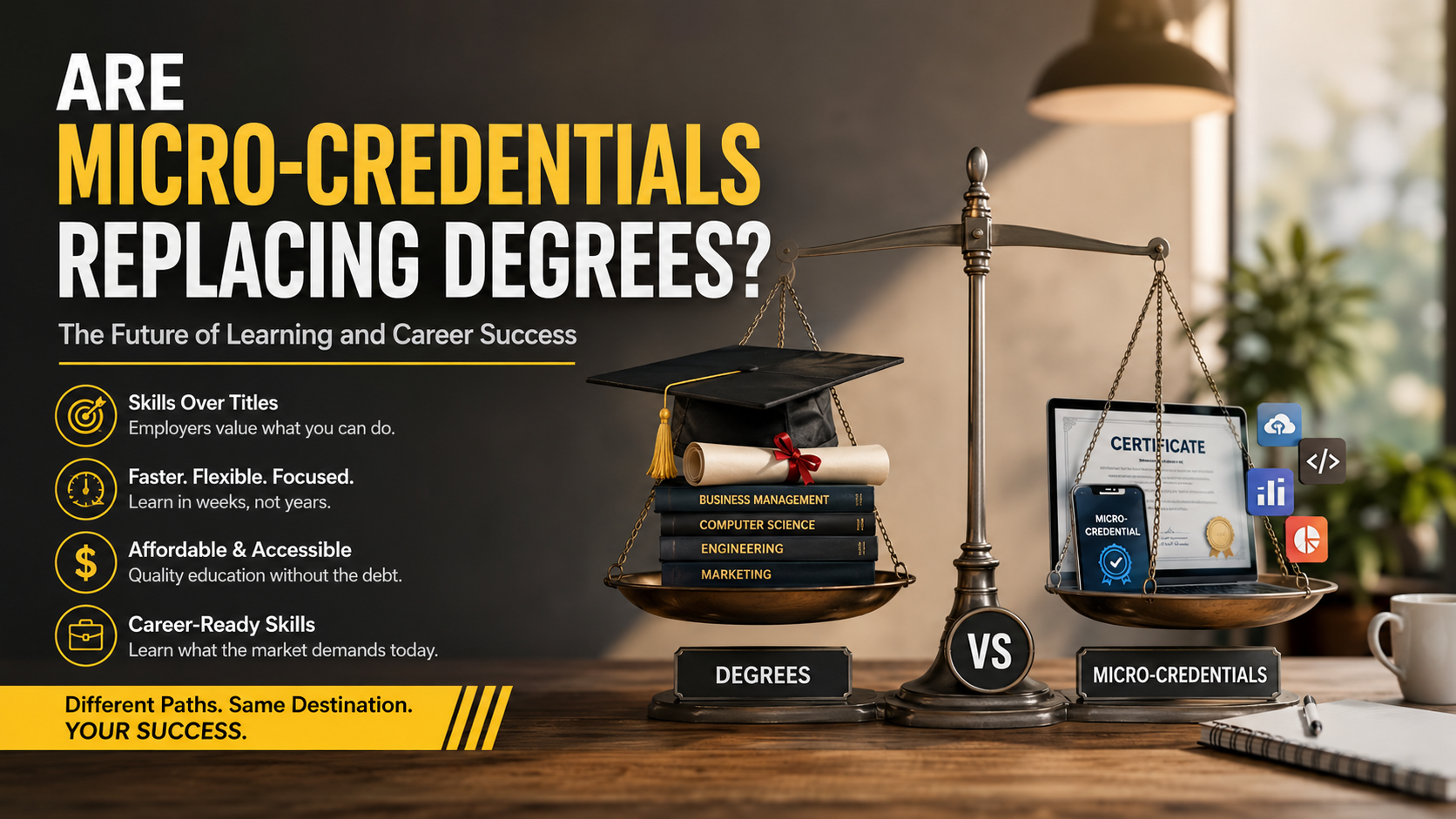
Are Micro-Credentials Replacing Degrees?
The modern job market is shifting rapidly. Consequently, traditional higher education is facing its biggest competitor yet. Rising tuition costs and evolving industry demands have sparked a massive debate. Specifically, are micro-credentials replacing degrees as the preferred choice for career advancement? Today, learners actively seek faster, more affordable ways to gain specific skills. The Coursera Global Skills Report highlights a surging demand for targeted, industry-backed certificates. These programs align directly with open tech and business roles.
This educational evolution matters immensely. Employers no longer view a four-year university diploma as the sole gold standard for talent. Instead, hiring managers increasingly prioritize proven competency over institutional pedigree. Therefore, the traditional pathway from high school straight to a university campus is expanding. It is turning into a multi-option highway that accommodates non-traditional professionals.
In this article, we will deeply analyze the structural differences between alternative certificates and degrees. We will explore current hiring trends, corporate viewpoints, and the distinct pros and cons of each route. Furthermore, we will dissect the economic factors that accelerate alternative education options. Ultimately, you will discover whether are micro-credentials replacing degrees in the digital era, or if they are simply reforming how we learn.
Understanding the Shift to Alternative Certificates
A micro-credential is a short, highly focused learning program. It verifies a student’s competence in a specific, narrow skill set. Naturally, people ask: are micro-credentials replacing degrees because of this razor-sharp focus? Unlike broad university majors, these courses cut out elective subjects completely. They focus purely on practical knowledge. This training ranges from cloud computing architecture to digital marketing analytics.
Students can often complete these certifications online within a few weeks or months. They can also work entirely at their own pace. This flexibility allows learners to balance education with their existing employment. Achieving this balance is incredibly difficult within a rigid, full-time university framework.
Several major macroeconomic factors drive this rapid, widespread adoption among global learners. First, the crushing financial burden of traditional college leaves millions with substantial student loan debt. Micro-credentials offer a fraction of that cost. Therefore, they make high-quality instruction accessible to a much wider demographic. Second, modern technology evolves at an exponential pace. University curriculums simply struggle to match this speed.
A specialized certification updates its digital syllabus instantly when new software launches. Conversely, a traditional university degree program might take years to approve a minor curriculum change. This delay occurs due to complex bureaucratic processes. Thus, short courses fill a critical evolutionary gap in real-time professional training.
Analysis: Are Micro-Credentials Replacing Degrees in Modern Hiring?
The short answer is no, but they are radically changing recruitment rules. Many major corporations have explicitly dropped their four-year degree requirements for entry-level positions. They did this to access a wider, more diverse talent pool. Technology giants like Google, IBM, and Apple now accept verified industry certificates for competitive technical roles. They realize that technical proficiency and hands-on capability matter far more than parchment. This shift has forced human resource departments to transition toward skills-based evaluation methods.
However, a complete replacement of the bachelor’s degree is not happening across the broader employment spectrum. Instead, a complex hybrid model is emerging within corporate hiring practices. Employers view short-form certificates as excellent proof of current, actionable skills. Yet, they still value traditional degrees for broad, foundational knowledge.
Therefore, when evaluating if are micro-credentials replacing degrees, we must see them as equalizers. These digital credentials bridge the gap between systemic educational barriers and high-paying corporate careers. They allow self-taught individuals to compete fairly against Ivy League graduates.
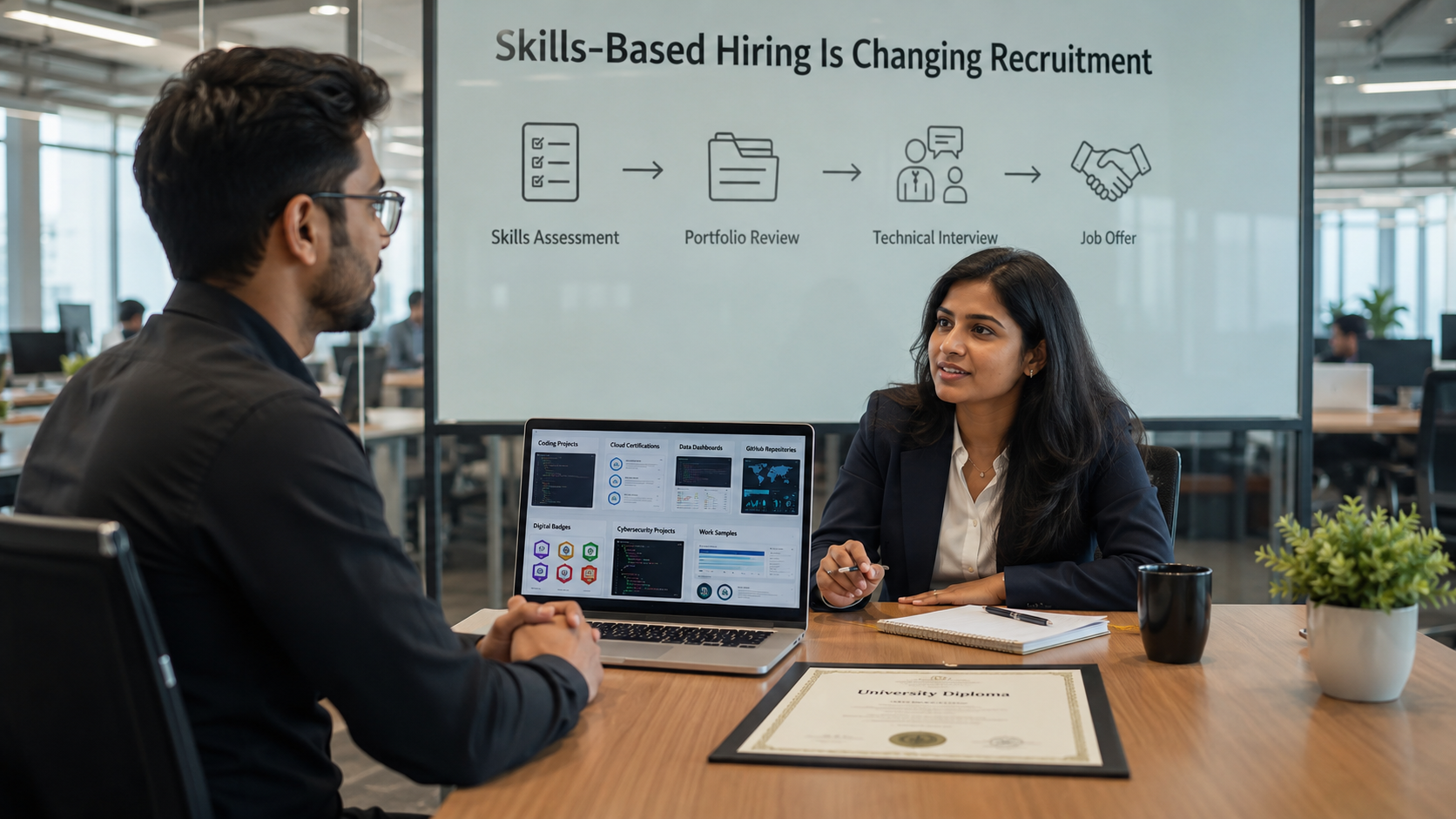
Sectors Embracing Skills-Based Hiring
-
Information Technology: Coding bootcamps and cloud certificates dominate this space. They frequently override formal computer science diplomas during technical review stages.
-
Digital Marketing: Platform-specific certifications from major ad networks prove practical skills. They showcase current campaign management much better than a generic marketing degree.
-
Data Analytics: SQL and Python certificates showcase technical competency. Students prove their worth through portfolio-based capstone projects that mimic real corporate data problems.
The Advantages of Short-Form Certifications Over Traditional Diplomas
The most significant benefit of a specialized certification is its direct, undeniable return on investment (ROI). Students gain exact skills that match current job openings. They do this without spending years in a classroom studying unrelated topics. This extreme speed allows professionals to pivot careers quickly. Moreover, they can upskill efficiently while maintaining a full-time job.
This format eliminates the heavy opportunity cost associated with leaving the workforce to attend school. Consequently, individuals can dramatically increase their earning potential in months rather than years. Similarly, it lowers the barrier to entry for highly competitive corporate fields.
Furthermore, these modern programs emphasize hands-on, practical learning over abstract theory. Instead of writing long research essays, students build real-world applications. They manage simulated corporate budgets or write functional code. This practical approach builds a tangible digital portfolio. Job seekers can show this portfolio directly to recruiters during technical interviews. It removes the guesswork from hiring completely. Employers can see exactly what a candidate can produce before offering a contract.
Where Traditional University Qualifications Maintain the Edge
Despite the massive rise of alternative education, traditional degrees retain substantial structural advantages. Certain highly regulated industries strictly require accredited university qualifications. This is due to legal and safety compliance guidelines. For instance, you cannot become a licensed surgeon through an online certificate program. Similarly, corporate lawyers and structural civil engineers require formal university diplomas. These fields demand deep, multi-year institutional validation, rigorous residency training, and state-mandated board examinations.
Additionally, universities provide a holistic environment for personal and professional development. Short online courses simply cannot replicate this environment. College campuses foster advanced critical thinking, deep networking opportunities, and lifelong mentorship structures with academic experts.
The critical soft skills built through collaborative group projects remain highly prized in executive leadership roles. The same applies to campus organizations and daily peer interactions. A degree signifies to an employer that an individual possesses long-term discipline. They can commit to a complex, multi-year goal and see it through to completion. Short-term courses cannot fully evaluate this metric.
Key Structural Differences At a Glance
| Feature | Micro-Credentials | Traditional Degrees |
| Time Commitment | Weeks to months | 3 to 4 years |
| Financial Cost | Low to moderate | High tuition investment |
| Curriculum Focus | Specialized technical skills | Broad foundational knowledge |
| Industry Agility | Updates in real-time | Slower curriculum updates |
The Future of Education: Blending Certificates and Higher Education Degrees
Moving forward, the relationship between these two educational pathways will likely be collaborative. It will not be combative. Progressive universities are already integrating industry certificates directly into their standard undergraduate degree plans. This innovative fusion allows a student to graduate with a broad, theoretical bachelor’s degree. Simultaneously, they earn a collection of specific, job-ready technical credentials. By doing so, academic institutions can protect their long-term relevance. They also ensure their graduates are highly employable on day one.
For the modern professional, education is no longer an isolated, one-time event that ends at age 22. Continuous upskilling through targeted micro-credentials will become the mandatory standard method. It is the only way to maintain career relevance across all sectors. Therefore, the old debate of are micro-credentials replacing degrees misses the grander shift. The future belongs entirely to the lifelong learner. This individual fluidly combines structural, foundational knowledge with agile, specialized digital skills. Embracing this dual approach ensures that your professional profile remains deeply grounded yet incredibly adaptable.
FAQ SECTION
Are micro-credentials replacing degrees entirely in the workforce?
No, micro-credentials are not completely replacing traditional degrees across the entire global workforce. While many progressive tech and creative industries have consciously removed strict university degree requirements from their job descriptions, deeply regulated fields still mandate formal higher education. Industries such as healthcare, corporate law, public education, and structural engineering require state licensing, which is legally tied to accredited university degrees. Instead of an outright replacement, a symbiotic relationship is forming. Micro-credentials act as an alternative pathway for specialized, skill-centric technical roles, or as a powerful additive booster to an existing degree. They allow professionals who already hold a diploma to pivot into new, fast-evolving subfields without undergoing a complete four-year retraining process. Therefore, degrees establish the foundational baseline, while credentials provide the targeted career agility.
Can I get a high-paying tech job using only micro-credentials?
Yes, it is entirely possible to secure a high-paying technology position relying solely on micro-credentials and proven skills. The technology sector was the pioneer of skills-based hiring because technical competence is easily testable. If you hold recognized certifications from top tier cloud providers, software networks, or reputable coding bootcamps, you can bypass the traditional HR screening filters. However, your certificates must be backed by a robust, public portfolio of practical work, such as active GitHub repositories or complex data analysis projects. Recruiters in fields like software engineering, cybersecurity, and data science value verified problem-solving capabilities far above institutional background. You must be prepared to excel in rigorous technical interviews and live coding assessments, which prove you possess the exact competencies your digital badges claim.
How do employers verify the authenticity of a micro-credentials certificate?
Employers verify the authenticity of modern micro-credentials through secure, tamper-proof digital badge platforms, with Credly being the most prominent industry standard. When a candidate includes a micro-credential on their resume or LinkedIn profile, it links back to a centralized digital registry managed by the issuing organization. This digital token contains extensive metadata that details the recipient’s identity, the specific date of issuance, the criteria required to earn the badge, and the exact skills that were assessed. Because these badges are cryptographically secured by the platform provider, they cannot be easily forged or altered by the applicant. This high level of transparency gives corporate hiring managers and human resource professionals immediate peace of mind, allowing them to instantly trust the validity of your non-traditional educational achievements.
Do micro-credentials expire over time?
Yes, many technical and software-specific micro-credentials feature mandatory expiration dates, typically ranging between two to three years from the initial date of issuance. Because modern technology platforms, cloud architectures, and coding libraries evolve at an incredibly rapid pace, a certification earned five years ago may no longer reflect current industry realities. To maintain an active status, certified professionals must undergo a formal recertification process, which frequently involves passing an updated exam or logging continuing education credits. This built-in expiration structure is actually highly valued by employers. It serves as concrete proof that a candidate’s technical skills are fully up-to-date and that they are actively engaged in continuous professional development, unlike a static university degree which is granted once and never updated.
Are university degrees still worth the financial investment?
Yes, traditional university degrees remain highly valuable and worth the financial investment, provided you select your field of study and financial funding options strategically. A university degree offers unmatched long-term advantages for those aiming for executive leadership roles, academic research positions, or careers within highly structured corporate hierarchies. The deep professional networks, institutional career fairs, corporate alumni connections, and long-term mentorship opportunities found on a physical college campus are nearly impossible to replicate through isolated online certificates. However, the modern student must perform a strict financial calculation. Taking on massive, six-figure debt for a low-yield industry is no longer economically viable. Students must balance the projected entry-level salary of their chosen major against the total cost of tuition, using micro-credentials strategically to accelerate their graduation timeline.
CONCLUSION
The shifting educational landscape makes one reality incredibly clear: learning has changed forever. The core question of whether are micro-credentials replacing degrees cannot be answered with a simple yes. However, alternative credentials have successfully broken the long-standing monopoly of traditional higher education. They have forced conservative employers to completely rethink talent acquisition. Companies now enthusiastically embrace modern skills-based hiring over strict, outdated credentialism.
Traditional degrees still hold immense value for foundational learning, executive networking, and highly regulated professional fields. However, short-form certifications offer unmatched industry agility, financial affordability, and practical application for rapid career pivots. They democratize access to high-paying fields, allowing determined individuals to prove their worth without taking on life-altering student loan debt. Those exploring a teaching career opportunities guide will find that education sectors are also shifting toward these flexible certification models.
Ultimately, you do not have to choose just one rigid path. The most successful modern professionals use a blended, multi-layered strategy. They establish a solid educational baseline. Then, they continuously stack targeted certifications on top of it as the broader market evolves. To stay competitive in this fast-moving workplace, audit your current skillset today. Identify one highly specific micro-credential that can immediately elevate your resume.