
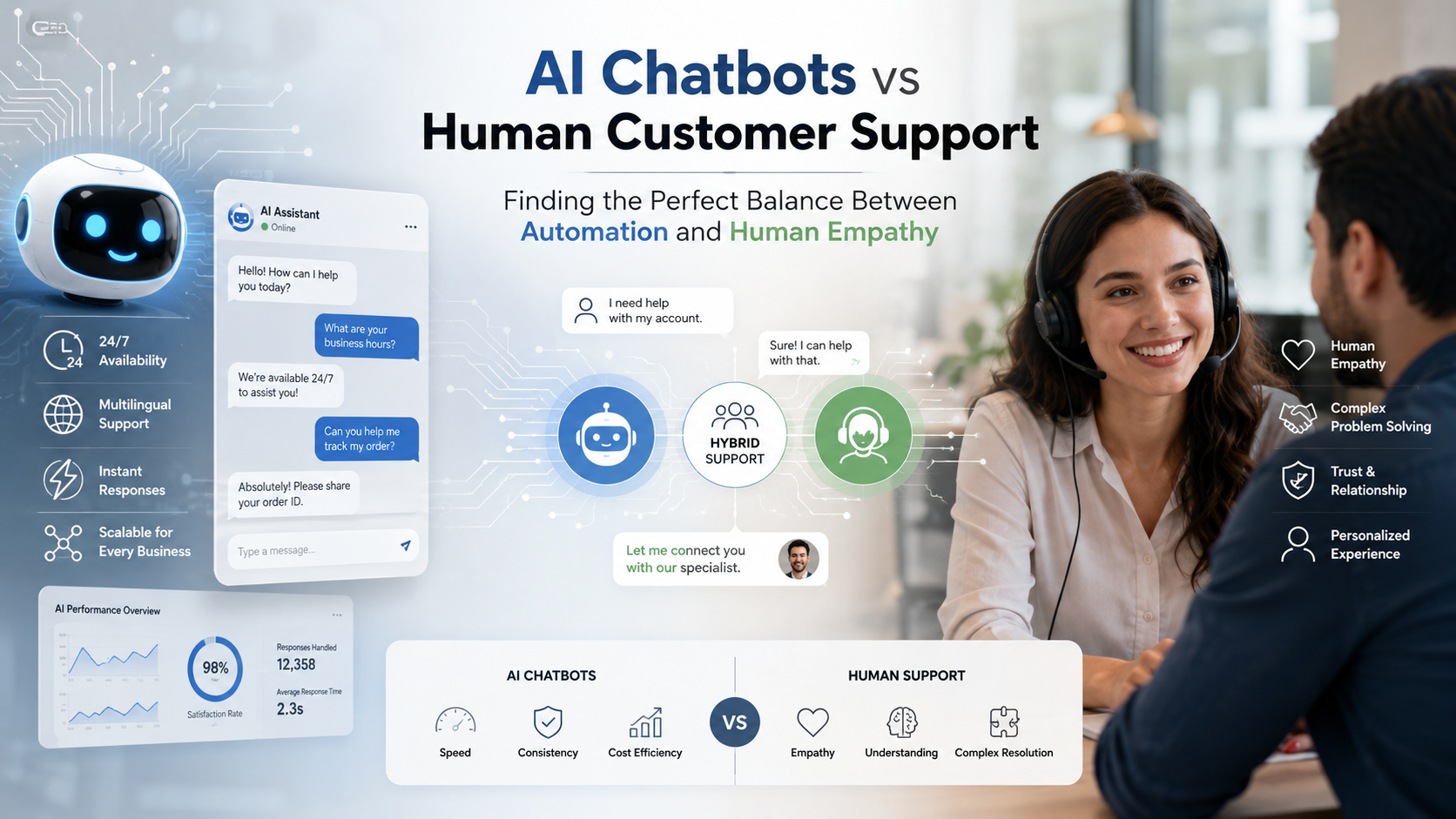
AI Chatbots vs Human Customer Support: Finding the Perfect Balance
The debate around AI chatbots vs human customer support has become a major focus for modern businesses looking to improve service quality while scaling operations. As companies adopt automation, customer service teams are experiencing a significant transformation.
Advancements in conversational AI have made automated assistants faster, smarter, and more capable than ever. Modern platforms can understand customer questions, provide instant answers, and manage large volumes of requests without increasing staff workload. Businesses exploring the latest developments in AI can learn more about how conversational technologies are evolving through resources such as the OpenAI Blog.
However, technology still cannot fully replace human interaction. Customer support is not only about solving problems. It is also about understanding emotions, building trust, and creating positive experiences.
Choosing the right customer support approach is important because customer satisfaction directly affects retention, loyalty, and business growth. A poorly designed chatbot can frustrate users, while long waiting times for human agents can push customers toward competitors.
The ideal solution is not choosing between automation and people. Instead, businesses should create a balanced support strategy that combines the speed of AI with the empathy of human professionals.
This guide explores the strengths and limitations of AI chatbots and human customer support teams. It covers response times, costs, scalability, customer experience, and the benefits of creating a hybrid support model.
The Rise of Automated Customer Service
Automation has transformed the way businesses manage customer inquiries. AI-powered support tools can now handle thousands of conversations at the same time. This allows companies to provide faster service while reducing pressure on customer support teams.
Modern AI chatbots are especially effective for repetitive tasks. They can answer frequently asked questions, provide account information, guide users through simple processes, and collect important details before a human agent becomes involved.
For businesses, this creates significant operational benefits. Instead of spending valuable employee time on basic requests, support teams can focus on more complex issues that require human judgment.
Key Advantages of AI Chatbots
Instant response times:
AI chatbots remove long waiting periods by providing answers within seconds. Quick responses improve customer engagement and create a smoother support experience.
24/7 availability:
Unlike human teams, AI assistants can operate continuously. Customers can receive help during weekends, holidays, and late-night hours without waiting for business hours.
Multilingual support:
Many AI tools can communicate in multiple languages. This helps businesses serve international customers without requiring large multilingual support teams.
Despite these advantages, AI chatbots have limitations. They depend heavily on available data, training, and programmed workflows. When customers present unusual situations or complex problems, automated systems may struggle to provide accurate solutions.
This limitation shows why businesses should avoid relying only on automation. The strongest customer service strategies combine AI efficiency with human expertise.
The Indispensable Value of Human Customer Support
While AI excels at speed and efficiency, human customer support remains essential for situations that require empathy, creativity, and emotional understanding.
Human agents can recognize frustration, adjust their communication style, and provide reassurance during difficult interactions. These abilities are especially valuable when customers face billing concerns, technical failures, or sensitive account issues.
A human representative does more than provide information. They create a personal connection that strengthens customer relationships and protects brand reputation.
Why Human Support Still Matters
Emotional understanding and empathy:
People naturally understand emotions and can respond with genuine care. A compassionate agent can calm frustrated customers and make challenging situations easier.
Complex problem-solving:
Human agents can analyze unique problems and connect information from different sources. They can handle situations that fall outside standard chatbot responses.
Building customer loyalty:
Positive human interactions often create memorable experiences. These moments can turn one-time buyers into long-term customers.
Human support remains a critical part of high-value customer service strategies. While automation improves speed, human expertise provides the trust and understanding customers often need.
AI Chatbots vs Human Customer Support: A Direct Comparison
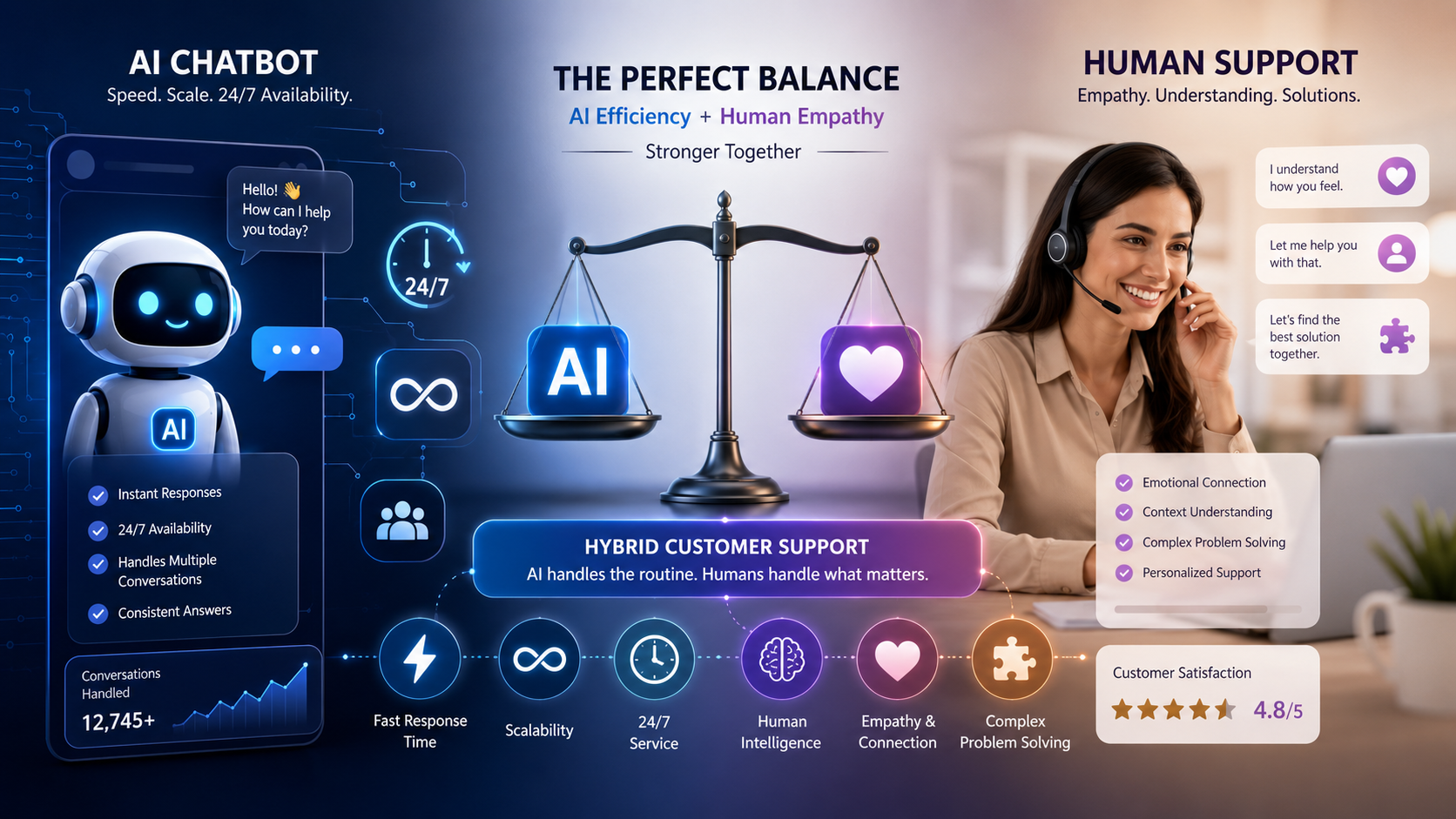
When comparing AI chatbots vs human customer support, businesses must consider more than just speed. Each approach offers unique advantages depending on customer needs, business goals, and support requirements.
AI chatbots are designed for efficiency. They can manage large volumes of simple requests instantly and provide consistent answers. This makes them valuable for businesses that receive many repetitive inquiries.
Human support teams, however, provide flexibility and emotional intelligence. They can handle complicated situations, understand customer emotions, and make decisions based on context.
The best choice depends on the type of customer interaction. Simple questions often benefit from automation, while complex problems usually require human involvement.
The following comparison highlights the key differences between automated assistants and human support teams:
| Feature | AI Chatbots | Human Support Teams |
|---|---|---|
| Response Speed | Immediate responses within seconds | Depends on queue size and agent availability |
| Scalability | Handles unlimited conversations simultaneously | Requires hiring and training more employees |
| Setup Cost | Higher initial investment | Lower starting cost but higher long-term expenses |
| Availability | Operates 24/7 without breaks | Limited by working hours and staff capacity |
| Problem Solving | Best for routine questions | Better for complex and emotional situations |
| Accuracy | Reliable with trained information but limited outside its data | Can adapt using experience and judgment |
The comparison shows that automation leads in speed and scalability. However, human agents remain stronger in empathy, critical thinking, and relationship building.
Rather than viewing AI and humans as competitors, businesses should see them as complementary tools. Combining both creates a support system that improves efficiency while maintaining customer satisfaction.
Financial Implications and Scalability
Cost is one of the biggest factors businesses consider when choosing between AI chatbots and human customer support. Growing companies must find solutions that provide excellent service without creating unsustainable expenses.
Expanding a human support team requires significant investment. Businesses must pay salaries, provide benefits, purchase equipment, and spend time training new employees. As customer demand increases, these costs continue to rise.
AI chatbots require an initial investment in software, setup, and customization. However, once implemented, they can handle thousands of conversations without increasing operational expenses.
For startups and growing businesses, this scalability can provide a major advantage. A sudden increase in website visitors or customer questions will not overwhelm an automated support system.
AI-powered tools also make budgeting easier. Many providers offer subscription-based pricing, allowing businesses to predict monthly support costs more accurately.
However, cost savings should not be the only consideration. Poor customer experiences can damage loyalty and revenue. Businesses should focus on using automation where it improves efficiency while keeping human support available for important interactions.
A balanced approach allows companies to reduce unnecessary costs without sacrificing customer satisfaction.
The Problem of Algorithmic Bias and AI Hallucinations
Although AI chatbots provide many benefits, businesses must understand their limitations. Automated systems can sometimes produce incorrect responses, which are often called AI hallucinations.
Hallucinations occur when an AI system generates information that sounds accurate but is incorrect. In customer support, this can create serious problems.
For example, if a chatbot provides incorrect information about refunds, warranties, or account policies, customers may lose trust in the business. Incorrect answers can also create compliance risks in industries with strict regulations.
Another concern is algorithmic bias. AI systems learn from existing data, and poor-quality or incomplete data can influence their responses. This may result in unfair, inaccurate, or inconsistent customer interactions.
Human oversight is essential for preventing these issues. Support teams should regularly review chatbot conversations, update training information, and monitor responses for accuracy.
Businesses should treat AI as a support tool rather than a completely independent decision-maker. Combining automation with human supervision creates a safer and more reliable customer service experience.
Designing a Hybrid Customer Support Ecosystem
The most effective businesses do not choose between AI chatbots and human support teams. Instead, they create a hybrid customer support model that combines automation with human expertise.
In this approach, AI handles repetitive tasks while human agents focus on complex customer needs. This improves efficiency while allowing employees to spend more time on meaningful interactions.
A hybrid system also improves the customer experience. Customers receive instant answers for simple questions and personalized assistance when they face more difficult problems.
Practical Strategies for Building a Hybrid Support System
Start with common customer requests:
Deploy AI chatbots for frequent questions such as order tracking, password resets, account updates, and basic product information.
Create a smooth human handoff process:
When a chatbot detects confusion, frustration, or a complex issue, it should quickly transfer the conversation to a human agent. The agent should receive the previous conversation history to avoid making customers repeat information.
Continuously improve chatbot performance:
Review chatbot conversations regularly to identify weaknesses. Customer feedback and support transcripts can help improve responses over time.
A successful hybrid system does not replace employees. Instead, it helps them work more effectively by removing repetitive tasks and allowing them to focus on situations that require human judgment.
As AI technology continues to improve, businesses that combine automation with human connection will be better positioned to deliver reliable and memorable customer experiences.
Frequently Asked Questions About AI Chatbots vs Human Customer Support
Can AI chatbots completely replace human customer service representatives?
No, AI chatbots cannot completely replace human customer service representatives. While chatbots are highly effective at handling repetitive questions and simple requests, they cannot match human empathy, emotional understanding, and advanced problem-solving skills.
Customers often need human assistance during stressful situations, such as billing disputes, technical failures, or account problems. These situations require patience, judgment, and the ability to understand emotions.
AI chatbots work best as support tools that assist human agents rather than replace them. By handling routine inquiries, chatbots allow customer service teams to focus on more valuable interactions.
A balanced approach helps businesses improve efficiency while maintaining the personal connection customers expect.
How do AI chatbots handle complex technical troubleshooting?
AI chatbots can assist with basic troubleshooting by following programmed steps and analyzing common problems. However, they often struggle with complex technical issues that require creative thinking or detailed investigation.
Advanced problems may involve multiple systems, unusual errors, or customer-specific situations. These challenges usually require human expertise and experience.
A well-designed support system uses AI to collect initial details, suggest basic solutions, and gather relevant information. After that, the conversation can be transferred to a technical specialist who can provide deeper assistance.
This approach reduces response times while ensuring customers receive accurate solutions for complicated problems.
Is AI-powered customer service expensive for small businesses?
The cost of implementing AI customer service depends on the technology, features, and level of customization required. While advanced chatbot systems may require an initial investment, they can create long-term savings.
Many AI support platforms offer flexible pricing options designed for businesses of different sizes. Small companies can start with basic automation and expand their systems as customer demand grows.
By automating repetitive tasks, businesses can reduce pressure on support teams and avoid immediately hiring additional employees.
However, companies should evaluate more than cost alone. The goal should be improving customer experience while making operations more efficient.
What is a hybrid customer support model?
A hybrid customer support model combines AI automation with human assistance. It allows businesses to use technology for simple tasks while keeping human agents available for complex situations.
In this model, AI chatbots usually act as the first point of contact. They answer common questions, collect customer information, and guide users through basic processes.
When an issue requires emotional understanding or advanced problem-solving, the chatbot transfers the conversation to a human representative.
This approach creates a faster and more personalized customer experience. Businesses benefit from improved efficiency, while customers receive the right level of support for their specific needs.
How does response time affect customer satisfaction?
Response time plays a major role in customer satisfaction. Modern customers expect quick answers, especially when asking simple questions about orders, account details, or business information.
AI chatbots provide immediate responses, which helps reduce waiting times and improves convenience. This instant availability can increase customer confidence and engagement.
However, speed is not the only factor that matters. For complicated problems, customers often prefer waiting slightly longer for a knowledgeable human agent who can provide a complete solution.
The best customer support strategy balances fast responses with quality interactions. AI improves speed, while human agents provide understanding and expertise.
Conclusion: Combining AI Efficiency With Human Empathy
The discussion around AI chatbots vs human customer support does not have to end with choosing one option over the other. The strongest customer service strategies combine the advantages of both approaches.
AI chatbots provide speed, scalability, and constant availability. They can manage repetitive questions, reduce workload, and help businesses deliver faster responses. Businesses looking to understand how these tools work can explore this detailed guide on AI chatbots and their role in modern customer support.
Human support teams provide empathy, creativity, and personalized assistance. They handle sensitive situations and create the meaningful connections that build customer loyalty.
A successful hybrid support strategy allows businesses to use automation where it works best while keeping human expertise available when it matters most.
By reducing repetitive tasks, AI helps customer service teams focus on complex problems and valuable customer interactions. At the same time, customers receive faster solutions and better overall experiences.
As conversational AI continues to develop, businesses should focus on creating a balanced support ecosystem. Review your current customer service challenges, identify where automation can help, and determine where human involvement remains essential.
The future of customer support is not about replacing people with technology. It is about using technology to help people deliver better service.