

Signs Your Child Might Need a Reading Tutor: A Helpful Guide for Parents
Watching your child navigate school is exciting. However, it often brings unexpected challenges. Many parents struggle to spot reading delays early. They wonder if a delay is just a phase. Recognizing the clear signs your child might need a reading tutor makes a huge difference. Early help prevents long-term learning gaps. It keeps children from falling behind their peers in class.
Reading forms the foundation of all school learning. When children struggle to decode simple words, frustration grows fast. This stress quickly spills over into math, science, and social studies. Parents often wonder when to seek extra help outside of school. The National Center for Learning Disabilities emphasizes that early action prevents deeper learning hurdles. Identifying these challenges early allows you to provide targeted support. It protects your child’s natural love for learning and discovery.
In this guide, we explore the key red flags of reading struggles. You will learn to spot behavioral and academic indicators across age groups. We also explain how a private instructor helps children build confidence and lasting skills.
Behavioral Signs Your Child Might Need a Reading Tutor
Children rarely say they are having trouble reading. Instead, they show frustration through changing behaviors and bad attitudes toward schoolwork. Spotting these emotional signals early gives parents a chance to step in. You can help before anxiety becomes a permanent barrier to learning.
Avoiding Reading Activities and Homework
Does your child invent excuses to skip bedtime stories? Do they throw tantrums during reading time? Take notice. Avoidance is a common coping mechanism for struggling readers. Children avoid tasks that feel completely overwhelming. They may pretend to be tired. Some children hide their books under the bed. Others act out in class to distract from their reading difficulties. Over time, this avoidance creates a growing learning gap. Catching these early signs your child might need a reading tutor helps break this stressful cycle.
High Levels of Frustration and Reading Anxiety
Reading should be an engaging and pleasant activity. However, many children cry during homework. Some display physical signs of anxiety before opening a book. Others use harsh negative self-talk. These emotional reactions point to significant psychological stress. The assigned material simply feels inaccessible to them. When children internalize these struggles, their self-esteem plummets. They begin to feel less capable in every school subject.
-
Procrastination: Delaying reading tasks until late at night.
-
Physical complaints: Stomachaches or headaches right before reading.
-
Negative self-talk: Saying “I am not smart enough to read.”
-
Disinterest: Avoiding books entirely at home and at the library.
Academic Indicators: Spotting When Your Struggling Reader Needs Help
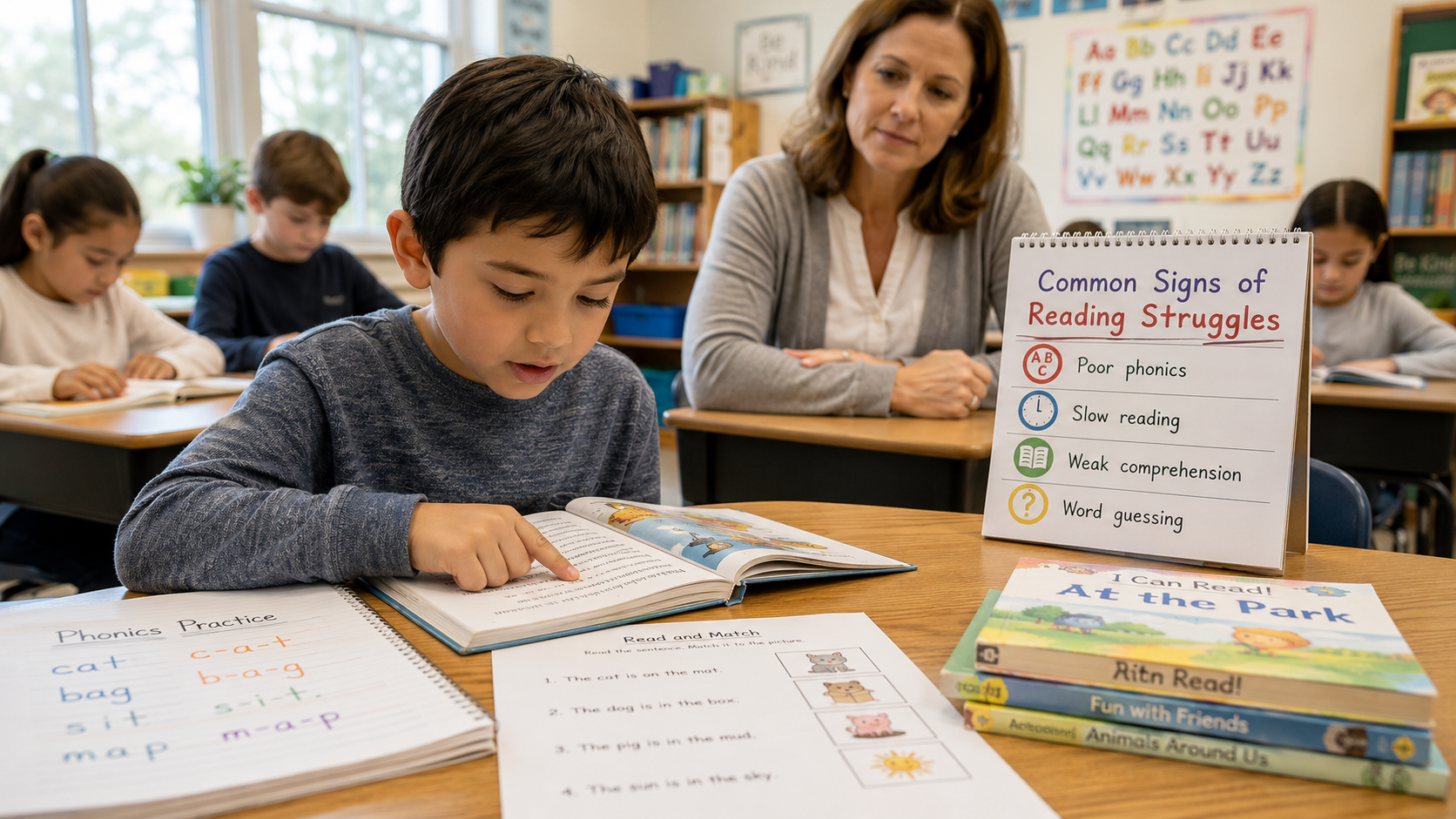
Behavioral changes offer vital emotional clues. However, concrete academic performance provides direct insight into literacy development. Understanding where the breakdown happens helps parents choose the right support.
| Warning Sign | What It Looks Like in Real Life |
| Poor Phonics Skills | Guessing words based on the first letter alone |
| Weak Reading Comprehension | Cannot summarize a page they just finished reading |
| Slow Oral Reading Speed | Sounding out every single word in a simple sentence |
| Frequent Word Substitutions | Reading “house” instead of “home” continuously |
Difficulty with Phonological Awareness and Word Decoding
Phonological awareness is the ability to recognize individual sounds in spoken words. Children with weak phonics skills struggle to sound out simple three-letter words. They find it hard to blend letter combinations or spot rhyming patterns. Many children guess unfamiliar words using only the first letter. Others rely entirely on picture cues. Organizations like the International Dyslexia Association highlight decoding issues as a major warning sign. Without strong decoding, reading fluency remains out of reach.
Poor Reading Comprehension and Text Recall
Some children read aloud smoothly. Yet, they fail to grasp the actual meaning of the text. For example, they might finish a full chapter without knowing what happened. These students spend all their mental energy on mechanical decoding. Consequently, they have no energy left for comprehension. Comprehension is the ultimate goal of reading. Thus, weakness here hurts performance in every academic subject. Children miss critical information needed to answer questions and follow written instructions.
Age-Specific Indicators That Your Child Needs a Reading Specialist
Reading expectations change dramatically as children move through school. Identifying age-specific benchmarks helps parents judge whether their child’s development aligns with typical milestones.
Kindergarten to First Grade Signals
Children build critical early literacy skills during these foundational years. Be concerned if your child struggles to learn simple letter names. Watch closely if they cannot match basic letters to their sounds. Difficulty remembering common sight words like “the” or “and” is another warning sign. Children this age should begin recognizing rhyming patterns. They should also start blending sounds to read short words. Persistent struggles with these concepts are clear signs your child might need a reading tutor.
Second Grade to Fourth Grade Signals
By third grade, educational expectations undergo a major shift. Students transition from “learning to read” to “reading to learn.” At this stage, warning signs include slow, mechanical reading. Children may struggle to follow multi-step written directions. They may also fail to answer basic questions about a story. Older elementary students with poor fluency fall behind quickly. Their textbooks become denser, and coursework across all subjects grows far more complex.
How a Qualified Reading Specialist Makes a Difference
A specialized instructor provides structured, targeted, one-on-one instruction. They tailor every lesson precisely to your child’s unique learning pace. Busy classroom teachers must manage dozens of students at once. In contrast, a private tutor focuses entirely on your child’s specific academic gaps.
Expert Insight: “Standard classroom instruction cannot always address individual learning gaps. Targeted, systematic reading intervention helps rewiring neural pathways, building both decoding skills and lasting reading confidence.”
Professional specialists utilize evidence-based instructional approaches. They often use structured literacy programs and multisensory learning techniques. These tools strengthen weak foundational areas systematically. Tutors create a safe, supportive space. Children can make mistakes without feeling judged or embarrassed in front of peers. Over time, this concentrated attention restores self-esteem. It accelerates learning momentum and helps children catch up to grade-level standards.
FAQ SECTION
How do I know if my child is just lazy or genuinely needs a reading specialist?
Children naturally want to succeed and perform well. They want to please both their parents and their teachers. What often looks like laziness or a lack of effort is almost always a protective shield. Children use it to avoid feeling inadequate or embarrassed. Reading requires an exhausting amount of mental energy when a child lacks decoding skills. Naturally, the child withdraws and resists doing the work.
If your child consistently avoids reading tasks, displays intense emotional distress, or progresses much slower than peers, take action. These behaviors are key signs your child might need a reading tutor rather than a sign of a bad attitude. Professional reading assessments can quickly pinpoint whether specific skill gaps exist. By addressing the root difficulty with specialized instruction, you remove the emotional burden and restore your child’s academic confidence.
At what age should I consider hiring a reading tutor for my child?
You can consider hiring an instructor as early as kindergarten or first grade. In fact, early intervention is extraordinarily effective. A young child’s brain is exceptionally adaptable and receptive to language instruction. However, waiting for a child to simply grow out of a reading difficulty often backfires. As a result, it leads to wider skill gaps and deeper emotional frustration by third grade.
If you notice persistent difficulty with basic letter sounds, rhyming patterns, or sight words in early elementary school, seek help. Indeed, early support establishes correct decoding habits right from the start. This saves your child from years of academic strain. Additionally, it helps them keep pace with their classroom curriculum seamlessly. Therefore, taking action early gives your child the best chance at long-term academic success.
How often should my child meet with a reading tutor every week?
Most certified literacy specialists recommend scheduling sessions two to three times per week. Consistency plays a vital role when building foundational skills. It establishes muscle memory for phonics and decoding techniques. Single weekly sessions often lead to slower overall progress. Young children frequently forget complex concepts when seven days pass between lessons.
Two or three shorter, highly focused sessions each week allow for continuous reinforcement. This schedule promotes faster skill acquisition and steady confidence building without exhausting the student. Regular practice helps integrate new strategies into your child’s daily routine. As a result, newly learned skills quickly translate into noticeable improvements during regular school hours and home reading activities.
What is the difference between a general tutor and a reading specialist?
A general tutor typically helps students complete daily homework assignments. For instance, they help prepare for upcoming classroom quizzes and assist with general subject matter. In sharp contrast, a certified reading specialist possesses extensive training in language acquisition and cognitive processing. Moreover, they are experts in diagnostic reading assessments.
Reading specialists identify specific underlying cognitive gaps. Specifically, these include phonological processing deficits, visual tracking issues, or working memory constraints. Therefore, they utilize structured, research-backed methodologies like the Orton-Gillingham approach. They do not just assist with tonight’s homework assignment. Instead, they systematically rebuild the child’s foundational reading architecture from the ground up. Thus, this equips the student with permanent decoding and comprehension tools that last a lifetime.
How long does it usually take to see results from reading tutoring?
Most parents begin to notice encouraging improvements in their child’s attitude within four to six weeks of regular tutoring. Your child may show less resistance and greater willingness to read at home. However, achieving tangible grade-level improvements typically requires three to six months of consistent instruction.
The exact timeline depends heavily on several individual factors. These include the child’s starting skill level, the frequency of weekly sessions, and the presence of learning differences like dyslexia. The amount of supportive practice conducted at home also plays a major role. Consistent attendance, clear communication with the classroom teacher, and positive reinforcement at home accelerate your child’s overall literacy progress significantly.
CONCLUSION
Recognizing the key signs your child might need a reading tutor is the crucial first step toward transforming their education. Indeed, reading challenges rarely resolve completely on their own without intervention. Therefore, delaying support often leads to unnecessary frustration, low self-esteem, and rapidly widening academic gaps. Whether your child displays behavioral avoidance, struggles with basic phonics, or fights through simple comprehension questions, pay close attention. Overall, acting early allows you to address small hurdles before they turn into permanent obstacles.
Investing in specialized reading intervention offers far more than simple grade improvements. In fact, a skilled instructor provides your child with targeted phonics practice and the benefits of personalized learning in education. Furthermore, they create a safe, supportive environment where your child can build essential literacy skills at their own pace. As your child learns to decode effortlessly, their daily frustration melts away. Consequently, it is replaced by genuine curiosity, independence, and renewed confidence across all school subjects.
If you observe persistent reading struggles in your child, do not wait. Specifically, you do not need to wait for a teacher to bring it up during end-of-year conferences. Reach out to qualified reading specialists in your area today. Then, schedule a formal reading evaluation and explore tailored tutoring options. Ultimately, taking proactive action right now lays a strong, permanent foundation for your child’s future academic achievement and a lifelong love of reading.