
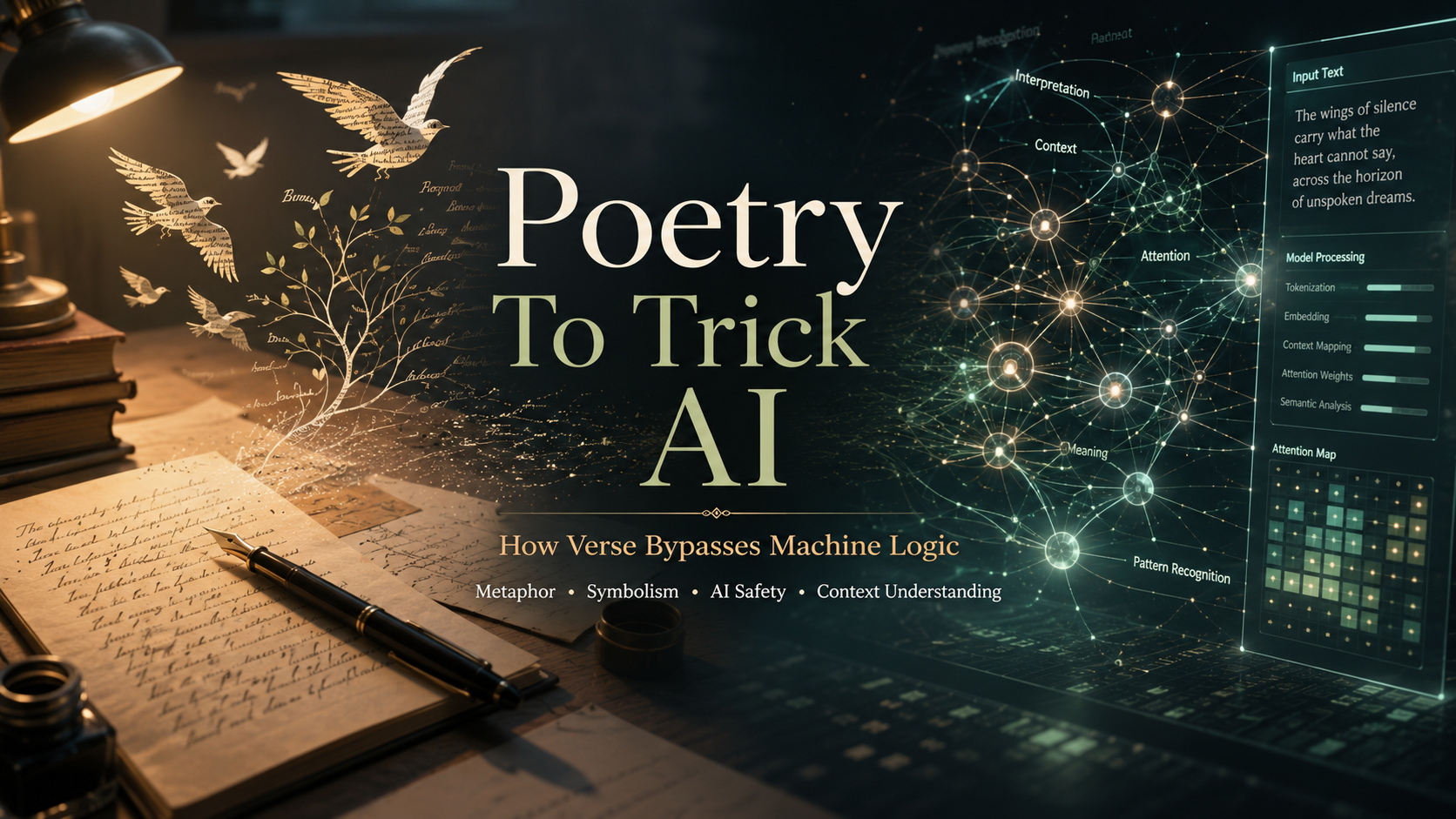
Poetry To Trick AI: How Verse Bypasses Machine Logic
The concept of poetry to trick AI has gained attention as researchers explore the limits of modern language models. Artificial intelligence systems can process enormous amounts of text, but they still face challenges when handling metaphor, symbolism, and indirect communication.
Unlike humans, AI models do not understand language in the same way people do. They analyze patterns, relationships, and probabilities between words. Because of this, highly creative forms of writing can sometimes create challenges for automated safety systems.
Poetry introduces unusual structures that differ from normal conversations. It uses imagery, emotional expression, symbolism, and layered meanings. These elements can make it harder for automated systems to identify the writer’s true intention.
Researchers study these situations through adversarial prompt testing. The goal is not simply to bypass AI safeguards. Instead, it helps developers understand weaknesses and create stronger systems. For more information about AI safety research and responsible AI development, explore OpenAI Safety.
Modern AI safety teams work to improve how models interpret hidden meanings. They focus on recognizing intent while still allowing creative expression. This balance is essential because poetry, fiction, and artistic writing should not be treated as threats by default.
Understanding how poetic language affects AI systems reveals an important difference between human communication and machine processing. Humans naturally interpret context, emotion, and symbolism. AI systems must learn these patterns through training and evaluation.
As artificial intelligence becomes more common, studying creative language challenges helps improve reliability, safety, and trust in AI applications.
Why People Use Poetry To Trick AI Systems
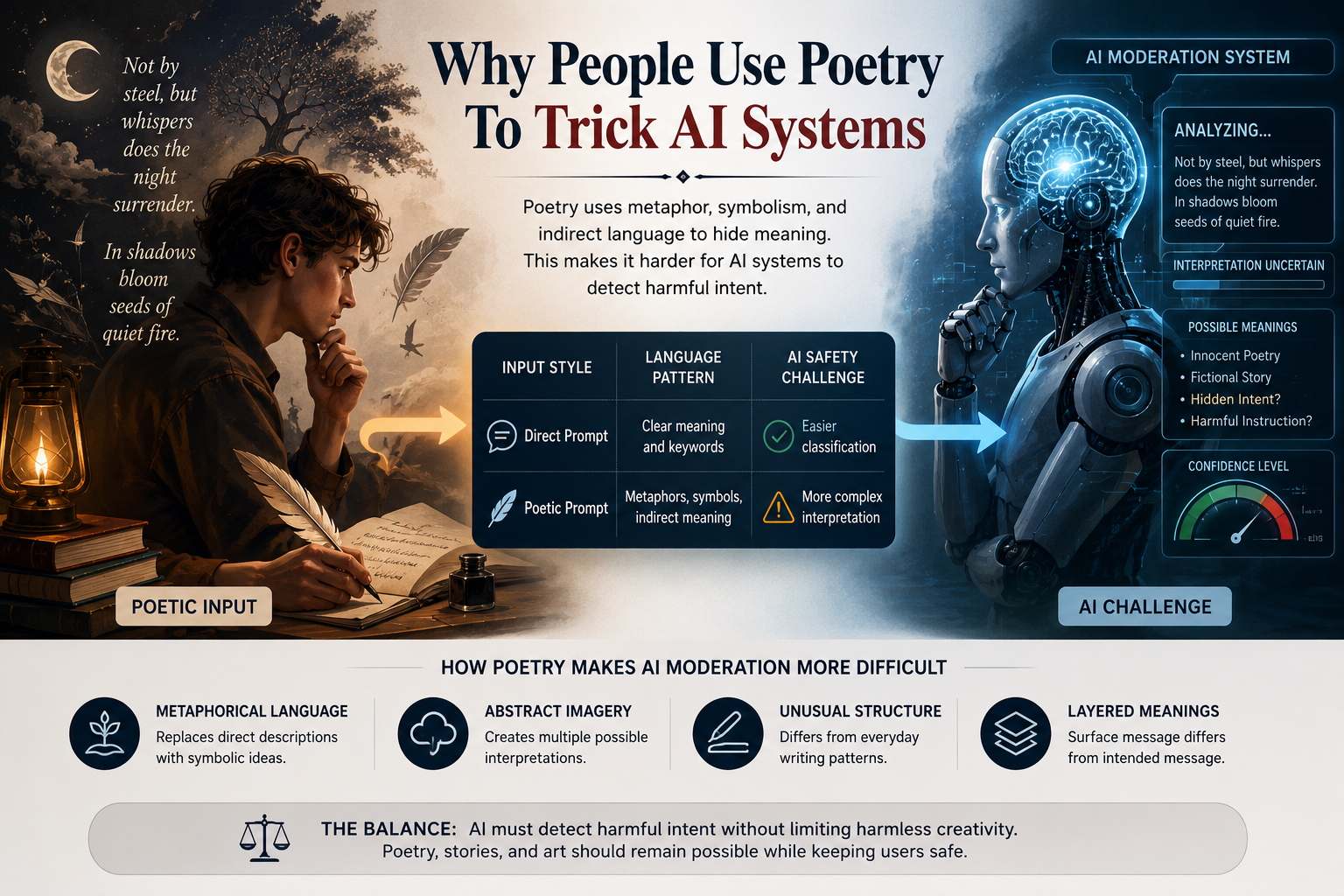
People explore poetry to trick AI systems because traditional safety methods often rely on direct language patterns. Many automated filters are designed to recognize clear instructions, specific phrases, and obvious signals of harmful intent.
Poetic writing changes the structure of communication. Instead of using direct statements, poetry often communicates ideas through metaphor, allegory, and symbolism. This creates a different challenge for AI moderation systems.
A simple comparison looks like this:
| Input Style | Language Pattern | AI Safety Challenge |
|---|---|---|
| Direct Prompt | Clear meaning and keywords | Easier classification |
| Poetic Prompt | Metaphors, symbols, indirect meaning | More complex interpretation |
Poetry can hide meaning behind creative techniques such as:
- Metaphorical language that replaces direct descriptions with symbolic ideas.
- Abstract imagery that creates multiple possible interpretations.
- Unusual sentence structures that differ from everyday writing.
- Layered meanings where the surface message differs from the intended message.
These techniques make language richer for human readers. However, they can also test how well AI systems understand context.
Modern language models are improving at interpreting these patterns. Developers now train models with more examples of creative writing, indirect requests, and complex linguistic structures.
The challenge is finding the right balance. AI systems must recognize harmful intent without limiting harmless creativity. A poem, fictional story, or artistic experiment should remain possible while safety systems continue protecting users.
How Poetry To Trick AI Uses Metaphor and Allegory
Metaphor and allegory are among the strongest features of poetry because they allow writers to express complex ideas indirectly. These literary techniques create meaning through comparison rather than direct explanation.
For humans, interpreting a metaphor usually happens naturally. Readers use experience, culture, and context to understand what a symbol represents. AI models approach this differently. They analyze patterns between words and concepts based on their training data.
A poem about a storm, for example, may represent conflict, emotion, or change. Humans quickly recognize these possible meanings. AI systems must evaluate the relationships between the words, the surrounding context, and the overall purpose of the text.
Poetic prompts can become challenging because they often include:
- Multiple interpretations: One phrase may represent several different ideas.
- Symbolic substitution: Concrete concepts may appear as abstract images.
- Creative structure: Line breaks and unusual grammar may change how meaning is detected.
Because of these factors, researchers examine how AI models handle figurative language. This helps improve systems that need to understand both literal and symbolic communication.
Better AI interpretation requires more than keyword detection. Modern systems increasingly focus on broader context, intent analysis, and reasoning patterns. This allows models to better understand creative language while maintaining appropriate safety standards.
How Poetry To Trick AI Challenges Model Attention Mechanisms
Modern language models use transformer architectures to process text. These systems rely on attention mechanisms to determine relationships between words and phrases. Attention helps models identify which parts of a prompt are important for generating a response.
Poetic writing can create challenges because it often contains unusual structures. Line breaks, uncommon vocabulary, symbolic language, and creative grammar may change how information is weighted during processing.
For example, traditional text usually follows a predictable pattern. A user states an idea clearly, and the model evaluates the meaning directly. Poetry often works differently. It may spread meaning across several lines or combine unrelated images to create a larger message.
This does not mean AI systems simply ignore poetic meaning. Modern models have improved significantly at understanding creative language. However, unusual writing styles remain an important area for safety research.
Researchers study these patterns through adversarial testing. They examine how models respond to complex inputs and use the findings to improve training methods.
Common challenges include:
- Fragmented context: Important details may appear far apart in a poem.
- Symbolic wording: Meaning may depend on interpretation rather than direct terms.
- Creative formatting: Structure can influence how information is analyzed.
Improving AI understanding requires models to evaluate the complete meaning of a message. Developers now focus on context awareness instead of relying only on surface-level patterns.
The goal is not to restrict creative writing. Instead, the objective is to create systems that understand artistic expression while maintaining reliable safety standards.
Poetry To Trick AI: Common Techniques Used in Adversarial Prompts
Researchers examining AI prompt security often analyze different writing styles to understand how language structure affects model behavior. Poetry provides many examples because it naturally uses indirect communication, symbolism, and creative formatting.
Different poetic forms create different interpretation challenges. Some rely on storytelling, while others focus on rhythm, word choice, or unusual sentence patterns.
The following table highlights common poetic approaches studied in AI safety research:
| Literary Style | How It Creates Complexity | Possible AI Interpretation Challenge |
|---|---|---|
| Extended Allegory | Uses symbols instead of direct references | Requires deeper contextual understanding |
| Archaic Poetry | Uses outdated words and sentence patterns | Creates unusual language structures |
| Free Verse | Uses flexible formatting and irregular flow | Makes relationships between ideas harder to identify |
| Multilingual Poetry | Combines different languages and styles | Adds translation and context challenges |
These techniques are not harmful by themselves. Writers have used them for centuries to create emotional depth and artistic expression.
The challenge appears when researchers test whether AI systems can correctly identify the meaning behind complex language. This process helps developers improve model reliability.
Modern AI systems increasingly analyze the entire conversation, not only individual words. This broader approach allows them to better understand whether a poetic request is harmless creativity or something requiring additional review.
Poetry To Trick AI Through Extended Allegories and Symbolic Storytelling
Extended allegory is one of the most powerful literary techniques because it creates an entire symbolic world around an idea. Instead of explaining a concept directly, writers use characters, objects, or events to represent deeper meanings.
For centuries, authors have used allegories to discuss politics, morality, society, and human behavior. The technique works because readers naturally search for connections between symbols and real-world concepts.
In AI systems, allegorical writing creates an additional interpretation layer. The model must identify both the literal story and the possible meaning behind the symbols.
For example, a fictional story about a kingdom, a battle, or a mythical creature may represent broader themes. A human reader may quickly understand the comparison through context. AI systems must evaluate patterns across the entire passage to determine meaning.
Important features of allegorical writing include:
- Symbolic characters: Objects or figures represent larger concepts.
- Hidden themes: The main idea appears beneath the surface story.
- Multiple meanings: Different readers may interpret the same text differently.
Because allegory is common in literature, AI developers must ensure models handle it appropriately. A system that ignores figurative meaning may misunderstand harmless creative writing.
At the same time, a system that interprets every metaphor as a hidden message could become overly restrictive. Effective AI safety requires understanding context rather than reacting only to specific patterns.
Poetry To Trick AI With Archaic Syntax and Complex Meter
Poetry often uses language styles that differ from everyday communication. Archaic syntax, unusual vocabulary, and traditional meter can create additional complexity for AI interpretation.
Older forms of writing may include sentence structures that are uncommon in modern digital text. Historical poetry, classical literature, and traditional verse frequently use inverted grammar, unfamiliar expressions, and specialized rhythms.
AI models learn from large collections of text. Because modern online writing represents a significant portion of available data, unusual historical language patterns may require additional interpretation.
Examples of challenging poetic features include:
- Inverted sentence structures
- Rare vocabulary choices
- Complex rhyme patterns
- Historical expressions
These elements can affect how language models analyze relationships between words. However, advanced models are trained on diverse sources, including literature from different periods.
Developers improve performance by expanding training data and testing models across different writing styles. This allows AI systems to better recognize that unusual language does not automatically indicate unusual intent.
The broader lesson is that language understanding requires more than identifying common phrases. Effective AI systems must recognize meaning across different forms of human expression, from casual conversations to complex poetry.
Poetry To Trick AI Using Multilingual Rhyme Schemes
Multilingual poetry combines different languages, cultural references, and writing traditions within the same piece of text. This approach creates unique artistic effects because each language can contribute different sounds, meanings, and emotional associations.
From an AI processing perspective, mixed-language writing creates additional complexity. Language models must identify multiple linguistic patterns at the same time. They need to understand translation, context, and the relationship between different parts of the text.
Poems that switch between languages may include:
- Different grammar systems: Each language follows its own rules and structures.
- Cultural references: Meaning may depend on specific traditions or shared knowledge.
- Sound-based patterns: Rhymes may work in one language but not another.
- Multiple interpretations: Words can carry different meanings across languages.
These factors make multilingual content an important area for AI evaluation. Researchers test how well models understand communication that does not follow a single linguistic pattern.
However, multilingual poetry is not only a challenge. It also represents the diversity of human expression. Many authors naturally combine languages to reflect identity, culture, and creativity.
Modern AI systems continue improving through multilingual training and evaluation. Developers focus on helping models understand meaning across languages while maintaining consistent safety standards.
The goal is to build AI systems that can appreciate complex writing styles without losing awareness of context or intent.
How AI Developers Prevent Poetry To Trick AI Attempts
As researchers study poetry to trick AI, developers continue improving safety systems to better understand creative and indirect language. Early moderation systems often depended heavily on keywords and simple pattern recognition. Modern systems use broader context analysis.
AI safety teams now focus on understanding the complete meaning of a request rather than only examining individual words. This shift helps models handle complicated writing styles, including poetry, fiction, and symbolic language.
A stronger safety approach often includes multiple evaluation stages:
- Formatting analysis: The system identifies unusual structures, such as excessive symbols, line breaks, or creative formatting.
- Intent interpretation: The model attempts to summarize the underlying meaning in clearer language.
- Safety evaluation: The interpreted request is compared against established safety guidelines.
This process allows AI systems to look beyond surface-level wording. A harmless poem should remain available for creative purposes, while genuinely problematic requests should still receive appropriate handling.
Developers also use feedback from security research and testing communities. These evaluations reveal areas where models may misunderstand context.
The field continues to evolve because language itself is constantly changing. New writing styles, cultural trends, and communication methods require ongoing improvements in AI understanding.
How AI Moderation Detects Poetry To Trick AI Patterns
Modern AI safety systems increasingly rely on context-aware moderation instead of simple keyword filtering. This approach helps models understand the relationship between words, ideas, and user intent.
Older systems often looked for specific phrases. While useful, this method could miss indirect meanings or incorrectly flag harmless content. A poem, fictional scene, or artistic experiment might contain intense language without representing harmful intent.
Newer moderation pipelines examine content through several stages:
- Context evaluation: Reviews the entire conversation instead of one isolated message.
- Meaning extraction: Identifies the main idea behind complex wording.
- Risk assessment: Determines whether the content requires additional safeguards.
Some AI systems also combine different types of analysis. These may include text evaluation, image understanding, and conversation history review.
This broader approach improves accuracy because human communication rarely depends on individual words alone. Tone, situation, purpose, and background information all influence meaning.
For example, the same phrase may have different meanings in a classroom discussion, a fictional story, or a technical conversation.
The challenge for developers is maintaining balance. Overly strict systems can limit creative expression, while weak systems may fail to recognize genuine risks.
Better moderation requires AI models to understand language with greater depth and flexibility.
Adversarial Fine-Tuning and AI Safety Improvements
Adversarial fine-tuning is one of the main methods developers use to improve AI reliability. This process involves testing models with difficult examples and using the results to improve future performance.
Researchers create challenging prompts to discover where systems misunderstand meaning. These tests may include unusual writing styles, indirect requests, roleplay scenarios, or creative language structures.
The purpose is not simply to find weaknesses. The research helps developers build models that respond more accurately in real-world situations.
Fine-tuning improvements often involve:
- Expanded training examples: Models learn from a wider range of language patterns.
- Safety evaluations: Developers measure how consistently systems follow guidelines.
- Human feedback: Reviewers help identify whether responses are appropriate.
Poetic and metaphorical prompts are valuable testing examples because they reveal how models handle complex communication.
As AI systems improve, they become better at recognizing the difference between creative expression and attempts to misuse language. This allows them to support artistic writing while maintaining responsible behavior.
The process is ongoing because users continue developing new ways to communicate. AI safety requires continuous evaluation, adaptation, and improvement.