
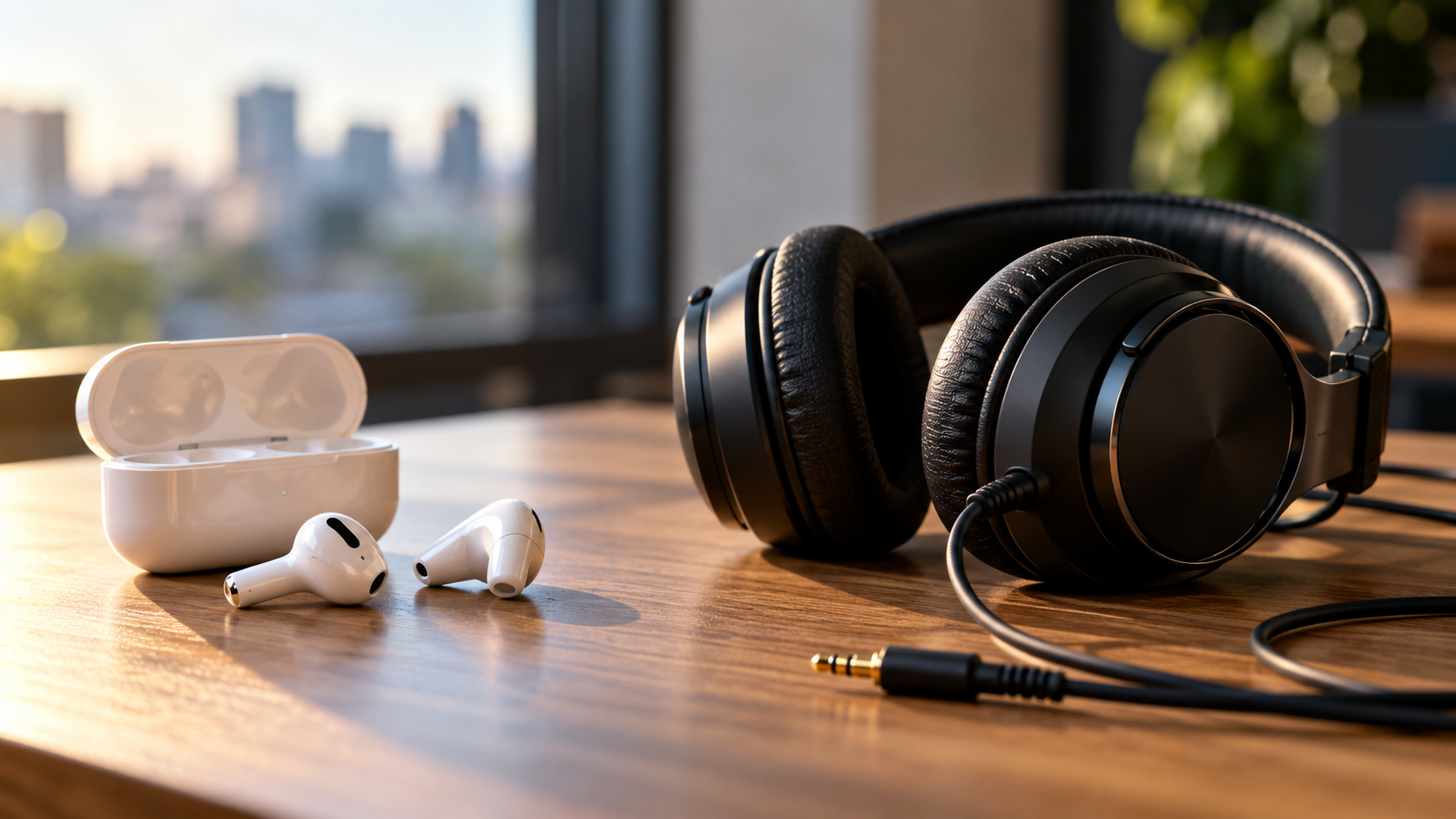
5 Reasons to Skip Wireless Headphones and Return to Wired Audio
Bluetooth earbuds have become a normal part of commuting, workouts, calls, and daily entertainment. However, convenience does not always mean a better listening experience. Exploring the reasons to skip wireless headphones can reveal several practical drawbacks.
Battery management is one concern. Audio latency, connection problems, repairability, and replacement costs can also matter. Wired headphones avoid many of these issues because they connect directly to the audio source.
Sound quality is another consideration. Bluetooth audio uses digital transmission and codecs, although modern codecs can deliver excellent quality. The difference is not always noticeable during everyday listening.
For some listeners, these trade-offs explain the growing interest in the reasons to skip wireless headphones and return to traditional wired audio. Health is another consideration, particularly when listening at high volumes for extended periods. The World Health Organization’s guidance on safe listening highlights the importance of managing both sound levels and listening duration to reduce the risk of hearing damage.
Health also deserves careful consideration. The main established hearing risk comes from excessive sound exposure, not from whether headphones use Bluetooth or a cable. The World Health Organization recommends managing both listening volume and duration to reduce the risk of hearing loss.
This guide explores five practical reasons to skip wireless headphones. It also examines battery lifespan, connection reliability, charging, pricing, listening safety, and the renewed interest in wired audio.

1. Superior Audio Performance Can Favor Wired Headphones
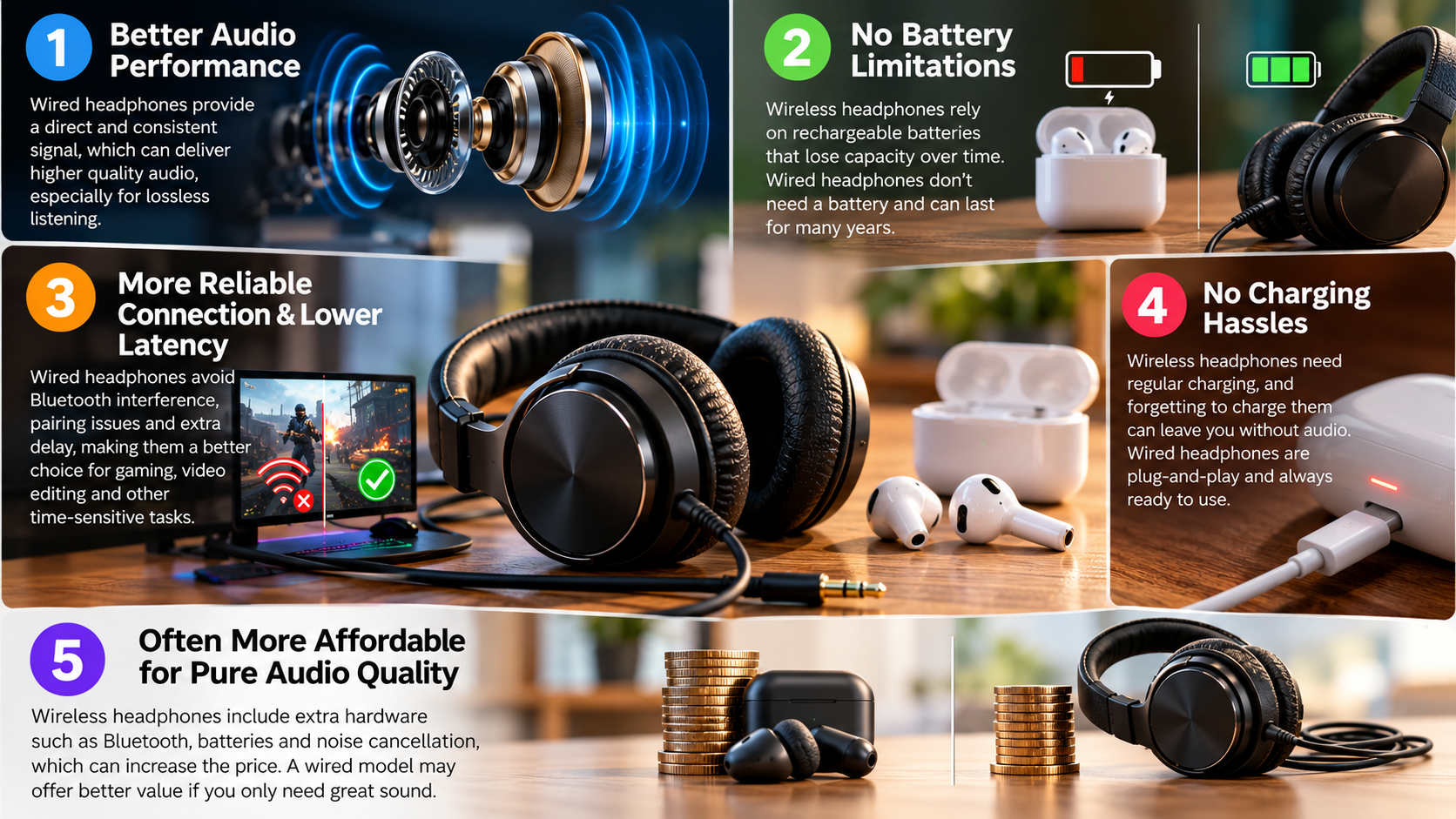
One of the main reasons to skip wireless headphones is the desire for greater control over audio transmission. Wireless headphones send audio through Bluetooth, which requires encoding, transmission, and decoding. Depending on the codec, device, and settings, some compression may occur.
Wired headphones can avoid the Bluetooth transmission stage. A wired connection can provide a direct and consistent signal path from the source device to the headphones.
This does not mean every wired headphone automatically sounds better. Headphone drivers, tuning, amplification, source quality, and personal preferences have a much larger effect on perceived sound.
However, wired models can offer advantages for lossless audio and critical listening. Compatible wired connections can carry lossless digital audio or an uncompressed analog signal. For a deeper look at how audio data affects what you hear, see how bitrate affects audio quality.
Wireless headphones can also sound excellent. Modern Bluetooth codecs have improved considerably, and many listeners may not notice a meaningful difference during everyday listening.
For listeners who prioritize maximum control over the signal path, wired headphones remain an attractive option. They also avoid dependence on Bluetooth codec compatibility between the source and headphones.
2. Battery Lifespan Can Limit Wireless Headphone Longevity
Battery dependence is another important reason people consider the reasons to skip wireless headphones. Wireless headphones rely on internal rechargeable batteries. Like other lithium-ion batteries, these batteries gradually lose capacity through normal use and charging cycles.
The problem can be particularly noticeable with compact true-wireless earbuds. Their small batteries are usually integrated into sealed housings. This can make professional battery replacement difficult or uneconomical. Proper headphone care and maintenance can still help protect the parts that are easier to service.
That does not mean every wireless headphone becomes unusable after three to five years. Actual lifespan varies considerably. Battery quality, charging habits, usage, temperature, and construction all affect longevity.
Wired headphones have one major advantage here: they do not need an internal battery. A durable wired model can remain functional for many years if its drivers and other components remain in good condition.
Detachable cables provide another benefit. If the cable becomes damaged, users can often replace it without replacing the entire headphone.
For long-term ownership, look for:
- Replaceable cables
- Replaceable ear pads
- Repairable construction
- Durable connectors
- Available replacement parts
These features can reduce waste and extend the useful life of the product.
3. Connection Reliability and Latency Can Favor Wired Audio
Connection reliability is another factor behind the reasons to skip wireless headphones. Bluetooth headphones add a wireless connection between the audio source and the headphones.
That connection can occasionally experience pairing problems, interference, or unexpected disconnections. If your Bluetooth connection keeps dropping, understanding the common reasons Bluetooth keeps disconnecting can help identify the underlying problem. Bluetooth operates in the 2.4 GHz band, which is also used by technologies such as Wi-Fi.
Modern Bluetooth systems use techniques designed to manage interference. Therefore, everyday dropouts are not inevitable. However, wireless performance can still vary between devices and environments.
Latency is a separate issue. Wireless audio requires processing, encoding, transmission, and decoding. These stages can introduce a delay between an action and the resulting sound.
For ordinary music listening, this delay is usually insignificant. It can matter more during competitive gaming, music production, live monitoring, or precise video editing.
Wired headphones can reduce the wireless transmission stage and provide a more predictable connection. They are not completely “zero latency,” because other digital processing can still introduce delays.
For users who prioritize low latency and connection simplicity, wired headphones can therefore be more practical.
4. Charging Hassles Make Wireless Headphones Less Convenient
Charging is one of the simplest reasons to skip wireless headphones. Wireless models need regular charging, which creates an additional maintenance task.
Forgetting to charge them can leave you without audio when you need it. This can become especially inconvenient during long workdays, flights, road trips, or extended meetings.
True-wireless earbuds add another component to manage. Both the earbuds and their charging case depend on battery power.
Wired headphones remove this particular limitation. They can usually be connected and used immediately without checking a battery indicator or carrying a charging case.
There are exceptions. USB-C wired headphones can draw power from the connected device, while some active wired headphones require their own battery. If your phone has a single USB-C port, using wired headphones without losing the charging port may require an adapter or another solution. Traditional passive wired headphones generally need no separate power source.
This makes wired audio particularly convenient for people who want plug-and-play listening.
Wireless headphones remain useful when cables get in the way. They can be convenient during workouts, commuting, and other activities where freedom of movement matters.
The trade-off is straightforward. Wireless headphones provide cable-free convenience but introduce battery management. Wired headphones provide a physical connection but remove charging from the equation.
5. Wireless Headphones Can Cost More for Added Features
Price is another factor behind the reasons to skip wireless headphones, especially for buyers focused mainly on sound quality.
Wireless headphones contain additional hardware that wired models may not require. Depending on the product, this can include Bluetooth radios, batteries, charging circuits, microphones, active noise cancellation hardware, amplifiers, and digital signal processing.
These components can increase manufacturing complexity and contribute to a higher retail price. However, it would be too broad to claim that wireless headphones always cost $50 to $100 more than equivalent wired models.
Prices vary significantly across brands, product categories, features, and sound quality. Some inexpensive wireless headphones cost less than premium wired models. High-end wireless headphones can also be considerably more expensive.
The more useful comparison is what you receive for your budget. A wired headphone at a given price may devote more of its design and manufacturing cost to drivers, materials, and acoustic performance. If you are comparing both connection types before buying, a broader wired vs wireless audio comparison can help you evaluate the trade-offs.
Wireless models may instead include features such as:
- Bluetooth connectivity
- Active noise cancellation
- Transparency modes
- Built-in microphones
- Touch controls
- Battery systems
- Companion software
If you do not need these features, a wired model may provide a simpler way to spend your headphone budget.
Why Do People Avoid Wireless Headphones?
People avoid wireless headphones for several practical reasons. Battery dependence is one of the biggest drawbacks. Wireless headphones need regular charging, and their batteries gradually lose capacity.
Connection issues can also become frustrating. Bluetooth headphones may experience pairing problems, interference, or unexpected disconnections.
Audio latency is another consideration. Bluetooth processing can introduce a delay between an action and the resulting sound. Modern low-latency technologies can reduce this delay, but they do not eliminate it in every situation.
Wired headphones avoid most of these concerns because they connect directly to the source.
Common reasons people choose wired models include:
- No headphone battery to recharge
- No Bluetooth pairing process
- No wireless connection to troubleshoot
- Easier cable replacement on many models
- Longer potential service life
- Consistent performance without wireless transmission
For listeners who value simplicity and reliability, these differences can outweigh the convenience of going wireless.
The best choice still depends on how you use your headphones. Wireless models remain useful for mobility, workouts, commuting, and hands-free convenience.
Why Are Gen Z Using Wired Headphones?
Gen Z’s renewed interest in wired headphones combines fashion, nostalgia, simplicity, and practicality. Wired earbuds have become more visible in social media posts and everyday streetwear.
Their appearance often connects with Y2K fashion and other retro-inspired trends. The cable itself can become part of an outfit rather than simply being viewed as outdated technology.
The appeal is not purely visual. Wired headphones remove several small inconveniences associated with wireless models.
There is no charging case to remember. There is also no Bluetooth pairing menu or concern about an earbud running out of power.
Wired headphones can also be inexpensive. Losing one does not necessarily mean replacing an expensive charging case and a complete set of earbuds.
However, it would be inaccurate to assume that all Gen Z users prefer wired audio. Wireless earbuds remain extremely popular among younger consumers.
The renewed interest is better understood as a cultural trend rather than a universal preference. Some users simply like the combination of retro style and straightforward functionality. The broader trend is explored in more detail in why Gen Z is using wired headphones.
For these listeners, the reasons to skip wireless headphones can be as much about lifestyle and simplicity as technical performance.
What Is the 60-60 Rule for Headphones?
The 60-60 rule is commonly described as listening at no more than 60% volume for 60 minutes before taking a break. It is widely promoted as a simple listening-safety rule.
However, it should not be treated as a precise medical threshold. Volume percentages do not correspond to the same sound level across every phone, headphone, recording, or listening environment.
A better approach is to consider actual sound level and listening duration. The World Health Organization recommends keeping personal listening levels within safer exposure limits and taking regular breaks.
The risk of hearing damage increases with louder sound and longer exposure. This applies whether the headphones are wired or wireless.
Useful listening habits include:
- Keep the volume at a comfortable level.
- Take regular breaks during long sessions.
- Use noise cancellation in noisy environments when appropriate.
- Avoid increasing volume to overcome background noise.
- Pay attention to ringing or muffled hearing after listening.
The key point is simple: wired headphones are not automatically safer for hearing.
Sound exposure matters far more than the transmission method. Therefore, hearing protection should remain a priority regardless of whether you choose wired or wireless audio.
What Are the Drawbacks of Wireless Headphones?
Wireless headphones introduce several technical trade-offs. Battery dependence is the most obvious. Unlike wired headphones, they cannot operate indefinitely without access to power.
Bluetooth audio also requires encoding, transmission, and decoding. Modern codecs can provide high-quality sound, and many listeners may not notice a meaningful difference from wired playback.
However, codec support and implementation vary between devices. This can make the wireless listening experience dependent on both the headphones and the source device.
Latency can be another drawback. Wireless audio may introduce processing delays that matter during gaming, live monitoring, music production, or video editing.
Connection reliability can also vary. Crowded radio environments, device compatibility, software problems, and physical obstacles can sometimes affect wireless performance.
Other drawbacks include:
- Battery charging
- Potential connection problems
- Audio latency
- Codec dependence
- Greater electronic complexity
- Difficult battery replacement on some models
These limitations help explain why some listeners continue searching for reasons to skip wireless headphones and return to wired designs.
Is It Better to Use Wired or Wireless Headphones for Health?
There is no general health rule stating that wired headphones are safer than wireless headphones. The strongest established hearing risk comes from excessive sound exposure, regardless of the connection method.
Bluetooth headphones transmit radiofrequency signals, but consumer Bluetooth devices operate at relatively low power. Claims that wired headphones are medically safer because they eliminate Bluetooth radiation are not supported by established evidence.
Physical ear hygiene is a separate issue. In-ear headphones can trap moisture and earwax, particularly when worn for long periods. Poor cleaning habits may contribute to irritation or infection risk.
The fit of the headphone also matters. Deeply inserted earbuds and tight-fitting models can create different comfort and hygiene issues from over-ear headphones.
For safer listening, focus on factors with stronger evidence:
- Moderate listening volume
- Reasonable listening duration
- Regular breaks
- Clean headphone surfaces
- Appropriate earbud fit
- Reduced exposure to loud environments
Ultimately, wired versus wireless is not the main health question. Listening habits, volume, duration, and hygiene matter more.
For readers comparing the reasons to skip wireless headphones, health should therefore be considered separately from convenience, sound quality, battery life, and connectivity.