

What Is the 30-Day Rule for Buying New Gadgets?
Tech companies launch tempting devices every month. This makes impulse spending easy to justify. If you often add smartwatches, tablets, phones, or gaming accessories to your cart, a cooling-off period can help. The 30-day rule for buying new gadgets gives you time to separate genuine needs from temporary excitement.
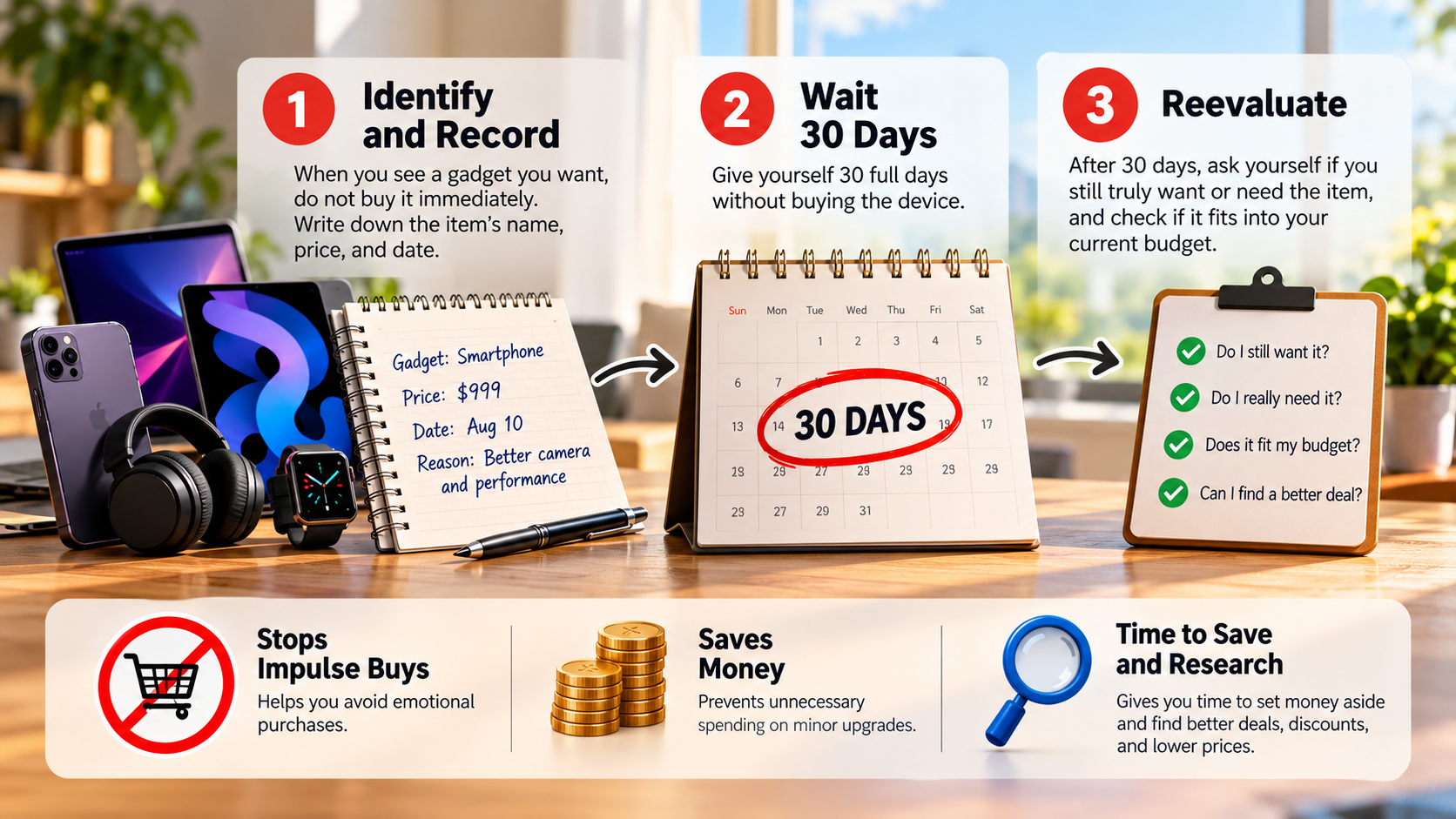
The basic idea is simple. When you want a non-essential gadget, write down its name, price, and reason for buying it. Then wait 30 days before making the final decision. This approach creates distance between the emotional urge and the financial decision. The Consumer Financial Protection Bureau’s guidance on financial well-being also highlights the importance of making deliberate financial choices.
The rule does not mean you can never buy new technology. It encourages more deliberate spending. You can use the waiting period to compare prices, read independent reviews, check your budget, and consider alternatives.
Throughout this guide, you will learn how the 30-day rule works. We will also cover shorter waiting periods, smartphone upgrades, the 48-hour shopping rule, and practical grocery budgeting.
What Is the 30-Day Rule for Saving Money?
The 30-day rule for saving money is a simple strategy for controlling impulse purchases. When you suddenly want a non-essential item, record the product and its price. Then wait 30 days before deciding whether to buy it. This pause creates distance between the emotional urge and the financial decision.
During the waiting period, ask why you want the item. Does it solve a recurring problem? Will you use it regularly? Can your current product perform the same task? Thinking about needs vs. wants when spending money can also help you determine whether the purchase is necessary or simply attractive because it is new.
The rule can also protect money intended for more important goals. Instead of spending immediately, you keep the money available while you evaluate the purchase. If the desire disappears, you avoid an unnecessary expense.
However, the rule is mainly designed for discretionary purchases. It should not delay essential items that you genuinely need for work, health, safety, or daily life.

Prioritizing Needs Over Fleeting Wants
After 30 days, return to the purchase note you created. Review the original reason for wanting the product. Then compare that reason with your current situation. This simple review can show whether the item still matters.
Consider whether you have enough money available after covering essential expenses. You should also check whether buying the product would interfere with savings, debt payments, or other financial goals.
If the purchase remains useful and affordable, you can make the decision with less emotional pressure. You may also find a better deal during the waiting period. New products sometimes receive discounts after their initial launch.
Another useful step is checking how frequently you expect to use the gadget. A device used every day may provide more value than one used occasionally. If you work remotely, you can also compare whether gadgets that increase productivity when working remotely provide enough practical value to justify the purchase. Think about cost per use, durability, warranty coverage, and compatibility with your existing devices.
The goal is not to avoid spending completely. It is to make spending more intentional and reduce purchases you later regret.
How Long Should I Wait Before Buying Something?
How long you should wait before buying something depends on the item’s price, importance, and effect on your budget. There is no universal waiting period that works for every purchase. A small discretionary item may not require the same consideration as an expensive laptop or smartphone.
For inexpensive purchases, a 24-hour waiting period can provide enough distance from an initial impulse. For moderately priced items, consider waiting several days. This gives you time to compare alternatives and decide whether the purchase is worth the money.
For expensive gadgets, the 30-day rule can provide a stronger safeguard. A longer pause gives you time to research specifications, read reviews, compare prices, and examine your budget.
You should also consider whether the product replaces something you already own. For example, if you are considering a tablet as a laptop replacement, review its limitations before deciding. Understanding the disadvantages of using a tablet as a laptop replacement can help you determine whether an upgrade solves a real problem.
The important point is consistency. A personal waiting system can help prevent emotional purchases while still allowing reasonable spending when something genuinely provides value.
Matching Waiting Periods to Price Tags
A personalized waiting system can make the buying process easier. Instead of deciding when you feel tempted, establish your rules before shopping. This removes some of the emotion from the decision.
For example, you could use the following framework:
- Under $50: Wait at least 24 hours before purchasing.
- $50–$200: Consider waiting three to seven days.
- $200–$500: Give yourself one to two weeks for research.
- Expensive gadgets: Consider using the full 30-day rule.
These amounts are only examples. Your income, expenses, savings, and financial responsibilities should determine your actual limits.
During each waiting period, compare prices from different sellers. Check whether you already own something that performs the same function. Read independent reviews rather than relying only on promotional material.
You can also create a simple purchase checklist. Ask whether you need the item, whether you can afford it, and how frequently you will use it.
This approach turns a vague impulse into a structured decision. It also makes it easier to identify purchases that are driven mainly by excitement.
How Long Should I Wait Before Buying a New Phone?
There is no fixed replacement period that applies to every smartphone user. Many people can keep a phone for several years if its battery, hardware, software support, and performance remain adequate. Instead of upgrading according to a calendar, consider the condition and support of your current device.
If your phone still performs everyday tasks smoothly, replacing it simply because a newer model launched may provide limited value. However, serious battery degradation, physical damage, poor performance, or the end of security support can justify an upgrade.
The 30-day rule for buying new gadgets is especially useful after a major phone launch. Waiting 30 days gives you time to see independent reviews and real-world feedback. Early marketing often emphasizes new features without showing how useful they are in daily use.
Before upgrading, compare the new phone with your existing device. If you are considering a different form factor, such as a foldable model, review whether a foldable phone is worth it before making the purchase. Identify which features would actually change your daily experience and whether those improvements justify the cost.
Evaluating Software Support and Hardware Lifespans
Software support should be one of the first things you check before replacing a smartphone. Manufacturers provide different update periods, so the expected support lifespan varies by model and brand.
Check whether your current phone still receives security updates and operating system updates. If it remains supported and performs your normal tasks well, an immediate upgrade may not be necessary.
Battery health is another important factor. A battery that drains quickly can make an otherwise capable phone frustrating to use. In some cases, replacing the battery can extend the useful life of the device at a much lower cost than buying a new phone.
Also consider storage, camera performance, charging speed, and application compatibility. If durability matters, understanding IP67 and IP68 water resistance ratings can help you evaluate how well a device may handle exposure to water and dust. Focus on problems you actually experience rather than specifications you may never use.
If your current phone has reached the end of software support or has serious hardware problems, compare replacement options carefully. Waiting 30 days is still useful when the purchase is non-urgent. It gives you time to find a suitable model and avoid paying more than necessary.
What Is the 48-Hour Rule for Shopping?
The 48-hour rule for shopping is a shorter cooling-off strategy for discretionary purchases. Instead of buying an item immediately, you wait two days before completing the purchase. This approach can work well when a full 30-day waiting period feels excessive for a relatively inexpensive item.
Online shopping makes this strategy particularly useful. Retail websites often use discounts, countdown timers, personalized recommendations, and limited-stock messages. These features can create a sense of urgency and encourage quick decisions.
Adding an item to your cart without checking out gives you time to reconsider. After 48 hours, ask whether you still want the product. Check whether it fits your budget and whether you have a practical reason to own it.
The rule does not guarantee that every purchase will be unnecessary. Instead, it creates a small barrier between temptation and payment.
For more expensive electronics, the 30-day rule for buying new gadgets provides a longer research period. The 48-hour rule is better suited to smaller discretionary purchases where a shorter pause may be enough.
Breaking the Cycle of Digital Retail Triggers
Digital shopping platforms are designed to make purchasing convenient. That convenience can become a problem when every browsing session turns into a potential purchase.
A useful first step is removing saved payment details from shopping websites. This adds a small amount of friction to the checkout process. You can also disable promotional notifications that encourage frequent shopping.
When something catches your attention, place it on a 48-hour waiting list instead of purchasing immediately. Record its price and the reason you want it. After two days, review the item without opening promotional pages.
Be careful with phrases such as “limited-time offer” or “only a few left.” Sometimes these messages may reflect genuine inventory conditions, but they can also increase perceived urgency. Compare the product’s price with other sellers before assuming the discount is exceptional.
For expensive gadgets, extend the waiting period to 30 days. During that time, research alternatives and consider whether your current device already solves the problem.
The goal is to make buying a deliberate action rather than an automatic response to digital marketing.
Is $50 a Week Enough for Groceries for One Person?
Whether $50 a week is enough for groceries depends heavily on where you live, local food prices, dietary needs, and what the budget includes. It may be possible in some areas with careful planning, but it is not a universal grocery budget.
A strict weekly budget requires prioritizing affordable, filling foods. Whole grains, beans, lentils, eggs, seasonal vegetables, and other low-cost staples can help stretch your money. Buying ingredients instead of prepared meals can also reduce costs.
Meal planning is important because unplanned shopping often leads to unnecessary purchases. Create a list before visiting a store and organize it around meals you will actually prepare.
You should also distinguish groceries from other food expenses. A $50 grocery budget may not cover restaurant meals, delivery fees, household supplies, or specialty foods.
Tracking your spending for several weeks can give you a more realistic personal target. If your normal grocery costs are higher, cutting the budget too aggressively may create unnecessary stress.
The broader lesson is similar to the 30-day rule for buying new gadgets: intentional planning can reduce avoidable spending.
Leveraging Meal Prep and Bulk Staples
Meal preparation can make a limited grocery budget easier to manage. Start with affordable ingredients that can be used across several meals. Rice, oats, potatoes, lentils, beans, pasta, and seasonal vegetables are examples of versatile staples.
Buy larger quantities only when the price per unit is genuinely lower and you can use the food before it spoils. Bulk buying is not automatically cheaper if it creates waste.
Plan several meals before shopping. For example, one batch of cooked beans can become part of different meals during the week. Leftovers can also reduce the temptation to order expensive takeaway food.
Seasonal produce may offer better value than out-of-season options. Frozen vegetables can also be useful because they can last longer and reduce food waste.
Keep a simple record of what you spend. After a few weeks, you will see which foods consume the most money and where adjustments are possible.
A practical grocery budget should fit your actual location and needs. Use $50 as a planning example rather than a universal rule. This keeps the budget realistic while encouraging disciplined spending.
Conclusion
Buying a new gadget can be exciting, but excitement should not make the financial decision for you. The 30-day rule for buying new gadgets creates a simple pause between wanting a product and paying for it. That pause gives you time to consider your needs, compare alternatives, research the product, and review your budget.
Not every purchase needs a full 30-day wait. Smaller discretionary items may only require 24 or 48 hours, while expensive electronics deserve more careful consideration. For smartphones, check your current device’s performance, battery condition, and software support before deciding to upgrade.
The same principle applies to everyday spending. Planning your groceries, comparing prices, and avoiding unnecessary purchases can help you keep more money available for important financial goals.
The goal is not to stop buying things you enjoy. It is to spend intentionally instead of impulsively. Before your next gadget purchase, step back, wait, research, and ask whether the product will genuinely improve your daily life. If it still makes sense after the waiting period, you can buy it with greater confidence.