Why Did Tech Companies Stop Using Removable Batteries?
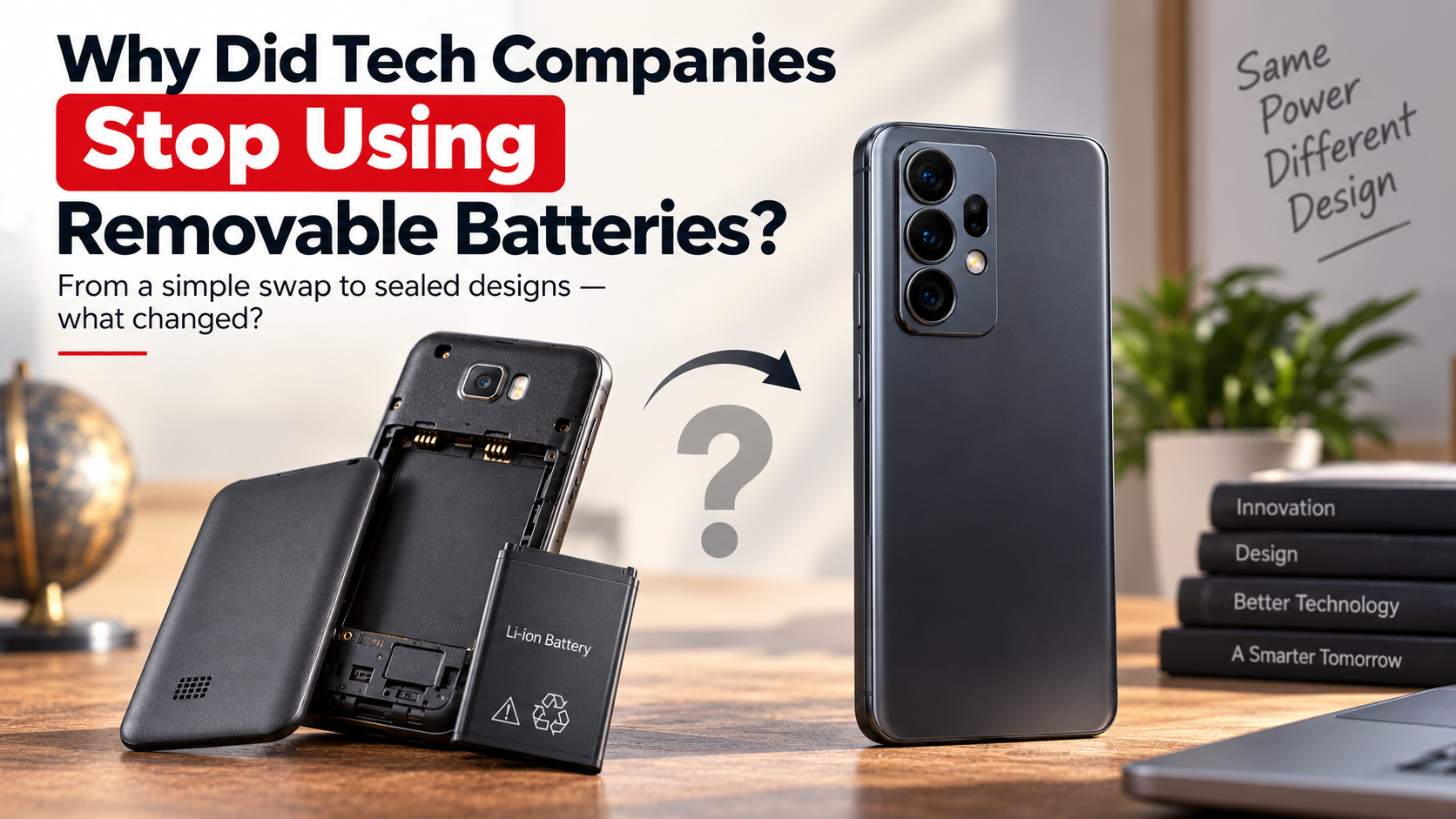
Removable batteries were once a standard feature in mobile phones, making it easy to replace a dead battery in seconds. Remember when you could remove your phone’s back cover and swap in a fresh battery? That simple design made long trips and busy workdays much easier.
Today, most flagship smartphones and many thin laptops use sealed battery designs. This shift was not caused by one decision. It followed changes in industrial design, consumer expectations, and hardware engineering.
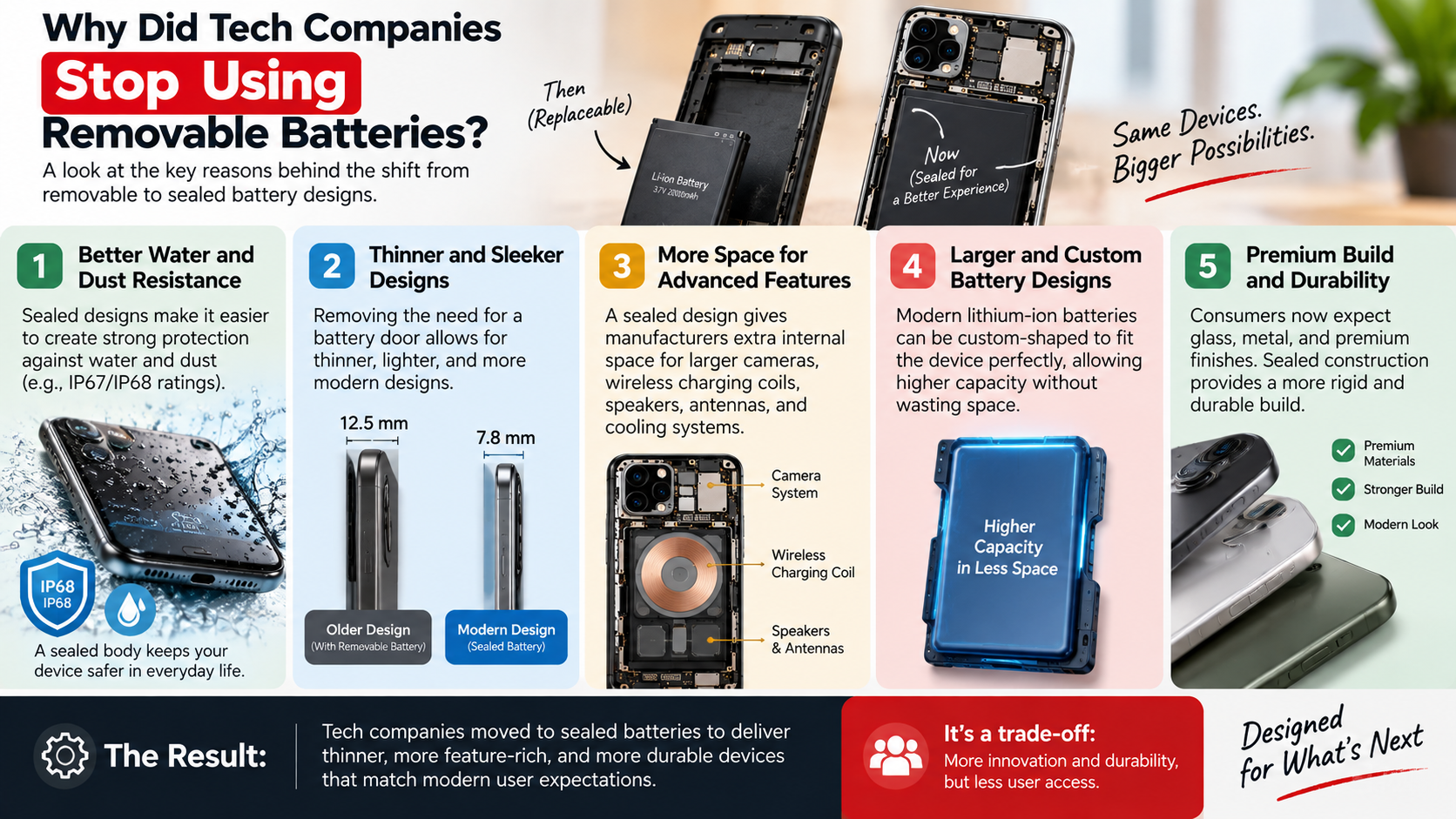
Manufacturers moved away from removable batteries to improve water resistance, reduce device thickness, and use internal space more efficiently. Modern phones also need room for larger camera systems, wireless charging coils, speakers, antennas, cooling hardware, and bigger battery cells.
Sealed construction also makes it easier to create consistent dust and water protection. IP ratings, defined under IEC 60529, measure this protection. They do not require a sealed battery design, but sealed construction can make those designs easier to engineer.
This guide explains why removable batteries disappeared, what EU rules could change in 2027, and how to protect your battery today.
Why did phone companies get rid of removable batteries?
Phone companies largely abandoned removable batteries because modern smartphones demanded better water resistance, thinner designs, and more internal space. A user-swappable battery usually needs a removable rear panel and additional mechanical components.
Those parts take up space and add potential points for dust or moisture to enter. Modern phones instead use tightly fitted frames, adhesives, seals, and internal brackets.
Removing the battery door also gives engineers greater freedom when arranging internal components. That space can support larger camera sensors, wireless charging coils, speakers, haptic motors, and cooling systems.
Battery design has changed as well. Manufacturers can fit larger custom-shaped lithium-ion or lithium-polymer packs into available space. These packs do not need to follow the standard shapes once common with removable batteries.
Consumers also began expecting premium materials such as glass and aluminum. Those materials pair naturally with sealed construction and help manufacturers create thinner, more rigid devices.
The result is a tradeoff: better integration and durability, but less user access.
The Tradeoff for IP68 Water and Dust Resistance
Removable batteries made water resistance more difficult, although they did not make it impossible. A removable back cover needs seals, clips, or gaskets that must maintain their fit over time.
Every opening also creates another potential entry point for moisture and dust. Manufacturers therefore gained an engineering advantage by using permanently assembled frames and carefully controlled seals.
This approach can support high IP ratings, including IP68 on some smartphones. However, an IP68 rating does not mean a phone is permanently waterproof. Protection depends on the specific device, test conditions, and condition of its seals.
Sealed construction also helps manufacturers control the tolerances between the display, frame, rear panel, and internal components. That consistency can simplify assembly and improve resistance to everyday exposure.
Still, water resistance is only one reason removable batteries disappeared. Space efficiency, aesthetics, structural design, wireless charging, and larger battery capacities also played important roles.
The tradeoff is clear. Consumers gained slimmer, better-protected devices but lost the convenience of carrying spare removable batteries.
Will phones in 2027 have replaceable batteries?
Many portable electronic products sold in the European Union will face stronger battery-replacement requirements from February 18, 2027. Covered portable batteries will generally need to be readily removable and replaceable by the end user during the product’s lifetime.
That does not necessarily mean phones will return to old-style snap-off battery covers. The rules focus on practical removability and replacement rather than recreating older phone designs.
The regulation requires batteries to be removable using commercially available tools. Users should not normally need specialized tools, thermal energy, or solvents to disassemble the product, subject to specific requirements and exemptions.
Manufacturers must also provide instructions and safety information covering battery removal and replacement. Spare batteries must generally remain available for the required period.
There are exemptions for certain products and specific circumstances. Therefore, not every portable electronic device will necessarily follow the exact same requirements.
The important point is that battery repairability is becoming a legal requirement in the EU. Manufacturers will need to rethink how they install batteries in many covered products.
So, replaceable batteries are returning to the regulatory conversation. However, the classic removable-back phone design is not guaranteed to return.
How Brands Are Adapting to New EU Regulations
Manufacturers have several ways to improve battery serviceability without returning to old plastic back covers. One approach is to redesign internal assemblies so users or technicians can access the battery without destructive disassembly.
Pull-tab adhesives are one example already used in some electronics. They can allow a battery to separate from its mounting surface without applying the intense heat sometimes needed with conventional adhesive.
The new rules do not require every manufacturer to use one specific adhesive or removal method. Instead, they establish requirements for readily removable and replaceable batteries.
This gives manufacturers flexibility when developing compliant hardware. They can redesign battery mounts, adhesives, brackets, connectors, and internal layouts.
Safety is another major consideration. Battery removal should not damage the battery or device unnecessarily. This matters because damaged lithium batteries can overheat and create serious fire hazards.
The likely result is not a return to older smartphones with simple plastic backs. Instead, manufacturers may create devices that combine premium external materials with easier battery replacement.
Some designs could use accessible battery tabs, improved mounting systems, or modular internal components. These solutions could make repairs easier while preserving modern phone features.
The future of smartphone repair may therefore focus on better serviceability rather than traditional removable batteries.
Will removable batteries come back?
Removable batteries may return in some form, but the classic pop-out battery is unlikely to become universal again. Modern smartphones have very different hardware requirements from older models.
Today’s devices combine large displays, multiple cameras, wireless charging, advanced antennas, powerful processors, and larger battery packs. Manufacturers need to use internal space efficiently.
That makes a fully enclosed battery compartment less attractive from a design perspective. It also explains why repairability can be improved without recreating the thick plastic backs of older phones.
Brands such as Fairphone have already shown that modular and repairable smartphones can work in the consumer market. Their designs demonstrate that battery replacement does not require sacrificing every modern feature.
The bigger industry trend is therefore likely to be serviceable batteries rather than traditional removable batteries. Devices may use easier-to-remove adhesives, accessible connectors, replaceable modules, and better repair documentation.
External accessories will also remain important. Power banks and magnetic battery packs offer extra runtime without requiring users to carry a spare internal battery.
The future could therefore combine the best parts of both approaches. Phones may remain slim and water-resistant while offering safer and easier battery replacement.
The Rise of High-Speed Charging and Modular Hardware
Fast charging changed how people think about battery replacement. Instead of carrying a spare internal battery, users can often restore a meaningful amount of charge during a short break. For everyday charging, chargers with multiple ports can also make it easier to power several devices from one adapter.
Power banks provide another alternative. They can add hours of runtime without requiring the device to be opened.
Magnetic charging accessories have also made external battery packs easier to use with compatible smartphones. They attach directly to the device and can provide power while the phone remains in use.
These solutions do not make removable batteries unnecessary for everyone. Field workers, travelers, photographers, and emergency users may still value instant battery swaps.
However, mainstream consumers often prioritize convenience, thinness, water resistance, and premium construction. Those preferences helped drive the move toward sealed designs.
Fast charging also reduces the need to carry spare internal batteries for many everyday users. A short charging session can provide enough power to finish a commute, meeting, or workday.
Future hardware may therefore combine both approaches. A phone could remain slim and water-resistant while still allowing safer battery replacement.
That would create a middle ground between traditional removable batteries and today’s highly sealed devices.
What is the 40-80 rule for laptop batteries?
The 40–80 rule for rechargeable batteries is a battery-care habit that recommends keeping a lithium-ion battery roughly between 40% and 80% when practical. It is not a mandatory rule, and you do not need to follow it perfectly.
Lithium-ion batteries generally experience more chemical stress at high charge levels and high temperatures. Battery health and cycle count both provide useful context for understanding how batteries age, but keeping a battery away from extremes can help reduce long-term aging.
However, there is no universal rule saying that charging below 20% is inherently damaging. Modern battery-management systems monitor voltage, temperature, and charging conditions to protect the cells.
Likewise, occasionally charging to 100% is normal. You should do it when you need maximum runtime, especially before travel or long periods away from an outlet.
The most useful habits are simple:
- Avoid prolonged exposure to high temperatures.
- Use the manufacturer’s charging and battery-health features.
- Avoid regularly keeping the battery at 100% for extended periods.
- Do not deliberately drain the battery to 0% as a routine habit.
- Use a charge limit when your device provides one.
For more practical advice, see smartphone mistakes that reduce battery life.
These practices can reduce battery aging, but no charging routine can double battery life for every device.
Managing Battery Health Through Operating System Thresholds
Modern operating systems increasingly include tools that reduce unnecessary battery stress. These features can be more useful than manually watching the battery percentage all day. They are also part of the broader set of ways to improve iPhone battery life in 2026, even though specific settings vary between devices.
Windows Smart Charging can limit charging on supported devices when keeping the battery at 100% could accelerate deterioration. Manufacturers may implement this feature differently across devices.
Some Windows laptops can limit charging to around 80% in certain situations. Users can usually charge to 100% when they need the extra capacity.
Mac laptops also include battery-health features. Optimized Battery Charging can delay charging beyond 80% when the system expects the Mac to remain connected to power.
Some compatible Macs also provide a configurable charge limit. These tools can help reduce the time the battery spends at a high charge level.
These features are useful because they automate battery care. Instead of constantly unplugging your laptop, let the operating system manage charging when possible.
The exact settings vary by manufacturer and model. Always check your device’s battery settings before changing charging behavior.
Using built-in battery management is usually more practical than following a strict percentage target every day. Consistency matters more than perfection when maintaining lithium-ion battery health.
Is a 1% battery drain in 3 minutes normal?
A 1% battery drop every three minutes equals about 20% per hour. That can happen during demanding smartphone use, but it should not automatically be considered normal.
Screen brightness, cellular reception, camera use, gaming, navigation, video streaming, and high-refresh-rate displays can all increase power consumption. Background synchronization and location services can also contribute.
For example, a phone running a demanding game may lose battery much faster than one displaying a static webpage. Battery age also matters because an older battery may provide less usable capacity than when it was new.
The situation is more concerning when the same drain occurs while the phone is idle. A screen-off device that loses 1% every three minutes deserves investigation.
Check your phone’s battery settings first. Look for apps consuming unusual amounts of power, weak network conditions, excessive background activity, or recent software changes.
Also consider battery health. If the battery is significantly degraded, replacing it may restore much of the device’s original runtime.
There is no single percentage-per-minute figure that defines healthy battery performance. Usage conditions matter more than a simple drain-rate calculation.
Diagnosing Standby Power Drains Versus Active Screen Use
Start by separating active use from standby drain. A phone can consume significant power while the screen is on, especially during gaming, navigation, video recording, or high-resolution streaming.
Standby drain is different. If the screen remains off and the battery still falls rapidly, investigate background activity.
Open your device’s battery or power-management settings. Most modern phones show which apps and services have used the most energy.
Look for unexpected activity from:
- Location services
- Cloud synchronization
- Social media apps
- Video or music services
- Poor cellular connections
- Recently installed applications
- Background refresh processes
A weak cellular signal can be especially important. The phone may use more power while repeatedly searching for or maintaining a network connection.
Software updates can also temporarily change battery behavior. After a major update, background indexing or synchronization may increase consumption for a short period. If unusual battery drain continues, it is also worth checking what happens if you don’t update apps, since outdated apps can sometimes contribute to performance or battery problems.
If standby drain remains unusually high after basic troubleshooting, restart the device and check for system updates. Persistent problems may indicate an app issue or an aging battery.
The goal is to compare screen-on consumption with idle consumption, rather than judging battery health from one percentage reading.
Frequently Asked Questions
Can I replace a sealed phone battery myself at home?
Yes, you can replace a sealed battery at home, but it requires patience, safety gear, and specialized tools. Modern phones use heavy industrial adhesives that require controlled heat guns or isopropyl alcohol to loosen safely. Puncturing a soft lithium pouch during removal can cause chemical fires. If you lack experience with delicate ribbon cables, hire a certified technician or use an official manufacturer self-repair program.
Why do modern phone batteries degrade after two years?
Lithium-ion cells degrade naturally due to chemical wear from routine charge-discharge cycles. Each full cycle causes microscopic physical cracking within internal electrodes, reducing energy retention capacity. Fast charging speeds and ambient thermal heat accelerate this loss over time. Most consumer phone batteries are chemically rated for 500 to 800 full cycles before their original capacity drops below 80%.
Does fast charging damage a non-removable battery?
Fast charging generates extra ambient heat, which is the primary driver of chemical degradation in mobile lithium cells. However, modern smartphone motherboards include integrated thermal sensors and smart charge controllers. These safety chips throttle incoming wattages as the battery fills up or temperatures rise. Using an official, manufacturer-certified power adapter keeps charging safe and prevents dangerous thermal runaway.
What is the best way to store a device you don’t use?
Store idle mobile devices and laptops in a cool, dry environment with the battery charged to roughly 50%. Leaving a stored lithium battery sitting completely empty causes it to drop into a permanent deep-discharge state, rendering it unchargeable. Storing it fully charged at 100% accelerates internal capacity loss over time. Check and recharge idle equipment back to 50% every six months.
Conclusion
The disappearance of removable batteries was driven by several changes in modern electronics. Manufacturers wanted thinner devices, better water resistance, efficient internal layouts, and premium materials.
Sealed designs helped engineers integrate larger batteries, complex cameras, wireless charging systems, speakers, antennas, and other components. Consumers also became accustomed to slimmer devices with fewer external openings.
The tradeoff was clear. Users lost the ability to swap a depleted battery in seconds, while manufacturers gained more freedom over industrial design.
That balance may now begin to change. New European battery rules are pushing manufacturers toward easier battery removal and replacement for covered portable products from February 18, 2027.
The future is unlikely to look exactly like the past. Instead of snap-off covers, manufacturers may develop easier and safer battery-replacement systems.
The result could be a new generation of devices that combine premium construction with better repairability.
Until then, good battery care still matters. Avoid excessive heat, use built-in charging limits when available, and monitor unusual power consumption.
A well-maintained battery can help your modern device remain useful for longer.