
What Do AMD GPU Names and Numbers Actually Mean?
Understanding computer hardware can feel overwhelming when you encounter complex model names and product generations. However, learning how AMD GPU names work makes comparing graphics cards much easier.
If you are planning a PC upgrade, knowing how to read a graphics card name can help you identify its generation and performance tier. You can also check the official AMD website for verified specifications.
Graphics processing units (GPUs) affect gaming performance, video editing speeds, and visual quality. However, a higher model number does not automatically guarantee better performance in every situation. Explore things your GPU can do besides play games to understand how your graphics card can be useful beyond entertainment.
This guide explains what AMD Radeon GPU names mean, how model numbers differ across generations, and what suffixes such as XT indicate. It also answers common questions about the RX 9070, future graphics cards, and AMD Ryzen processor tiers.
What Do the Different Numbers in AMD GPU Names Mean?
AMD Radeon graphics card names contain letters and numbers that help identify the product family, generation, and performance tier. Understanding these details makes it easier to compare GPUs before purchasing one.
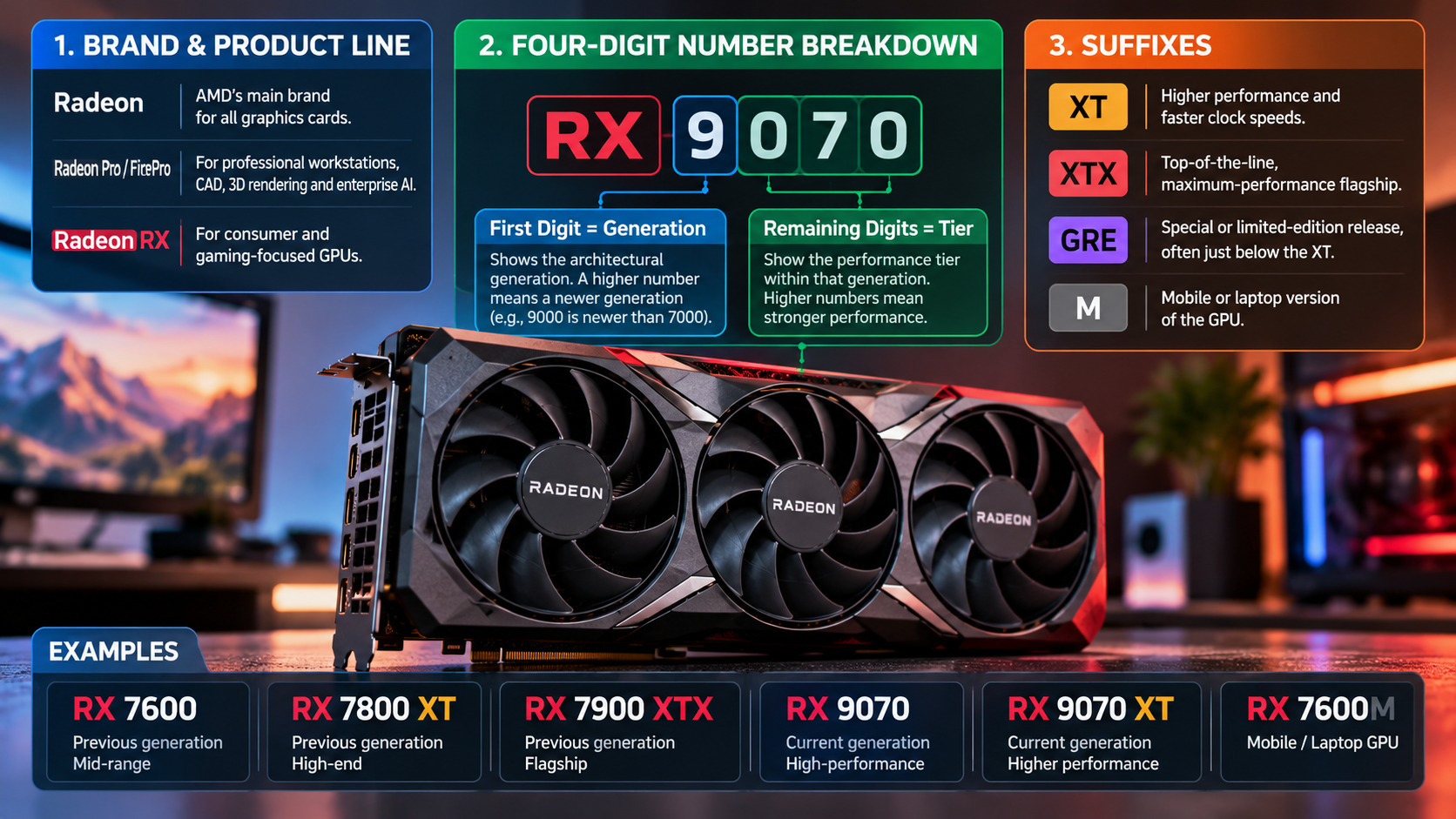
For example, consider the AMD Radeon RX 9070 XT. The Radeon name identifies the graphics brand, RX identifies the gaming graphics product line, and 9000 identifies the series. The 9070 portion identifies the specific model, while XT indicates a higher-performance variant within that model family.
However, AMD does not use one identical naming formula for every graphics generation. Older Radeon cards, such as the RX 6000 and RX 7000 series, follow related but different naming patterns.
Therefore, you should compare model numbers within their respective generations rather than relying on the digits alone. Architecture, memory capacity, power consumption, and independent benchmarks provide a clearer picture of actual performance.

Understanding Tier and Generation Digits
The series number in an AMD Radeon GPU name helps identify its product generation. For example, the RX 6000, RX 7000, and RX 9000 series belong to different generations of Radeon gaming graphics cards.
Within a series, the remaining digits help distinguish individual models and their approximate market positions. For instance, the RX 7900 XTX sits above the RX 7800 XT in AMD’s previous-generation gaming lineup. Similarly, the RX 9070 XT offers higher performance than the RX 9070.
However, these patterns are not universal rules. A newer mid-range graphics card may outperform an older high-end model in some games, while the older card may remain competitive in others. To get the best results from your existing hardware, learn how to get more out of your GPU without overclocking through practical performance adjustments.
When comparing AMD GPU model numbers, consider these factors:
- Generation: Identifies the graphics card series and helps establish its technological age.
- Model tier: Indicates the card’s approximate position within its product family.
- Architecture: Determines important hardware features and influences performance.
- Benchmarks: Show how the card performs in actual games and applications.
This approach helps you compare graphics cards without relying on model numbers alone.
Decoding Prefixes and Suffixes
Letters before and after an AMD GPU model number provide additional information about its product family or variant. Understanding these labels can help you distinguish gaming graphics cards from professional graphics solutions.
The RX prefix identifies AMD’s Radeon RX gaming graphics lineup. AMD also sells professional graphics products under other Radeon branding, so not every AMD GPU uses the RX designation.
Suffixes provide further distinctions between models. For example, XT commonly identifies a higher-performance variant within a Radeon family. The RX 9070 XT is positioned above the standard RX 9070, with more compute units and higher power consumption.
Some older Radeon cards also use XTX, while certain models include GRE in their names. These labels identify specific product variants, but their meanings should not be treated as universal performance rankings.
Third-party manufacturers may add their own branding to cards from companies such as Sapphire, ASUS, and PowerColor. These additions can identify cooling designs, factory overclocks, or product families.
Always check the manufacturer’s specifications before purchasing. A suffix alone cannot tell you everything about performance, cooling, dimensions, or power requirements.
Is the RX 9070 High-End?
The AMD Radeon RX 9070 is a capable upper-mainstream to high-performance gaming graphics card, but whether it qualifies as high-end depends on your expectations and the comparison group.
AMD introduced the RX 9070 and RX 9070 XT in its Radeon RX 9000 series, based on the RDNA 4 architecture. Both cards feature 16GB of GDDR6 memory and support modern gaming technologies. However, the RX 9070 XT has more compute units and higher power consumption than the standard RX 9070.
The standard RX 9070 can suit demanding 1440p gaming and some 4K workloads, depending on the game and graphics settings. The XT variant offers additional performance for users seeking higher frame rates or more demanding settings.
Before buying either model, consider your monitor resolution, target frame rate, preferred games, and budget. These factors matter more than whether a product is labelled high-end.
Performance Expectations for Flagship Hardware
High-performance graphics cards are designed for demanding workloads, including high-resolution gaming, complex visual effects, and GPU-accelerated creative applications. However, the RX 9070 should not automatically be treated as the flagship of every AMD graphics generation.
The RX 9070 XT delivers more processing capacity than the standard RX 9070, making it a better choice for some demanding gaming scenarios. Actual results still depend on the game, resolution, graphics settings, and processor used alongside the GPU.
Power requirements also deserve attention. AMD lists a typical board power of 304W and a minimum recommended power supply of 750W for the RX 9070 XT. The standard RX 9070 has lower power requirements, so check its specifications separately.
Cooling and case compatibility matter, too. Partner cards can differ in size, cooling systems, and factory clock speeds.
Before choosing a GPU, review independent benchmarks for the games you play. Compare average frame rates, ray-tracing performance, power consumption, and price to determine which card offers the best value for your needs. Since ray tracing can affect frame rates significantly, understanding how ray tracing can reduce FPS and when to turn it off can help you choose settings that balance visual quality and performance.
Is the AMD Radeon RX 6090 Coming?
The name RX 6090 should not be treated as a confirmed upcoming AMD graphics card. AMD’s official Radeon gaming graphics lineup includes the RX 9000 series, while the RX 6000 series belongs to an older generation.
A model name appearing in a forum post, social media discussion, or speculative article does not confirm that a product exists. Manufacturers can change product names and release plans before announcing new hardware.
It is also important not to confuse AMD Radeon naming with NVIDIA GeForce RTX naming. The two companies use different product families and numbering systems, so a model number associated with one brand does not establish what the other brand will release.
If you are planning a graphics card upgrade, focus on products with confirmed specifications, pricing, and availability. Waiting for an unannounced GPU can make sense if your current system meets your needs, but it can also delay an upgrade unnecessarily.
Tracking Hardware Rumors Safely
Following graphics card rumors can help you understand possible future developments, but speculation should not guide a purchasing decision on its own.
Before trusting a claim about an upcoming AMD GPU, check whether AMD has published an official announcement, product page, or technical specification. Reliable technology publications can also help explain leaks, although leaked information may change before launch.
Pay attention to the difference between confirmed details and predictions. A reported codename, possible release date, or rumored model number does not guarantee that a product will reach the market.
When comparing future and current graphics cards, wait for independent benchmarks whenever possible. These tests help establish actual performance, power consumption, and value rather than relying on marketing claims or estimated specifications.
If you need a graphics card now, compare available models against your budget and workload. If you can comfortably wait, monitor official announcements and credible reporting before making a final decision.
This approach reduces the risk of buying hardware based on inaccurate rumors or postponing an upgrade for a product that may not arrive as expected.
What Does Ryzen 5 or Ryzen 7 Mean?
AMD uses a separate naming system for its Ryzen processors, which handle general computing tasks rather than graphics rendering alone. Understanding Ryzen model names helps you choose a suitable CPU for gaming, multitasking, and productivity. If you are building a gaming PC, compare the available options in this guide to which AMD CPU is best for gaming in 2026 before choosing a processor to pair with your graphics card.
Ryzen 3, Ryzen 5, Ryzen 7, and Ryzen 9 broadly indicate different performance and market tiers. Ryzen 5 processors commonly target mainstream users, while Ryzen 7 models often provide additional processing capacity for demanding applications.
However, the tier alone does not determine a processor’s speed. Its generation, architecture, core count, clock speeds, cache, and power limits also affect performance.
For example, a newer Ryzen 5 processor may outperform an older Ryzen 7 in certain applications. Gaming performance also depends on the graphics card, game engine, resolution, and system configuration.
AMD GPU names and Ryzen processor names use numbers and suffixes to distinguish product families and specific models. Ryzen processor numbers help identify the product series, while suffixes may indicate features such as integrated graphics or a focus on performance and efficiency. However, these naming conventions vary by product category. Always check the official specifications to understand a processor’s capabilities before choosing one for gaming or productivity.
Conclusion
Understanding AMD GPU names makes it easier to compare graphics cards and choose the right hardware for your needs. Model numbers, series digits, and suffixes such as XT provide useful clues about a card’s generation and performance tier. However, these labels do not tell the whole story.
Before buying a graphics card, compare its specifications, gaming benchmarks, memory capacity, power requirements, and price. Also, remember that newer models do not always outperform older high-end cards in every workload. If you are building a PC, consider your processor and graphics card together to maintain balanced performance. You can also evaluate whether building your own PC is still the cheaper option in 2026 before deciding between assembling a system and buying a prebuilt computer.
Ultimately, the best AMD GPU is not necessarily the most expensive or the one with the highest model number. It is the one that delivers the performance you need within your budget.