
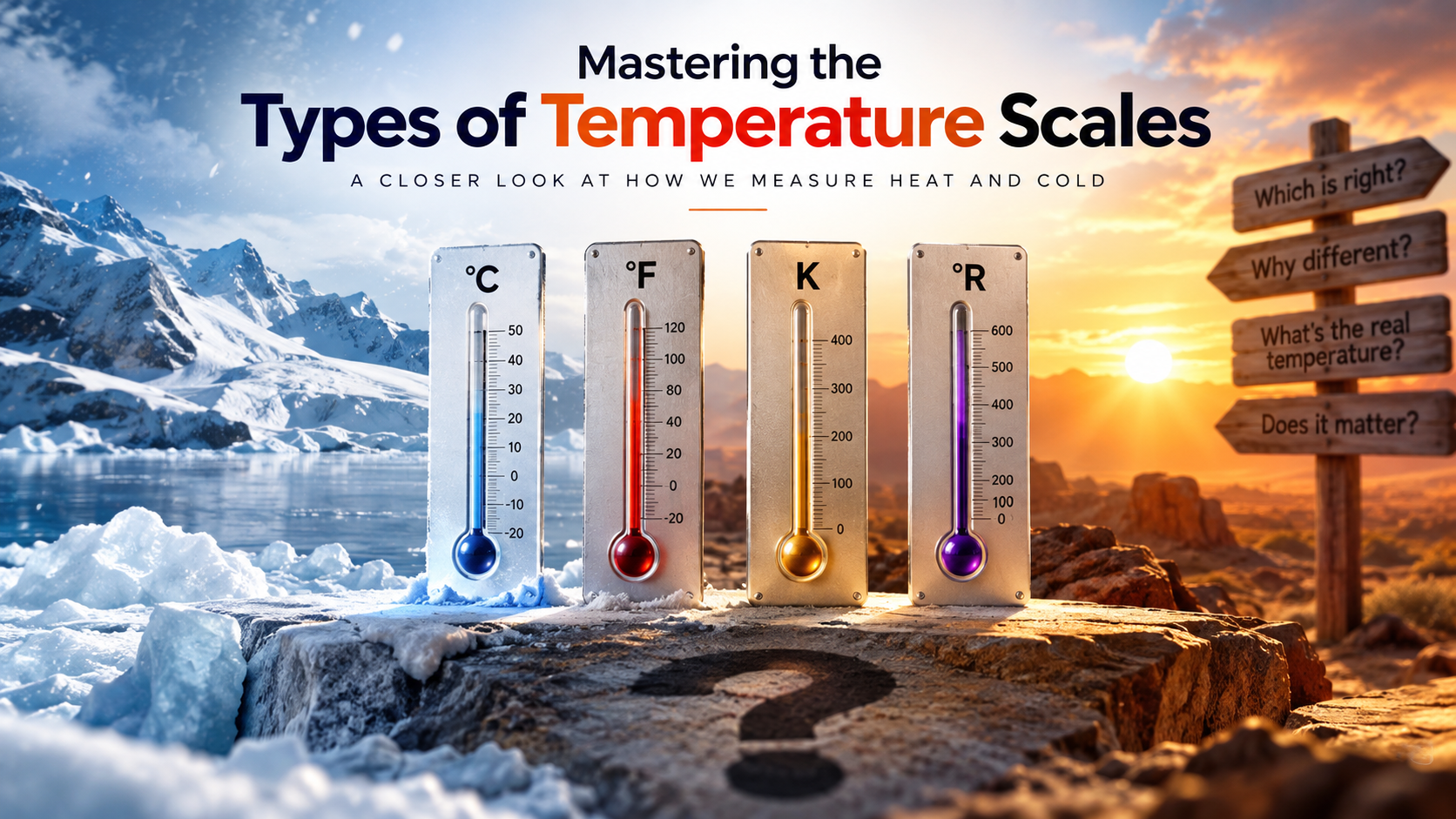
Mastering the Types of Temperature Scales and Thermal Measurements
Understanding the types of temperature scales is essential in science, engineering, medicine, and everyday life. Temperature describes how hot or cold something is. More precisely, it relates to the average kinetic energy of particles within a substance. Scientists, engineers, and technicians use standardized temperature scales to communicate thermal measurements accurately.
The most familiar scales are Celsius, Fahrenheit, Kelvin, and Rankine. Each scale has a different reference point and purpose. Celsius dominates everyday use worldwide, while Fahrenheit remains common in the United States. Kelvin is especially important in physics and thermodynamics. Rankine is mainly used in some engineering applications.
According to the National Institute of Standards and Technology, accurate temperature measurement supports scientific research, manufacturing, and international commerce. Understanding temperature scales also makes conversions easier. It helps readers interpret weather reports, laboratory results, medical readings, and engineering specifications correctly.
What are the four types of temperature scales?
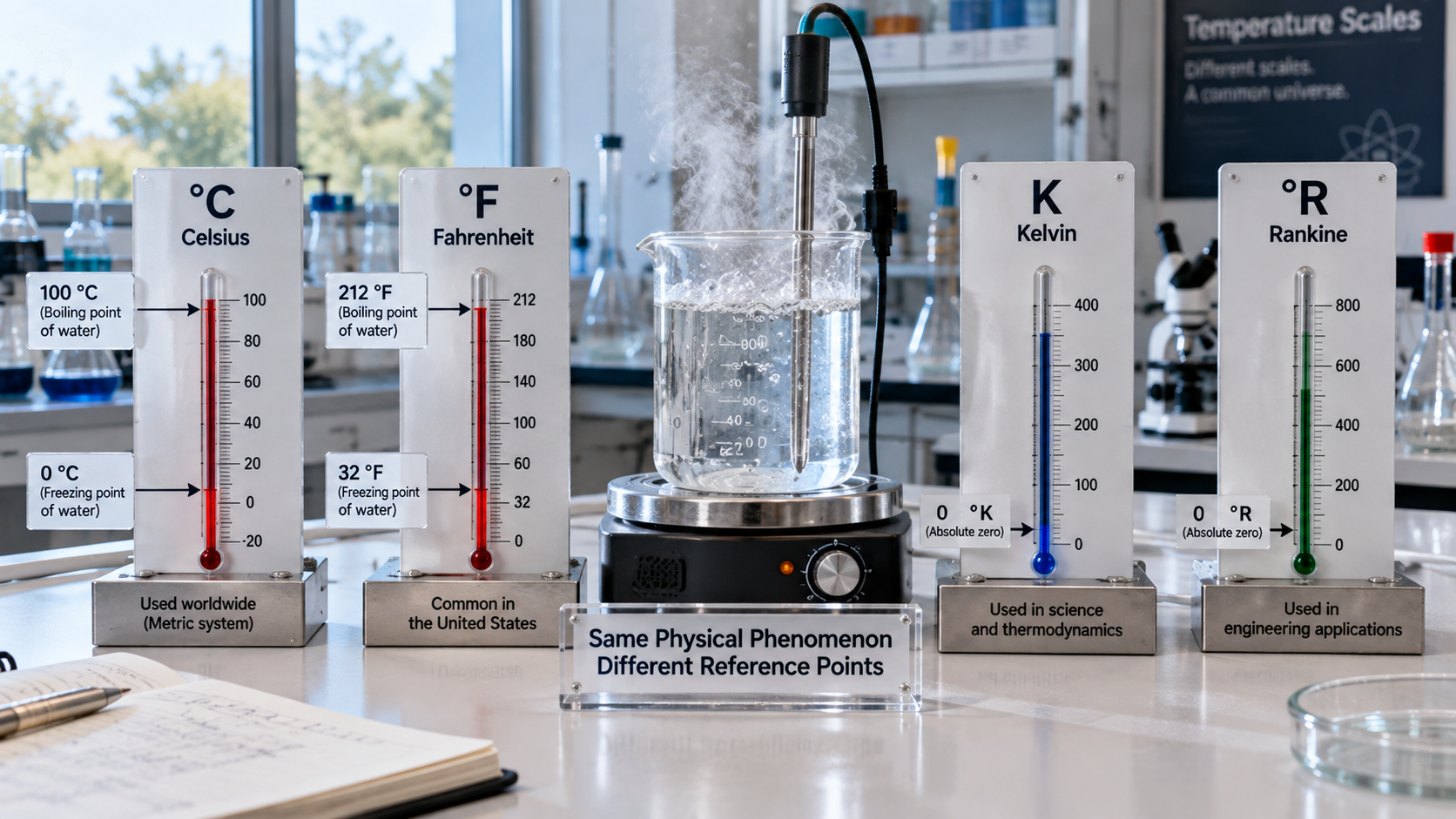
The four primary types of temperature scales are Fahrenheit, Celsius, Kelvin, and Rankine. Each scale uses different reference points and serves different practical purposes. The Fahrenheit scale places the freezing point of water at 32°F and its boiling point at 212°F under standard atmospheric pressure. It remains common in the United States for weather reports and household measurements.
The Celsius scale places water’s freezing point at 0°C and boiling point at 100°C under standard atmospheric pressure. It is widely used around the world and works naturally with the metric system.
The Kelvin scale begins at absolute zero, represented by 0 K. It is widely used in scientific calculations involving thermodynamics and physical processes.
The Rankine scale also begins at absolute zero but uses Fahrenheit-sized degrees. It therefore appears mainly in specialized engineering and thermodynamic applications.
Together, these scales provide practical ways to describe and compare thermal conditions.

Exploring Absolute Zero in Kelvin and Rankine
Absolute zero is the lowest theoretical temperature possible. It corresponds to 0 K on the Kelvin scale and 0°R on the Rankine scale. At this point, a system reaches its minimum possible thermal energy. However, particles do not simply stop all quantum motion, so saying that all molecular motion completely ceases can be misleading.
Scientists use Kelvin when studying extremely low temperatures because the scale begins at absolute zero. This avoids negative values in many thermodynamic calculations. The Kelvin scale is especially useful for calculating relationships involving energy, pressure, and temperature.
The Rankine scale follows the same absolute-zero principle. However, its degree size matches the Fahrenheit scale. This makes it useful in certain engineering calculations, particularly where Fahrenheit-based measurements are already used.
Absolute zero has major importance in quantum physics, cryogenics, thermodynamics, and aerospace engineering. Laboratories can approach absolute zero extremely closely, but reaching exactly 0 K is not practically possible.
Understanding absolute zero also explains why Kelvin differs fundamentally from Celsius and Fahrenheit.
What are the 7 types of thermometer?
There are several types of thermometers, and each uses a different physical property to measure temperature. Liquid-in-glass thermometers use thermal expansion. Mercury or colored alcohol expands inside a narrow glass tube as temperature increases. Bimetallic thermometers use two bonded metals that expand at different rates. Their movement operates mechanical temperature displays, such as oven dials. For laboratory work, understanding basic laboratory glassware and its uses can also help when working with traditional liquid-in-glass measurement equipment.
Infrared thermometers measure thermal radiation from surfaces without requiring physical contact. They are useful for machinery, cooking, HVAC systems, and safety inspections.
Thermocouples generate a small voltage when two different metals experience a temperature difference. They work across a wide temperature range and suit industrial environments.
Resistance temperature detectors, or RTDs, measure changes in electrical resistance. Platinum RTDs are valued for accuracy and stability.
Thermistors also measure temperature through electrical resistance changes. They provide high sensitivity over specific temperature ranges.
Finally, gas thermometers use changes in gas pressure or volume to determine temperature. They have historically supported precise laboratory measurements and calibration work.
Choosing Infrared Thermometers for Industrial Safety
Infrared thermometers provide fast temperature measurements without requiring direct contact with a surface. They detect the infrared radiation naturally emitted by objects and convert that radiation into a temperature reading. This makes them useful when touching the target would be dangerous or impractical.
Industrial technicians can use infrared devices to inspect electrical panels, motors, bearings, pipes, furnaces, and moving machinery. They can also identify unusual heat patterns before equipment develops a serious fault, supporting routine equipment checks in industrial environments.
These thermometers are particularly valuable in environments involving high temperatures. Workers can stand at a safer distance while checking thermal conditions. This reduces unnecessary exposure to hot equipment and supports routine safety inspections.
However, infrared measurements represent surface temperature, not necessarily the internal temperature of an object. Emissivity, reflective surfaces, distance, and environmental conditions can also affect accuracy.
For reliable industrial measurements, technicians should follow the manufacturer’s operating instructions. They should also understand the limitations of infrared sensing.
When used correctly, infrared thermometers combine speed, convenience, and reduced physical contact. They are therefore valuable tools for preventive maintenance and industrial safety programs.
What are types of temperature?
Temperature can be described in different ways depending on what is being measured and why the measurement matters. Ambient temperature refers to the temperature of the surrounding air. Weather stations, HVAC systems, and indoor monitoring equipment commonly measure it.
Body temperature describes the thermal condition of a living organism. Medical professionals use body-temperature measurements to assess general health and detect abnormal conditions.
Surface temperature describes the temperature at the outer boundary of an object. It can differ considerably from the temperature inside that object. Infrared thermometers commonly measure this type of temperature.
Core temperature refers to the temperature of an organism’s internal tissues and organs. It is especially important when studying human physiology and thermal regulation.
In fluid systems, stagnation temperature describes the temperature a moving fluid would reach if brought to rest adiabatically. Engineers use this concept in areas such as fluid dynamics and aerospace systems.
Effective temperature can describe a combined measure used to represent perceived thermal conditions. Depending on the application, it may consider factors such as air temperature, humidity, and air movement.
These categories help professionals select appropriate measurement methods for different environments and purposes.
Understanding Core Temperature in Biological Systems
Core temperature represents the internal thermal condition of an organism. In humans and other warm-blooded animals, the body regulates this temperature within a relatively narrow range. This regulation supports essential biological processes, including metabolism, circulation, and enzyme activity.
Medical professionals may monitor core temperature during surgery, intensive care, severe illness, or suspected heat-related conditions. Changes can provide important information about how the body is responding to its environment or a medical situation.
Core temperature differs from skin or surface temperature. Skin temperature can change quickly because of surrounding air, humidity, clothing, physical activity, and blood flow. Core temperature usually changes more slowly because the body actively regulates internal heat.
Scientists also study core temperature when examining thermoregulation. The body produces heat through metabolism and loses heat through processes such as radiation, convection, conduction, and evaporation.
Understanding the difference between core and surface temperature prevents incorrect interpretations. A person’s skin may feel cool while their internal temperature remains stable.
Core temperature is therefore an important concept in physiology, medicine, sports science, and environmental studies. Accurate measurement requires suitable instruments and appropriate measurement techniques.
Which are the three scales of temperature?
The three temperature scales most frequently encountered in everyday and scientific contexts are Celsius, Fahrenheit, and Kelvin. Each scale has a distinct role based on regional practice or scientific requirements.
The Celsius scale is widely used internationally for weather reports, medicine, education, cooking, and general measurements. It defines water’s freezing and boiling points as 0°C and 100°C under standard atmospheric pressure.
The Fahrenheit scale remains widely used in the United States. Weather forecasts, household thermostats, and many cooking instructions commonly use Fahrenheit measurements.
The Kelvin scale is especially important in science. Unlike Celsius and Fahrenheit, Kelvin is an absolute temperature scale. Its zero point corresponds to absolute zero. One kelvin has the same size as one degree Celsius, although the two scales use different zero points.
These three systems allow people to communicate temperature according to different practical needs. International research often requires accurate conversions between them.
Understanding their reference points makes temperature conversion easier. It also prevents confusion when comparing measurements from different countries, industries, or scientific disciplines.
Converting Between Celsius and Fahrenheit
Converting between Celsius and Fahrenheit requires a simple mathematical relationship. The two scales have different zero points and different degree sizes, so conversion requires both multiplication and an offset.
To convert Celsius to Fahrenheit, multiply the Celsius value by 9/5 and then add 32.
°F = (°C × 9/5) + 32
For example, 20°C converts to 68°F. This relationship explains why a temperature that appears moderate on the Celsius scale has a different numerical value on Fahrenheit.
To convert Fahrenheit to Celsius, subtract 32 from the Fahrenheit value. Then multiply the result by 5/9.
°C = (°F − 32) × 5/9
For example, 68°F converts to 20°C.
These formulas are useful when reading international weather forecasts, scientific information, recipes, and technical documents. They also help prevent mistakes when temperatures are reported using different measurement systems.
Kelvin conversions are slightly different because Kelvin and Celsius have the same degree size. The basic relationship is K = °C + 273.15.
Knowing these relationships makes temperature data easier to compare across different applications.
What are the two most commonly used temperature scales?
The two most commonly encountered temperature scales in everyday life are Celsius and Fahrenheit. Their widespread use reflects regional customs, historical development, and measurement standards.
The Celsius scale uses 0°C as the freezing point of water and 100°C as its boiling point under standard atmospheric pressure. Its 100-degree interval makes it convenient for metric-based calculations. Most countries use Celsius for everyday weather information and many other practical measurements.
The Fahrenheit scale places water’s freezing point at 32°F and boiling point at 212°F under standard atmospheric pressure. This creates a 180-degree interval between those reference points. Fahrenheit remains especially common in the United States.
Both scales can describe the same physical temperature. Their numerical values simply differ because their reference points and degree sizes differ.
Understanding both systems is useful when traveling, comparing weather information, reading international recipes, or interpreting technical material. It also helps prevent confusion between temperature values that look similar but represent different thermal conditions.
For scientific work, Kelvin is often preferred because it provides an absolute thermodynamic scale.
Global Adoption of the Celsius Scale
The Celsius scale became widely adopted alongside the metric system because its structure is simple and practical. Its 100-degree interval between water’s freezing and boiling points provides an intuitive framework for everyday measurements.
Many countries use Celsius for weather forecasts, school science, cooking, healthcare, and industrial applications. Its compatibility with the metric system also makes calculations straightforward in many scientific and commercial settings.
The scale was originally called the centigrade scale because of its hundred-degree structure. It was later renamed Celsius in honor of Swedish astronomer Anders Celsius.
International scientific communication commonly uses Celsius for many practical temperature measurements. However, Celsius is not the only important temperature scale. Scientists often use Kelvin when calculations involve thermodynamic temperature.
Celsius also remains closely connected to Kelvin because both scales have identical degree intervals. A change of 1°C represents the same temperature difference as a change of 1 K.
The widespread use of Celsius makes it one of the most important temperature scales for global communication. Learning how it relates to Fahrenheit and Kelvin helps readers interpret thermal measurements accurately across different countries and technical fields.
What are the three main types of thermometers?
Three common thermometer designs used across households, healthcare, and industry are digital, liquid-in-glass, and infrared thermometers. Each design measures temperature differently and offers specific advantages.
Digital electronic thermometers use electronic sensors, often thermistors, to detect temperature changes. A processor converts the sensor signal into a numerical reading. These thermometers are common in homes, clinics, laboratories, and kitchens because they provide quick results.
Liquid-in-glass thermometers use the thermal expansion of a liquid inside a narrow glass tube. Traditional designs used mercury, while many modern versions use colored alcohol or other safer liquids. Their readings are displayed using a graduated scale.
Infrared thermometers measure infrared radiation emitted from a surface. They do not require direct contact with the target. This makes them useful for checking food, machinery, HVAC equipment, and other surfaces.
Choosing among these types of thermometers depends on the application. Users should consider accuracy, measurement range, response time, contact requirements, and safety.
Using the correct thermometer improves measurement reliability and reduces the risk of incorrect readings.
Advantages of Digital Electronic Thermometers
Digital electronic thermometers have become common because they provide fast, clear, and convenient temperature readings. Many models use thermistors or other electronic sensors to detect changes in temperature. The device then processes the signal and displays the result numerically.
Unlike traditional mercury thermometers, digital models do not contain liquid mercury. This removes the risk associated with mercury exposure if the device breaks. Digital displays also make readings easier to interpret because users do not need to estimate the position of a liquid column.
Many digital thermometers provide results within seconds. Some models include features such as automatic shutoff, memory functions, audible alerts, and interchangeable measurement modes.
These devices are used in healthcare, cooking, laboratories, HVAC systems, and household monitoring. In laboratory settings, knowing what a laboratory is and how laboratories are used provides useful context for understanding where temperature-measurement equipment is applied. Their compact design also makes them easy to store and transport.
However, digital thermometers still require correct placement and proper use. Battery condition, sensor quality, and calibration can affect performance.
For reliable results, users should follow the manufacturer’s instructions and allow the sensor to reach the appropriate thermal condition. When used correctly, digital thermometers offer a practical combination of speed, safety, and readability.
Frequently Asked Questions
What is absolute zero?
Absolute zero is the lowest theoretical temperature possible, equal to 0 Kelvin, −273.15°C, or −459.67°F. It represents the minimum possible thermal energy and is an important reference point when studying the types of temperature scales used in physics.
Why does the United States still use Fahrenheit?
The United States continues using Fahrenheit mainly because of historical tradition, widespread public familiarity, and existing infrastructure. Although Celsius is common internationally, Fahrenheit remains deeply established in American weather reports, household thermostats, and everyday temperature measurements, unlike other types of temperature scales.
How do infrared thermometers work?
Infrared thermometers measure the thermal radiation naturally emitted by objects. A detector captures this radiation and converts it into an electrical signal, allowing the device to calculate surface temperature without physical contact. This makes them useful for measuring hot, moving, or difficult-to-reach surfaces across different types of temperature scales.
What is the difference between heat and temperature?
Heat refers to the total thermal energy transferred or contained within a substance, while temperature indicates the average kinetic energy of its particles. Understanding this distinction is essential when comparing measurements across the different types of temperature scales, including Celsius, Fahrenheit, and Kelvin.
Conclusion
Understanding the types of temperature scales helps explain how temperature is measured in science, weather, engineering, and everyday life. Celsius, Fahrenheit, and Kelvin each serve different purposes and provide standardized ways to describe thermal conditions. Knowing their relationships, applications, and fundamental concepts makes temperature conversions easier and supports more accurate interpretation of scientific and practical measurements.