
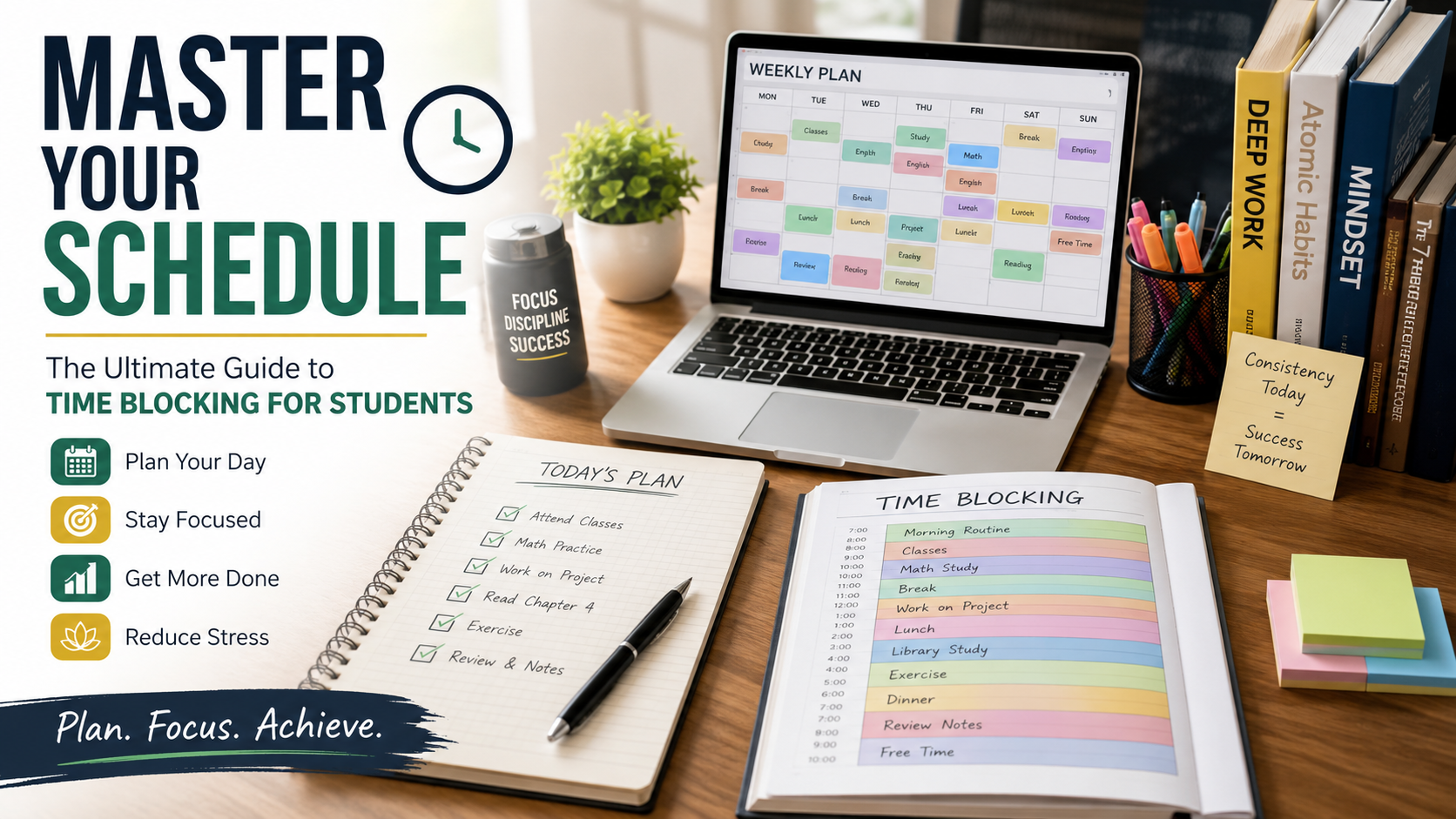
Master Your Schedule: The Ultimate Guide to Time Blocking for Students
Managing classes and homework often feels overwhelming for modern learners. However, adopting time blocking for students is the single best way to control your daily schedule. Consequently, this strategy cuts academic stress and eliminates procrastination fast. Instead of using a vague to-do list, you assign tasks to fixed blocks on your calendar. Furthermore, educational research from the U.S. Department of Education proves that structured time management directly improves student grades. Therefore, it also lowers anxiety and boosts retention.
Switching to a time-blocked schedule transforms big goals into simple daily actions. As a result, you stop wasting mental energy choosing what to study next. In addition, you stop feeling guilty during breaks. Every hour gets a clear purpose. Thus, you can focus deeply without digital distractions.
This guide explains how time blocking for students works in detail. Additionally, you will learn why it beats standard study habits. Ultimately, you will get a clear step-by-step framework to build your own system. Whether you struggle with cramming or juggling part-time work, this method provides the ideal structure.
Understanding the Basics of Time Blocking for Students
Time blocking is a simple daily scheduling strategy. Specifically, you divide your entire day into small, dedicated chunks of time. Each block belongs to one specific task or class. Therefore, you focus entirely on that single item during its time window. Once the block ends, you move smoothly to the next scheduled item.
Indeed, this method turns study sessions into firm appointments. You would not skip a doctor visit or class. Similarly, you must respect your scheduled study time. Seeing your day on a calendar grid shows your real availability. Thus, it stops you from overestimating free time. Consequently, it also prevents late-night cramming.
| Traditional To-Do List | Time-Blocked Calendar |
| • Study for Math | 09:00 – 10:30 Math Review |
| • Write History Essay | 10:30 – 10:45 Short Break |
| • Read Chapter 4 | 10:45 – 12:00 Outline Essay |
Why Traditional Checklists Fail Academic Learners
To-do lists fail because they grow endlessly without time limits. A list shows what to do. However, it fails to show when you will do it. As a result, a long checklist creates severe decision fatigue. Students often pick easy tasks first. Consequently, they avoid hard, high-value assignments until late at night.
Furthermore, standard lists create a false illusion of infinite time. For instance, you might write down ten huge assignments for one evening. When you miss your goal, you feel intense stress. Fortunately, time blocking for students fixes this major issue. It forces you to map tasks directly onto actual hours. Therefore, if a task does not fit today, you reschedule it immediately.
Psychological Benefits of Block Scheduling for Learning
Block scheduling changes how your brain processes complex topics. For example, the main mental benefit is sustained deep focus. When you dedicate a block to chemistry, your mind stops worrying about history. Thus, you give yourself full permission to concentrate on one subject at a time.
Moreover, this approach prevents constant context switching. Jumping between phone alerts, reading notes, and math problems destroys mental focus. Conversely, staying on one task solidifies neural pathways. As a result, you comprehend material faster and retain facts longer. In addition, knowing you scheduled rest later removes study guilt completely.
-
Less Academic Stress: Clear schedules eliminate constant worry about upcoming deadlines.
-
Guilt-Free Rest: Scheduled breaks let you relax without feeling lazy.
-
Stronger Focus: Single-tasking trains your brain to concentrate longer.
-
Better Grade Retention: Focused study blocks build long-term memory fast.
Defeating Student Procrastination with Micro-Blocks
Huge academic projects trigger severe procrastination. For example, a twenty-page paper feels far too scary to tackle at once. Consequently, students freeze up and delay starting for days. However, micro-blocks solve this mental barrier cleanly. You break intimidating projects into tiny, timed action steps.
Instead of writing “work on term paper,” create a thirty-minute micro-block to “find three sources.” Next, add a forty-five-minute block to “write the introduction.” Thus, small blocks lower the barrier to entry. Starting a tiny task requires very little willpower. As a result, as you finish small blocks, you build fast momentum and eliminate anxiety.
-
30 Minutes: Source Research
-
15 Minutes: Break
-
45 Minutes: Draft Introduction
How to Build a Student Time Blocking Schedule Step by Step
Building a strong schedule requires a clear, repeatable system. Fortunately, you do not need costly software. A basic digital calendar or paper notebook works great. Ultimately, the secret lies in balancing study sessions with personal wellness.
However, many learners try to block every free minute for studying. This rigid approach causes fast burnout. Instead, build your calendar in careful layers. First, start with fixed obligations. Then, add flexible study slots and personal rest. Follow these four basic steps to create a resilient routine.
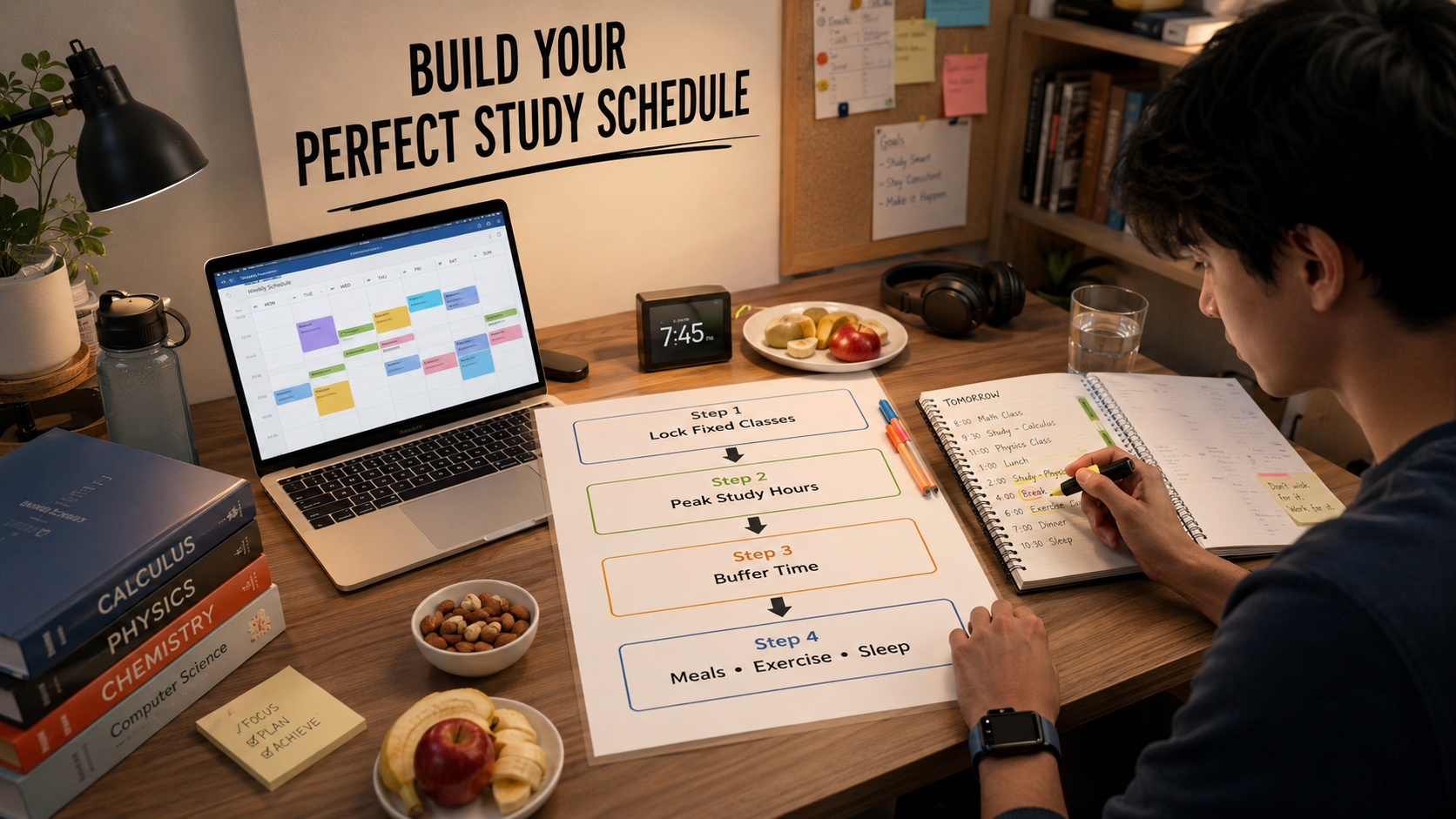

Step 1: Lock In Fixed Academic Commitments
First, start by filling in your non-negotiable weekly events. These items are the rigid foundation of your schedule. Therefore, enter them before adding homework sessions or personal fun.
To begin, add all class times, lab hours, and lectures. Second, add fixed work shifts and commute times. Third, include regular doctor visits and family duties. Consequently, visualizing these fixed constraints provides an honest view of your real working hours. Thus, it prevents overbooking and anchors your weekly plan in reality.
Step 2: Map Out Peak Energy Study Windows
Next, align your hard study blocks with your natural energy levels. Every student has unique peak focus hours. For instance, morning people think best early in the day. Conversely, night owls focus better during late afternoon or evening hours.
Therefore, identify your sharpest hours. Reserve those prime windows for your hardest subjects. If physics is difficult for you, study it during your peak energy block. Meanwhile, save administrative work for lower-energy periods. Answering emails or organizing files takes far less mental energy. As a result, matching task difficulty to biological energy yields faster learning.
Step 3: Insert Buffer Time and Short Breaks
Furthermore, never fill your calendar grid back-to-back with zero gaps. Real life brings sudden delays. For example, lectures run long, hard readings take extra time, and technical bugs happen. Consequently, a tightly packed calendar collapses as soon as one delay occurs.
Instead, insert short buffer blocks to protect your schedule. Leave fifteen to thirty open minutes in the morning and afternoon. These gaps act as shock absorbers for your day. If an assignment runs long, use the buffer block to finish. However, if you finish on time, use the buffer for extra rest. In addition, always schedule short micro-breaks to keep your brain fresh.
Step 4: Schedule Personal Time and Self-Care
Additionally, long-term academic success requires prioritizing physical and mental health. Students who skip self-care burn out quickly. Therefore, scheduling your personal life is just as vital as blocking study sessions.
Specifically, block out time for meals, workout sessions, hobbies, and sleep. Treating personal care as a fixed commitment ensures you actually do it. Furthermore, scheduling guilt-free rest creates a strong reward system. Because fun time is guaranteed, you stay motivated to work hard during study blocks.
Top Scheduling Tools for Student Time Management
Choosing the right tool depends on your personal habits and preferences. Fortunately, you do not need complicated software to run a great system. Learners usually pick between digital calendars, structured apps, or paper planners.
| Tool Type | Popular Choice | Key Features & Advantages |
| Digital Calendars | Google Calendar | Color coding, fast block dragging, phone alerts |
| Productivity Apps | Notion, Todoist | Integrates task lists directly into calendar slots |
| Paper Planners | Hourly Planners | Zero screen distraction, tactile writing focus |
For instance, digital calendars offer great flexibility. You can drag blocks easily when plans shift. Meanwhile, dedicated apps combine task lists with calendar slots smoothly. Alternatively, paper planners appeal to visual learners who want zero screen distraction. Thus, writing blocks by hand builds personal accountability fast.
FAQ SECTION
How many hours should a student block for studying each day?
Most university and high school learners thrive on two to four daily study hours outside of class. Moreover, focus quality matters far more than total time spent. For instance, two hours of deep, uninterrupted single-tasking beats six hours of distracted studying in a busy library. Therefore, adjust your total hours based on upcoming test dates and course difficulty. During light weeks, two hours daily is plenty for readings. However, during finals week, expand your routine to four or five hours divided into separate morning and evening sessions. Consequently, listen to your body and take frequent breaks to keep your brain sharp.
What should I do when my schedule gets disrupted?
Schedule disruptions happen to every busy learner. However, when an unexpected emergency or long assignment breaks your plan, adapt without frustration. Instead, treat your calendar as a flexible guide, not a rigid set of rules. First, take two minutes to look at your remaining afternoon blocks. Then, move unfinished study tasks into your scheduled buffer time. Alternatively, you can move low-priority tasks to tomorrow. If needed, shorten a non-essential study slot to fit urgent work. Ultimately, the real goal of time blocking for students is giving you situational awareness so you can adjust smoothly when plans change.
Is time blocking better than using the Pomodoro Technique?
In fact, time blocking and the Pomodoro Technique work wonderfully together. Time blocking sets the high-level map for your day. Specifically, it determines what you study and when you do it. Meanwhile, the Pomodoro Technique handles moment-to-moment execution during that block. Thus, it dictates how you work. For example, block two hours on your calendar for history research. Within that block, run four 25-minute study intervals separated by 5-minute breaks. Consequently, using time blocking for your main schedule and Pomodoro for task execution gives you total control over both daily time and short-term focus.
How do I estimate how long homework tasks will take?
Estimating task duration is a skill that improves with practice. However, beginners often fall for the planning fallacy. They overestimate working speed and underestimate task difficulty. To fix this, track your actual study times for two full weeks. For example, use a basic stopwatch to time your textbook readings, essay drafting, and problem sets. Then, use this real data to plan future blocks accurately. Furthermore, add a 50% time buffer to your initial estimates. If you think a math assignment will take one hour, block ninety minutes. As a result, this extra space easily absorbs unexpected study difficulties.
Can high school students use time blocking effectively?
Yes, high school learners benefit greatly from block scheduling. Indeed, it is ideal for managing hard classes, sports practice, clubs, and college applications. Since high school days feature fixed class hours, time blocking works best for managing afternoon hours between 3:30 PM and bedtime. Therefore, blocking clear windows for homework, family dinners, and rest prevents late-night study sessions that ruin healthy sleep cycles. Furthermore, adopting structured time management in high school builds strong self-discipline. Consequently, it develops executive functioning skills that make the eventual transition to university life vastly smoother and less stressful.
How do I handle group projects with time blocking?
Handling group projects with a blocked schedule requires splitting team syncs from solo work slots. First, create clear blocks on your calendar for group meetings and shared video calls. In addition, share your open calendar blocks with teammates early to find convenient meeting times fast. Second, once the team assigns individual duties, create dedicated solo blocks on your calendar. Then, use those private slots to complete your specific section, such as gathering sources or building slides. Ultimately, treating solo project blocks as firm commitments ensures you never delay teammates or rush work at the last minute.
CONCLUSION
Mastering time blocking for students is one of the most effective habits you can build for long-term academic success. Moving away from messy to-do lists and using deliberate calendar management gives you full control of your day. Moreover, this structured system helps you earn better grades, understand complex topics faster, and eliminate last-minute cramming stress. Explore additional time management tips for college students to further optimize your weekly routine.
However, remember that perfecting your schedule takes patience. Your initial weeks will involve simple trial and error. Gradually, you will learn your true working pace and natural energy rhythms. Therefore, embrace this adjustment phase, build generous buffer blocks into your day, and protect your sleep hours fiercely.
Start right now by opening your calendar or paper planner. First, lock in your mandatory class times, and set your very first study block for tomorrow. Consequently, with consistent daily practice, time blocking for students will transform your academic habits while giving you back precious free time.