
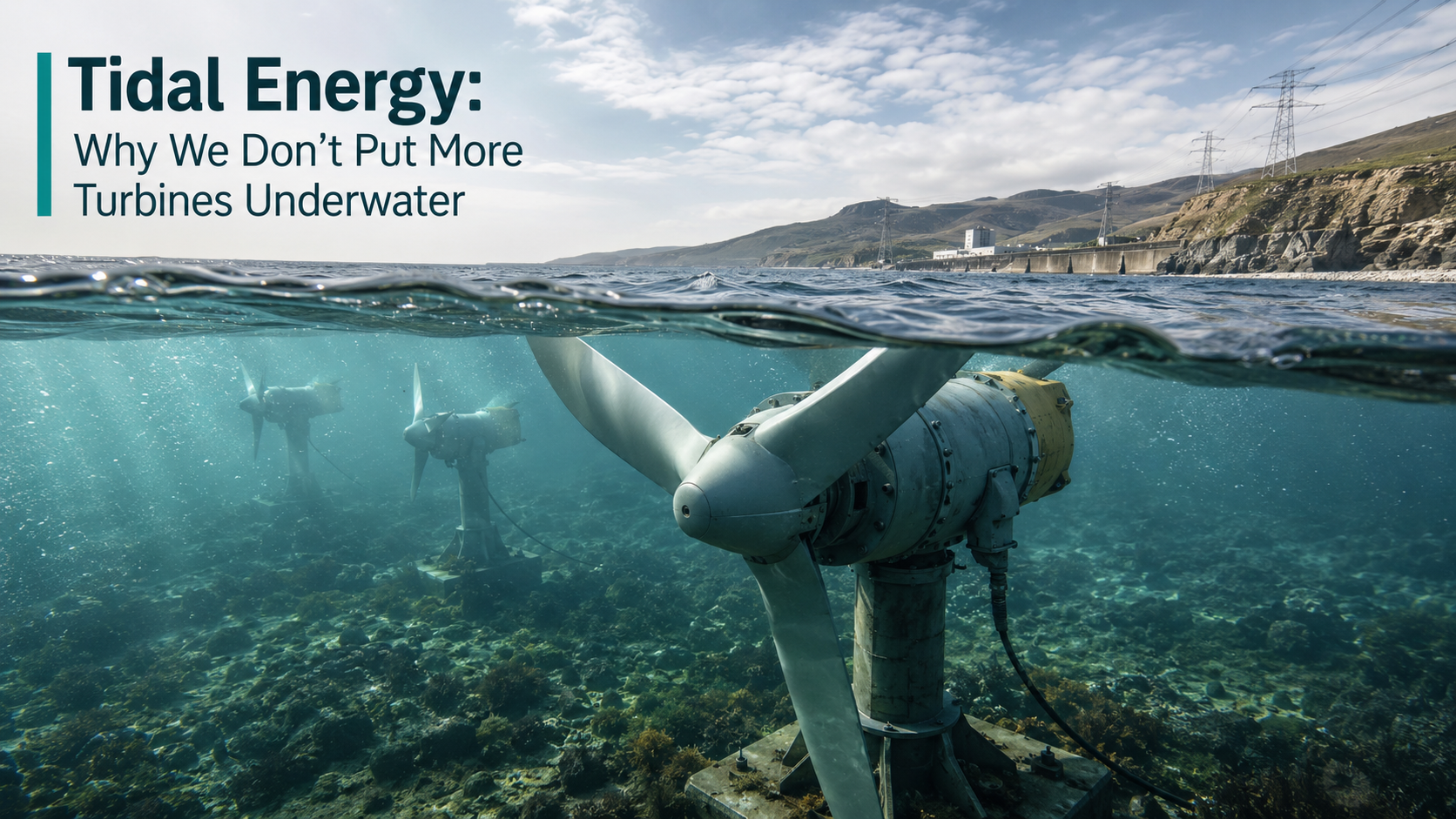
Tidal Energy: Why We Don’t Put More Turbines Underwater
Harnessing the immense, predictable power of the ocean has long fascinated engineers, yet widespread adoption remains surprisingly limited. When exploring why renewable portfolios lean heavily on wind and solar, understanding tidal energy becomes crucial. This article answers why we don’t use more tidal energy, the disadvantages and environmental impacts of tidal turbines, whether they use turbines, and five key advantages of this marine resource. According to the U.S. Department of Energy, unlocking marine power requires overcoming steep economic and technological hurdles. While oceans cover most of our planet, capturing their kinetic movement efficiently is a modern engineering puzzle. By examining the realities of underwater installations, we can better understand the future of global renewable energy grids.
Why Don’t We Use More Tidal Energy?
Tidal energy remains a niche part of the global energy mix despite one major advantage: its resource is highly predictable. Unlike wind and solar power, tidal cycles can be forecast years in advance. The main barrier is cost. Building, installing, and maintaining marine equipment requires specialized vessels, durable materials, skilled crews, and planning.
Saltwater creates persistent corrosion risks. Strong currents, waves, storms, and changing tides also place heavy stress on underwater equipment. Repairs can become expensive when turbines or cables are difficult to access. These challenges can reduce project profitability and make financing harder.
Tidal power also depends on geography. Only certain coastal areas have strong enough tidal currents or large enough tidal ranges for commercial projects. Suitable sites may be far from major cities.
As a result, tidal energy often struggles to compete with cheaper renewables such as onshore wind and solar. Predictable output helps, but high costs limit adoption.
High Capital Costs and Maintenance Hurdles
Tidal power projects require significant investment before they produce electricity. Developers may need specialized marine vessels, underwater construction equipment, reinforced foundations, subsea cables, and corrosion-resistant components. These requirements make construction more complex than many land-based renewable projects.
Maintenance can also increase lifetime costs. Equipment must operate in saltwater while facing strong currents and changing loads. Access may depend on weather, tides, vessel availability, and safe working conditions. A repair that is simple on land can become a major offshore operation.
These costs create a difficult financial equation. Tidal projects can offer predictable generation, but high capital and operating costs can lengthen the time needed to recover investment. Investors may therefore favor renewable technologies with lower construction costs and established supply chains.
Industry is working to reduce these barriers through better turbine designs, modular systems, improved materials, and efficient installation methods. Cost remains one of the biggest obstacles to wider deployment.
What Are the Disadvantages of Tidal Turbines?
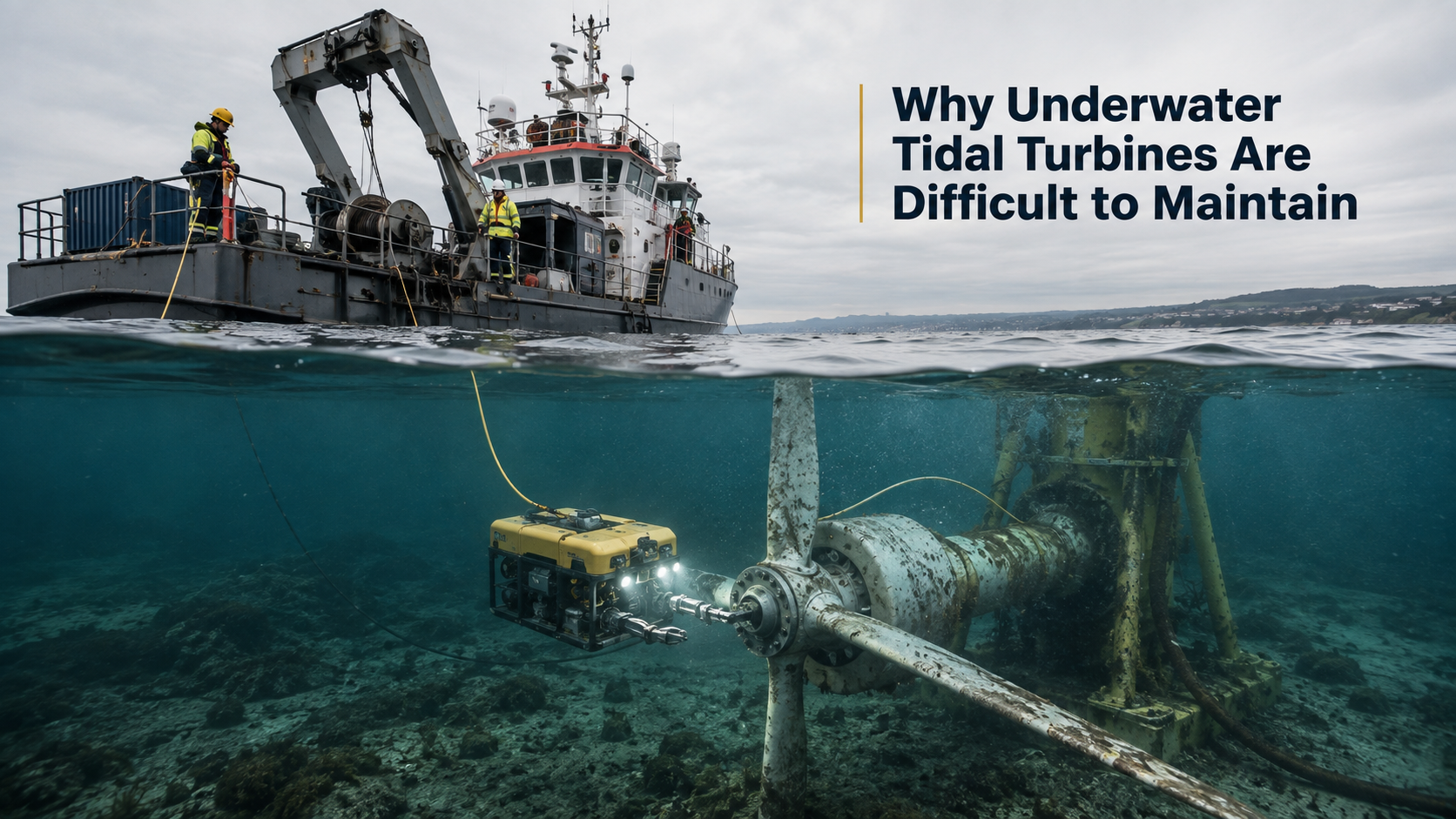
Tidal turbines face several disadvantages because they operate directly in a demanding marine environment. The most obvious challenge is maintenance. When a submerged turbine develops a mechanical or electrical fault, technicians cannot access it as easily as equipment on land. Repairs may require specialized vessels, lifting equipment, remotely operated vehicles, or carefully timed tidal conditions.
Turbines can also compete with existing uses of coastal waters. Commercial fishing, shipping, recreation, and navigation may need to share the same areas. Large projects therefore require planning and consultation with marine industries.
Environmental effects are another consideration. Rotating blades can create collision risks for some marine animals, while underwater structures can change habitats and sediment patterns. Impacts depend on the technology and location.
Tidal turbines also have site limitations. They need strong water movement to generate useful electricity. This limits deployment to suitable coastal areas and can increase connection costs.
Maintenance and Repair Complexities
Subsea maintenance is one of the biggest practical challenges facing tidal turbines. A malfunctioning turbine may require a support vessel to reach the site, position itself safely, and lift or service heavy equipment. Strong currents can make these operations difficult and restrict working time.
Some projects use remotely operated vehicles to inspect underwater components before crews perform repairs. These systems can reduce unnecessary dives, but they still require specialized equipment and trained operators. Vessel time can also be expensive, especially when repairs take longer than expected.
Corrosion, seals, bearings, electrical connections, and subsea cables must withstand harsh conditions for long periods. Developers therefore focus heavily on reliability and predictive maintenance.
Improved sensors can detect vibration, temperature, or performance changes before a major failure occurs. Designing turbines for easier retrieval and servicing can also reduce downtime. These improvements may lower lifetime costs as the technology matures.
What Are 5 Advantages of Tidal Energy?
Tidal energy has several advantages that make it attractive for suitable coastal regions.
- Predictable generation: Tidal cycles follow well-understood gravitational patterns, so output can be forecast accurately.
- High energy density: Water is far denser than air, allowing compact turbines to capture substantial energy from moving currents.
- Low operational emissions: Tidal systems produce electricity without directly burning fuel during operation.
- Long-lasting infrastructure: Well-designed marine structures can operate for decades, although components may need replacement.
- Local energy potential: Coastal communities can use nearby marine resources to diversify their electricity supply.
These advantages do not remove tidal power’s economic challenges. Predictability is valuable because grid operators can plan around expected tidal cycles. However, tidal output still changes throughout the day and is not constant like a traditional baseload plant.
Tidal energy works best as part of a broader electricity system alongside other renewables, storage, and flexible generation.
Predictability and Reliability
Tidal power’s strongest advantage is its predictability. Tides can be calculated years in advance because they are driven mainly by lunar and solar gravity. This makes tidal generation easier to forecast than weather-dependent wind and solar output.
However, predictability should not be confused with constant electricity production. Tidal currents change throughout each cycle, and many turbines generate their highest output only during particular periods. Some technologies can produce power during both ebb and flood tides, but generation still follows a natural schedule overall.
This predictability can help grid operators plan electricity supply and coordinate other resources. It can complement wind, solar, storage, hydropower, and flexible generation.
Tidal power is useful renewable generation, but it is not automatically a baseload replacement. Its value comes from knowing when generation is likely to occur. This helps operators manage a diverse, low-carbon electricity system.
Does Tidal Energy Use Turbines?
Yes. Many tidal energy systems use turbines to convert moving seawater into electricity. Tidal-stream turbines work in a similar way to wind turbines, but they operate in water, which is much denser than air. This density allows water currents to transfer substantial energy to relatively compact blades.
Several turbine designs are being developed or deployed. Horizontal-axis turbines use rotating blades around a central shaft. Vertical-axis designs rotate around a vertical shaft and can capture flow from different directions. Other marine systems use oscillating hydrofoils instead of conventional rotating blades.
The technology depends on the site, current speed, and water depth. Some tidal systems also use barrages or lagoons, which rely on water-level differences rather than free-flowing currents. These systems may use conventional hydro turbines.
Turbines are important to tidal energy, but not every tidal technology uses the same design. The goal is to convert tidal movement into electricity.
Mechanics of Submerged Blade Systems
In a tidal-stream turbine, moving seawater flows through the rotor and pushes against its blades. The blades are shaped to capture hydrodynamic energy efficiently. As the rotor turns, its shaft transfers mechanical energy to a generator, which converts that energy into electricity.
The electricity then travels through electrical equipment and subsea cables toward shore. Depending on the project, cables may be buried beneath the seabed or protected using other engineering methods. Power can then enter the local electrical grid.
Because water is much denser than air, tidal turbines can capture significant energy from relatively small rotors. However, that density also creates strong forces on blades, bearings, foundations, and other components. Engineers must balance energy capture with structural strength and reliability.
Some turbines can generate during both ebb and flood tides. Successful designs focus on efficiency, durability, maintenance access, and safe operation in challenging marine conditions.
Tidal Energy Environmental Impact
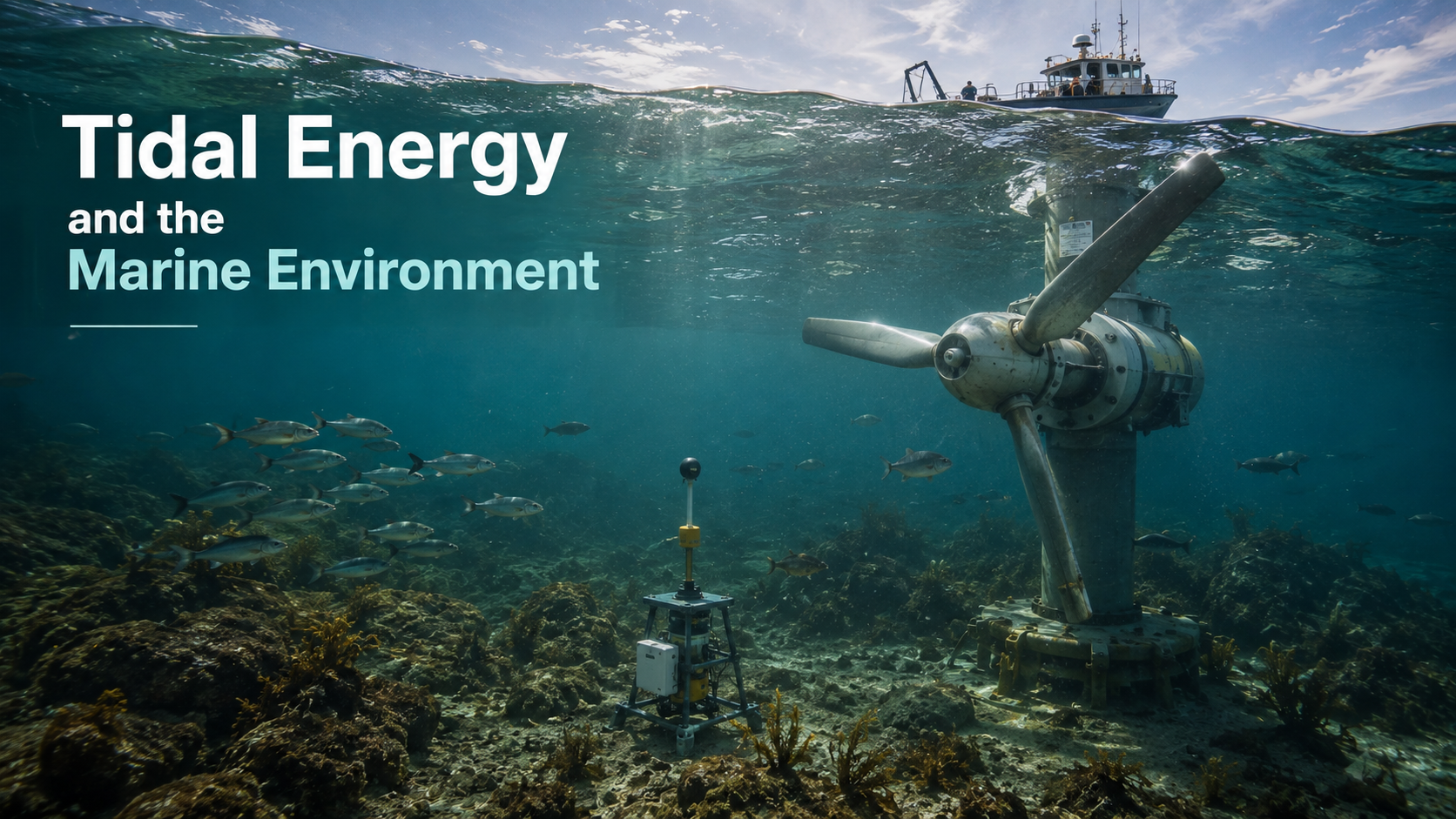
Tidal energy produces electricity without direct combustion emissions, but it can still affect ecosystems. The environmental impact depends on the technology, project size, and location. Tidal-stream turbines may create collision risks for fish and marine mammals, although risk varies with turbine speed, animal behavior, and site conditions.
Large tidal barrages can have broader effects because they alter water movement across an estuary or coastal area. Changes in tidal range, sediment transport, salinity, and habitat conditions can affect fish, invertebrates, plants, and birds. Intertidal habitats can be particularly sensitive to changes in water levels.
Tidal structures can also influence navigation, fishing, and other human activities. These effects do not mean tidal energy is inherently harmful, but they require careful site selection and environmental assessment.
Developers study marine habitats before construction and monitor projects after they begin operating. Responsible development must balance renewable electricity production with protection of coastal ecosystems.
Mitigation and Ecosystem Monitoring
Developers can reduce environmental risks through careful site selection, turbine design, operational controls, and monitoring. Before construction, environmental assessments can identify sensitive habitats, migration routes, fishing areas, and other ecological concerns. This can help engineers avoid high-risk locations, drawing valuable parallels to insights shared in this analysis of the future of offshore wind farms.
During operation, monitoring systems can track marine wildlife, underwater noise, water conditions, and changes in sediment movement. Sonar and other acoustic technologies can help researchers observe animals near turbines when visibility is poor. Operators may also adjust operations during sensitive periods.
Turbine design matters as well. Slower blade speeds, improved rotor geometry, and protective systems can help reduce collision risks, though no single solution fits every site. Developers must test these measures under real conditions.
Continuous monitoring is important because environmental effects can change over time. Data collected over time can reveal whether predicted impacts match actual conditions. This evidence helps operators improve mitigation while supporting responsible tidal energy development.
FAQ SECTION
How much energy can tidal power realistically generate?
Tidal power has immense theoretical potential worldwide, particularly in narrow bays and estuaries with extreme tidal ranges. However, practical generation is currently limited by high construction costs and suitable geography. While it may never fully replace wind or solar, it serves as a powerful, reliable regional energy source for coastal nations with favorable geography.
How long do underwater tidal turbines typically last?
Well-engineered tidal turbines are built to withstand harsh marine conditions for roughly twenty to thirty years. High-grade stainless steel, composite materials, and corrosion-resistant coatings help extend their operational lifespan. However, periodic overhauls and component replacements are usually required every few years to keep the subsea generators functioning smoothly.
Can tidal energy be harnessed without building massive barrages?
Yes, modern technology has shifted away from disruptive tidal barrages toward free-flowing in-stream tidal turbines. These standalone underwater turbines resemble submerged wind farms and generate electricity without blocking entire estuaries. This modern approach significantly reduces environmental damage while still capturing powerful coastal currents.
Where are the most successful tidal energy projects located?
Some of the most successful and advanced tidal energy projects operate in regions with extreme tidal ranges, such as the Bay of Fundy in Canada and the Pentland Firth in Scotland. South Korea also operates the massive Sihwa Lake tidal power station, demonstrating the commercial viability of large-scale marine energy generation when conditions align properly.
Conclusion
Tidal energy remains one of the most fascinating yet challenging frontiers in the renewable energy sector. By understanding the core mechanics behind underwater turbines, the financial hurdles of marine engineering, and the delicate environmental impacts involved, we gain a clearer picture of why adoption has been slow. Despite high maintenance costs and ecological considerations, the unmatched predictability and reliability of ocean tides keep marine power relevant. As technology advances and innovative, less invasive turbine designs emerge, tidal energy could eventually unlock a vast, untapped reservoir of clean power. Embracing these innovations thoughtfully will help coastal nations diversify their renewable portfolios, much like exploring the broader debate detailed in this guide on wind vs solar efficiency, to build a more resilient energy future.