
School Branding and Marketing Strategies to Drive Growth and Enrollment
Implementing strong school branding and marketing strategies is essential for educational institutions seeking to stand out in an increasingly competitive landscape. Today, families have more choices than ever when selecting a school for their children. Consequently, to remain viable and grow, educational institutions must proactively build a recognizable brand identity and communicate their unique value proposition. According to data from the U.S. Department of Education, shifts in demographics and school choice models have fundamentally transformed how families evaluate K-12 and higher education options.
Because of these shifting dynamics, relying solely on traditional word-of-mouth marketing is no longer enough to maintain stable enrollment numbers. Therefore, school leaders must adopt comprehensive strategic marketing approaches that resonate with modern parents and prospective students. By combining digital outreach, authentic storytelling, and consistent messaging, schools can build lasting relationships within their communities.
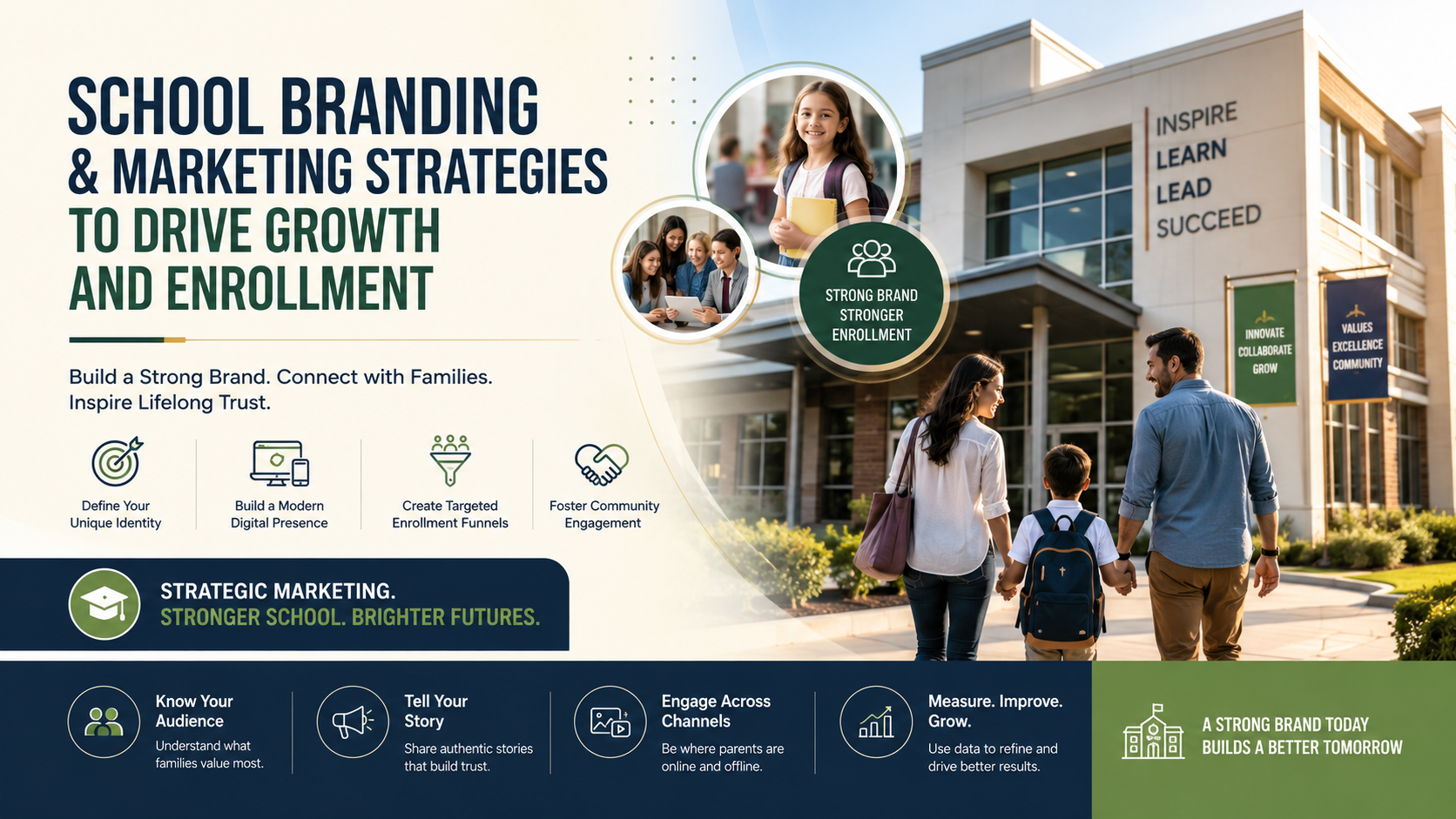
Furthermore, this guide explores practical ways to transform your school’s outreach efforts. Ultimately, we will cover how to define your core institutional identity, build a cohesive online presence, implement targeted enrollment funnels, and foster lasting community engagement to drive sustainable growth.
Defining Your Unique Educational Brand Identity with School Branding and Marketing Strategies


Before launching any promotional campaign, school leaders must clearly define what their institution stands for. Indeed, a brand identity is much more than a polished logo, a vibrant color scheme, or a catchy slogan. Instead, it represents the core values, educational philosophy, internal culture, and daily student experience that your school promises to deliver.
Consequently, establishing a strong identity creates a memorable impression on prospective parents. As a result, it helps bridge the gap between what your school offers and what local families desire for their children. When families search for educational options, they naturally look for institutions that reflect their personal values and academic aspirations.
However, defining your identity requires internal reflection and active input from key stakeholders. Therefore, you should gather insights from administrators, teachers, parents, and alumni. For example, ask probing questions about what makes your learning environment distinct and valuable. Ultimately, identifying these unique elements gives your outreach a clear, authentic voice.
Additionally, effective school branding and marketing strategies depend on an authentic brand identity to serve as the foundation for every campaign. Thus, it ensures that your website, social posts, printed brochures, and campus tours tell a consistent and compelling story.
Uncovering Your Core Value Proposition Through Strategic School Branding
To stand out in a crowded educational market, your leadership team must pinpoint its unique value proposition. Specifically, you must articulate precisely what sets your school apart from local public, private, charter, or magnet alternatives.
For instance, start by evaluating your core academic strengths and specialized programs. Do you offer advanced STEM tracks, immersive language programs, specialized arts education, or unique International Baccalaureate diplomas? Moreover, beyond academics, consider your institutional culture, student-to-teacher ratios, and character-building initiatives.
-
Academic Innovations: Highlight specialized tracks, advanced placement programs, or unique project-based learning models.
-
Supportive Community: Emphasize small class sizes, individualized learning plans, and robust counseling resources.
-
Campus Facilities: Showcase modern science labs, artistic spaces, athletic complexes, and outdoor learning environments.
Furthermore, documenting these differentiators enables you to craft clear messages that directly address parental priorities. As a result, when prospective families quickly understand what makes your school unique, they are much more likely to keep your campus on their short list.
Crafting a Consistent Visual and Verbal Style for School Marketing Tactics
Once you identify your unique strengths, you must present them consistently across all channels. Indeed, a cohesive visual and verbal style builds instant recognition and establishes professional credibility for your institution.
To begin with, create a centralized brand style guide for your administrative team and content creators. Consequently, this guide should outline exact logo usage, official color palettes, and standard typography choices. On the other hand, using mismatched fonts or outdated logos across different departments undermines institutional authority and confuses prospective families.
Equally important is defining your verbal tone of voice. Therefore, determine how your school communicates in written content across digital and print channels. Should your tone sound warm and nurturing, highly academic and rigorous, or modern and forward-thinking?
Ultimately, aligning your visual assets and writing style creates a polished presentation everywhere your school appears. Thus, whether a parent reads a social media post, opens a newsletter, or views a print ad, they should immediately recognize your institutional voice and visual brand.
Building a Modern Digital Presence to Enhance School Marketing Strategies
Modern parents conduct extensive online research long before scheduling an in-person campus visit or attending an open house. Consequently, your digital footprint acts as the primary virtual front door to your academic community. Therefore, investing in user-friendly, responsive, and search-optimized digital channels is essential for executing successful school branding and marketing strategies that attract prospective families.
Digital Ecosystem Architecture: A Modern School Website serves as the central hub, supported by three essential drivers: Optimized Mobile UX, Organic Search Visibility, and Targeted Social Ads.
Furthermore, a well-rounded digital presence reaches parents where they spend their time daily. As a result, it provides easy access to essential information while showcasing the vibrant life of your campus through modern media.
Optimizing Your Website with Educational Branding Principles
Your school website must cater primarily to prospective families while still serving current students and parents. Therefore, make sure your site architecture remains clean, intuitive, and easy to navigate on both desktop and mobile devices.
| Page Section | Content Elements & Call-to-Action |
| Hero Banner | “Discover Excellence at St. Jude Academy” |
| Primary CTA | [ Schedule a Campus Tour Today ] |
| Key Statistics |
• 98% Graduation Rate
• 12:1 Student-Teacher Ratio |
| Media & Proof |
• Interactive Virtual Tour Video
• Student & Parent Reviews |
In addition, place clear calls-to-action (CTAs) prominently across high-traffic landing pages. For instance, buttons such as “Schedule a Tour,” “Request Information,” or “Apply Now” should be visible without requiring users to scroll excessively.
Additionally, prioritize page load speeds and mobile accessibility. Since parents often research schools on smartphones during busy workdays, a slow website can hurt your outreach. Indeed, if your website loads slowly or formats poorly on mobile screens, visitors will quickly leave.
Finally, incorporate authentic visual elements throughout your web pages. For example, replace generic stock photography with high-quality, professional photos and short video clips of your real students, teachers, and classrooms. Consequently, authentic visuals create an immediate emotional connection and foster deep trust.
Leveraging Local Search and Social Media Outlets for School Outreach
Local search engine optimization (SEO) helps prospective parents discover your school when searching for nearby options on Google. Therefore, claim and optimize your Google Business Profile with accurate address details, contact phone numbers, operating hours, and updated campus photos.
Furthermore, actively encourage satisfied current parents and alumni to leave positive reviews on your local search profile. As a result, high ratings and genuine parent reviews provide powerful social proof that influences hesitant families during their school selection process.
Simultaneously, leverage active social media channels like Instagram, Facebook, and LinkedIn to showcase daily campus life. For example, share posts highlighting student achievements, classroom projects, athletic victories, and faculty milestones.
Moreover, video content performs exceptionally well on social platforms. Therefore, post short video tours, teacher spotlights, and live Q&A sessions with admissions directors. Ultimately, consistent social engagement keeps your school top-of-mind for local families evaluating future options.
Data-Driven School Branding and Marketing Strategies to Boost Enrollment Rates
To build a sustainable pipeline of prospective students, school leaders must execute targeted, data-driven outreach tactics. Consequently, passive approaches no longer produce predictable enrollment growth in competitive regions.
Step-by-Step Numbered List
-
Targeted PPC Ads — Drive qualified traffic from parents searching for educational options.
-
Inquiry Form — Capture key contact details on a conversion-focused landing page.
-
Automated Nurture Emails — Deliver timed, value-driven content to build trust and address questions.
-
Campus Tour & Enrollment — Convert engaged prospective families into official registrants.
Indeed, combining paid digital campaigns with automated nurturing guarantees that prospective inquiries convert into actual campus visits and completed applications. Therefore, modern school branding and marketing strategies must prioritize these automated conversion funnels.
Implementing Targeted Advertising Campaigns for Educational Outreach
Pay-per-click (PPC) advertising on search engines and social media networks allows schools to reach specific target demographics efficiently. For instance, you can set strict geographic parameters, targeting families within specific zip codes or driving radiuses around your campus.
Specifically, search advertising lets you target high-intent parents who are actively typing terms like “top private schools near me” or “best STEM elementary school” into search engines. Consequently, these ads direct users directly to tailored landing pages designed to capture contact information.
Similarly, social media advertising platforms enable precise demographic targeting based on child age ranges, parental interests, and household income levels. Thus, you can run visually engaging carousel ads or short video campaigns showcasing your unique campus offerings.
Ultimately, running targeted campaigns ensures your marketing budget reaches families most likely to enroll. However, you should regularly review campaign performance metrics, test different ad graphics, and refine copy to lower your acquisition costs over time.
Developing an Admissions Nurture Sequence for School Recruitment Promos
Capturing an inquiry form submission on your website is only the beginning of the recruitment journey. Therefore, to convert inquiries into completed applications, you must build an automated email nurture sequence.
In practice, an automated sequence delivers relevant, value-packed content directly to prospective parents over several weeks. Consequently, this steady communication addresses common parent concerns, highlights key institutional benefits, and gently prompts families toward the next step in the admissions funnel.


Furthermore, each email in the sequence should focus on a specific aspect of your community, such as academic outcomes, extracurricular options, or financial aid options. As a result, including clear calls-to-action in every message invites parents to schedule an in-person campus tour or attend an upcoming open house event.
Measuring and Optimizing Strategy Effectiveness in School Promotion
Executing outreach campaigns without tracking performance data leads to wasted marketing budgets and missed enrollment targets. Therefore, school administrators must systematically measure performance indicators to evaluate the return on investment for every strategy.
First, establish key performance indicators (KPIs) before launching any campaign. For example, track metrics such as total website visits, landing page conversion rates, cost-per-inquiry, tour attendance numbers, and final inquiry-to-enrollment conversion percentages.
Next, use platform analytics to identify which channels yield the highest quality inquiries. For instance, you might discover that local search ads generate fewer inquiries than social media, but result in significantly higher final enrollment rates.
Finally, reviewing performance analytics monthly allows leadership teams to make data-driven budget adjustments mid-season. Consequently, reallocating resources away from underperforming strategies toward high-converting channels maximizes recruitment outcomes and ensures long-term institutional growth.
FAQ SECTION
Why are school branding and marketing strategies important for modern institutions?
Implementing strategic outreach is essential because the modern educational market offers families unprecedented flexibility and choice. Parents actively evaluate public, private, charter, magnet, and online alternatives before enrolling their children. Consequently, relying solely on historical reputation or traditional word-of-mouth marketing is no longer sufficient to maintain steady enrollment numbers.
Furthermore, comprehensive school branding and marketing strategies communicate your school’s unique mission, academic strengths, and community culture directly to target audiences. Digital marketing tactics ensure that prospective families discover your institution during their online research process. Therefore, by building brand equity and maintaining strong visibility across local channels, schools establish trust, boost application numbers, differentiate themselves from competitors, and secure long-term financial stability for their academic programs.
How can a school define its unique value proposition through educational branding?
Defining a compelling value proposition requires a thorough evaluation of your institution’s distinct academic and cultural attributes. Therefore, school leadership should collect feedback from current families, alumni, faculty, and board members through surveys and focus groups. Specifically, identify areas where your school consistently excels, such as specialized STEM curricula, small class sizes, robust fine arts offerings, or dedicated student support services.
Once you identify these key strengths, articulate them in simple, compelling language that directly addresses common parental priorities and concerns. Consequently, your value proposition must clearly answer why a family should choose your campus over every other local alternative. Ultimately, consistently embedding this core message across your website, promotional materials, and admissions presentations ensures that prospective parents instantly recognize your unique value.
What digital channels work best for executing school marketing strategies?
The most effective digital channels for student recruitment include search-optimized websites, local search profiles, search engine marketing, and targeted social media platforms. Specifically, your website acts as the primary destination for inquiries, requiring mobile responsiveness, fast load speeds, and intuitive navigation. Furthermore, Google Business Profile optimization ensures local families easily locate your campus during geographic search queries.
In addition, paid search advertising captures high-intent parents who actively search for educational solutions in your area. Meanwhile, social media channels like Instagram and Facebook are ideal for sharing dynamic visual content, live video tours, student success stories, and upcoming campus events. Therefore, combining these complementary digital channels creates a comprehensive marketing ecosystem that reaches prospective families across multiple touchpoints throughout their decision-making process.
How does email nurture help increase admissions numbers in school marketing?
Email nurture sequences bridge the critical gap between initial prospective interest and final enrollment. Specifically, when prospective parents submit an inquiry form or download a digital brochure, they enter an automated sequence designed to guide them step-by-step through the admissions funnel.
Instead of overwhelming families with immediate sales pitches, automated workflows deliver valuable, targeted information over several weeks. For instance, emails can showcase faculty spotlights, detail academic tracks, explain financial aid options, and share parent testimonials. Consequently, by providing helpful content continuously, email nurture campaigns keep your institution top-of-mind, resolve parent hesitations, and systematically encourage families to complete campus tours and submit final student applications.
What metrics should school leaders track to evaluate school marketing strategies?
School leaders must track quantitative metrics across every stage of the admissions funnel to accurately evaluate marketing performance. Specifically, key metrics include website traffic, cost-per-click on digital ads, landing page inquiry conversion rates, total inquiries generated, campus tour completion rates, and final application submission numbers.
Additionally, calculating the total cost-per-enrolled student helps evaluate overall marketing return on investment. Consequently, monitoring these data points enables administrative teams to pinpoint bottlenecks in the recruitment funnel. For example, if inquiry numbers are high but tour bookings remain low, administrators can optimize follow-up communication. Ultimately, continually evaluating performance data allows leadership teams to reallocate budget toward high-performing channels and optimize enrollment results.
CONCLUSION
Navigating today’s competitive educational landscape requires a proactive, strategic approach to student recruitment and brand positioning. Consequently, developing robust school branding and marketing strategies allows educational institutions to articulate their unique strengths, connect meaningfully with prospective families, and secure long-term financial and operational stability.
By defining a distinct institutional identity, maintaining a modern digital presence, and executing targeted outreach campaigns, your school can build a strong pipeline of interested applicants. Furthermore, building an internal team skilled in executing these campaigns—or exploring growing careers in digital marketing to bring in fresh expertise—ensures that your outreach remains innovative, effective, and adaptable. Remember that successful marketing is not a one-time initiative; instead, it demands continuous evaluation, refinement, and authentic community engagement.
Therefore, prioritize authentic storytelling, leverage modern digital tools, and continuously adapt your approach based on data insights. By taking these decisive steps today, your leadership team can build an enduring brand that attracts top talent, fosters active family participation, and ensures thriving enrollment for years to come.