
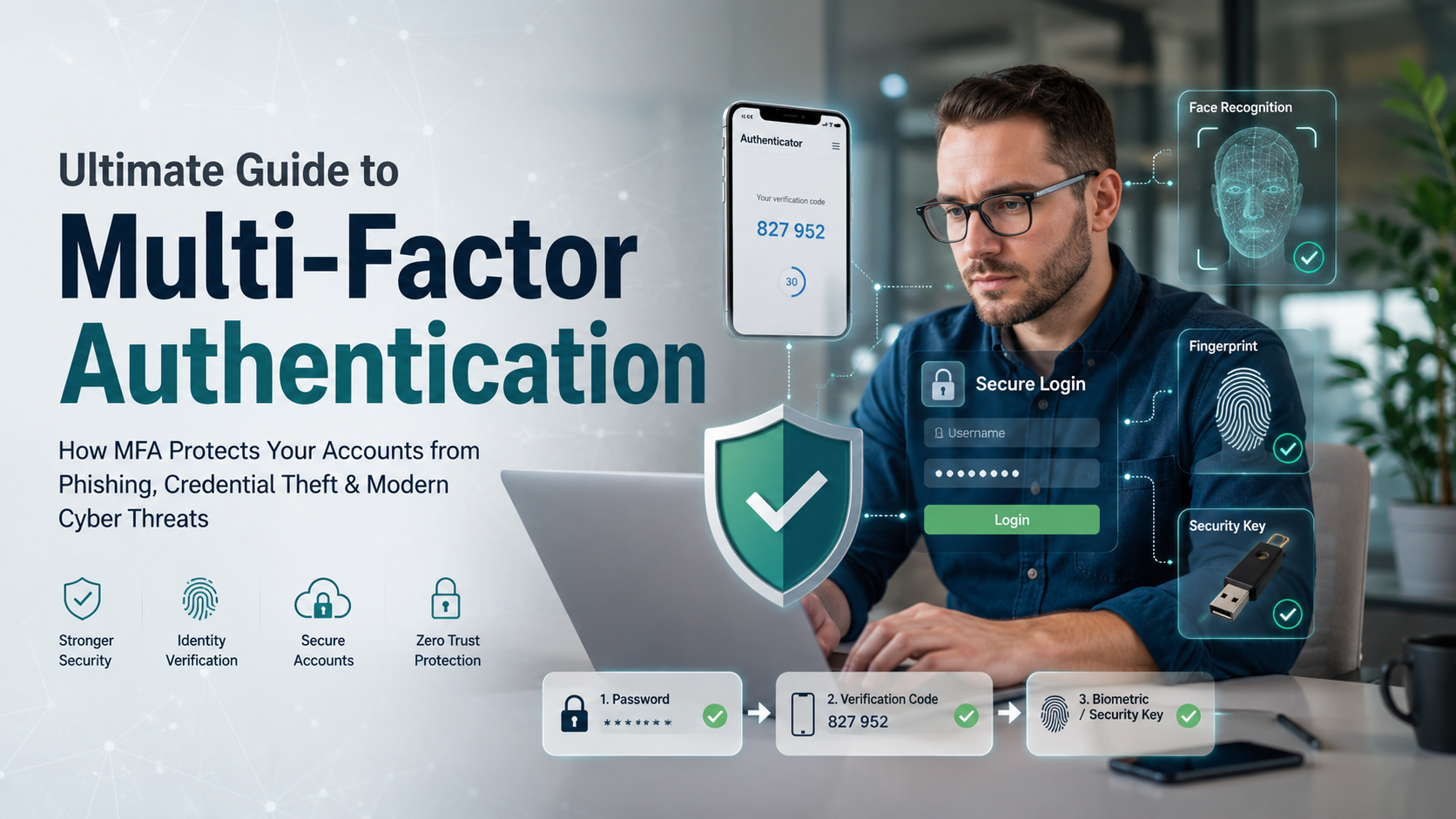
Ultimate Guide to Multi-Factor Authentication and Account Security
Multi-factor authentication (MFA) has become one of the most effective ways to protect online accounts from modern cyber threats. Unlike traditional password-only security, MFA requires users to provide multiple forms of verification before accessing an account, application, or network.
This additional security layer helps prevent unauthorized access caused by stolen passwords, phishing attacks, and credential-stuffing attempts. However, MFA works best when combined with strong awareness of social engineering threats. Learning how to recognize suspicious messages through a guide on How to Identify a Phishing Attack Email in 2026 can help users avoid the attacks that often lead to stolen login credentials.
Whether you are protecting personal information or managing enterprise systems, understanding how multi-factor authentication works is essential. This guide explains what MFA means, the different authentication factors, the major types of MFA, and how these security methods compare.By requiring users to provide two or more verification factors to gain access, this security process drastically reduces the risk of unauthorized breaches. According to NIST Guidelines on Digital Identity, implementing layered verification controls is critical for mitigating credential stuffing and phishing attacks.
What Is Meant by Multi-Factor Authentication?
Multi-factor authentication is a security process that requires users to verify their identity using two or more independent authentication factors. Instead of relying only on a password, MFA adds extra verification steps that make unauthorized access much more difficult.
A password alone can be exposed through data breaches, phishing emails, malware, or weak password habits. While MFA adds an important layer of protection, users should also maintain device security because malware infections can expose sensitive information and login details. If you suspect a compromised system, follow this guide on How to Remove Malware from Windows 11 Safely to reduce security risks and protect your accounts.
The main authentication categories include:
- Something you know: Passwords, PINs, or security answers.
- Something you have: Smartphones, security keys, or authentication devices.
- Something you are: Fingerprints, facial recognition, or other biometric traits.
By combining different verification layers, MFA creates stronger account protection. Even if an attacker steals a password, they still need to bypass the additional security checks.
Why Verification Layers Matter for Security
Passwords remain one of the weakest points in digital security. Attackers often use automated tools to guess passwords or reuse credentials stolen from previous breaches.
Additional authentication layers reduce the impact of password compromise. A stolen password alone is usually not enough to access a protected account.
MFA improves security by:
- Blocking many unauthorized login attempts.
- Reducing risks from credential theft.
- Protecting sensitive personal and business information.
- Improving compliance with modern security standards.
A layered security approach is especially important for financial accounts, cloud platforms, workplace systems, and applications containing confidential data.
What Are the 5 Factors of MFA?
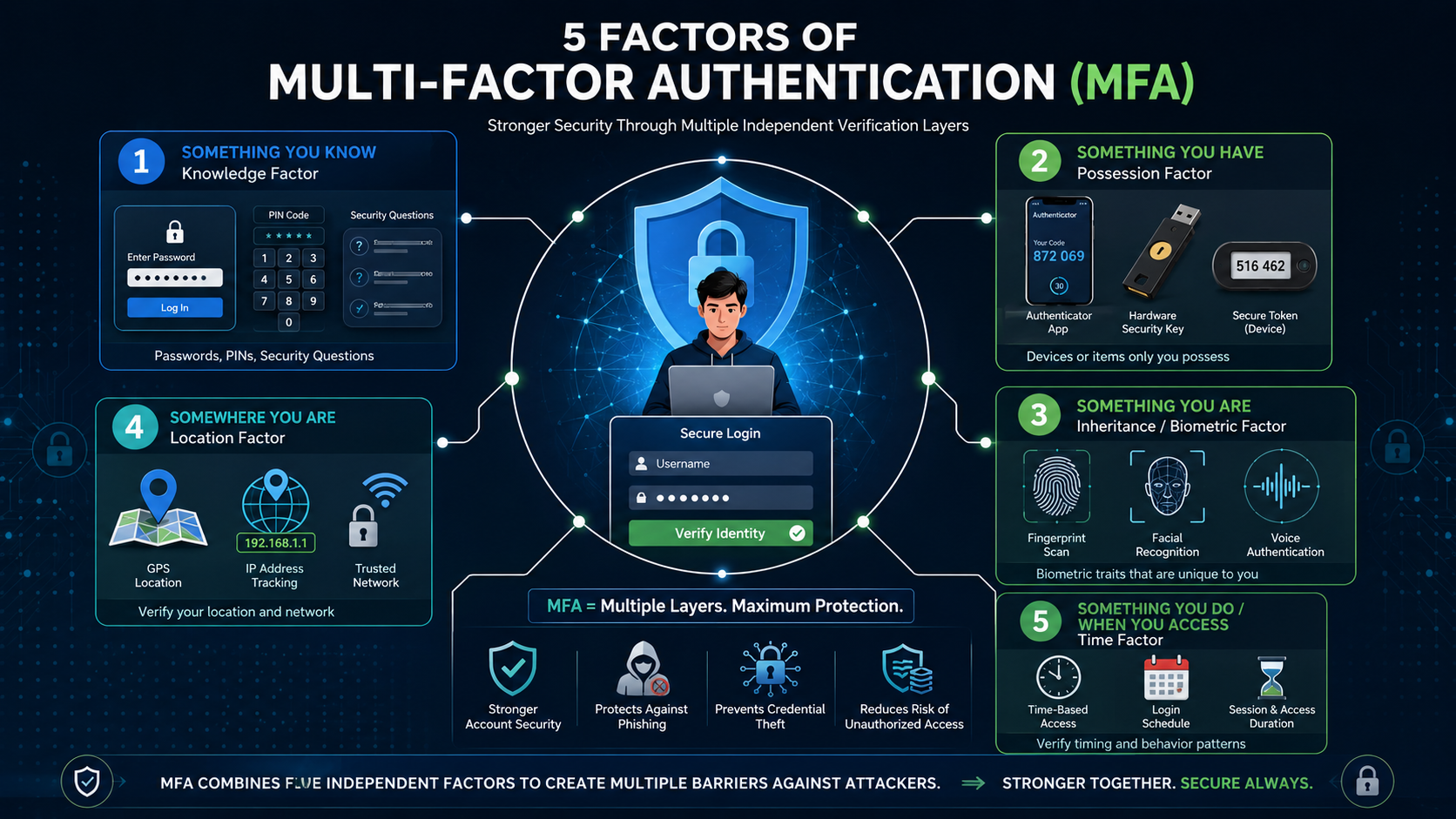

The five authentication factors describe the different types of evidence used to confirm a user’s identity. These factors include knowledge, possession, inheritance, location, and time.
Knowledge factors include information only the user should know, such as passwords or PINs. Possession factors rely on physical items, such as smartphones, security tokens, or hardware keys.
Inheritance factors use biological characteristics, including fingerprints, facial recognition, or voice patterns. These biometric methods provide convenient identity verification because they are unique to each person.
Other authentication signals include:
- Location factors: Verify where a login attempt occurs through GPS data or IP information.
- Time factors: Restrict access based on approved schedules or time periods.
Combining multiple factors creates stronger identity protection and helps organizations defend against advanced cyber threats.
Understanding Biometrics and Physical Tokens
Biometric authentication and physical security tokens are important parts of modern MFA systems. They provide stronger protection than traditional passwords because they rely on unique physical characteristics or secure digital keys.
Biometric methods, such as fingerprint scanning and facial recognition, offer convenience because users do not need to remember additional credentials. However, organizations must still protect biometric data carefully.
Hardware security keys provide another strong authentication method. These devices use cryptographic technology to verify identity and are highly resistant to phishing attacks.
Together, biometrics and physical tokens support passwordless security systems. They help organizations create safer login experiences while reducing dependence on vulnerable passwords.
What Are the Four Types of MFA?
Multi-factor authentication can be organized into several common approaches. Each method applies verification requirements differently based on security needs.
The four major types include:
1. Two-factor authentication (2FA)
Two-factor authentication requires exactly two verification methods, such as a password and an authentication code.
2. Adaptive authentication
Adaptive MFA adjusts security requirements based on risk signals, including device information, location, and user behavior.
3. Step-up authentication
Step-up authentication adds extra verification when users attempt sensitive actions, such as accessing financial records or administrative settings.
4. Multi-step authentication
Multi-step authentication uses several verification stages to confirm identity before granting access.
Organizations choose the appropriate MFA approach based on their security requirements, user needs, and risk levels.
Adaptive Authentication and User Context
Adaptive authentication improves security by analyzing login behavior and risk factors in real time. Instead of applying identical verification rules for every login, it adjusts security requirements based on the situation.
For example, a user accessing an account from a familiar device may experience a simple login process. However, a login attempt from an unusual location or unknown device may trigger additional verification.
Adaptive MFA can evaluate:
- Device security status.
- Network reputation.
- Login location.
- User behavior patterns.
- Access risk levels.
This approach creates a balance between strong protection and user convenience. It allows organizations to increase security without creating unnecessary friction for normal users.
What Is Multi-Level Factor Authentication?
Multi-level factor authentication is a security model that applies verification requirements across different levels of access. Instead of checking all security factors during one login, organizations can introduce additional verification steps when users access more sensitive resources.
For example, an employee may use a password to access a company network. However, accessing confidential financial systems may require biometric verification and a hardware security key.
This approach supports the principle of least privilege. Users receive only the access level they need, reducing the chances of unauthorized movement inside a network.
Benefits of multi-level authentication include:
- Stronger protection for sensitive systems.
- Better control over user permissions.
- Reduced risk from compromised accounts.
- Improved enterprise security management.
Tiered Access Control in Enterprise Networks
Enterprise organizations often use tiered access controls to protect critical infrastructure and sensitive information. Different resources require different levels of verification depending on their importance.
A standard employee account may require basic MFA protection. Administrative accounts or systems containing confidential information may require stronger authentication methods.
This layered approach helps prevent attackers from moving freely through a compromised network. Even if one account is exposed, additional security barriers limit further access.
Tiered authentication is especially valuable for industries such as finance, healthcare, government, and technology, where protecting sensitive data is a priority.
Which Is Better, 2FA or MFA?
Two-factor authentication and multi-factor authentication both improve account security, but MFA provides broader protection. 2FA always uses exactly two authentication factors, while MFA can include multiple layers depending on security requirements.
For basic accounts, 2FA may provide sufficient protection. However, organizations managing valuable data often require stronger MFA solutions with additional verification methods.
MFA offers advantages such as:
- More flexible security controls.
- Support for multiple authentication methods.
- Better protection against advanced attacks.
- Stronger identity verification.
The right choice depends on the sensitivity of the information being protected. Higher-risk systems usually require more comprehensive authentication strategies.
Choosing the Right Security Threshold
Selecting between 2FA and advanced MFA depends on security needs, user requirements, and the value of the protected data.
Low-risk accounts may only need basic two-step verification. However, businesses, financial institutions, and organizations handling confidential information should consider stronger MFA solutions.
A good security strategy evaluates:
- The importance of the data.
- Possible attack risks.
- User access requirements.
- Compliance obligations.
The goal is to create effective protection without making systems unnecessarily difficult to use.
Frequently Asked Questions About Multi-Factor Authentication
How Does SMS-Based Verification Compare to Authenticator Apps?
SMS-based verification sends temporary security codes through text messages whenever a user attempts to log in. In contrast, authenticator apps generate time-based security codes directly on the user’s device.
Generally, authenticator apps provide stronger protection because they reduce risks linked to SIM-swapping attacks and mobile network interception. On the other hand, SMS verification depends on telecommunications networks, which attackers may exploit through social engineering or phone number takeover techniques.
Therefore, many security professionals recommend using authenticator apps or hardware security keys whenever possible. Additionally, phishing-resistant authentication methods provide even stronger protection for sensitive accounts and business systems.
Can Hackers Bypass Multi-Factor Authentication Systems?
Although multi-factor authentication significantly improves account security, some MFA systems can still face advanced attack methods. For example, attackers may use phishing campaigns, session hijacking, or adversary-in-the-middle techniques to target weak implementations.
However, stronger authentication methods provide much better protection against these threats. In particular, phishing-resistant technologies such as hardware security keys and passkeys use cryptographic verification to prevent many common attack techniques.
As a result, MFA does not make accounts completely impossible to compromise, but it greatly reduces the chances of unauthorized access. Ultimately, using modern MFA methods creates a stronger defense against evolving cyber threats.
What Happens If I Lose My MFA Recovery Device?
If you lose your MFA recovery device, the available recovery options depend on the platform, service provider, or organization managing your account. Fortunately, most systems provide alternative methods to restore access.
For example, common recovery options include:
- Backup recovery codes saved during MFA setup.
- Account recovery procedures provided by the service.
- Administrator-assisted account resets for workplace systems.
- Secondary identity verification methods.
Additionally, users should store backup codes in a secure location when enabling MFA. By keeping recovery options available, users can avoid unnecessary account lockouts while maintaining strong security protection.
Is Multi-Factor Authentication Difficult to Set Up?
Modern multi-factor authentication systems are usually quick and simple to configure. In most cases, users can connect an authenticator app by scanning a QR code and completing a few setup steps.
Furthermore, the entire process often takes only a few minutes while providing long-term security benefits. Once enabled, MFA adds an additional protection layer against stolen passwords, phishing attempts, and unauthorized login attempts.
As a result, the small amount of time required for setup provides significant security advantages. Therefore, enabling MFA on important personal and professional accounts is a practical step toward improving online safety.
Conclusion
Multi-factor authentication is one of the most reliable methods for improving digital security. By adding multiple identity verification layers, MFA helps reduce the risks associated with stolen passwords, phishing attacks, and unauthorized account access.
Throughout this guide, we explored the meaning of MFA, different authentication factors, major MFA types, tiered security models, and the differences between two-factor authentication and broader multi-factor authentication solutions.
As cyber threats continue to develop, relying only on passwords is no longer enough. Instead, users and organizations should enable MFA on critical accounts to protect personal information, business data, and digital identities.
Ultimately, strong authentication practices create a safer online environment. Moreover, they help users maintain greater control over their valuable information while reducing exposure to modern cyber risks.