
Microsoft CEO Satya Nadella Warns Against AI Monopoly Risks
Artificial intelligence is rapidly becoming the foundation of how modern businesses operate. However, as the technology accelerates, industry leaders are urging caution so we do not repeat the mistakes of past economic transformations. The tech world recently buzzed with debate after a profound statement from one of its most influential voices, sparking global conversations because Microsoft CEO Satya Nadella warns against AI monopoly risks that could reshape our entire economy.
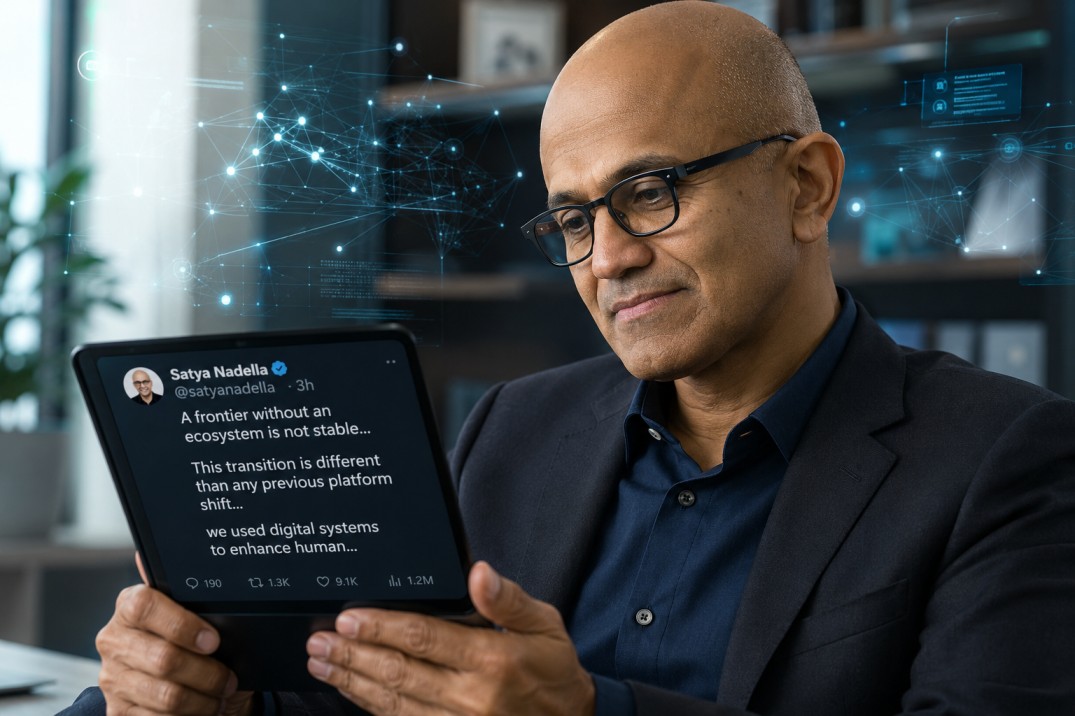
Taking to X (formerly Twitter), Microsoft’s leader shared a highly anticipated article titled, “A frontier without an ecosystem is not stable.” In his viral post, he explicitly laid out his concerns, writing: “I’ve been thinking a lot about the future of the firm in an AI-driven economy. This transition is different than any previous platform shift. In the past, we used digital systems to enhance human…”
This opening thought immediately hooked the business world. While many technology companies blindly promote AI as a simple productivity booster, concerns around workforce disruption and economic concentration are growing intense. Nadella warns that if the benefits of AI end up being controlled by only a handful of massive companies, entire industries could find themselves losing their value, expertise, and long-term competitiveness.
In this article, we will break down Nadella’s viral post, explore what building a “cognitive loop” truly means, and look at how other top tech executives are reacting to this massive economic shift.
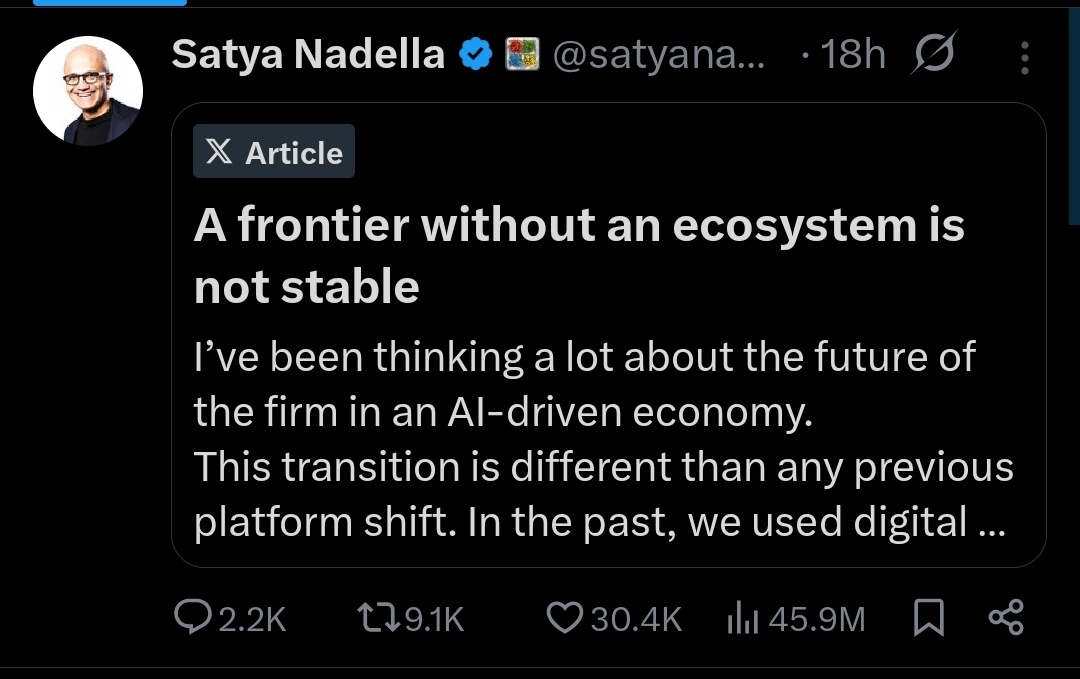
“A Frontier Without an Ecosystem is Not Stable”
When Nadella shared his article on X, his central thesis was impossible to ignore. A frontier—the bleeding edge of advanced foundation models—is highly dangerous if it exists without a supportive, diverse network of businesses around it. Microsoft CEO Satya Nadella warns against AI monopoly because a highly centralized tech landscape will eventually hollow out the unique value of individual firms.
He drew a sharp parallel to the early years of globalization, when manufacturing jobs moved across borders. While the global GDP looked healthy on paper, the displacement of local communities was severe. Nadella is terrified of a similar situation emerging today. He explicitly noted, “The last thing any of us want is a world where every company across every sector is ceding value to a few models that eat everything they see.” To prevent this, the tech industry must foster a “frontier ecosystem.” Instead of renting intelligence from external providers, businesses across all sectors must be empowered to build their own capabilities securely.
Shifting from Human Enhancement to a “Cognitive Loop”
In his post, Nadella reflected heavily on the future of the firm, noting that this shift is entirely different from past digital trends. Historically, businesses adopted tools like computers strictly to make human workers faster. Today, however, we are entering a phase where people and AI systems continuously learn from one another, creating a powerful “cognitive loop.”
To survive and thrive, companies must cultivate two distinct forms of capital:
-
Human Capital: The irreplaceable knowledge, judgment, creativity, and relationships of human employees.
-
Token Capital: The proprietary AI capabilities, data weights, and localized learning systems that an organization actually develops and owns.
Rather than treating AI as a replacement for people, Satya Nadella argues that human expertise becomes more important as systems improve. He emphasizes that humans still set direction, make strategic choices, and define what success looks like.
In this view, human agency drives the real economic value created by AI systems. People guide goals, interpret outputs, and connect ideas across domains. AI then accelerates execution, but it does not replace judgment or purpose.
The Growing Industry Debate on Job Disruption
Nadella’s focus on spreading economic value comes as AI leaders disagree on how serious job disruption will be.
Dario Amodei has warned that advanced AI could permanently displace many types of cognitive work. He argues that governments may need to respond with wage insurance or long-term income support funded by taxes on AI-driven profits. His view is that job loss may not just be temporary, but structural as AI becomes more capable.
These concerns align with IMF estimates suggesting AI could affect about 40% of global jobs. That figure reflects exposure, not full replacement. Still, it signals major change across many industries.
In contrast, Jensen Huang rejects the idea that AI is the main cause of current layoffs. He argues that many companies were already cutting jobs before generative AI became widespread. From his perspective, AI is more often a tool for restructuring than the root cause of workforce reductions.
These views differ in emphasis. Amodei focuses on long-term displacement. Huang focuses on near-term business cycles. Satya Nadella focuses more on how power and value get distributed.
Nadella argues that AI should expand opportunity for workers and companies, not concentrate control in a few dominant platforms.
FAQ SECTION
Did Microsoft CEO warn about AI?
Yes—Satya Nadella has publicly warned about risks in how AI power could become concentrated. His concern isn’t that AI itself is harmful, but that a small number of companies controlling the most powerful models could concentrate economic value and reduce competition. He has also emphasized that businesses shouldn’t become fully dependent on a single external AI system. Instead, he often promotes a “platform + ecosystem” approach where organizations adapt AI to their own data, workflows, and expertise rather than outsourcing everything to one provider. That framing is consistent with Microsoft’s broader strategy of building AI infrastructure while also integrating it across many partners and industries.
Who is richer, Sundar Pichai or Satya Nadella?
On the comparison between wealth, Sundar Pichai is generally considered to have a higher net worth than Satya Nadella. Both are billionaires mainly due to long-term stock-based compensation at their companies, not founding ownership. However, Pichai’s accumulated equity in Alphabet has typically been estimated to place him above Nadella in most public wealth rankings. Exact figures fluctuate with stock prices and compensation cycles, but the overall ranking trend is consistent: Pichai is usually ahead, while Nadella’s net worth is also substantial but somewhat lower.
What Satya Nadella says about AI value?
Satya Nadella believes that the true value of artificial intelligence lies in a company’s ability to own, control, and seamlessly integrate it with human intelligence. He categorizes future corporate value into two distinct buckets: human capital and what he calls “token capital.” Human capital involves the creativity, relationship-building, and strategic judgment of human employees. Token capital, however, represents the proprietary AI capabilities, trained algorithms, and learned model weights that a company actually develops and owns in-house. He stresses that simply renting AI tools from third parties without retaining proprietary knowledge leads to “leaking enterprise value.” Essentially, if you do not own the model’s knowledge, you are subsidizing your competitors. Furthermore, he insists that human expertise will become even more valuable to guide these intelligent systems. Without human direction to connect ideas across different domains, he famously noted that you just have computers running in circles without real purpose.
Did Satya Nadella give up his green card?
Satya Nadella reportedly made an unusual immigration decision in 1994 when he gave up his U.S. Green Card. The main issue was a long visa backlog affecting his ability to keep his family together after marrying his wife, Anu. To avoid years of separation, he switched back to an H-1B work visa.
This change allowed his wife to join him in the U.S. sooner on an H-4 dependent visa. Later, he regained permanent residency again through employer sponsorship. Nadella has described the choice as straightforward, since it prioritized family stability despite the professional inconvenience.
How will AI impact jobs and the economy?
AI is likely to reshape jobs and the economy on a large scale. Many roles will be affected, not just in manual work but also in office and knowledge-based jobs.
The International Monetary Fund (IMF) estimates that around 40% of jobs globally are exposed to AI. In advanced economies, that share may rise to about 60%. This does not mean all of these jobs will disappear. It means many tasks within them will change or be automated.
AI can significantly increase productivity. It can speed up workflows, reduce costs, and help people make better decisions. At the same time, it may reduce demand for some routine tasks. This creates concerns about job displacement and widening wage inequality.
One major risk is that a few large companies could control most advanced AI systems. If businesses rely entirely on external platforms, industries may become more uniform and less competitive. That could weaken bargaining power for workers and smaller firms.
A different approach is for companies to build or customize their own AI systems. This can help them keep control over data and expertise. It also allows workers to use AI as a tool rather than being replaced by it.
Overall, the economy is likely to shift rather than shrink. New roles will emerge while others fade. Workers who learn to use AI effectively will be better positioned in this changing landscape.