

Lateral Reading: Master Fact-Checking Online and Spot Misinformation
In today’s digital landscape, misinformation spreads faster than ever. Lateral Reading is an essential skill for evaluating online information and identifying misleading claims. Whether you browse social media or read breaking news, knowing how to verify information helps you make informed decisions.
According to research from the Stanford History Education Group, effective digital literacy involves looking beyond a single webpage to evaluate credibility. Instead of trusting a website based on its appearance, readers should investigate what independent sources say about it.
This guide explains how to fact-check online information, understand the four key questions in lateral reading, and follow a step-by-step verification process. You’ll also learn how AI fact-checking tools can support your research and why human judgment remains essential for spotting fake news.

How do you fact check online?
Fact-checking online begins with healthy skepticism. Rather than accepting information at face value, investigate the claim and the source behind it. Lateral Reading helps you evaluate credibility by looking beyond the original webpage. Learn more about how to spot fake news and misinformation online to strengthen your fact-checking skills.
When you encounter a questionable claim, open a new browser tab and research the publisher’s reputation, background, and potential motives. Search for independent reporting, trusted news coverage, and expert analysis. If an article references a study, locate the original research paper to confirm whether the findings have been represented accurately. These habits are essential digital literacy skills every student needs to evaluate online information responsibly.
Follow these practical steps:
- Investigate the source: Check the publisher’s reputation and editorial standards.
- Compare independent sources: Look for reliable organizations reporting the same facts.
- Verify original evidence: Consult research papers, official records, or primary documents.
- Check before sharing: Confirm the information before forwarding it to others.
Remember, widespread sharing does not prove that a claim is true. Viral posts can contain outdated information, misleading headlines, or fabricated details.
Verifying Source Credentials
Checking an author’s credentials and an organization’s reputation is an important part of digital verification. However, a professional-looking website or impressive biography does not automatically establish credibility.
Look for transparent editorial standards, accessible contact information, correction policies, and verifiable author profiles. Search outside the website to determine whether independent sources recognize the organization or its experts.
For specialized topics, check whether the author has relevant qualifications, professional experience, or peer-reviewed publications. Membership in a professional association can provide useful context, but it does not guarantee that every claim is accurate.
Be cautious when a website hides its ownership, provides no reliable contact details, or makes extraordinary claims without supporting evidence. These signs do not automatically prove deception, but they warrant further investigation.
The key principle of lateral reading is to verify credentials independently. Do not rely solely on information that a source provides about itself.
What is an example of lateral reading?
Imagine you encounter an unfamiliar advocacy group claiming to protect children’s health online. Its website looks professional, features expert testimonials, and presents convincing statistics. However, its appearance alone cannot establish whether its claims are trustworthy.
Instead of reading only the organization’s mission statement, you open several browser tabs. You search for independent news reports, reliable reference sources, and fact-checking articles about the group. You also investigate its funding, leadership, and connections with other organizations.
Your research reveals that the group has ties to a political lobbying campaign. This information provides important context that the organization’s own website does not explain.
You can now evaluate its claims more carefully, considering its potential interests and the evidence supporting its statements.
This example demonstrates how lateral reading helps uncover information that a website may leave out. Rather than judging credibility by design or persuasive language, you investigate what independent sources reveal. The goal is not to dismiss every advocacy group, but to understand its background before accepting its claims.
What are the four key questions in lateral reading?
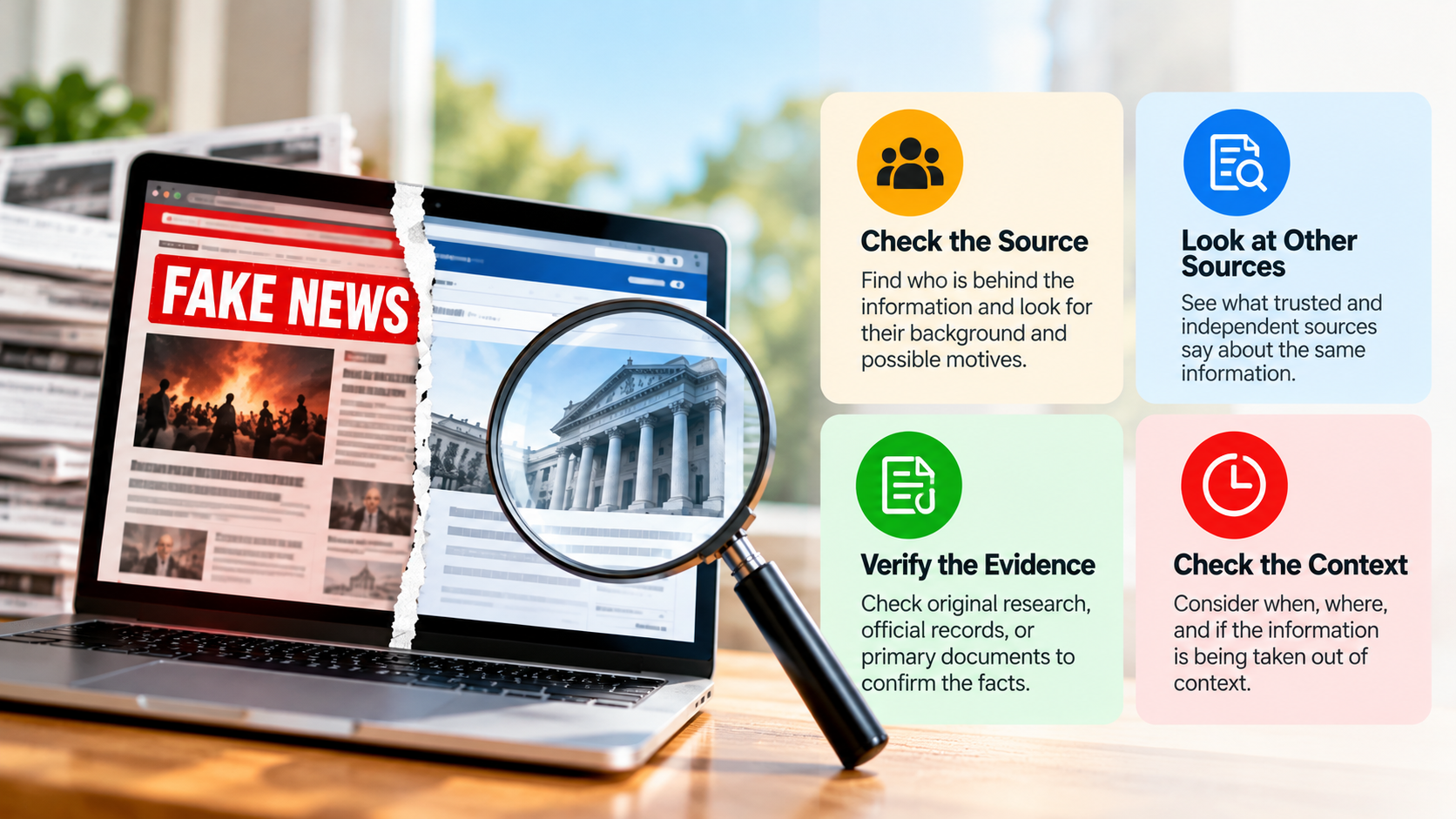
The four key questions in lateral reading provide a practical framework for evaluating online information. They help you move beyond appearances and examine a source’s credibility, evidence, and context.
- Who is behind the information? Identify the author, publisher, organization, and potential motives. Check who funds the source and whether it has relevant expertise.
- What do other sources say? Search for independent reporting, expert assessments, and reliable fact-checking organizations. Determine whether credible sources support the publisher’s reputation and claims.
- What is the evidence? Trace statements back to original research, official documents, direct interviews, or other primary sources. Check whether the evidence genuinely supports the conclusion.
- What is the context? Examine when and where the information appeared. Determine whether an image, quotation, statistic, or video has been taken out of context or presented misleadingly.
These questions work together to create a reliable verification process. You do not need to answer them in a rigid order every time. Instead, use them as a checklist whenever a claim seems questionable.
By consistently applying these questions, you can improve your digital literacy, recognize potential bias, and make better-informed decisions about what to trust and share online. These skills are particularly useful when learning how to avoid misinformation while studying online and evaluating educational resources.
What is the lateral reading strategy and how does it work?
The lateral reading strategy involves leaving a webpage to investigate its credibility using other sources across the internet. It differs from vertical reading, which focuses on examining information within the same website.
Vertical reading might involve scrolling through an article, checking its design, or reading its About Us page. Although these actions can provide useful details, they are not enough to establish credibility. Misleading websites can imitate trusted publishers and display convincing but unverified credentials.
Lateral reading takes a different approach. You open new browser tabs, search for independent assessments, and compare the source’s claims with reliable evidence. This helps you understand the publisher’s reputation and determine whether its information deserves further consideration.
The strategy is particularly useful when evaluating unfamiliar websites, viral social media posts, political claims, and questionable news stories. Rather than spending too much time analyzing one page, you investigate the broader information environment.
The main advantage of lateral reading is independent verification. It shifts your attention from how a source presents itself to what reliable outside sources reveal about it.
Emulating Professional Fact-Checkers
Professional fact-checkers often leave unfamiliar websites to investigate their credibility elsewhere. Instead of trusting a publisher’s self-description, they search for independent reporting, background information, and evidence supporting its claims.
You can apply the same approach during everyday browsing. When you encounter a suspicious headline, search for the original report and see how established news organizations cover the story. If the claim involves a scientific study, locate the published research and check whether the article describes its findings accurately.
You should also investigate the source’s ownership, funding, and potential conflicts of interest when these factors are relevant. Such details can help explain why particular information is presented in a specific way.
However, a source’s reputation alone cannot determine whether an individual claim is true. Reliable publishers can make mistakes, and unfamiliar sources can publish accurate information.
Combine lateral reading with evidence-based reasoning. This approach helps you evaluate claims more carefully without automatically accepting or rejecting information based on the publisher’s identity.
How to fact check step by step?
Following a consistent fact-checking process makes online verification easier and reduces the risk of overlooking important details. Whether you are checking a news article, social media post, or viral photograph, use these steps to investigate the information.
- Identify the main claim. Determine exactly what the content is asserting. Separate verifiable facts from opinions, predictions, and emotional language.
- Investigate the source. Open new browser tabs to research the author, publisher, organization, and relevant background information.
- Find independent evidence. Compare the claim with trusted news reports, official government websites, academic research, and established fact-checking organizations.
- Trace the original information. Locate the primary document, research paper, public statement, or dataset whenever possible.
- Verify images and videos. Use reverse image search tools to find earlier appearances of an image. Check its original date, location, and context.
- Evaluate the findings. Determine whether the available evidence supports, contradicts, or fails to establish the claim.
- Share responsibly. Avoid spreading information when its accuracy remains uncertain.
This process combines lateral reading with source evaluation and evidence verification. Not every claim requires every step, but following a consistent method helps you identify misinformation before it spreads further.
Which AI tool is best for fact-checking?
The best AI tool for fact-checking depends on the type of information you need to verify. Tools such as ChatGPT, Microsoft Copilot, and Google Gemini can help summarize research, explain complex claims, and identify sources for further investigation.
ChatGPT can help break down complicated statements, analyze supplied documents, and suggest verification questions. Microsoft Copilot can assist with research and source discovery through its available search features. Google Gemini can help investigate claims and summarize information using its available tools and integrations.
However, the capabilities of these tools vary by version, settings, and access to current information. An AI-generated answer is not proof that a claim is accurate. Models can produce incorrect statements, misinterpret evidence, or cite sources that do not support their conclusions.
For reliable fact-checking, use AI as a research assistant rather than your final authority. Open the original sources, examine the evidence, and compare independent reporting before accepting an answer.
The most effective approach combines AI assistance with lateral reading and human judgment. AI can speed up research, but independent verification remains essential for identifying misinformation and making informed decisions.
Understanding AI Limitations
Artificial intelligence can make research faster, but it cannot guarantee that every answer is correct. AI systems may generate fabricated details, misunderstand context, or present uncertain information with convincing language.
Some tools also rely on outdated training data or have limited access to current sources. Even when an AI tool provides links, you should check whether those sources exist and genuinely support its claims.
To reduce these risks, follow a few practical guidelines:
- Verify important claims: Check primary sources and independent reporting.
- Inspect citations: Open linked documents instead of trusting summaries alone.
- Check dates and context: Ensure that information remains relevant and accurately represents the original material.
- Question confident answers: Treat unsupported statements cautiously, even when they sound authoritative.
AI tools are most useful when they help you identify questions, organize evidence, and find relevant sources. They should not replace critical thinking or independent research.
By combining AI-assisted research with lateral reading, you can build a stronger defense against misleading content, manipulated media, and online misinformation.
FAQ SECTION
What is the main difference between vertical and lateral reading?
Vertical reading involves staying on a single webpage and evaluating its design, tone, and “About Us” page to judge credibility. In contrast, lateral reading requires leaving the source entirely to open new browser tabs and see what independent experts say about it. While bad actors easily manipulate single webpages, lateral reading exposes their true reputation across the broader web.
Can social media algorithms affect online fact-checking?
Social media algorithms prioritize engagement, which frequently amplifies sensationalized content, outrage, and viral misinformation. Because emotional posts spread faster than nuanced corrections, users often encounter biased narratives before seeing verified facts. Recognizing this algorithmic bias encourages readers to pause, step outside the platform, and perform independent lateral reading before reacting.
How do I spot deepfakes and manipulated videos online?
Spotting deepfakes requires looking for unnatural lighting inconsistencies, audio-visual sync issues, and strange facial blurring. When you encounter a shocking video of a public figure, search for official statements and verify if major news networks reported the event. Checking multiple independent sources quickly reveals whether the footage is authentic or a digitally manipulated fabrication.
Conclusion
Mastering lateral reading is no longer optional in our digital age; it is a vital daily practice. By stepping away from single webpages, evaluating outside perspectives, and asking the four key questions, you protect yourself from manipulation. Every time you verify a source before sharing, you help stop the spread of harmful misinformation. Apply these step-by-step strategies consistently to build a safer, more informed online community for everyone.