

Many older students struggle with reading because they lack strong multisyllabic word decoding skills. When texts become more complex, students often guess words instead of sounding them out. According to the Institute of Education Sciences, explicit word-study instruction dramatically improves reading fluency and comprehension. Teachers must address this gap to help students succeed academically. This article answers several critical questions, including how to teach decoding, how to decode these words, effective classroom activities, and how to guide student reading development.
How to Teach Decoding of Multisyllabic Words
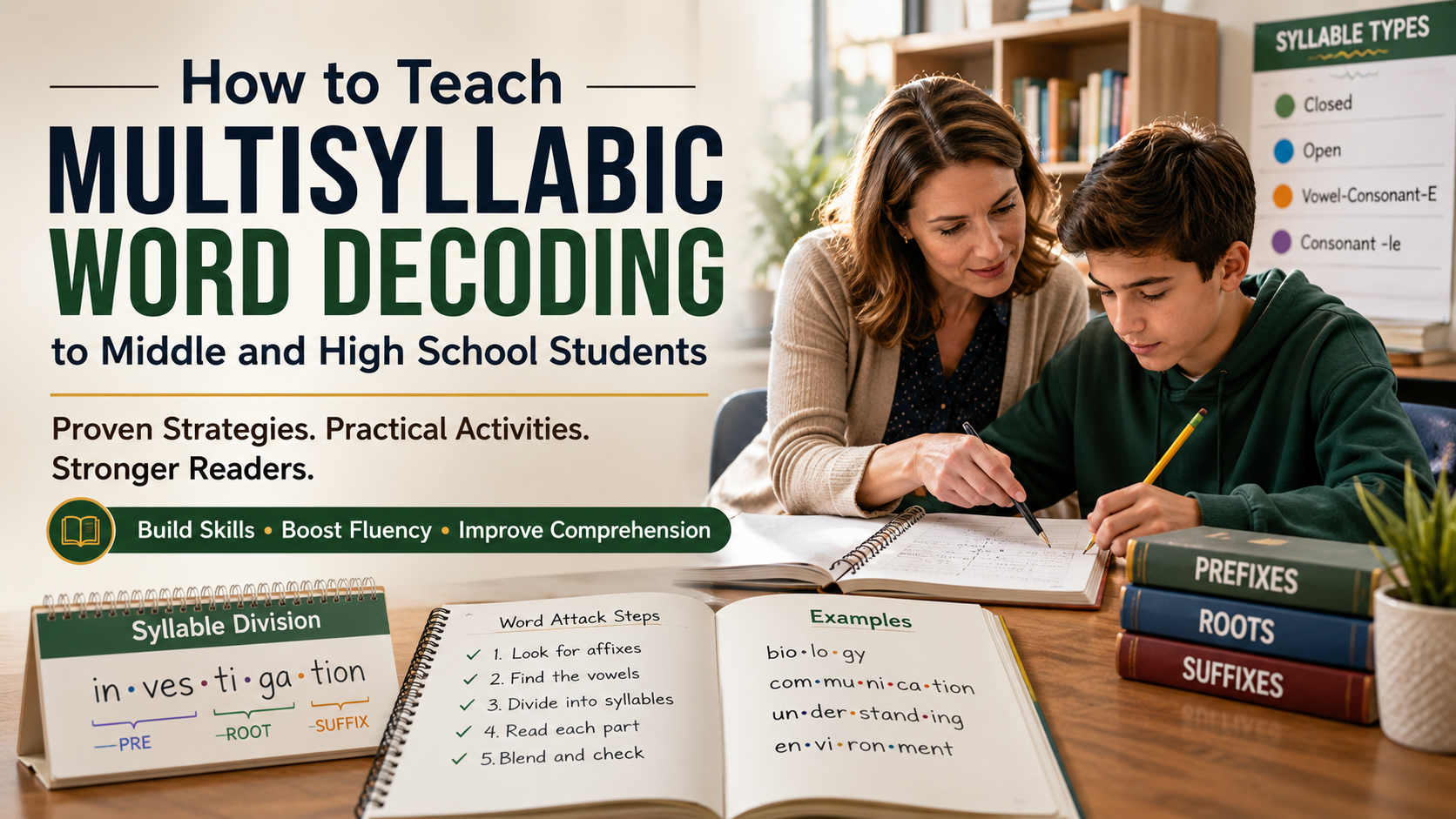
Teaching older students to decode multisyllabic words requires a structured, systematic approach. Instruction should build on foundational phonics skills while showing students how longer words contain manageable parts. Structured literacy for older struggling readers can provide a useful framework for this type of instruction. Begin by reviewing common syllable types, including closed, open, vowel-consonant-e, and consonant-le syllables. Students need repeated practice identifying these patterns within unfamiliar words.
Teachers should model how to break complex words into smaller units. Start with guided practice, then gradually move toward independent application. Encourage students to look for familiar prefixes, roots, suffixes, and vowel patterns before attempting the whole word. This reduces the pressure to guess from context or appearance.
Consistent feedback also matters. When students make errors, explain which decoding step caused the problem. Scaffold difficult words until students can apply the strategy independently. Regular practice with academic vocabulary helps struggling readers transfer these skills to science, history, literature, and other content areas. The goal is accurate decoding that eventually becomes faster and more automatic.
Implementing Explicit Syllable Division Strategies
Explicit syllable division strategies help students recognize patterns within long words. Instead of asking learners to guess an unfamiliar term, teach them a repeatable process. First, have students identify recognizable prefixes, roots, and suffixes. These word parts often provide useful clues about pronunciation and meaning.
Next, ask students to locate the vowels and vowel combinations in the remaining word. Teach appropriate syllable division patterns based on the syllable types being studied. Students can then pronounce each section separately before blending the parts into the complete word.
Use the same sequence during repeated practice. Consistency helps students develop an efficient word-attack strategy rather than relying on memorization. Teachers can mark syllable divisions directly on sample words before gradually removing those supports.
Apply these strategies to meaningful academic vocabulary. Words from current science, social studies, or English lessons provide stronger transfer than isolated word lists. Over time, students should begin applying syllable division automatically when they encounter unfamiliar multisyllabic words during independent reading.
How Do You Decode Multisyllabic Words?
Decoding multisyllabic words becomes easier when students follow a consistent sequence. Begin by scanning the entire word rather than immediately sounding out every letter. Ask students to identify familiar prefixes, suffixes, and roots. These recognizable parts can reduce the amount of unfamiliar information they must process.
After identifying meaningful word parts, students should examine the vowels and consonants within the remaining sections. Divide the word into manageable syllables according to the patterns being taught. Have students pronounce each syllable separately before blending the parts together.
Encourage students to check the completed pronunciation against the sentence. Context should confirm a decoding attempt rather than replace phonics analysis. This distinction helps prevent students from guessing words based only on meaning or surrounding pictures.
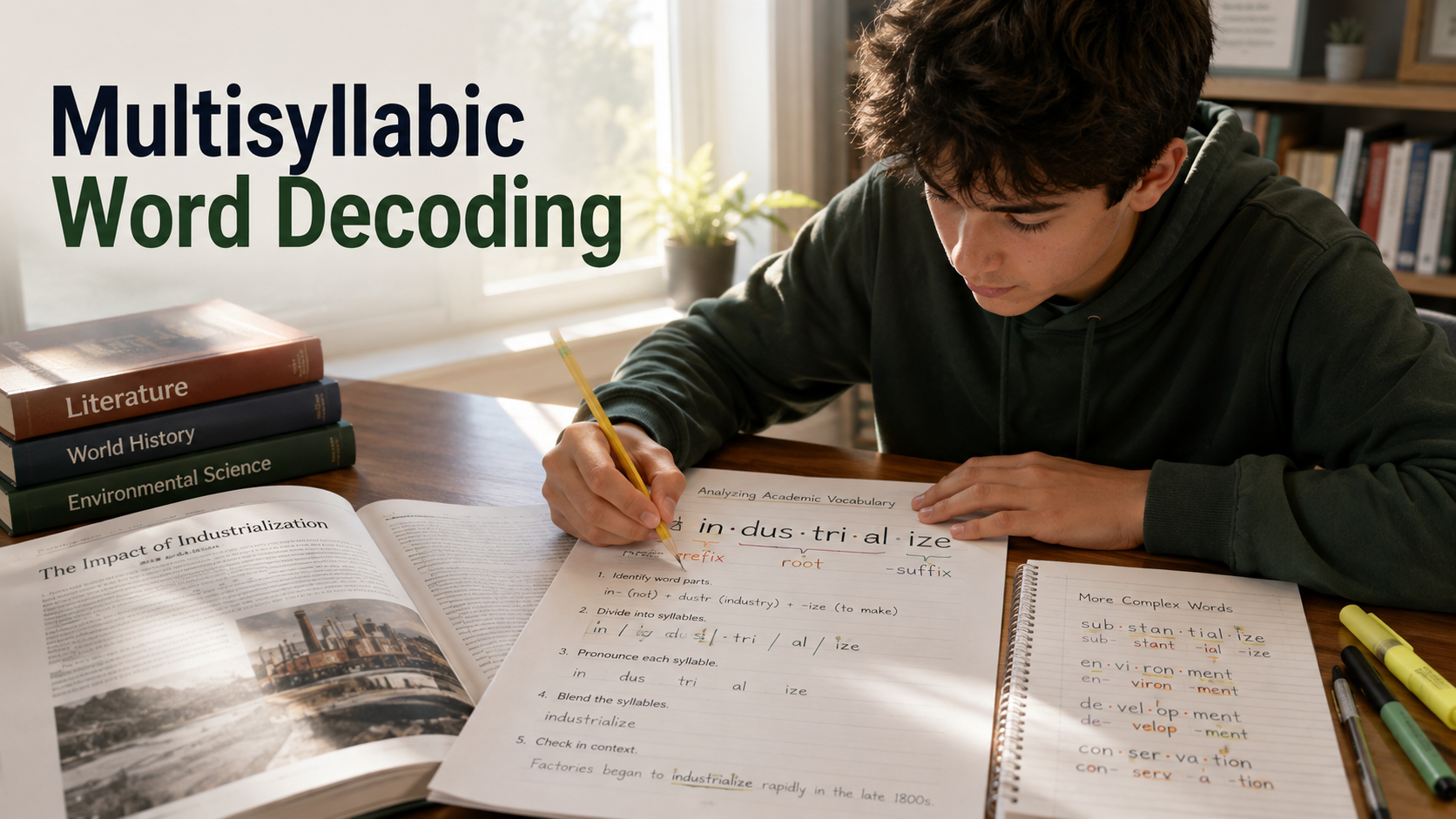
For example, a student encountering a long academic word can first identify known affixes. The remaining base can then be divided into syllables and decoded. Repeated practice makes this process increasingly efficient. The ultimate goal is accurate, automatic word recognition that supports reading fluency and comprehension.
Utilizing Affix Isolation for Word Attack
Affix isolation gives students another practical method for decoding complex vocabulary. Teach learners to look for common prefixes and suffixes before attempting to pronounce the entire word. They can underline or lightly mark these parts to reduce visual clutter.
Once the affixes are identified, students can focus on the root or base word. Common prefixes such as un-, re-, dis-, and pre- often appear in academic vocabulary. Common suffixes such as -tion, -ment, -able, and -ity also provide useful structural clues.
This strategy supports both pronunciation and meaning. Students begin to recognize that many long words contain familiar building blocks. That recognition can make unfamiliar vocabulary appear less intimidating.
Teachers should connect affix work to authentic reading whenever possible. Use vocabulary from current classroom texts instead of relying only on disconnected word lists. Students can mark the affixes, decode the remaining word, and discuss how each part contributes to meaning.
Repeated exposure across subjects strengthens transfer. Over time, affix isolation becomes part of a broader word analysis strategy that students can use independently when reading challenging academic texts.
What Are Some Activities for Decoding Multisyllabic Words?
Effective activities should give older students repeated practice without making instruction feel childish. Word-building tasks allow learners to manipulate syllables, roots, prefixes, and suffixes while creating complete words. This makes the structure of complex vocabulary more visible.
Syllable sorting activities can reinforce different vowel patterns and syllable types. Give students groups of words and ask them to categorize each word according to its structure. Discussing why a word belongs in a particular category encourages students to explain their decoding decisions.
Collaborative decoding challenges can add social interaction. Students can work in pairs to divide unfamiliar words, identify recognizable parts, and compare pronunciations. Pair reading when reading aloud can also give students structured opportunities to practice reading with a partner. Teachers can then review difficult examples and correct errors immediately.
Digital matching activities can also provide useful independent practice. Students might match word parts, definitions, and complete words while receiving immediate feedback. However, technology should support instruction rather than replace explicit teaching.
Choose vocabulary that matches students’ reading levels and classroom subjects. Relevant words from textbooks make practice more meaningful. These activities should reinforce the same decoding procedures taught during direct instruction. Consistent practice helps students develop accuracy, automaticity, and confidence with multisyllabic words.
Hands-On Syllable Puzzle Manipulation
Syllable puzzles provide a simple way to make word structure visible. Prepare cards containing syllables from common academic vocabulary. Students combine the cards to construct complete words, then pronounce and analyze the resulting terms.
Begin with familiar patterns before introducing more challenging combinations. For example, students might first combine two clear syllables. Later, they can work with longer words containing prefixes, roots, and suffixes. This gradual increase in difficulty prevents the activity from becoming overwhelming.
Ask students to explain how they know the pieces belong together. This encourages structural analysis instead of random guessing. After constructing a word, have students divide it into syllables and read it aloud several times.
Teachers can also turn the activity into a vocabulary challenge. Provide a definition or sentence and ask students to build the matching word from the available pieces. This connects decoding, spelling, and vocabulary development.
Use academic terms from current classroom instruction whenever possible. Students are more likely to transfer the strategy when the practice resembles their real reading demands. The tactile element can reinforce visual recognition while giving students repeated opportunities to analyze complex word structures.
How to Teach Students to Read Multisyllabic Words?
Teaching students to read multisyllabic words independently requires explicit instruction and gradual release of support. Start with word patterns students have already learned. Select practice texts containing familiar syllable types and manageable academic vocabulary.
Teachers should model what skilled readers do when they encounter unfamiliar words. A think-aloud can show students how to identify word parts, divide syllables, pronounce each section, and blend the sounds. This makes the decoding process visible instead of leaving students to discover it through trial and error.
Encourage students to mark syllable boundaries when appropriate. They can underline prefixes, circle roots, or separate syllables with small lines. These annotations provide temporary support while students develop independence.
Move from isolated words to sentences and connected texts. Reading words in context helps students develop fluency while maintaining attention to accurate decoding. When students make mistakes, ask them to return to the relevant decoding step instead of simply supplying the answer.
Regular practice is essential. Short, focused sessions can be more effective than occasional long drills. As accuracy improves, gradually remove visual and teacher support. The goal is for students to decode unfamiliar multisyllabic words independently while maintaining meaning and comprehension.
Leveraging Think-Aloud Modeling for Independence
Think-aloud modeling helps students understand the mental process behind successful decoding. When teachers encounter an unfamiliar multisyllabic word, they should demonstrate the steps aloud. This turns an invisible reading process into something students can observe and imitate.
Begin by identifying recognizable word parts. Explain why a particular prefix, suffix, or root stands out. Then show students how to examine the remaining vowels and consonants. Divide the word into appropriate syllable units and pronounce each part carefully.
Afterward, blend the syllables into the complete word. Teachers can briefly check whether the pronunciation makes sense within the sentence. This final step reinforces the difference between decoding and guessing.
Students should eventually practice the same process with teacher support. Ask them to explain their thinking while working through unfamiliar words. Correct errors immediately, but avoid taking over the entire task.
Gradually reduce prompts as students become more confident. Eventually, learners should be able to apply the process silently during independent reading. Think-aloud modeling is most effective when teachers use consistent decoding language and routines. Repeated exposure helps students internalize the strategy and apply it automatically across different texts.
Decoding Multisyllabic Words Activities
Decoding multisyllabic words activities should strengthen advanced word-analysis skills while remaining appropriate for older learners. Activities work best when they connect directly to authentic reading and academic vocabulary. Students need opportunities to apply decoding strategies rather than simply memorize long word lists.
Word matrix activities can challenge students to combine roots with different prefixes and suffixes. This helps learners recognize recurring structures across multiple words. Syllable fluency drills can also improve automatic recognition when used briefly and purposefully.
Root-word detective activities add an analytical element. Give students a short paragraph from science, history, or another subject. Ask them to locate familiar Greek or Latin roots and explain how surrounding affixes affect meaning.
Digital matching games can provide additional independent practice. Students might match syllables, word parts, definitions, and complete vocabulary terms. Immediate feedback can help reinforce accurate responses.
Keep activities challenging without making them unnecessarily complicated. Older students often respond better to tasks connected to real academic demands. Rotate activities while maintaining the same underlying decoding process. This balance provides variety without sacrificing instructional consistency. The strongest multisyllabic word decoding activities combine phonics practice, word structure, vocabulary, and meaningful reading.
Engaging in Root Word Detective Missions
Root word detective missions turn academic vocabulary into an investigation. Choose a short content-area passage containing several words with recognizable Greek or Latin roots. Select roots that students have already encountered during direct instruction.
Ask students to highlight or underline the target roots. Next, have them identify prefixes and suffixes attached to each root. Students can then discuss how these word parts influence pronunciation and meaning.
For example, learners might compare several words that share the same root. They can examine how different affixes change the meaning of each word. This helps students recognize relationships across vocabulary instead of treating every long word as completely new.
Encourage students to justify their answers. Ask which parts helped them decode the word and which parts helped them understand its meaning. This promotes metalinguistic awareness and deeper word analysis.
Use passages from subjects students already study. Science and social studies texts often contain useful multisyllabic vocabulary with Greek and Latin roots. The activity therefore supports both decoding and vocabulary comprehension.
As students improve, increase the difficulty of the passages. Gradually remove prompts and allow learners to identify useful word parts independently. This progression helps students transfer root analysis from classroom activities to authentic academic reading.
FAQ SECTION
Why Do Middle and High School Students Struggle With Multisyllabic Words?
Many older students missed explicit, systematic phonics instruction during earlier grades. As academic texts become more complex, students encounter longer words with multiple syllables, roots, prefixes, and suffixes. Without strong multisyllabic word decoding skills, they may guess words from the first letter or surrounding context. This approach becomes less reliable as vocabulary becomes more advanced. Explicit instruction in syllable patterns, affixes, and word structure gives students a reliable method for multisyllabic word decoding and helps them approach unfamiliar academic vocabulary with greater confidence.
Are Phonics Interventions Appropriate for Older Students?
Yes. Systematic phonics interventions can support older struggling readers when instruction is age-appropriate and directly connected to their reading needs. Adolescents can benefit from explicit lessons on syllable patterns, prefixes, suffixes, roots, and other structural features. Effective multisyllabic word decoding instruction should avoid activities that feel too childish. Instead, teachers can use academic vocabulary from science, history, literature, and other subjects. Regular practice helps students strengthen foundational skills while improving their ability to decode unfamiliar words and read challenging texts more independently.
How Long Does It Take to See Improvement in Decoding Skills?
Improvement varies based on the student’s starting skills, instructional quality, and consistency. Some students may show noticeable progress within several weeks of explicit instruction. Others require longer intervention and repeated practice. Consistent multisyllabic word decoding instruction should include direct modeling, guided practice, independent application, and immediate feedback. Students also need opportunities to use these strategies in authentic texts. Daily or frequent practice can help transfer skills from isolated word exercises to connected reading. Teachers should monitor accuracy and fluency regularly rather than relying on a fixed timeline for every learner.
Can Content-Area Teachers Help With Decoding Instruction?
Yes. Content-area teachers can reinforce multisyllabic word decoding while teaching subject-specific vocabulary. Science, history, and mathematics often contain complex terms that students must understand to access the curriculum. Teachers can briefly break unfamiliar words into prefixes, roots, suffixes, and syllables before students encounter them in a lesson or textbook. These routines do not require full phonics lessons in every class. Instead, they provide repeated opportunities to apply decoding strategies within meaningful contexts. Collaboration between reading specialists and content teachers can further strengthen vocabulary development, reading accuracy, and comprehension.
Conclusion
Strong multisyllabic word decoding skills help middle and high school students access increasingly complex academic texts. Students need explicit instruction in syllable types, affixes, roots, and structural analysis. They also need regular opportunities to apply these strategies during authentic reading. Interactive activities can make practice more engaging without reducing instructional rigor. With consistent modeling, guided practice, feedback, and gradual release of support, struggling readers can become more accurate and independent. Teachers across subject areas can reinforce these skills by addressing unfamiliar academic vocabulary directly. This coordinated approach helps students overcome foundational reading gaps and develop stronger fluency, vocabulary, and comprehension.