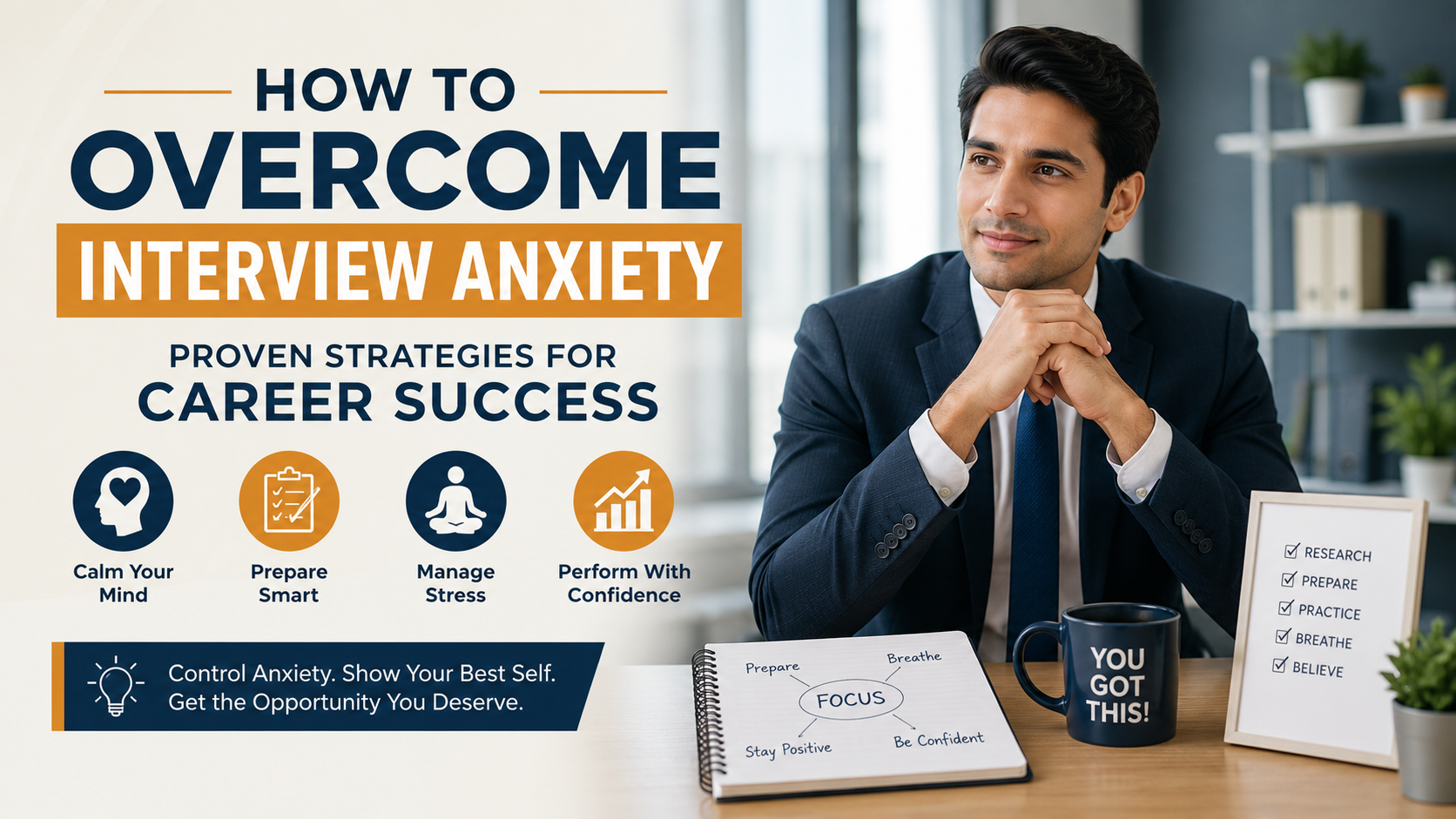
How to Overcome Interview Anxiety: Proven Strategies for Career Success
Your hands are suddenly sweaty and your heart is racing fast. Consequently, your mind goes completely blank right before a big job interview. If this situation sounds familiar, you are certainly not alone in this struggle. Ultimately, learning how to overcome interview anxiety is a vital career skill for every professional. Nervous jitters affect even the most qualified job candidates. For example, the American Psychological Association notes that stress triggers a natural fight-or-flight response. This physical reaction disrupts logical thinking precisely when you need it most. Therefore, you can explore insights on stress management strategies from the APA to understand these physical reactions better.
Fortunately, interview stress does not mean you are underqualified or unprepared for the role. Instead, it is simply a natural body response to a high-stakes evaluation. As a result, you can manage this nervous tension quite easily. Furthermore, you can transform nervous energy into real confidence with key preparation and cognitive tools. In this comprehensive guide, we explain why interview stress happens in the first place. Moreover, we share clear steps on how to overcome interview anxiety effectively before and during your meeting. Thus, you will discover practical ways to prepare, manage physical symptoms, and present your best self.
Understanding Why Job Interview Nerves and Stress Happen
To begin with, interview anxiety stems from a few clear psychological triggers. These triggers include fear of failure, social evaluation, and the stress of the unknown. When you step into an interview setting, your brain sees a high-stakes test. As a result, your adrenal glands flood your body with stress hormones like cortisol and adrenaline. Subsequently, this sudden hormone spike causes a fast heartbeat and shaky hands. In addition, you might experience a dry mouth and shallow breathing. While these physical symptoms were originally meant to protect us from danger, they feel completely overwhelming in a job interview.
Furthermore, the pressure to make a great impression creates a continuous loop. Specifically, you worry about getting nervous, which consequently makes you even more anxious. Therefore, recognizing these reactions as normal human biology is the first crucial step toward recovery. After all, they are definitely not signs of personal weakness or low skill. Once you accept that nervousness is just redirected energy, you can regain control of your emotions. For instance, you can use simple grounding techniques to calm down quickly. This practice helps you communicate your true value clearly without letting fear drive your performance. Ultimately, learning how to overcome interview anxiety starts with understanding these biological triggers.
The Science Behind Performance Anxiety and Interview Dread
In short, performance anxiety happens when your brain misinterprets a professional evaluation as a physical threat. Consequently, your autonomic nervous system prepares you to fight, flee, or freeze on the spot. This physiological reaction moves blood away from your prefrontal cortex. That specific area of the brain manages critical decision-making, clear speech, and memory recall. Instead, blood shifts directly toward your major muscle groups. As a result, this ancient survival trick explains why smart professionals frequently struggle to recall basic work details under pressure.
However, you can implement simple physical habits to signal safety back to your brain. For example, actions like intentionally slowing your speech and taking deep breaths help instantly. Similarly, grounding your feet flat on the floor reverses this biological hijack. By deactivating your brain’s alarm system, you restore full access to your prefrontal cortex. Therefore, this simple physical shift allows you to think logically and speak with complete clarity. As a result, you will project the polished professional confidence that hiring managers always want to see.
Practical Steps for How to Overcome Interview Anxiety Before the Big Day
Without a doubt, thorough preparation is the ultimate antidote to severe interview nervousness. First of all, comprehensive prep boosts your natural baseline confidence long before the meeting begins. In addition, it reduces your fear of facing unpredictable questions. Therefore, instead of leaving your career performance to chance, set aside dedicated time to prepare properly. Ultimately, structured preparation builds a solid foundation for long-term career success.
| Step | Prep Phase | Action / Focus |
| 1 | Targeted Research | Company, Culture, Role Requirements |
| 2 | STAR Practice | Structured, High-Impact Answers |
| 3 | Mock Interviews | Real-world Simulation & Feedback |
1. Research the Role to Beat Job Search Fear and Anxiety
Indeed, uncertainty feeds anxiety, while solid information builds quiet confidence. Therefore, spend quality time studying the prospective company’s background and core values. For instance, read recent news articles and review their major achievements before your scheduled meeting. In addition, start by reading the job description thoroughly so you can highlight key technical skills.
-
Review the job description thoroughly and highlight key qualifications.
-
Check the company’s official website and press releases for recent news.
-
Explore their social media channels to understand their workplace culture.
-
Look up your interviewers on LinkedIn to find common ground.
Consequently, having this context turns unknown evaluators into familiar potential colleagues. Thus, knowing what to expect is a proven tactic for how to overcome interview anxiety long before you step into the room.
2. Practice Structured Answers to Conquer Interview Jitters
Trying to formulate complex answers on the spot frequently triggers panic and rambling. Therefore, to keep your mind on track, structure your professional responses with the STAR framework:
-
Situation: Set the background context clearly and concisely.
-
Task: Explain your specific responsibility in that context.
-
Action: Detail the step-by-step actions you personally took.
-
Result: Quantify the positive outcome achieved through your efforts.
As a result, practicing your career accomplishments with this framework keeps your responses clear and focused. Furthermore, it helps you stay on topic even if physical nerves flare up during the meeting.
3. Use Mock Interviews to Master How to Overcome Interview Anxiety
Reading through answers silently in your head is simply not enough to build real performance resilience. Instead, practicing out loud creates physical muscle memory that helps tremendously on the actual day. For example, you can record yourself on video to check your posture and non-verbal body language. Similarly, conducting a realistic mock interview with a trusted friend or colleague works wonders.
Consequently, rehearsing answers out loud refines your vocal pacing and eliminates unnecessary filler words. Moreover, it reduces overall performance stress significantly over time. Indeed, the more your voice gets used to delivering key stories under simulated pressure, the easier it becomes. Thus, you will recall important career details naturally when it really counts.
Calming Your Mind and Body: Techniques for Managing Pre-Interview Stress
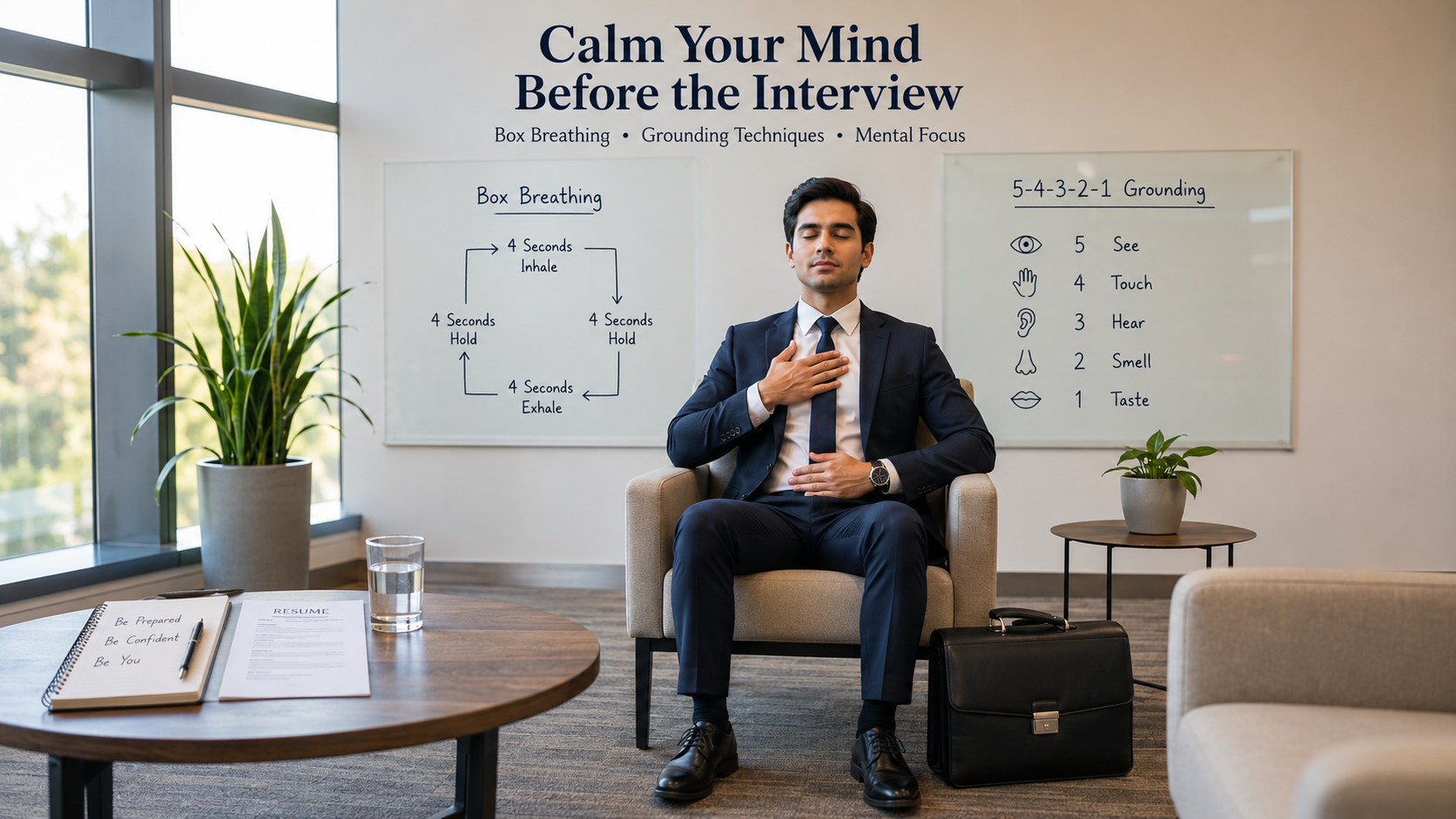
Even with thorough preparation, physical symptoms of stress can still appear on interview day. However, using somatic and mental techniques in the morning helps regulate your nervous system effectively. As a result, these proven methods bring your focus back to the present moment quickly.
| Count | Sense | Sensory Focus |
| 5 | Sight | Things you can SEE |
| 4 | Touch | Things you can TOUCH |
| 3 | Sound | Things you can HEAR |
| 2 | Smell | Things you can SMELL |
| 1 | Taste | Thing you can TASTE |
Deep Breathing Tactics for Handling Performance Anxiety and Stress
When acute panic sets in, your breathing automatically becomes fast and shallow. Consequently, this breathing pattern signals to your brain that real danger is present. To break this destructive cycle, use the deliberate “box breathing” technique. First, inhale through your nose for four seconds, and hold for four seconds. Next, exhale through your mouth for four seconds, and hold empty for four seconds. Repeating this simple four-step cycle four times lowers your elevated heart rate almost immediately. Thus, it activates your body’s relaxation system right away.
In addition, try the 5-4-3-2-1 grounding exercise to pull your mind away from anxious thoughts:
-
Acknowledge 5 things you can see around you.
-
Acknowledge 4 things you can physically touch.
-
Acknowledge 3 things you can hear in your environment.
-
Acknowledge 2 things you can smell.
-
Acknowledge 1 thing you can taste.
Shift Your Mindset to Reduce Candidate Nervousness and Fear
First, do not view the meeting as an intimidating interrogation where you are being judged. Instead, reframe the encounter as an equal conversation between two business professionals. Furthermore, remind yourself that you are also actively evaluating the company. After all, you need to see if their team and culture align with your personal career goals.
In addition, practice reframing your nervous jitters as genuine professional excitement. Physiologically, anxiety and excitement feel almost identical inside the human body. For instance, both conditions cause a fast heart rate and heightened alertness. Therefore, repeating the phrase “I am excited to share my skills” tricks your mind into feeling positive energy. Ultimately, this simple cognitive shift is a key strategy for how to overcome interview anxiety.
Navigating Live Nervousness and Managing Panic During the Interview
What if acute anxiety strikes right in the middle of a complex question? Fortunately, handling unexpected nervousness live requires simple strategies to stay completely composed under pressure.
Pause Before Answering to Control Interview Stress and Panic
Many job seekers feel an intense pressure to speak immediately after receiving a prompt. However, rushing to answer often leads to rambling and heightened anxiety. Instead, allow yourself a comfortable pause of two or three seconds to organize your thoughts logically.
For example, you can say, “That is a great question, let me take a quick moment to gather my thoughts.” Consequently, professional interviewers respect candidates who take a thoughtful moment before responding. Indeed, they view them as deliberate, composed professionals rather than reactive speakers who rush without thinking.
Embrace Imperfection to Relieve Candidate Stress and Anxiety
If you stumble over a word or temporarily lose your train of thought, do not panic. Instead, take a slow, resetting breath and offer a genuine, warm smile. Then, say something simple like, “Excuse me, let me rephrase that thought clearly.”
After all, hiring managers do not expect perfect, robotic candidates. On the contrary, they want to hire relatable human beings who show resilience under mild pressure. Therefore, recovering smoothly from a minor mistake demonstrates strong real-world problem-solving skills that employers value immensely.
FAQ SECTION
How common is job interview anxiety?
Job interview anxiety is extremely common across every single career stage today. In fact, it affects entry-level applicants and seasoned corporate executives alike. Research consistently shows that over 90% of job seekers experience stress during the hiring process. Therefore, knowing that almost everyone faces similar internal battles helps normalize your feelings significantly. Furthermore, it proves that feeling nervous does not mean you are underqualified or unprepared for the job. Employers naturally expect candidates to feel baseline excitement and nervous energy. Thus, you never need to feel ashamed about ordinary pre-interview jitters. Ultimately, learning how to overcome interview anxiety helps you manage these common feelings with genuine confidence.
Can hiring managers tell when I am nervous?
Hiring managers often spot subtle physical indicators of nervousness during a meeting. For example, these signs include an elevated voice pitch, fast speaking pace, fidgeting fingers, or flushed skin. However, experienced interviewers fully expect candidates to show these natural reactions during an evaluation. Consequently, they rarely penalize you for simple, relatable jitters. Instead, they focus primarily on your qualifications, communication skills, and overall cultural fit. Furthermore, most hiring teams actively try to put nervous candidates at ease early on. After all, they genuinely want to see your true talent shine through. Therefore, acknowledging your nervousness lightheartedly can dissolve tension completely for both sides.
How can I stop my hands from shaking during an interview?
To stop shaking hands effectively, focus on regulating your breathing before entering the room or launching your video call. Specifically, deep abdominal breathing slows your racing pulse instantly. As a result, it reduces the excess adrenaline driving those muscular tremors. In addition, plant both feet firmly flat on the floor to anchor your posture when seated. Next, rest your hands comfortably on your lap or lightly on the table surface. Furthermore, holding a pen or a notepad gives your hands a grounded, functional purpose. Thus, this practice channels excess physical energy constructively without drawing any negative attention to your temporary nervousness.
What should I do if my mind goes completely blank?
If your mind goes completely blank following a tough question, avoid panicking or blurting out random filler words. Instead, take a slow, steady breath and address the moment with complete honesty. For instance, say something like, “That is a great question. My mind just went blank for a second, so please give me a moment to gather my thoughts.” Alternatively, you can ask the interviewer to repeat or clarify the prompt. Consequently, this graceful pause gives your brain time to reset properly. As a result, it calms the panic response and helps you retrieve the memories you need for a strong, structured answer.
Is it okay to tell the interviewer that I am nervous?
Yes, briefly acknowledging your nerves can humanize you and build authentic rapport with your interviewers. For example, a quick comment works wonders: “I am a bit nervous today simply because I am genuinely excited about this role.” Consequently, this honest statement demonstrates high self-awareness and personal authenticity. Furthermore, most hiring managers respond with warmth and reassuring words, which instantly lowers the pressure in the room. However, the key is to mention your nervousness briefly once at the beginning to clear the air. Afterwards, immediately pivot your focus back to discussing your qualifications, experience, and enthusiasm for the role.
CONCLUSION
In conclusion, mastering how to overcome interview anxiety is not about magically eliminating every single flutter of nervousness. Instead, true success involves transforming your relationship with stress over time. Therefore, you must equip yourself with practical tools to manage your mental and physical reactions effectively. First, establish a solid preparation routine and master structured communication with the STAR method. Then, combine these strategies with deep breathing and grounding techniques to step into any meeting with calm composure.
Ultimately, view every job interview as a two-way exploration and a valuable learning opportunity. After all, it is certainly not a scary, one-sided evaluation of your personal worth. Moreover, every single conversation builds lasting communication skills and increases your emotional resilience for future career opportunities—for additional guidance on starting out, check out this comprehensive resume and interview tips beginners guide. Therefore, take a deep, deliberate breath and trust in your hard work and experience. Consequently, approach your next meeting with steady confidence, because you have truly earned your seat at the table.