
The Complete History of the Saturn V Rocket
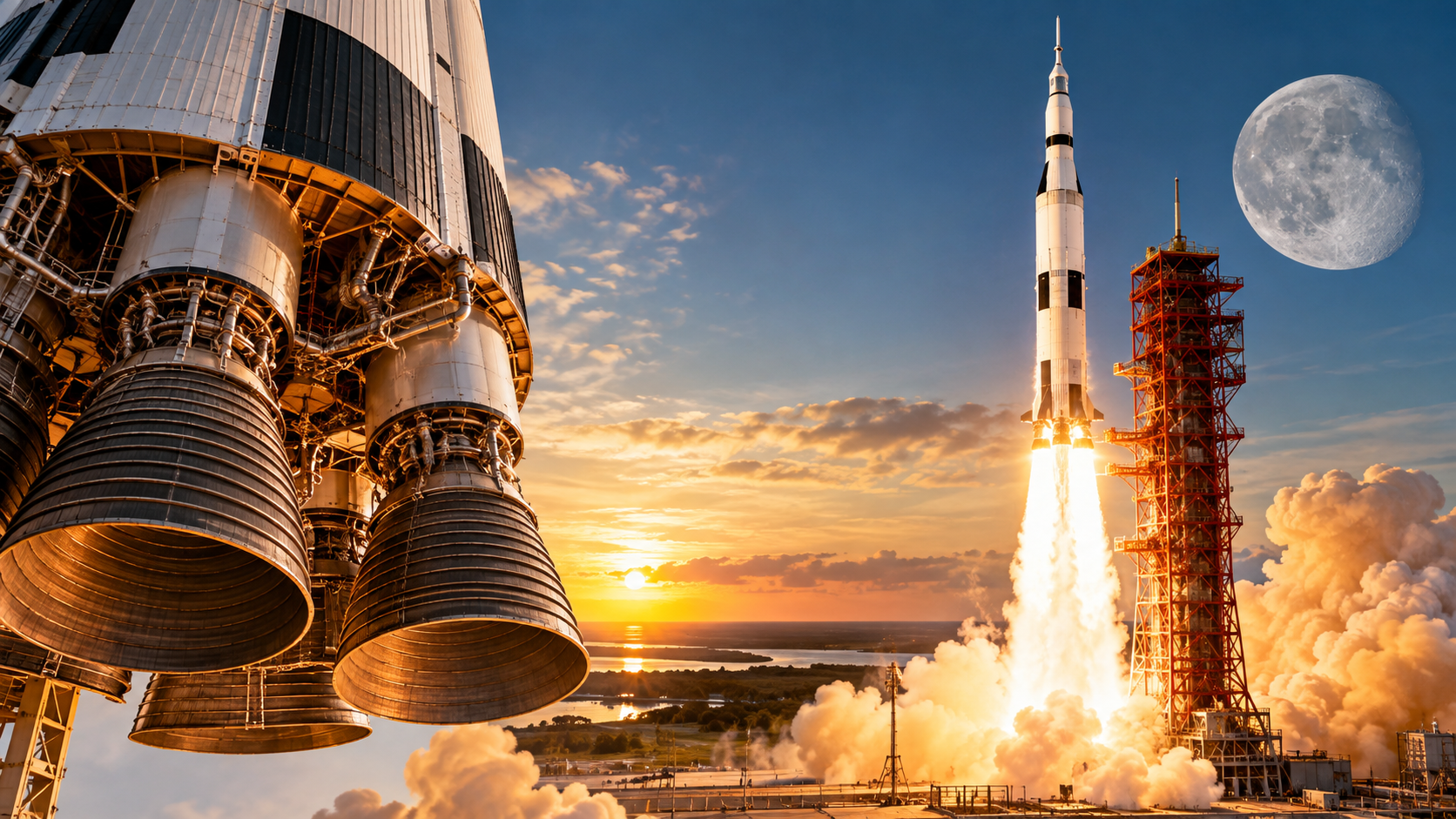
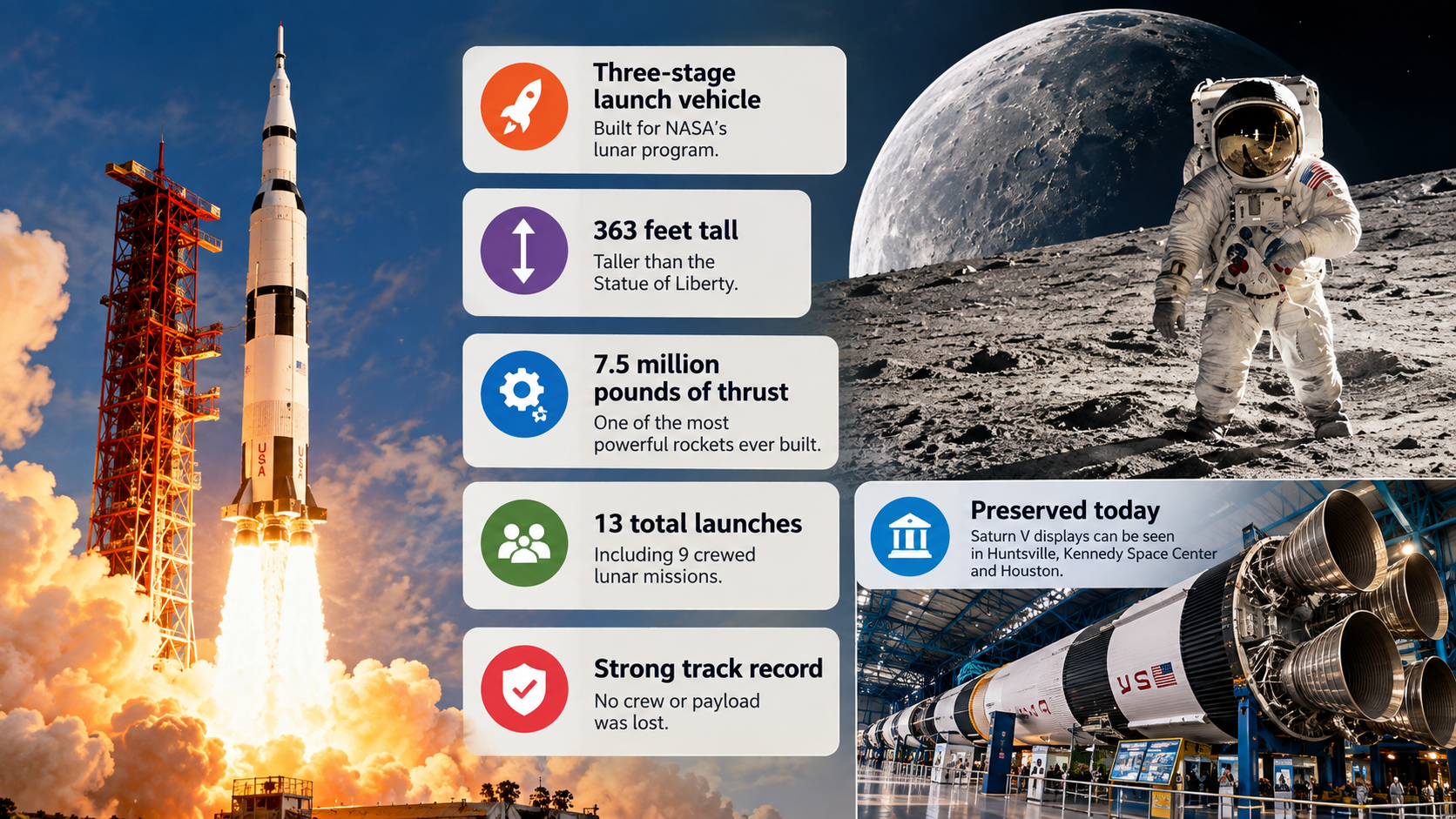
Few machines reshaped human ambition like the Apollo program’s flagship launcher. To understand modern aerospace engineering, it helps to explore the history of the Saturn V rocket. Wernher von Braun and his team developed this enormous three-stage launch vehicle for NASA’s lunar program. Between 1967 and 1973, Saturn V launched 13 missions, including nine crewed lunar missions. In total, 24 astronauts traveled toward the Moon aboard Saturn V launches. NASA records state that the rocket produced about 7.5 million pounds of thrust at liftoff.
Standing 363 feet tall, Saturn V dominated Launch Complex 39 at Kennedy Space Center. Its first stage burned kerosene and liquid oxygen, while its upper stages used liquid hydrogen and liquid oxygen. The vehicle generated enough energy to overcome Earth’s gravity and send spacecraft toward the Moon. For detailed technical specifications, see NASA’s Saturn V overview.
More than 50 years later, Saturn V remains a landmark in aerospace history. Its enormous scale, engineering complexity, and operational record continue to attract attention. NASA’s historical documentation provides additional details about the rocket’s development, testing, and Apollo-era missions.

Why is Saturn V so legendary?
Saturn V remains legendary because it enabled humans to travel beyond low Earth orbit and reach the Moon. No other human-rated launch vehicle has carried people on so many lunar missions. The rocket stood about 363 feet tall, making it taller than the Statue of Liberty. Its five F-1 engines produced enormous thrust during the first stage of flight.
However, raw power alone does not explain its reputation. The history of the Saturn V rocket also reflects an extraordinary achievement in systems engineering. Thousands of engineers and technicians developed the vehicle during the 1960s. They worked with far fewer digital tools than engineers use today. Understanding how rocket engines work also helps explain the propulsion engineering behind Saturn V.
Saturn V launched 13 times between 1967 and 1973. Its missions included Apollo 8, the first crewed mission to orbit the Moon, and the later Apollo lunar landings. The rocket also launched Skylab in 1973.
Its operational record strengthened its reputation. Although several missions experienced technical problems, no Saturn V launch resulted in the loss of a crew or payload. That combination of power, complexity, and reliability made Saturn V one of the most important rockets ever built.
The Audacious All-Up Testing Strategy
NASA adopted an unusually ambitious approach when testing Saturn V. George Mueller, NASA’s associate administrator for manned space flight, promoted all-up testing for the Apollo-Saturn program. The approach called for testing complete launch vehicles rather than gradually qualifying every stage through separate launches.
Apollo 4 became the first uncrewed Saturn V flight in November 1967. Its complete three-stage vehicle launched from Kennedy Space Center and performed successfully. The mission tested the rocket, the Apollo command module, and other systems under realistic flight conditions.
The strategy carried significant risk. A failure could have delayed Apollo and forced engineers to redesign major systems. Yet Apollo 4 demonstrated that Saturn V could operate as an integrated vehicle.
The approach did not eliminate testing between missions. NASA still conducted extensive ground tests, component tests, and qualification work. Engineers also studied the results from each flight and corrected problems before later missions.
The successful Apollo 4 mission therefore became an important milestone in the history of the Saturn V rocket. It demonstrated the value of testing complex systems together under actual flight conditions.
Do any Saturn 5 rockets still exist?
Yes. Several Saturn V displays remain preserved in the United States, although none of the complete public-display vehicles launched into space as an intact Saturn V. These displays combine different types of hardware, including flight stages, test articles, and other original components.
The U.S. Space & Rocket Center in Huntsville, Alabama, displays a Saturn V inside its Davidson Center for the Exploration of Space. The vehicle includes original hardware and provides visitors with a close view of the rocket’s enormous stages and engines.
The Kennedy Space Center Visitor Complex in Florida also displays a Saturn V. Visitors can examine the vehicle indoors and see major components from the Apollo-era launch system.
At Space Center Houston, visitors can see the historic Saturn V associated with the Apollo program. This vehicle includes stages and hardware preserved from NASA’s lunar exploration era.
These displays remain valuable because they show the rocket’s enormous scale in person. Visitors can examine the F-1 and J-2 engines, propellant tanks, structural sections, and other components.
For anyone studying the history of the Saturn V rocket, these preserved vehicles provide a direct connection to the engineering that enabled the Apollo missions.
Preserving Surviving Flight Hardware for History
Preserving Saturn V hardware requires more than simply placing a rocket inside a museum. Many components spent decades exposed to weather before receiving extensive conservation and restoration work. Environmental damage can affect insulation, coatings, wiring, structural materials, and other delicate components.
NASA and museum teams have therefore worked to stabilize and protect surviving hardware. At Space Center Houston, the Saturn V received extensive restoration before being placed inside its current display facility. The indoor environment helps protect the vehicle from further weather-related deterioration.
The preserved rockets also provide an important educational resource. Visitors can see the enormous F-1 engines that powered the first stage. They can also examine the larger structural sections that contained fuel, oxidizer, guidance equipment, and other systems.
These artifacts help explain how the Saturn V rocket actually worked. Photographs often fail to communicate the vehicle’s enormous scale. Standing beside its stages provides a much clearer understanding of the engineering challenge.
Preservation also benefits researchers, educators, and aerospace enthusiasts. Original hardware can reveal construction methods and design choices from the Apollo era.
For the history of the Saturn V rocket, these surviving artifacts remain an important physical record of America’s lunar program.
How many Saturn 5 rockets failed?
No Saturn V launch ended in a complete mission failure. NASA launched 13 Saturn V vehicles between 1967 and 1973. Those launches included uncrewed test missions, Apollo lunar missions, and the Skylab launch. No astronaut died because of a Saturn V launch failure.
However, describing the record as completely trouble-free would be misleading. Several flights experienced significant technical problems that tested the spacecraft and launch system.
Apollo 6, the second uncrewed Saturn V flight, suffered severe pogo oscillations during launch. Two first-stage engines also shut down early. The vehicle nevertheless placed the spacecraft into an orbit that allowed engineers to complete important tests.
Apollo 12 experienced a different problem. Lightning struck the spacecraft shortly after liftoff, causing temporary electrical and instrumentation problems. The Saturn V itself continued its flight normally, while the crew and ground controllers worked through the spacecraft’s electrical issues.
These incidents demonstrate an important distinction. Saturn V had a highly successful launch record, but individual missions still encountered serious anomalies.
The history of the Saturn V rocket is therefore better understood through both its successes and the engineering problems teams solved during the program.
Why did NASA stop using Saturn V?
NASA retired Saturn V because the Apollo lunar program was ending and the agency’s priorities were changing. The rocket was enormously capable, but maintaining its production system was expensive. Once the United States achieved the primary Apollo lunar objective, political support for continued lunar missions declined.
NASA’s budget also faced increasing pressure. Federal spending priorities shifted during the late 1960s and early 1970s, while the Vietnam War and domestic programs competed for government resources. Planned Apollo missions were canceled, reducing the need for additional Saturn V launches.
The rocket was also designed for a specific mission: sending large payloads beyond low Earth orbit. NASA’s next major human-spaceflight objective focused more heavily on reusable access to low Earth orbit, a concept that later became central to reusable spacecraft technology.
The agency therefore moved toward the Space Shuttle program. The Shuttle could return its orbiter to Earth and support repeated missions to low Earth orbit. It was not a direct replacement for Saturn V’s lunar capability.
The decision to retire Saturn V was consequently driven by more than technical performance. Economic considerations, political priorities, mission requirements, and NASA’s changing strategy all influenced the decision.
The history of the Saturn V rocket therefore ended not because the vehicle suddenly became ineffective, but because the program that required it came to an end.
What replaced Saturn V?
The Space Shuttle became NASA’s primary human spaceflight system after the Apollo era. The first Shuttle mission launched in 1981. Unlike Saturn V, the Shuttle focused on repeated access to low Earth orbit rather than direct lunar missions. The evolution of these programs also created opportunities across space industry careers for non-astronauts.
The Shuttle could carry astronauts, satellites, scientific equipment, and other payloads. It also played a major role in constructing and servicing the International Space Station. Its partially reusable design represented a major change from Saturn V’s expendable architecture.
However, the Shuttle could not perform the same lunar missions as Saturn V. Its capabilities were optimized for Earth orbit rather than sending crewed spacecraft toward the Moon.
NASA later returned to heavy-lift launch systems through the Space Launch System (SLS). Developed for the Artemis program, SLS combines technologies derived from the Space Shuttle era with new systems. Its design supports missions beyond low Earth orbit, including planned lunar exploration. This approach connects with the broader role of heavy-lift rockets in future lunar outposts.
The transition from Saturn V to Shuttle and later SLS shows how NASA’s launch requirements changed over time. Each system reflected the missions and technologies of its era.
The history of the Saturn V rocket therefore remains relevant today. Its engineering principles continue to influence discussions about heavy-lift launch vehicles and human exploration beyond Earth orbit.
Frequently Asked Questions
How much did building the Saturn V cost?
Developing and operating the Saturn family cost the United States roughly $6.4 billion between 1964 and 1973. Adjusted for modern inflation, that total exceeds $50 billion. Each individual launch carried an estimated price tag exceeding $1.3 billion, making routine commercial or scientific flights economically unsustainable for long-term operations.
Who was the chief designer of the Saturn V?
Wernher von Braun served as the chief architect and director of NASA’s Marshall Space Flight Center during development. He led an exceptional team of German-born and American engineers, including Arthur Rudolph. Together, they collaborated with aerospace contractors like Boeing, Douglas, and North American Aviation to build the launcher.
How fast did the Saturn V travel during launch?
The vehicle accelerated continuously throughout its powered ascent. The first stage propelled the stack to approximately 6,100 miles per hour in just under three minutes. After stage separations and final third-stage burns, the Apollo spacecraft reached translunar injection speeds exceeding 24,500 miles per hour to break Earth’s orbit.
Conclusion
The history of the Saturn V rocket remains an enduring testament to what focused ambition and bold engineering can achieve. By delivering astronauts to the Moon with a flawless operational safety record, this iconic booster permanently redefined humanity’s reach into the cosmos. While its service era was cut short by shifting budgets and priorities, the technical breakthroughs of the Saturn V continue to serve as the direct foundation for modern deep-space exploration under NASA’s Artemis program and beyond.