
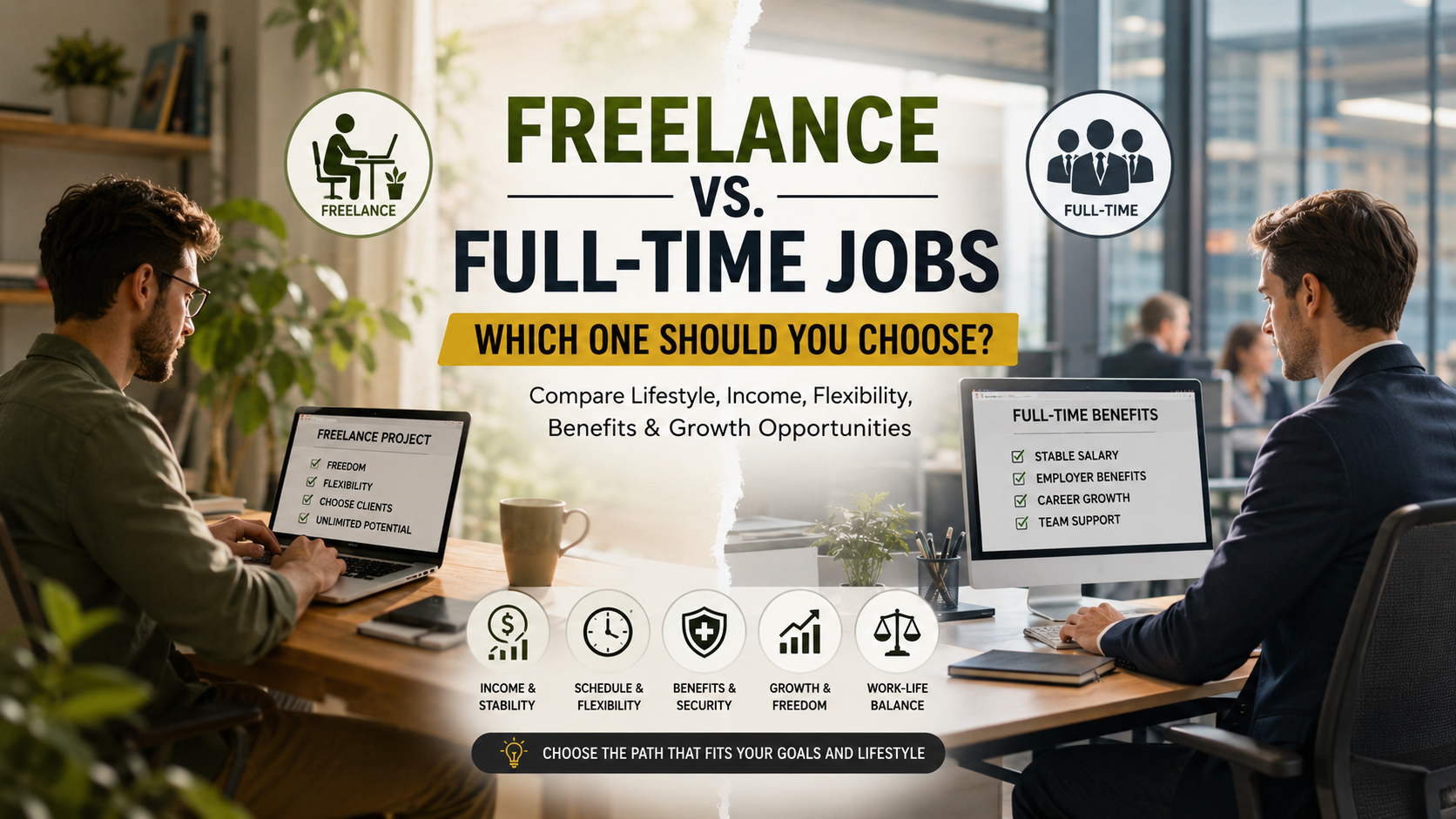
Freelance vs Full-Time Jobs: Which One Should You Choose?
Choosing between freelance vs full-time work is a major career decision. The traditional corporate path is no longer the only way to succeed. Millions of workers now consult the U.S. Bureau of Labor Statistics to analyze employment trends. Many professionals regularly evaluate independent contract work against standard employment options. Both paths offer unique lifestyle benefits, financial risks, and personal growth opportunities. Understanding these core differences helps you make an informed decision that matches your goals.
Navigating your professional choices requires a clear look at what each model demands. Independent contractors enjoy total control over their daily routines, client choices, and project commitments. On the flip side, traditional employment provides a stable foundation filled with steady paychecks, team collaboration, and employer-sponsored safety nets. This detailed guide breaks down everything you need to know about income stability, schedule flexibility, corporate benefits, skill development, and overall work-life balance across both models. Whether you crave the entrepreneurial freedom to build your own service business or prefer the financial predictability and structure of a traditional office role, this comprehensive breakdown will guide your next major career move.
Freelance vs Full-Time: Core Differences in How You Work
The main difference between these paths lies in ownership and structure. When you hold a traditional position, you work directly for a single employer. Your employer directs your daily priorities, sets your working hours, and provides a reliable paycheck. They handle administrative tasks, supply equipment, and handle tax withholdings automatically. In contrast, independent workers run a real business with multiple clients. You handle marketing, write proposals, invoice clients, and buy your own tools.
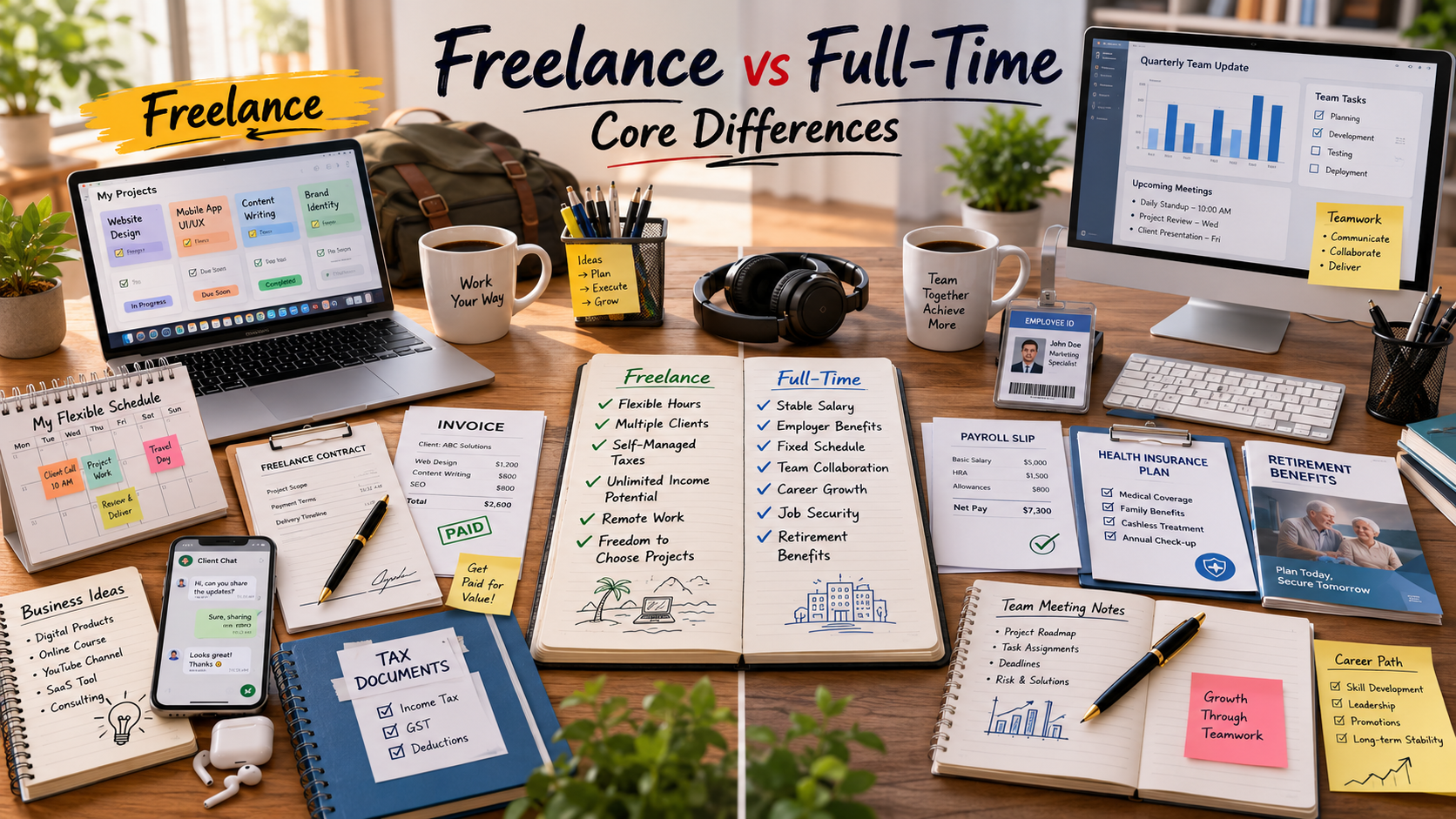

Income Structure: Freelance work offers variable income with dynamic earning potential based on the number and value of projects you secure. In contrast, full-time work provides a fixed and predictable salary or wage, making it easier to plan monthly finances.
Schedule Control: Freelancers enjoy complete autonomy over their working hours and can choose when and where they work. Full-time employees typically follow a schedule determined by their employer.
Taxes & Benefits: Freelancers are responsible for managing their own taxes, health insurance, and retirement planning. Full-time employees usually have taxes withheld by their employer and often receive benefits such as health insurance, paid leave, and retirement contributions.
Traditional roles offer clear organizational boundaries, but independent arrangements grant complete autonomy over your professional routine and workload capacity. In a traditional corporate setting, your day centers on company-wide meetings, manager check-ins, and group deliverables. Freelancers spend significant time balancing billable client work with administrative tasks like accounting, customer service, and business development. Choosing the right path starts with identifying which operating model fits your preferred daily lifestyle, focus capacity, and desire for operational independence.
Freelance vs Full-Time Income: Stability and Growth
Financial security forms the foundation of any long-term career decision. However, stability and growth function completely differently depending on your employment structure. Salaried workers trade high income variability for a consistent baseline salary, while independent professionals trade guaranteed paychecks for total control over their earning potential and client pricing.
Predictable Salary vs. Unlimited Earnings
Traditional positions deliver unmatched financial predictability. You receive a fixed salary or hourly wage every pay period, regardless of company revenue fluctuations or temporary business lulls. This predictability simplifies personal budgeting, mortgage applications, and long-term financial planning because you always know your exact income baseline.
Independent contract work operates on a variable revenue model. Some months bring high-revenue client projects, while others prove slow during seasonal lulls. However, your earning ceiling remains entirely uncapped. You set your own rates, take on additional client accounts, and scale your income directly through hard work, effective negotiation, and strategic market positioning.
Taxes, Overheads, and Operational Costs
Traditional employers deduct taxes directly from your paycheck and often match retirement contributions automatically. This automated system keeps your financial administration clean and simple throughout the year.
Contract workers must manage self-employment taxes, invoice clients on strict payment terms, track business expenses, and save for dry spells independently. You must factor in software subscriptions, equipment upgrades, and accountant fees into your overall service pricing strategy.
Schedule Control: Freelance vs Full-Time Workplaces
Workplace flexibility has evolved from a nice workplace benefit into a primary career priority for modern workers everywhere. How you structure your working hours directly impacts your energy levels, personal relationships, and overall quality of life.
Designing Your Ideal Work Environment
Contractors choose when, where, and how they operate on a daily basis. You can work from a dedicated home office, a vibrant local coffee shop, or halfway across the world while traveling as a digital nomad. If you perform best during late-night hours or need to take mid-day breaks for family commitments, you can schedule your workload accordingly without requesting manager approval.
Freelance Freedom Factors: One of the biggest advantages of freelancing is the freedom to design your work around your lifestyle. Freelancers can choose their own working hours, decide when to take days off, and create a schedule that suits their personal and professional needs. They also have complete control over the projects they accept and the clients they work with, allowing them to focus on opportunities that align with their skills and interests. In addition, freelancing offers true location independence, making it possible to work from home, a coworking space, or virtually anywhere with a reliable internet connection.
This flexibility allows you to align your work habits with your peak creative energy. However, it also demands exceptional personal discipline to avoid burnout, procrastination, or working around the clock.
Navigating Structure and Organizational Support
Traditional corporate structures offer clear expectations, built-in teams, and direct support systems. Managers outline performance goals, provide clear feedback, and facilitate cross-departmental collaboration on complex project deliverables.
For professionals who thrive on consistent routines, direct guidance, and daily social interaction, corporate structures provide an ideal environment. You leave work at the end of the day knowing your job responsibilities are clearly bounded, whereas independent contractors must constantly self-manage their time, energy, and boundaries to maintain balance.
Comparing Freelance vs Full-Time Benefits and Perks
Perks and benefits heavily influence your long-term financial security and overall well-being. Evaluating these packages helps reveal the true monetary value of each career option beyond baseline compensation.
Built-In Corporate Benefits Packages
Traditional employers typically cover a significant portion of essential employee perks, including:
-
Comprehensive group health, dental, and vision insurance
-
Paid vacation days, sick leave, and corporate holidays
-
Matching 401(k) or pension contributions
-
Disability coverage and life insurance options
These built-in perks save employees thousands of dollars annually out of pocket, providing peace of mind during health emergencies or planned family vacations.
Managing Your Own Independent Perks Package
Contractors must source and pay for their health insurance, private retirement funds, and emergency savings completely out of pocket. Taking time off means pausing client deliverables, which directly impacts your monthly income stream because you do not earn paid vacation time.
Key Takeaway: Independent contractors should price their services 30% to 50% above equivalent salaried hourly rates to cover self-employment taxes, health insurance, software tools, and unpaid time off.
Career Development and Security: Freelance vs Full-Time
Professional development looks fundamentally different when you manage your own business path versus climbing an established corporate ladder within an enterprise organization.
Corporate Ladders vs. Entrepreneurial Growth
Traditional jobs offer structured advancement paths. You move from entry-level titles to managerial or executive roles through performance reviews, internal promotions, and structured leadership tracks over several years.
Independent operators grow by expanding their technical skill sets, refining their service offerings, and raising their client rates. You function as your own marketing director, sales manager, accountant, and primary service provider. This setup accelerates diverse skill development across business disciplines but lacks standard corporate titles and formal internal promotions.
Redefining True Job Security
Corporate employment feels secure until unexpected layoffs, corporate restructuring, or broader economic downturns occur. Relying on a single employer means losing 100% of your income instantly if your specific position ends.
Independent professionals spread their financial risk across multiple clients. Losing one client reduces your monthly income temporarily, but it rarely wipes out your entire livelihood overnight, allowing you time to pitch new accounts.
Choosing Between Freelance vs Full-Time Careers
Choosing between these career tracks depends heavily on your current life stage, personality type, financial obligations, and long-term professional aspirations. Ask yourself these critical questions to clarify your optimal path moving forward:
-
What is your personal risk tolerance? If income variability causes high anxiety, traditional positions offer reliable peace of mind and predictable financial planning.
-
How disciplined are you on a day-to-day basis? Independent work requires strong self-motivation, time management skills, proactive client outreach, and organized administration.
-
What are your immediate financial and healthcare needs? If you require predictable health coverage or steady monthly income right now, structured employment provides immediate safety.
Many successful professionals start within traditional roles to gain critical industry experience, build a professional network, and save initial capital before transitioning into full-time independent contracting.
Frequently Asked Questions
Is freelancing riskier than holding a traditional job?
Independent work carries different types of risk rather than inherently higher risks overall. A traditional corporate position relies on a single employer for 100% of your earnings, making your household financial stability vulnerable to sudden corporate layoffs, company restructurings, or economic shifts. When a full-time position ends, your income drops to zero instantly. Independent contractors manage multiple revenue streams across various client accounts simultaneously. While monthly earnings fluctuate based on project cycles, losing a single client does not destroy your total income overnight. Managing independent risk effectively requires maintaining a robust 3-to-6-month emergency cash fund, setting aside money monthly for tax liabilities, and consistently pitching new business to keep a healthy sales pipeline active throughout the year.
Can independent contractors earn more money than traditional employees?
Yes, independent contractors often achieve significantly higher gross earnings than salaried employees working in similar professional roles. Salaried workers receive a fixed compensation package regardless of their overall output, efficiency, or project value. Independent professionals control their own pricing structures, charge premium hourly or project-based rates, and can scale their earnings by taking on multiple client retainers simultaneously. High-demand specialists in fields like software engineering, copy writing, cybersecurity, and digital marketing frequently build lucrative six-figure businesses. However, independent workers must account for business overhead expenses, self-employment taxes, software subscriptions, and health coverage when calculating their net take-home pay, requiring them to set higher baseline rates than standard salaried wages to achieve equal net profitability.
How do independent workers secure healthcare and retirement coverage?
Independent professionals source their benefits directly through private marketplaces, professional associations, and specialized financial providers. For healthcare, contractors utilize government health insurance exchanges, private brokers, professional union group plans, or health savings accounts (HSAs) to protect against unexpected medical costs. For retirement planning, self-employed individuals can establish specialized savings vehicles such as Solo 401(k) plans, SEP IRAs, or Traditional and Roth IRAs to build long-term wealth. These specialized self-employed retirement accounts often feature higher contribution limits and valuable tax deductions that help offset self-employment taxes. While researching, funding, and administering independent benefit plans requires proactive monthly effort, it gives you complete ownership over your coverage choices regardless of your employment status.
What are the main drawbacks of working a traditional position?
The primary drawbacks of traditional roles include limited schedule flexibility, capped earning potential, and lower daily autonomy. Salaried employees usually adhere to fixed schedules set by management, work from designated corporate offices, and operate within rigid company hierarchies. Your earning potential depends on annual performance reviews and pre-set corporate pay bands rather than your direct output or personal efficiency gains. Furthermore, traditional corporate environments can introduce workplace politics, tedious approval processes, and limited control over which projects you handle daily. These institutional constraints can frustrate ambitious professionals who prioritize creative independence, location freedom, and rapid financial growth over corporate stability and routine administrative structure.
How do I transition safely from employment to independent contracting?
Transitioning from full-time employment to freelancing requires careful planning and solid financial preparation. Start by building an emergency fund that covers at least three to six months of living expenses. This financial cushion can help you manage delayed client payments and unexpected costs.
Next, begin freelancing during evenings or weekends while keeping your full-time job. This side hustle approach lets you test market demand without giving up a stable income. It also gives you time to refine your pricing, build a strong portfolio, and develop lasting client relationships.
Once your freelance income consistently covers your essential monthly expenses, you can confidently leave your full-time job and focus on growing your independent business.
Conclusion
The decision between freelance vs full-time work depends on your values, risk tolerance, and goals. Traditional employment offers structural stability, guaranteed income, and comprehensive employer-funded benefits, making it an excellent choice for professionals who value predictability, clear corporate progression, and team-based collaboration. Independent work delivers unparalleled personal autonomy, flexible scheduling, and uncapped earning potential for self-motivated individuals who are ready to build and manage their own service business operations over time.
Neither career path is permanently binding or mutually exclusive. Modern careers are highly fluid, allowing professionals to move seamlessly between traditional employment and independent contracting as their personal goals, family needs, and lifestyle preferences evolve over time. Evaluate your current financial obligations, personal self-discipline, and long-term career aspirations carefully before making a move. If you’re exploring location-independent opportunities, check out this guide to high-paying remote jobs in 2026 to better understand the growing range of flexible career options. By choosing the work environment that aligns best with your core strengths and lifestyle goals, you position yourself for sustainable professional success and deep personal satisfaction.