BRICS vs G20: Understanding the Shifting Balance of Global Power
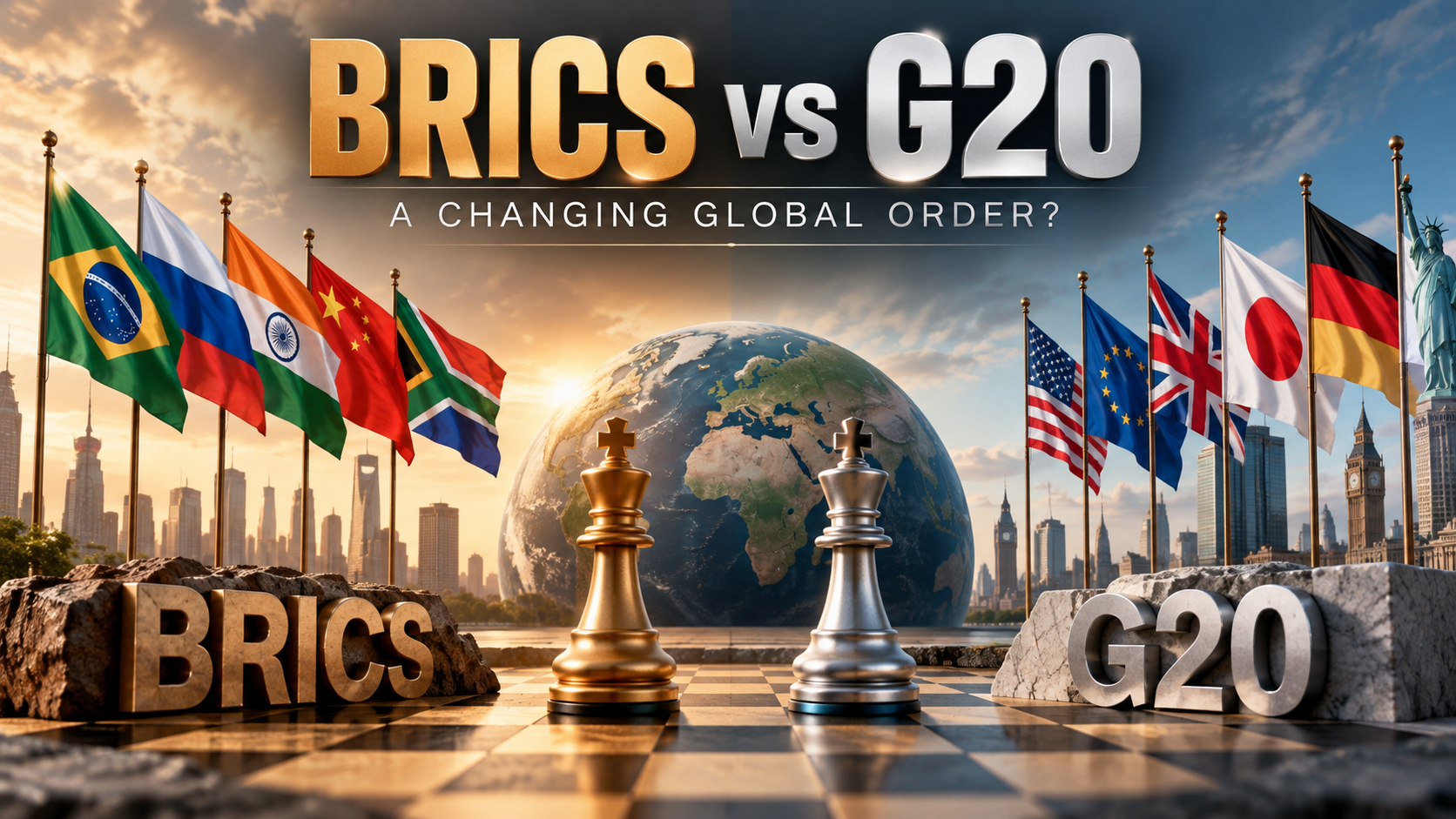
Global governance is changing as emerging economies gain greater influence in international institutions. The debate over BRICS vs G20 sits at the center of discussions about trade, finance, diplomacy, and economic power. BRICS has expanded beyond its original five members, while the G20 remains a broad forum that brings major advanced and emerging economies together. The G20 includes 19 countries plus the European Union and African Union. Its members represent about 85% of global GDP and more than 75% of global trade. For readers seeking broader context on diplomatic cooperation, the importance of international relations offers additional background.
Understanding these groups matters for investors, businesses, policymakers, and citizens. Their decisions can affect trade routes, energy markets, development finance, and international cooperation. However, BRICS and the G20 are not direct substitutes. They have different memberships, structures, and purposes. The World Trade Organization (WTO) provides additional information on international trade rules and global trade cooperation.
This guide examines the key questions surrounding BRICS vs G20. It compares BRICS with the G7, explains how BRICS differs from the G20, examines India’s position on a common BRICS currency, and explains BRICS leadership. It also covers the group’s origins, current membership, and partner-country system.

Which is more powerful, G7 or BRICS?
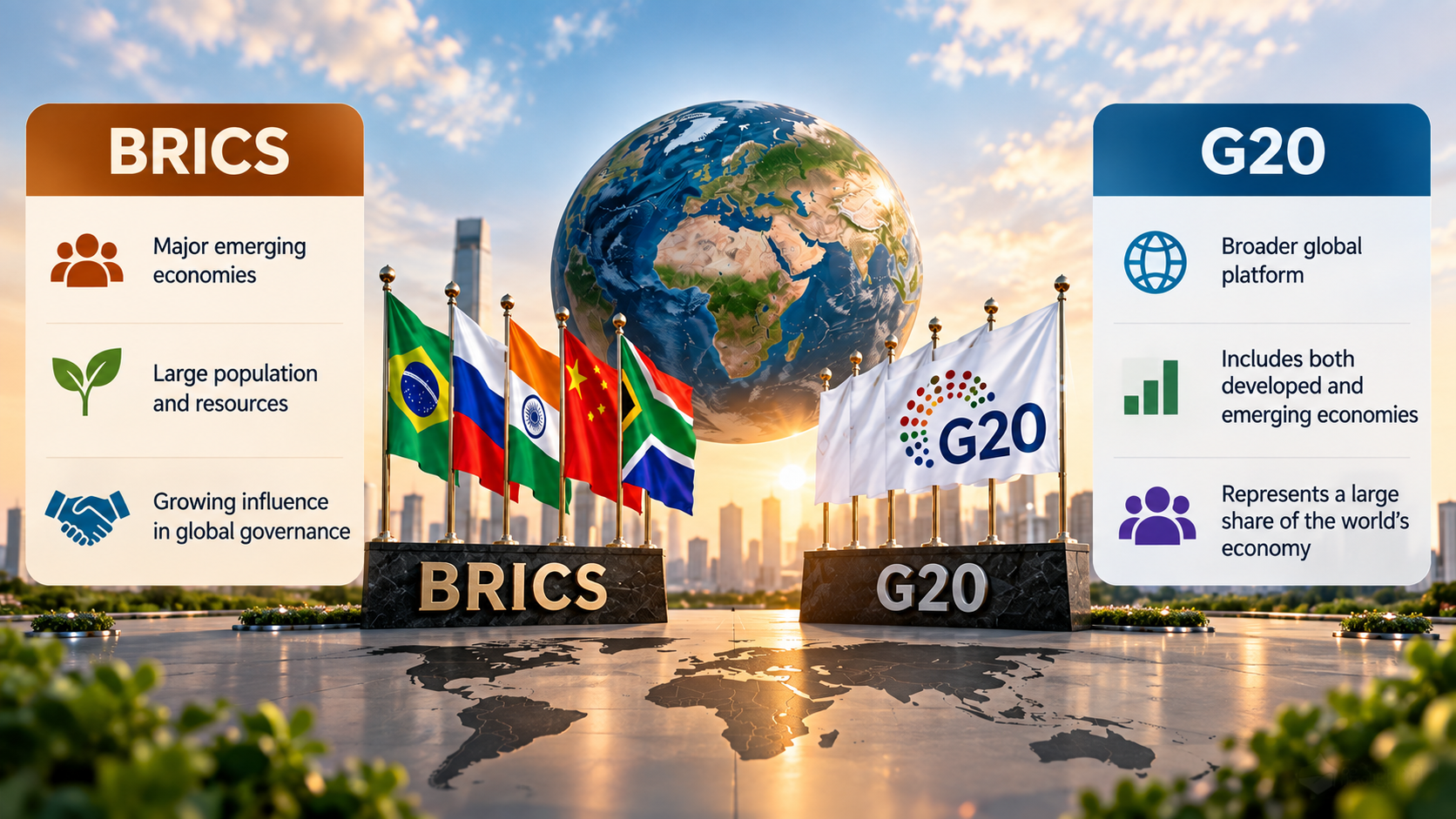
Comparing G7 and BRICS requires defining what “power” means. The G7 has substantial influence through advanced financial markets, major currencies, established institutions, and long-standing diplomatic relationships. BRICS brings a different combination of economic scale, population, natural resources, energy production, and emerging-market influence. The current BRICS group has 11 members, including Brazil, China, India, Russia, South Africa, Egypt, Ethiopia, Indonesia, Iran, Saudi Arabia, and the UAE. These economic relationships also connect with current developments in the foreign market, which can affect international trade and investment.
The G7 therefore retains important advantages in areas such as financial markets and institutional influence. BRICS has greater representation across several major emerging economies and a large share of the world’s population and resources.
The comparison also changes depending on the metric used:
- Financial influence: The G7 has major global financial centers and currencies.
- Population: BRICS represents a much larger population base.
- Natural resources: Several BRICS members are major producers of energy and commodities.
- Institutional reach: The G7 has deeper links with established global institutions.
- Emerging-market influence: BRICS provides a platform for cooperation among major developing economies.
The Decisive Metric: Financial Architecture vs Natural Resources
The BRICS vs G20 debate often becomes confused with the broader comparison between emerging and developed economies. Financial architecture is one important distinction. G7 economies include the United States, whose dollar remains central to international finance, alongside several other major financial markets. BRICS, meanwhile, includes major commodity and energy producers. This gives the two groupings different sources of influence.
BRICS has also promoted greater use of local currencies in trade and financial transactions. Its members have discussed payment mechanisms and platforms designed to make cross-border transactions easier. However, these initiatives do not currently amount to a unified BRICS currency. In 2024, BRICS ministers emphasized expanding local-currency transactions rather than establishing a single monetary system.
This distinction matters because financial infrastructure and physical economic resources create different forms of global influence. Neither metric alone captures the entire picture.
Are BRICS and G20 the same?
No. BRICS and the G20 are different forums with different memberships, purposes, and structures. The G20 brings together 19 countries and two regional organizations, the European Union and African Union. Its members include both developed economies and major emerging markets. The forum focuses heavily on international economic cooperation and broader global governance, making the importance of international relations useful context for understanding how these forums operate.
BRICS is narrower in its institutional focus and is centered on cooperation among major countries of the Global South. It has expanded substantially from its original five members. Its current members participate in meetings where decisions are made through consensus. BRICS also has a separate partner-country category.
The two groups overlap significantly. Brazil, China, India, Indonesia, Russia, and South Africa participate in both frameworks. This means BRICS is not simply an alternative to the G20.
Instead, the two forums can address similar global issues from different perspectives. The G20 provides a broader platform involving developed and developing economies, while BRICS provides a dedicated platform for cooperation among its members.
Distinct Mandates: Consensus Forum vs Reformist Coalition
The G20 functions as a broad forum for international economic cooperation. Its agenda has expanded beyond macroeconomic policy to include trade, development, energy, climate change, health, and other global issues. It has no permanent secretariat, and its presidency rotates annually.
BRICS also operates through consensus, but its agenda places greater emphasis on cooperation among emerging economies and reform of global governance structures. The group does not have a constitutive treaty, permanent secretariat, or independent budget.
That difference helps explain the BRICS vs G20 distinction. The G20 brings diverse economic powers into one forum. BRICS concentrates on cooperation among its own members and partners.
Both can discuss financial reform, trade, development, and international governance. However, their membership structures create different negotiating dynamics.
The relationship is therefore better understood as overlapping rather than purely competitive. Countries can use both platforms to pursue different economic and diplomatic objectives.
Why did India reject BRICS currency?
The claim that India simply “rejected BRICS currency” needs some qualification. India has opposed the idea of a common BRICS currency as a current priority and has instead supported greater use of national currencies for bilateral trade. In September 2026, Indian officials again indicated that there was no current proposal for a unified BRICS currency.
India’s approach focuses on practical payment mechanisms rather than creating a single currency. BRICS discussions have emphasized improving cross-border payments and increasing the use of local currencies in trade and investment. The 2026 BRICS discussions continued this approach. These issues also connect with the importance of religion in political economy, which explores how broader social factors can intersect with economic and political systems.
A common currency would also require extensive coordination between participating countries. That could involve monetary policy, exchange-rate management, financial regulation, and central-bank cooperation. Such integration would be considerably deeper than simply settling individual transactions in national currencies.
India has therefore favored arrangements that preserve its monetary-policy independence while reducing some dependence on third-country currencies for specific transactions.
Preserving Monetary Independence and National Interests
India’s preference for local-currency settlements reflects a broader approach to economic sovereignty and practical financial cooperation. Using national currencies does not require BRICS members to create a common central bank or surrender control over domestic monetary policy.
This distinction is important when discussing de-dollarization. Reducing the use of the US dollar in selected transactions is not the same as eliminating the dollar from international finance.
BRICS has continued working on payment mechanisms and local-currency financing. Its finance ministers and central-bank governors have also supported efforts to make cross-border payments more efficient.
India’s position therefore fits within a broader BRICS strategy that emphasizes local-currency trade rather than a single shared currency. The approach allows individual countries to cooperate while retaining their own currencies and monetary institutions.
As a result, describing India’s position simply as opposition to BRICS financial cooperation would be misleading. The country supports several forms of financial cooperation while remaining cautious about monetary integration.
Who is BRICS’ president?
BRICS does not have a permanent president or a single executive leader. Instead, the group uses a rotating presidency. The country holding the presidency organizes the annual summit, coordinates meetings, and helps establish priorities for its term. BRICS decisions are generally based on consensus among members.
The presidency previously followed the acronym’s original sequence, although expansion has created a need to consider how future rotations should work. Brazil held the presidency in 2025 before formally transferring it to India for 2026.
India is therefore the 2026 BRICS chair, rather than BRICS having an individual president. India’s 2026 chairship has focused on resilience, innovation, cooperation, and sustainability.
This structure differs from a conventional international organization with a permanent executive administration. BRICS also does not have a permanent secretariat or constitutive treaty. Understanding the role of religion in international relationships provides another perspective on how different factors can shape international cooperation and diplomatic relationships.
The New Development Bank is separate from the political chairmanship. It is a financial institution created by BRICS countries and has its own management structure.
Who first started BRICS?
The original BRIC concept was not created as a formal political organization. British economist Jim O’Neill coined the term “BRIC” in a 2001 Goldman Sachs research paper. The acronym referred to Brazil, Russia, India, and China, which O’Neill identified as major emerging economies with significant long-term growth potential.
The concept later developed into political and diplomatic cooperation. Representatives from the four countries began meeting at the foreign-minister level in 2006. The first BRIC leaders’ summit took place in Yekaterinburg, Russia, in 2009. South Africa subsequently joined, turning BRIC into BRICS in 2010.
This history matters because the acronym and the political grouping were not created at the same time. The original term came from economic research, while the formal cooperation developed later through government diplomacy.
The group has since evolved considerably. Its expansion added countries from Africa, the Middle East, and Southeast Asia, while creating a separate partner-country category. Readers interested in placing these developments in a wider historical context can also explore resources to research world history.
The BRICS vs G20 comparison therefore involves a relatively newer cooperation framework alongside a broader forum created for international economic coordination.
Which countries want to join BRICS?
BRICS now distinguishes between full members and partner countries, so simply listing countries that “want to join” can be misleading. The group created its partner-country category at the 2024 Kazan Summit. Several countries subsequently became partners, while other governments have expressed interest in participating.
The current partner-country framework has included countries such as Belarus, Bolivia, Cuba, Kazakhstan, Malaysia, Nigeria, Thailand, Uganda, Uzbekistan, and Vietnam. Vietnam became the tenth partner country in June 2025.
BRICS has also received interest from many other countries. Official BRICS information has listed countries including Algeria, Azerbaijan, Bahrain, Bangladesh, Kuwait, Morocco, Pakistan, Türkiye, Venezuela, and others among those expressing interest in participation.
However, interest does not automatically mean full membership. Admission involves consultations and consensus among existing members.
The expansion reflects the broader appeal of BRICS cooperation, including development finance, trade, local-currency transactions, and participation in discussions about global governance reform.
This makes BRICS increasingly diverse, but it also creates a more complex coordination environment. Different members have different economic structures, foreign-policy priorities, and relationships with other major powers.
Frequently Asked Questions
What does the BRICS acronym stand for?
The acronym originally stood for Brazil, Russia, India, and China, created in 2001. It expanded to BRICS in 2010 with the inclusion of South Africa. Even as new full members join the coalition, the organization retains the recognizable BRICS branding for diplomatic continuity and institutional identity.
Can a country belong to both the G7 and BRICS?
Currently, no country holds dual membership in both the G7 and BRICS. The G7 consists strictly of advanced Western-aligned democracies: Canada, France, Germany, Italy, Japan, the United Kingdom, and the United States. BRICS is specifically focused on emerging markets, making concurrent membership politically and ideologically inconsistent.
What is the New Development Bank?
The New Development Bank is a multilateral development institution founded by BRICS nations in 2014. Headquartered in Shanghai, it funds infrastructure, energy, and sustainable development projects across member states and developing economies, providing a sovereign alternative to lending from the World Bank and IMF.
Does BRICS aim to eliminate the US dollar?
BRICS does not seek the immediate elimination of the US dollar, which remains essential for global trade. Instead, the bloc pursues de-dollarization through diversification. Members encourage trade settlement in domestic currencies and develop independent payment rails to mitigate exchange risks and avoid unilateral financial sanctions.
Conclusion
The ongoing discourse surrounding BRICS vs G20 highlights a fundamental reality: the global order is no longer unipolar. While the G20 remains the central consensus forum connecting industrialized and emerging powers, BRICS has evolved into a vital vehicle for the Global South to assert collective bargaining power. By advancing alternative infrastructure financing, local-currency clearing mechanisms, and shared trade corridors, BRICS provides options that previously did not exist for developing economies. These developments also intersect with the impact of war on stock markets, particularly where geopolitical tensions affect trade, investment, and financial markets.
India’s calculated refusal of a shared currency underscores that national sovereignty and pragmatic self-interest still govern intra-bloc diplomacy. The coalition is not a uniform monolith, yet its rapid expansion proves its growing appeal across multiple continents. As emerging markets capture a larger portion of world trade and industrial production, businesses and policymakers must monitor both coalitions closely. Understanding the complementary, competing forces between established institutions and rising partnerships is essential for navigating the modern economic landscape.