

Best Study Techniques Backed by Science: Full Guide
Pulling an all-nighter before a major exam is a rite of passage for many students worldwide. However, modern neuroscientific research shows that cramming is one of the least effective ways to retain information long-term. To truly master complex subjects, you must rely on the best study techniques backed by science that align with how our brains naturally process and store data. According to cognitive research published by Harvard University, adopting active learning methods drastically improves long-term memory retention and overall academic performance compared to passive reading.
Understanding why effective learning matters can completely reshape your academic or professional trajectory. Traditional methods like highlighting textbooks or re-reading notes create a dangerous illusion of competence. You feel like you know the material because it looks familiar, but the knowledge quickly fades during a high-pressure test. Science-backed methods fix this common issue by strengthening the specific neural pathways responsible for deep memory retrieval.
This comprehensive beginner’s guide will walk you through the most powerful, proven cognitive strategies available today. We will explore practical frameworks including active recall, spaced repetition, and interleaving. If you want to further strengthen your retention skills, you can also explore our guide on memory improvement techniques for exams.
Whether you are preparing for a difficult professional certification or trying to master a new language, these tools will transform your daily routine. Let’s dive into the core methods that will boost your learning efficiency and help you avoid hours of ineffective studying.
The Core Scientific Principles of Effective Learning
To improve your academic performance, you must first understand how your brain stores information. Memory formation is not a passive recording process but an active construction project. Cognitive scientists emphasize two primary pillars when evaluating how humans retain knowledge over time.
Active Recall: Testing Your Knowledge
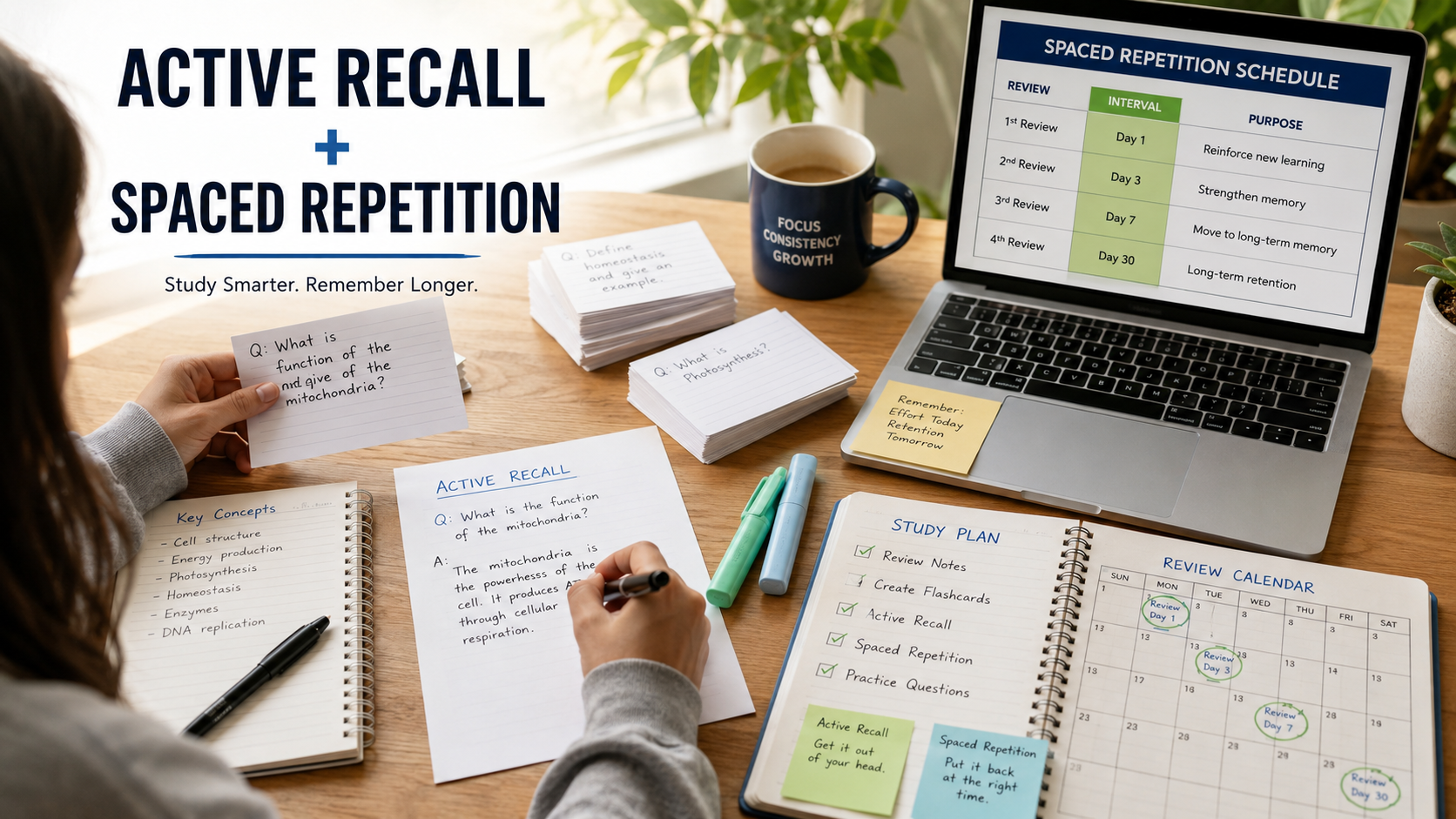
Active recall requires you to close your textbook and force your brain to retrieve information from memory. Instead of simply looking at a correct answer, you ask yourself a question and pull the response directly from your mind. This deliberate mental strain forces your neurons to build stronger, more resilient connections.
You can easily implement active recall by using flashcards, writing blank-sheet summaries, or taking practice quizzes before you feel fully ready. Research demonstrates that testing yourself acts as a powerful tool for learning, rather than just a method of final assessment.
Spaced Repetition: Beating the Forgetting Curve
The human brain naturally forgets new information at an exponential rate, a concept known in psychology as the Forgetting Curve. Spaced repetition fights this natural decline by reviewing the material at increasing intervals over time. For instance, you might review a complex concept after one day, then three days, then a week, and then a month.
This systematic approach tells your brain that the information is crucial for your long-term survival. Modern software applications like Anki use advanced algorithms to automate this process, ensuring you review specific flashcards right before you are about to forget them.
Implementing the Best Study Techniques Backed by Science
Now that you understand the core theory, let’s look at how to apply the best study techniques backed by science to your daily routine. Combining these methods yields exponential rewards for your personal productivity and comprehension.
The Feynman Technique for Deep Understanding
Named after the Nobel Prize-winning physicist Richard Feynman, this technique helps you quickly identify gaps in your knowledge. The process is incredibly simple yet profoundly effective for breaking down complex academic subjects:
-
Choose a specific concept you want to study.
-
Explain the concept to a hypothetical ten-year-old child using basic language.
-
Identify the specific areas where you struggle or rely on complex jargon.
-
Return to your source material to fill in those logical gaps.
By stripping away complex vocabulary, you force yourself to understand the core essence of the topic. If you cannot explain a concept simply, you do not truly understand it yet.
Interleaving vs. Blocking: Mixing Up Your Practice
Most students naturally use “blocking,” which means studying one specific topic for hours before moving to the next. However, cognitive science suggests that “interleaving”—or mixing different related topics together—is far more effective for long-term mastery.
For example, if you are studying mathematics, do not just practice twenty addition problems in a row. Instead, mix addition, subtraction, and multiplication problems together in a single session. This approach trains your brain to recognize which formula to apply to a given problem, which perfectly mirrors how actual exams work.
Environmental and Lifestyle Factors that Impact Studying
Even the finest cognitive strategies will fail if your environment and body are not optimized for deep focus. High-quality learning requires a holistic approach to your daily routine.
The Power of Pomodoro and Strategic Breaks
Human focus is a finite resource that depletes steadily over time. The Pomodoro Technique addresses this limitation by breaking your study sessions into manageable, highly focused intervals. You work intensely for 25 minutes, followed by a rewarding 5-minute break. After completing four cycles, you take a longer 30-minute break.
During these short breaks, step away from your screens entirely. Walk around your room, stretch your muscles, or grab a glass of water. These deliberate pauses give your brain a brief moment to consolidate the data you just absorbed.
Sleep and Nutrition as Cognitive Pillars
Many students sacrifice sleep to study longer, but this strategy completely backfires. Sleep is the exact time when your brain consolidates short-term memories into long-term storage. According to data from the World Health Organization, chronic sleep deprivation significantly impairs cognitive function, memory retrieval, and emotional regulation. Aim for seven to nine hours of quality sleep every night to keep your brain functioning at its peak performance level.
FAQ Section
How many hours should I study each day using these techniques?
When using the best study techniques backed by science, you should aim for two to four hours of highly focused study per day. Quality always matters far more than quantity when using advanced cognitive strategies. Because active recall, the Feynman technique, and interleaving demand intense mental effort, you will find that you cannot maintain this extreme level of concentration for eight hours straight without experiencing severe cognitive fatigue.
Breaking your day into shorter, deliberate blocks using the Pomodoro technique prevents mental burnout while ensuring your brain remains highly receptive to new information without losing structural efficiency. For instance, studying intensely for two hours using active retrieval methods will yield better exam results than pulling an unoptimized eight-hour marathon session of passive reading. Conserving your mental energy across well-spaced intervals keeps your focus sharp and your retention rates high.
Can I use the Feynman technique for mathematics?
Yes, you can easily apply the Feynman technique to mathematics, engineering, physics, and other highly technical subjects. Instead of simply memorizing a mathematical formula or blindly copying a set of algebraic steps, you should explain the underlying logic of why that specific formula functions in plain English. Describe what each variable represents, why it changes, and how they interact with each other to solve the final problem.
If you cannot explain the step-by-step logic of a mathematical proof to a complete beginner without using dense technical jargon or confusing equations, you need to review the core principles of that math topic again. Try drawing visual analogies or creating a real-world scenario where that specific formula applies. Breaking down abstract quantitative concepts into simple, everyday language forces your brain to build an authentic conceptual understanding rather than just relying on shallow rote memorization.
Is highlighting text completely useless?
Highlighting text is not completely useless. However, it is one of the least effective study methods when used on its own. It is a passive activity that creates a sense of familiarity with the material. Unfortunately, it does little to strengthen memory or improve recall.
When you highlight large sections of a chapter, it may feel productive. However, your brain is often not processing the information deeply. As a result, you may recognize the content later without truly understanding it.
If you enjoy highlighting, use it to mark important terms, definitions, or formulas during your first reading. Then follow it with an active study method. Create flashcards from the highlighted points. Write questions based on the material. You can also summarize the main ideas from memory on a blank sheet of paper.
This extra step turns passive reading into active learning. It also helps improve understanding, retention, and long-term recall.
How does music affect science-backed study methods?
Music affects studying based entirely on its structural complexity, its volume, and your unique cognitive baseline. Instrumental music, lo-fi beats, ambient soundscapes, or classical melodies can help block distracting background noise, reduce anxiety, and improve your overall workflow. However, music with lyrics typically hurts your concentration because human language centers automatically process the spoken words while you are trying to read or write text.
This split-attention effect drastically reduces your working memory capacity, making it much harder to absorb complex arguments. If you prefer absolute silence, forcing yourself to listen to music can actually increase your cognitive load and lower your learning speed. If you truly prefer background noise while you work, choose lyrical-free music, video game soundtracks, or pink noise. This strategy keeps your vital cognitive resources fully dedicated to processing your study materials rather than parsing song lyrics.
How long does it take to see results from spaced repetition?
Most people notice better memory retention within two to three weeks of using spaced repetition consistently. At first, the process may feel slow. You need time to create flashcards and organize your review schedule.
As the system adapts to your performance, review sessions become more efficient. You spend less time relearning old material and more time building long-term knowledge.
Instead of forgetting concepts and relearning them repeatedly, you retain information for longer periods. This makes studying less stressful and more effective.
The benefits become especially clear during exam preparation. While others may rely on last-minute cramming, you can review key concepts quickly and confidently. This often leads to better understanding and improved exam performance.
Conclusion
Transitioning away from outdated study habits like cramming and passive re-reading can feel intimidating at first. However, embracing the best study techniques backed by science is the most reliable way to unlock your full academic potential. Strategies like active recall and spaced repetition work in harmony with your brain’s natural biology, turning temporary information into permanent knowledge. Meanwhile, frameworks like the Feynman technique ensure that you actually comprehend the material deeply rather than just memorizing words for a temporary test.
True learning efficiency is never about studying harder or depriving yourself of sleep; it is about studying smarter. By structuring your environment, utilizing the Pomodoro technique, and prioritizing your cognitive health through proper rest, you set yourself up for sustainable success.
Now is the time to put these scientific principles into action. Pick just one technique from this guide—whether it is creating a set of active recall flashcards or mixing your topics using interleaving—and apply it to your very next study session. Consistency is the ultimate key to mastering any discipline. Once you experience the power of evidence-based learning, you will never look at a textbook the exact same way again.