
Arts-Integrated Outdoor Lessons: Creative Guides for Experiential Learning
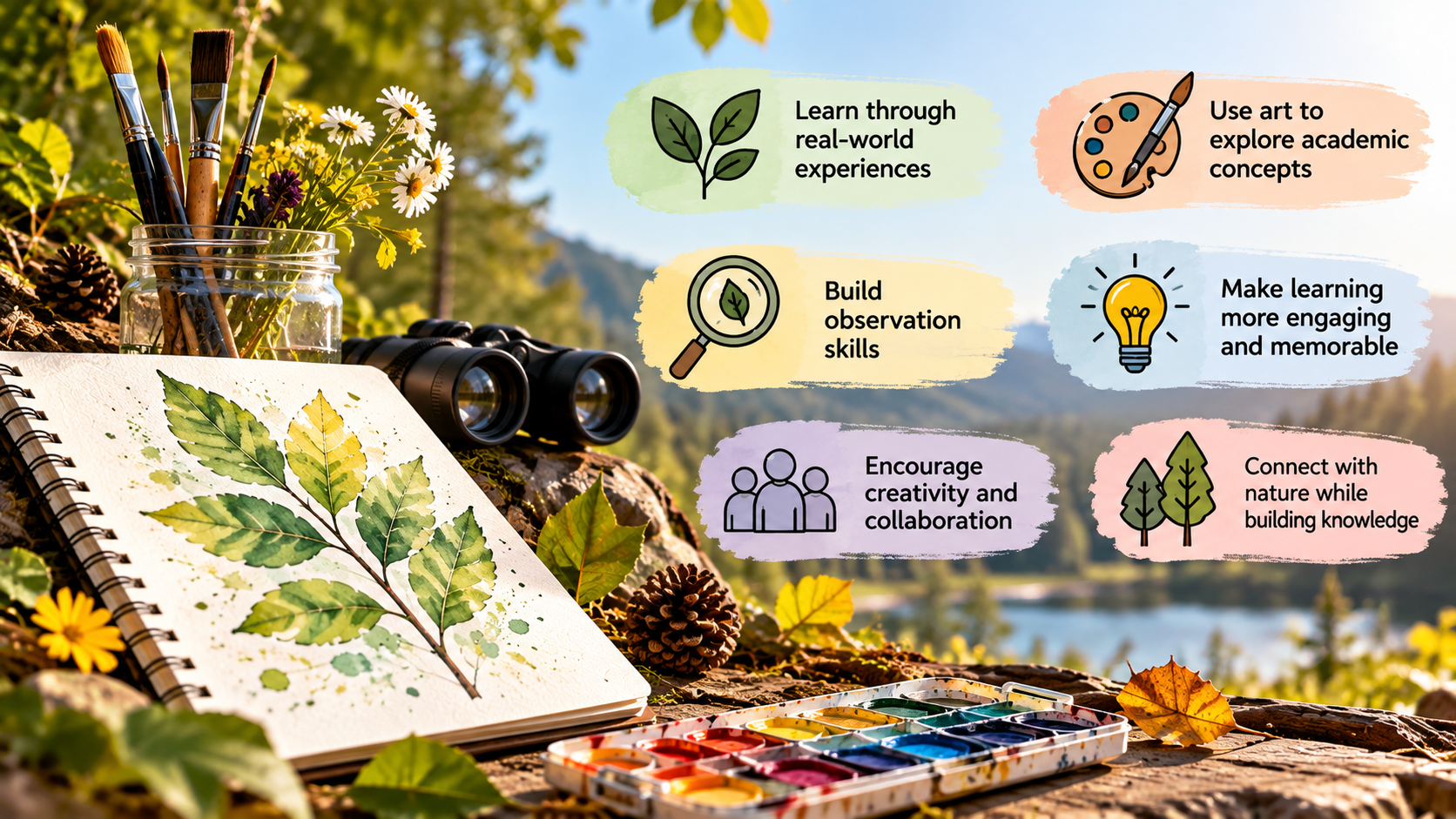
Stepping beyond traditional four-walled classrooms can transform how children understand difficult concepts. When educators combine creative disciplines with fresh air, abstract ideas can become easier to see and remember. Arts-integrated outdoor lessons give students a multisensory way to explore science, math, history, and language arts.
Rather than treating creative expression as an occasional activity, this approach connects artistic practice with academic learning. Students can use sketching, movement, music, photography, and sculpture to reinforce important concepts. Outdoor environments also provide natural subjects for observation, experimentation, and creative interpretation. For more ideas, see learning outside the classroom.
Research highlighted by the National Endowment for the Arts has examined connections between arts participation and learning, social, and cognitive outcomes. Nature can also provide an engaging setting that encourages curiosity, movement, observation, and collaboration.
This guide answers practical questions about experiential learning and outdoor education. You will find examples of integrated lessons, creative outdoor activities, and practical strategies for building purposeful learning routines outside. These ideas can support classroom teachers and homeschooling parents who want to combine academic learning with creative exploration.

What are some examples of art integration lessons?
Concrete art integration lessons connect creative practice directly with specific academic goals. For example, students studying geometry can explore their surroundings for angles, shapes, symmetry, and patterns. They can record their findings through perspective drawings or labeled sketches. This approach makes geometric concepts visible in everyday environments.
In science, learners can study plant life cycles by examining fallen flowers, leaves, or seed structures. They can create detailed botanical illustrations and add accurate scientific labels. The artistic task then reinforces observation and scientific vocabulary.
Historical storytelling offers another practical option. Students can research local stories or historical events before creating outdoor dioramas from safe, naturally available materials. They can use the model to explain geography, sequence, and cultural context. This approach can also complement global school styles and classroom differences when exploring how education varies across countries.
Effective arts-integrated outdoor lessons should always connect the creative task to a clear academic objective. The artwork is not simply decoration. It becomes a tool for observing, explaining, documenting, or demonstrating understanding.
Botanical Watercolor Studies for Life Science
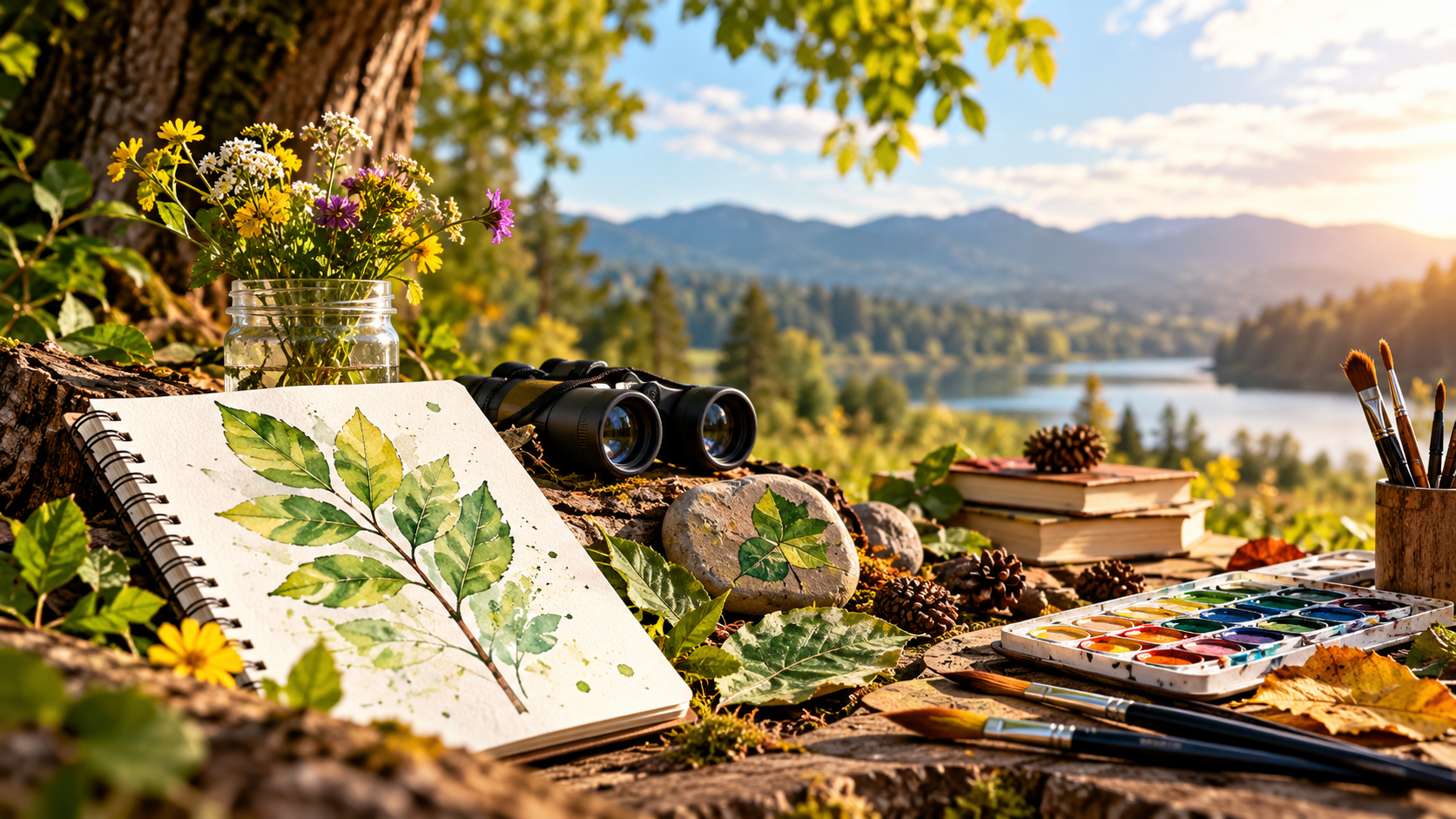
Botanical watercolor studies combine scientific observation with visual art and can work well during outdoor life science lessons. Students begin by collecting suitable fallen leaves rather than damaging living plants. They can identify each specimen with a field guide or classroom reference material.
Next, students observe differences in shape, texture, veins, margins, and color. They then use primary watercolor paints to approximate the natural colors they observe. This process introduces basic color theory while encouraging careful scientific observation.
Students can label important structures on their finished illustrations. Depending on their age, labels may include the leaf blade, veins, stem, and other relevant features. Older students can connect observations to topics such as photosynthesis, seasonal change, or plant adaptation.
The finished paintings can become part of an outdoor science journal or classroom display. Teachers can assess both scientific accuracy and artistic observation. This makes the activity more than a traditional painting exercise because students must communicate information visually.
What are some creative art activities for outdoors?
Outdoor environments provide many opportunities for hands-on artistic exploration. One simple activity is ephemeral land art, where students arrange fallen twigs, stones, acorns, and dry leaves into temporary patterns. They can create mandalas, geometric designs, or nature-inspired compositions. Once photographed, the artwork can naturally return to the environment.
Sun-printing offers another engaging option. Students arrange safe natural objects, such as grasses and fern fronds, on light-sensitive paper. Depending on the materials and process used, sunlight can create striking silhouettes and patterns. Teachers should follow the safety instructions for the specific materials.
Bark rubbing is another accessible activity. Children can place paper over suitable textured surfaces and use charcoal or crayons to reveal patterns. Several rubbings can later become a large collaborative landscape or texture collage.
These outdoor art activities for kids encourage observation and experimentation without requiring expensive equipment. They also help children notice natural textures, shapes, colors, and patterns. Teachers can extend the activities by asking students to describe what they observed and explain how their artistic choices represent the environment. Activities like these can also help address when students lose their curiosity by giving them opportunities to explore and ask questions.
What are art-integrated activities?
Art-integrated activities are intentional learning experiences that use an art form to support learning in another subject. Unlike a simple arts-and-crafts session, an integrated activity has clear objectives for both the artistic process and the academic subject.
For example, students can choreograph a short movement sequence representing the water cycle. To complete the activity successfully, they must understand concepts such as evaporation, condensation, and precipitation. At the same time, they practice movement, timing, spatial awareness, and creative expression.
Other arts-integrated outdoor lessons can connect drawing with environmental science, music with language development, or sculpture with mathematics. The important factor is the connection between the two learning goals.
Students also benefit because they have another way to demonstrate understanding. A learner who struggles to explain an idea through a traditional written response may communicate it effectively through movement, visual design, or sound.
Teachers should therefore plan the academic and artistic objectives before beginning. This keeps the activity purposeful and prevents the creative component from becoming disconnected from the lesson.
Defining Dual Objectives in Practice
Authentic art integration requires educators to establish two connected learning objectives. One objective should relate to the academic subject, while the other should address the selected art form.
For example, students creating an illustration of an outdoor habitat can demonstrate scientific knowledge by accurately showing relationships between organisms. Their artistic objective might focus on composition, proportion, color, or tonal shading. Both objectives should be visible in the final assessment.
Teachers can make these expectations clear with a simple rubric. One section can measure academic understanding, while another evaluates the relevant artistic skills. This approach helps students understand that both areas matter.
The two objectives should also support each other. A drawing task should require students to observe and communicate scientific information, rather than simply decorate a worksheet. Similarly, a musical activity should reinforce the concept being studied.
This balanced structure keeps arts integration in education academically meaningful. It allows creative exploration while maintaining appropriate subject expectations. Outdoor settings can make this process especially effective because students can observe real objects and phenomena before representing them artistically.
What are some examples of art-integrated learning?
Art-integrated learning can connect outdoor observation with subjects across the curriculum. In environmental science, students can listen to birds and record different sounds in field journals. They can represent patterns through simple graphic symbols before discussing how animals communicate.
Mathematics provides another opportunity. Students can search for naturally occurring spirals in pinecones, plants, or shells. They can sketch these patterns, compare proportions, and discuss mathematical sequences or geometric forms. Teachers should introduce the mathematical concept at an age-appropriate level rather than assuming every natural spiral follows a precise mathematical pattern.
Social studies can also become more physical and creative. Students can reconstruct historical trade routes across an outdoor space using maps, clay, sand, and pebbles. They can then explain how geography influenced movement, resources, and settlement.
Language arts can be integrated through nature journaling and descriptive writing. Students observe a landscape, create a quick sketch, and write a short description using sensory language. These activities can also support building a child’s vocabulary naturally by encouraging children to describe what they see and experience.
These arts-integrated outdoor lessons turn abstract ideas into experiences. Students observe, create, discuss, and reflect instead of relying only on memorization.
What are some good outdoor learning activities for kids?
Effective outdoor learning activities give children opportunities to observe, move, create, and investigate. A scavenger hunt focused on symmetry can ask children to find balanced leaves, paired natural forms, or objects with repeated patterns. The activity can introduce connections between biology, geometry, and visual design.
Weather observation stations provide another practical option. Children can make simple windsocks, observe cloud formations, and record weather conditions in outdoor journals. Older students can compare observations across several days and create visual charts.
A mud kitchen can support early science exploration when children mix soil and water. They can observe changes in texture, consistency, and saturation while creating simple structures or vessels. Adults should supervise the activity and ensure that materials are safe and clean.
Nature journaling is also useful because it combines drawing, writing, and observation. Children can sketch an object and describe its color, texture, shape, or movement.
The strongest outdoor learning activities for kids have a clear purpose but still allow exploration. They should encourage questions rather than provide every answer immediately. This balance supports curiosity, creativity, movement, and meaningful experiential learning.
Frequently Asked Questions
How do arts-integrated lessons support traditional academic standards?
Art-integrated approaches align directly with national educational standards by anchoring creative tasks to measurable benchmarks. Instead of memorizing abstract formulas, students actively demonstrate principles like geometric ratios or biological systems through visual, kinesthetic, or auditory mediums. This dual-objective structure deepens cognitive processing, accommodates diverse learning styles, and increases information recall without sacrificing academic rigor.
What basic materials are needed to begin outdoor arts integration?
You do not need expensive supplies to start effective outdoor teaching. Basic materials include sturdy clipboards, unlined sketchbooks, watercolor pencils, wax crayons, measuring tapes, and recycled paper. Natural loose parts—such as fallen bark, seedpods, twigs, and smooth stones—serve as free, sustainable resources for sculptures, engineering tasks, and patterning activities.
How do teachers manage student behavior during outdoor lessons?
Effective outdoor management begins with establishing explicit physical boundaries and concrete routines before leaving the classroom. Educators should set distinct gathering signals, outline safety expectations, and assign clear, hands-on tasks immediately upon arrival outside. Keeping students actively involved in sensory exploration and documentation minimizes distractions and keeps energy directed toward collaborative learning.
Conclusion
Stepping outside the traditional classroom enriches educational practice by uniting academic discovery with organic creativity. Implementing arts-integrated outdoor lessons provides students with a refreshing, hands-on approach to complex subjects like ecology, geometry, physics, and creative writing. When children manipulate natural materials, observe light and shade, and sketch real-world phenomena, their retention improves alongside their emotional well-being. These multi-sensory experiences replace rote memorization with authentic curiosity, helping young learners draw meaningful connections between their textbooks and the natural world.
Educators do not need specialized outdoor classrooms or costly equipment to make an immediate impact. By starting with simple adjustments—such as botanical watercolor studies, sidewalk chalk geometry, or acoustic sound maps—you can immediately elevate daily curriculum standards. Step into the open air, embrace the changing seasons, and invite your students to observe, create, and thrive across every learning discipline.