
AI Glasses Can Replace Your Prescription Glasses, But Should They?
Wearable technology is moving onto our faces, with AI glasses leading the way in consumer electronics. Major technology and eyewear brands now offer smart frames with built-in cameras, audio, and AI assistants. These devices can translate languages, answer questions, and capture photos hands-free.
For people who wear prescription eyewear, this technology offers an interesting alternative. Instead of carrying separate gadgets, you can combine vision correction and smart features in one pair of glasses.
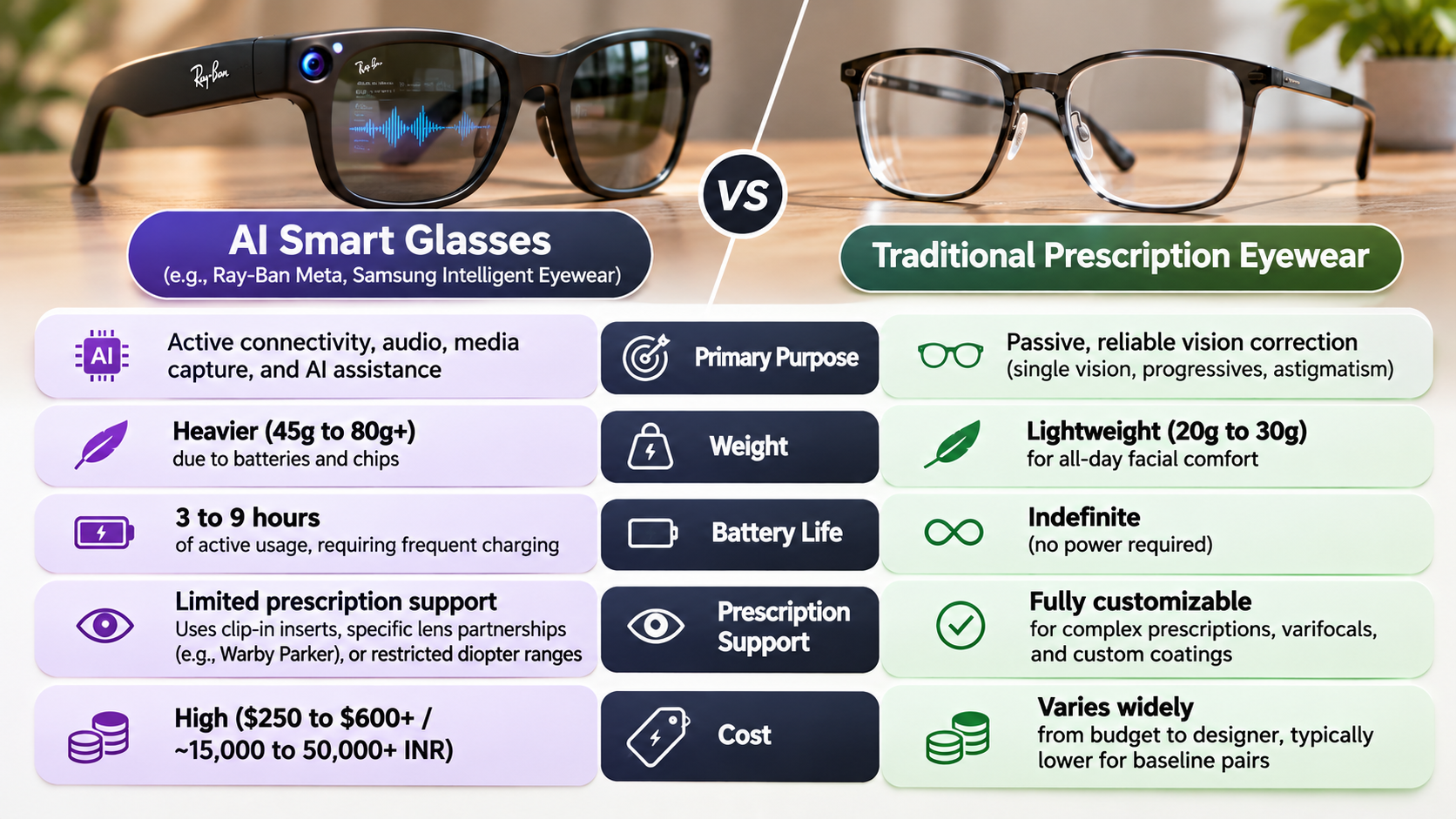
However, replacing traditional prescription glasses involves several trade-offs. Battery life, frame weight, lens compatibility, and privacy all affect everyday usability. Some models also have limitations when accommodating stronger prescriptions.
This guide explores whether AI glasses can replace your regular eyewear. We examine prescription compatibility, minus 7.5 eyesight, privacy restrictions, battery performance, and potential safety concerns. By the end, you will understand whether smart eyewear is practical for everyday use.
Can You Use AI Glasses Instead of Prescription Glasses?
Yes, you can use AI glasses instead of prescription glasses if the selected model supports your vision requirements. Several manufacturers offer prescription-ready smart frames. These include products from Ray-Ban Meta and other connected eyewear brands. For a closer look at their features, design, and everyday performance, explore our Meta Glasses Review.
Depending on the model, you can choose single-vision or progressive lenses. Some manufacturers also support prescription sunglasses and different lens treatments. You can order through participating optical retailers or approved online stores.
However, prescription compatibility varies between products. The electronics inside smart frames can limit lens thickness, frame adjustments, and available sizes. Therefore, not every prescription will fit every model.
Before purchasing, check the manufacturer’s prescription guidelines. Confirm your sphere, cylinder, axis, and pupillary distance requirements with an optician. You should also consider frame comfort and lens positioning.
AI glasses can replace traditional eyewear when their optical specifications meet your needs. Otherwise, conventional prescription frames remain the more practical option.

Lens Compatibility and Optical Limits
Prescription compatibility is one of the most important factors when choosing AI glasses. Manufacturers establish different prescription limits based on frame construction and available lens designs.
For example, Ray-Ban Meta prescription compatibility depends on the specific product and market. Some models support prescriptions within a limited range. Other compatible products and retailers may support wider ranges.
Before ordering, check these important details:
-
Sphere (SPH): Measures the correction needed for nearsightedness or farsightedness.
-
Cylinder (CYL): Indicates the correction required for astigmatism.
-
Axis: Specifies the orientation of astigmatism correction.
-
Pupillary distance (PD): Measures the distance between your pupils.
-
Lens type: Confirms whether single-vision or progressive lenses are supported.
Thicker prescriptions may require specialized lens materials. Frame size and lens curvature can also affect compatibility. Ask an optician to confirm the complete prescription before purchasing.
Is Minus 7.5 Eyesight Bad?
A prescription of -7.5 diopters indicates high myopia, also known as severe nearsightedness. People with this prescription generally struggle to see distant objects clearly without corrective lenses. High myopia is commonly defined as a correction of -6.00 diopters or more.
This prescription does not mean someone cannot live normally. Corrective glasses and contact lenses can provide clear vision. However, high myopia can increase the risk of certain eye conditions. These include retinal detachment, glaucoma, and other retinal changes.
Regular comprehensive eye examinations are particularly important for people with high myopia. An eye-care professional can monitor changes and identify potential complications early.
For AI glasses, the main challenge is optical compatibility. Strong prescriptions may require thicker or specially designed lenses. Some smart frames cannot accommodate these requirements. Therefore, check the manufacturer’s prescription limits before purchasing.
High-Index Lenses for High Myopia
If you have -7.5 eyesight, lens thickness and weight deserve particular attention. Stronger prescriptions often produce thicker lens edges. This can affect both appearance and comfort, especially with smaller smart frames.
High-index lenses can reduce thickness compared with standard lens materials. Options such as 1.67 and 1.74 may help accommodate stronger prescriptions. However, the best choice depends on your prescription, frame dimensions, and optical requirements.
Consider these factors before ordering:
-
Lens material: Ask whether high-index options are available for your selected frame.
-
Frame size: Smaller frames can help reduce lens thickness.
-
Lens design: Aspheric designs may improve appearance and reduce edge distortion.
-
Frame compatibility: Confirm that the lens can fit without affecting internal electronics.
-
Optical alignment: Ensure the optician can position the lenses correctly.
A 1.74 lens is not automatically necessary for every -7.5 prescription. Your optometrist or qualified optician should recommend suitable materials. If the manufacturer cannot support your prescription, traditional frames may provide a better solution.
Why Are Smart Glasses Being Banned?
Smart glasses face restrictions because of privacy concerns and unauthorized recording. Unlike smartphones, these devices look similar to ordinary prescription eyewear. People nearby may not immediately realize that a camera or microphone is active.
This creates concerns in places where privacy is especially important. Schools, healthcare facilities, changing rooms, and certain workplaces may restrict camera-equipped eyewear. Some organizations also prohibit recording to protect confidential information.
For example, some educational institutions have introduced restrictions on smart glasses across school premises and school-organized activities. Their policies address privacy, child safety, and data security concerns.
However, restrictions are not universal. Rules depend on local laws, organizational policies, and individual venue requirements. Before entering a restricted location, check its recording and device policies.
If you depend on AI glasses for vision correction, this creates another practical concern. You may need an alternative pair of prescription glasses when entering places that prohibit smart eyewear.
Workplace and Venue Restrictions
Workplaces and public venues may introduce specific rules for camera-equipped smart glasses. These restrictions are particularly relevant in environments containing confidential information or sensitive personal activities.
Privacy concerns surrounding smart glasses are increasing. Recording risks are particularly important in schools, hospitals, and workplaces. Organizations may introduce specific restrictions to protect individuals and confidential information.
Common situations where restrictions may apply include:
-
Schools and examination centres: To prevent unauthorized recording or potential academic misconduct.
-
Hospitals and clinics: To protect patient privacy and confidential medical information.
-
Corporate offices: To safeguard internal discussions, documents, and intellectual property.
-
Changing rooms: To protect individuals from unauthorized photography or video recording.
-
Private events: To respect organizers’ recording and photography policies.
Some devices include recording indicator lights. However, these indicators do not eliminate every privacy concern. Venue operators may still prohibit their use.
If AI glasses are your only prescription pair, these restrictions could become inconvenient. Keeping conventional prescription glasses as a backup is a practical precaution.
What Are the Downsides of Buying Smart Glasses in 2026?
Despite their advanced features, AI glasses have several practical disadvantages. Battery life, purchase price, repair costs, and hardware limitations can affect long-term value. If you want to understand these drawbacks in greater detail, explore the biggest disadvantages of using AI glasses before making a purchase decision. These concerns become more important when you plan to wear them throughout the day.
Battery performance varies significantly between models. Some first-generation smart glasses offer around four hours of moderate use. Newer models may provide considerably longer battery life. Actual performance depends on features, connectivity, and usage patterns.
The initial purchase price can also be considerably higher than traditional prescription eyewear. Adding customized lenses and coatings may increase the total cost.
Another concern is battery degradation. Rechargeable batteries gradually lose capacity over time. Replacing an entire smart frame can become expensive if the manufacturer does not offer economical repairs.
Therefore, consider the purchase price, battery performance, warranty, and repair options before making your decision.
Hidden Maintenance and Repair Costs
Smart glasses require different maintenance than conventional prescription frames. Their temples contain electronic components, batteries, speakers, and other delicate hardware. This makes ordinary frame adjustments more complicated.
Traditional opticians can often adjust standard frames using specialized heating equipment. However, applying excessive heat or pressure to electronic smart frames can damage internal components. Always follow the manufacturer’s fitting and maintenance instructions.
Consider these potential maintenance challenges:
-
Battery replacement: Some models have integrated batteries that are difficult to replace independently.
-
Water resistance: Protection varies by model. Water resistance does not necessarily mean waterproofing.
-
Frame adjustments: Electronic components can restrict bending and reshaping.
-
Repair availability: Not every optical shop can repair damaged smart eyewear.
-
Software support: Features may change or become unavailable through software updates or discontinued services.
These factors can increase ownership costs over time. Check the warranty coverage and authorized repair options before purchasing.
If you wear prescription glasses every day, reliability should matter more than additional technology. A conventional backup pair can also prevent inconvenience when your smart glasses need charging or repair.
Is It Safe to Wear Smart Glasses?
For most people, wearing properly manufactured smart glasses is not inherently unsafe. However, safety depends on how you use the device and which features it includes.
Wireless smart glasses generally use low-powered radiofrequency technology. In the United States, wearable devices must meet applicable exposure limits. Typical wearable devices operate at radiofrequency exposure levels below established regulatory limits.
Nevertheless, radiofrequency exposure is only one part of the safety discussion. Other concerns include visual distraction, reduced situational awareness, and improper use while driving.
For example, responding to voice commands or checking visual notifications while crossing roads can distract you. Using connected eyewear while driving can also divert attention from surrounding traffic.
You should treat AI glasses as electronic devices rather than ordinary eyewear. Understand their limitations and follow manufacturer instructions.
Choose features that support your daily activities without creating unnecessary distractions. If a particular model includes a display, learn how it works before relying on it regularly.
Managing Digital Eye Strain
Some smart glasses include near-eye displays that show notifications, navigation information, or other visual content. Repeatedly switching attention between distant surroundings and nearby graphics may cause visual discomfort for some users. This has also increased interest in screen-free technology trends that reduce dependence on constant digital interactions.
However, not all AI glasses contain displays. Camera-equipped models with audio assistants work differently from display-based smart eyewear. Therefore, the potential for digital eye strain depends on the device’s design and usage.
To make daily use more comfortable, follow these practical precautions:
-
Adjust display brightness: Use comfortable brightness settings in different lighting conditions.
-
Limit continuous viewing: Avoid spending unnecessary time reading information through near-eye displays.
-
Take regular breaks: Look away from digital content and focus on distant objects.
-
Manage notifications: Disable unnecessary alerts during activities requiring concentration.
-
Maintain proper fit: Ensure the frames sit comfortably and the lenses are correctly positioned.
Avoid interacting with smart displays while driving or cycling. Prioritize your surroundings rather than digital notifications. If you experience persistent headaches, blurred vision, or discomfort, consult an eye-care professional.
Conclusion: Should You Replace Your Prescription Glasses With AI Glasses?
AI glasses can replace traditional prescription glasses, but they are not the right choice for everyone. They combine vision correction with useful features such as hands-free photography, voice assistants, audio, and real-time information. However, their practical value depends on your prescription, daily routine, and expectations.
Before switching, consider a few important factors:
-
Prescription compatibility: Make sure the selected frame supports your exact prescription, especially if you have high myopia.
-
Battery life: Check whether the battery can last throughout your typical day.
-
Privacy: Understand where camera-equipped glasses are restricted.
-
Long-term costs: Consider repairs, battery degradation, replacement costs, and warranty coverage.
-
Everyday comfort: Choose frames that fit properly and remain comfortable during extended use.
For people with mild to moderate prescriptions, AI glasses can be a convenient everyday option. However, those with stronger prescriptions, such as -7.5, should confirm lens compatibility with an optician before purchasing.
If you are considering making the switch, explore the Ray-Ban Meta Smart Glasses to understand their features and available prescription options.
The smartest approach is to treat AI glasses as an alternative, not an automatic replacement for traditional eyewear. If you depend on prescription glasses throughout the day, keeping a conventional backup pair is worthwhile. Ultimately, clear vision, comfort, and eye health should always come before technology.