How Does Energy Travel Through Space Without Matter?
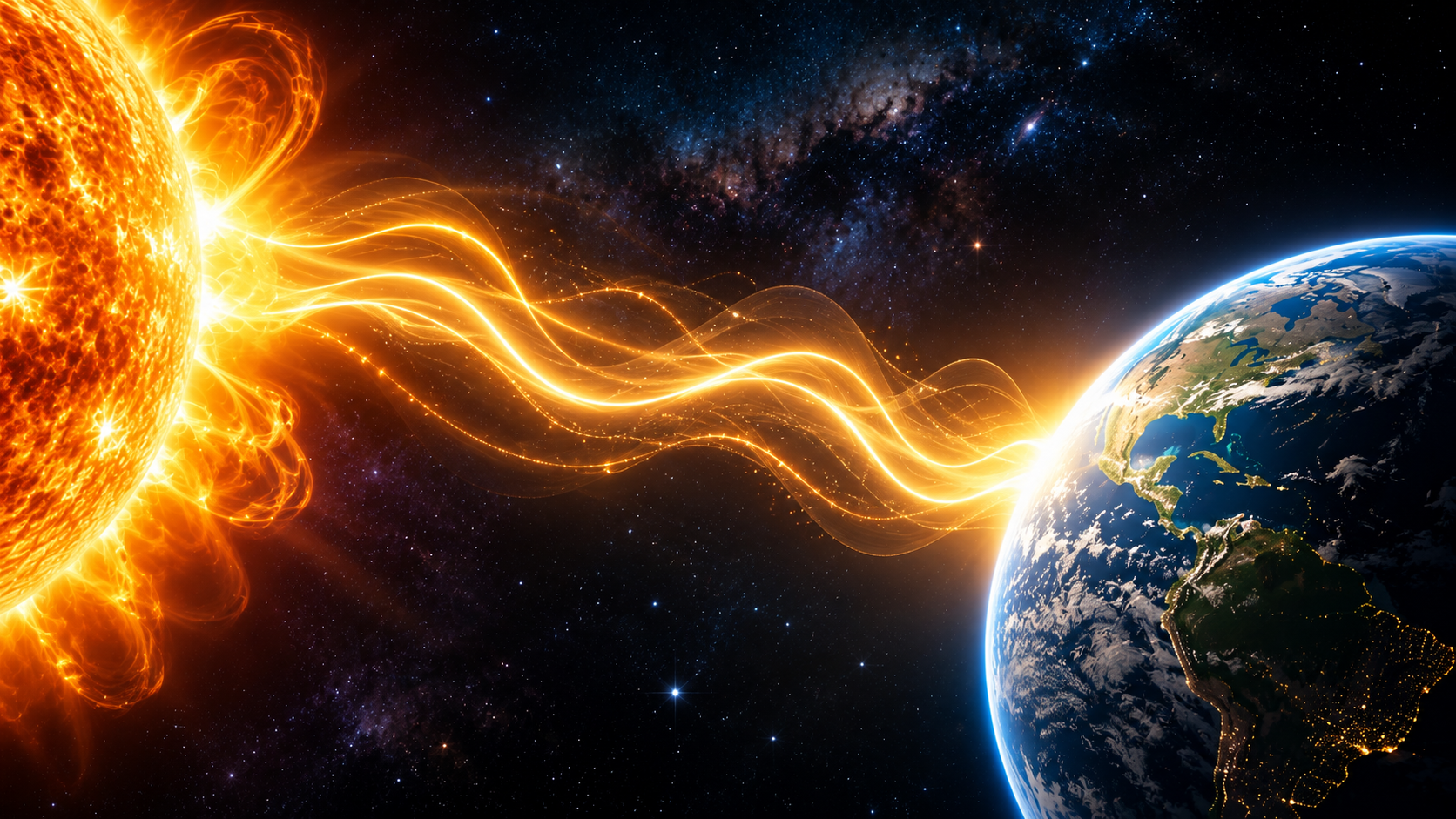
Look up at the night sky, and you are staring into a vast, nearly empty expanse. Earth sits roughly 93 million miles from the Sun, separated by an enormous cosmic void. Yet every morning, sunlight warms our planet and powers global ecosystems. So, how does energy travel through space when there is virtually no physical medium to carry it?
On Earth, energy often transfers through solid matter, liquids, or gases. Sound waves travel through vibrating air molecules, while a metal spoon heats up in a pot of boiling soup. Space, however, lacks the dense particles needed for conduction and convection to work normally. According to NASA, electromagnetic radiation can carry energy across a vacuum without requiring a material medium.
Understanding this process reveals fundamental principles of physics and astronomy. In this guide, we explore how electromagnetic radiation transports energy across the universe. We will also examine whether you would freeze instantly in space, why objects with mass cannot reach the speed of light, and whether completely empty space can exist. Finally, we will explain how sunlight warms your skin across millions of miles and what happens when individual photons interact with your body.
How does energy travel through space?
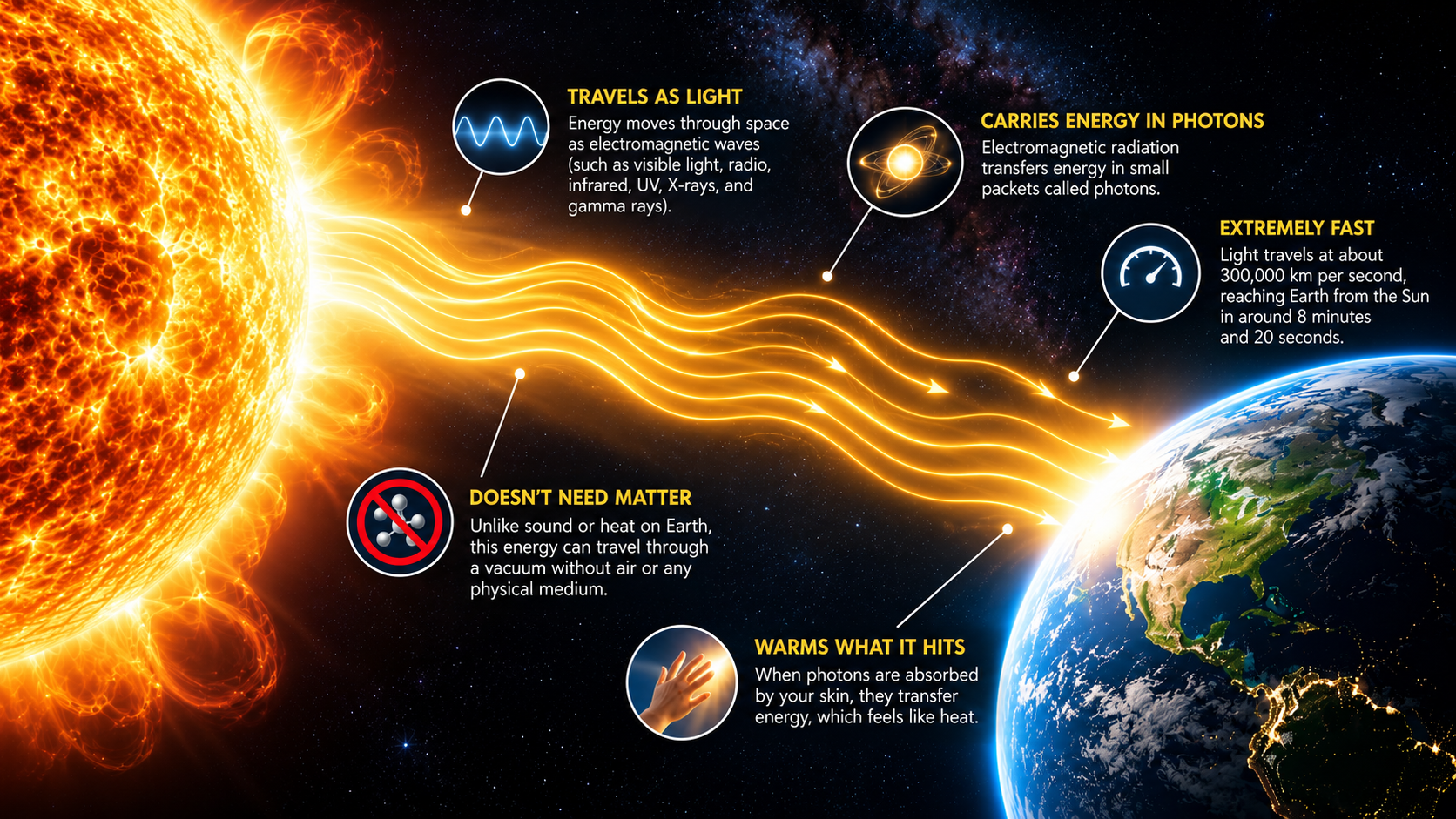
Energy travels through the vacuum of space primarily through electromagnetic radiation. Unlike sound waves or water ripples, electromagnetic waves do not require a material medium. They consist of changing electric and magnetic fields that propagate together through space. These fields can carry energy and momentum across enormous cosmic distances without physical contact between objects.
Light is one form of electromagnetic radiation. Other forms include radio waves, microwaves, infrared radiation, ultraviolet radiation, X-rays, and gamma rays. Each type has a different wavelength and frequency, but all travel at approximately 300,000 kilometers per second in a vacuum. This speed allows sunlight to reach Earth in about eight minutes and twenty seconds.
Electromagnetic radiation transfers energy through photons, which are its quantum units. When photons reach an object, they may be absorbed, reflected, or transmitted. Absorbed photons transfer energy to the object’s particles, potentially increasing its temperature. This process explains how sunlight warms planets, how stars illuminate distant galaxies, and how radio signals cross the vacuum between spacecraft and Earth.
The Role of Self-Sustaining Wave Fields
The ability of electromagnetic radiation to travel through a vacuum follows from the fundamental laws of electromagnetism. Physicist James Clerk Maxwell developed equations describing how electric and magnetic fields interact. These equations predict that changing electric and magnetic fields can propagate through space as electromagnetic waves.
In a traveling electromagnetic wave, the electric and magnetic fields oscillate perpendicular to each other and to the direction of propagation. Unlike mechanical waves, these oscillations do not require atoms or molecules to vibrate. The fields can exist and evolve even where ordinary matter is absent.
Light also exhibits wave-particle duality. Its wave properties explain phenomena such as interference and diffraction, while its particle-like behavior explains how individual photons transfer energy in discrete amounts. Together, these properties explain how electromagnetic radiation carries energy across the vacuum without needing a physical substance to transport it. Learn more about atmospheric light scattering and why the sky is blue to understand how light behaves when it interacts with matter.
Would we feel cold in space?
You would not freeze instantly if suddenly exposed to the vacuum of space. Although space has a background temperature of approximately 2.7 kelvin, or minus 270.45°C, this figure describes the cosmic microwave background radiation. It does not mean every object in space automatically reaches that temperature.
On Earth, heat transfers through conduction, convection, and radiation. Conduction transfers energy through interactions between neighboring particles. Convection carries heat through the movement of fluids, such as air or water. Both processes become ineffective in a near-perfect vacuum because very few particles are available to transfer thermal energy.
Radiation, however, does not require matter. Your body continuously emits infrared radiation, losing energy to its surroundings. In space, this radiative cooling can gradually lower your body temperature. The actual cooling rate depends on several factors, including sunlight exposure, the object’s temperature, its surface properties, and its ability to retain heat.
An unprotected human would face immediate, life-threatening dangers long before gradually freezing. The vacuum causes severe physiological problems, and exposure would quickly become fatal without protection. Therefore, the idea that someone would instantly turn into an ice block is misleading. Heat loss through radiation takes time, even though exposure to space is immediately dangerous.
Why can’t we reach lightspeed?
Objects with mass cannot reach the speed of light in a vacuum because doing so would require an unlimited amount of energy. According to Albert Einstein’s special theory of relativity, accelerating a massive object closer to light speed requires increasingly more energy. The object can continue gaining speed, but each additional increase becomes progressively harder to achieve.
Light travels at approximately 299,792 kilometers per second in a vacuum. Photons have zero rest mass, allowing them to travel at this speed. Spacecraft, planets, and human beings have rest mass, so they cannot reach the same velocity through ordinary acceleration.
This limitation does not mean traveling near light speed is impossible. In principle, a spacecraft could approach the speed of light with sufficient energy and suitable technology. However, the energy requirements, engineering challenges, and dangers of high-speed travel make such missions extremely difficult. These principles also help explain how rocket engines work, including their speed and heat.
Relativity also changes how observers measure time and distance at high velocities. For a traveler moving close to light speed, less proper time may pass than for someone remaining on Earth. These effects are real consequences of relativity, but they do not remove the fundamental speed limit for objects with mass.
Mass-Energy Equivalence Sets Universal Boundaries
Einstein’s famous equation, (E = mc^2), expresses the relationship between mass and energy. Here, (E) represents energy, (m) represents rest mass, and (c) represents the speed of light in a vacuum. The equation shows that even a small amount of mass corresponds to a substantial amount of energy.
However, mass-energy equivalence alone does not explain why accelerating a spacecraft to light speed is impossible. Special relativity provides the additional principle: the total energy of an object with rest mass increases without bound as its velocity approaches the speed of light.
As a spacecraft approaches this limit, each additional increase in velocity requires progressively more energy. Reaching exactly light speed would require infinite energy under special relativity. No finite fuel supply or energy source can meet that requirement.
This restriction applies to objects with nonzero rest mass. Photons have zero rest mass and travel at light speed in a vacuum. Massive particles can approach this speed, but they cannot reach it through acceleration. The distinction establishes a fundamental boundary for spacecraft, human exploration, and other forms of matter.
Is it possible to have space without matter?
Yes, vast regions of space can exist with extremely little ordinary matter. The space between galaxies contains far fewer particles than Earth’s atmosphere. In some regions, the average density can be lower than one atom per cubic meter, although actual densities vary considerably across the universe.
However, a vacuum does not necessarily mean absolute nothingness. Even where ordinary particles are absent, physical fields can still exist. The electromagnetic field, gravitational field, and Higgs field are examples of fields that form part of our current understanding of the universe.
Quantum field theory also predicts fluctuations in quantum fields. These fluctuations contribute to measurable physical effects, including the Casimir effect under suitable conditions. Popular explanations sometimes describe these fluctuations as virtual particles briefly appearing and disappearing. However, virtual particles are mathematical elements of quantum calculations, not ordinary particles directly observed popping into existence.
Space itself also has physical properties. It can expand, and changes in the gravitational field can propagate as gravitational waves. These waves have been detected even though they do not require conventional matter to travel through space. Observing distant galaxies also depends on advanced instruments, including the biggest telescopes in the world, which help astronomers study the universe.
Therefore, a region can contain virtually no ordinary matter while still having physical fields and measurable properties. Whether absolute nothingness is possible is a deeper philosophical and theoretical question. Modern physics does not establish that every conceivable form of nothingness is impossible.
Can we feel heat in space?
Yes, an object can receive substantial heat from sunlight in space. Solar energy travels across the vacuum as electromagnetic radiation, primarily in the visible, infrared, and ultraviolet parts of the spectrum. When this radiation reaches an object, some of its energy may be absorbed and converted into internal energy. On Earth, renewable technologies harness natural energy sources, as explored in this guide to the future of offshore wind farms.
On Earth, the atmosphere scatters and absorbs some incoming sunlight. In space, sunlight travels without passing through Earth’s atmosphere, although radiation can still be absorbed or scattered by dust and other material. An object exposed to direct sunlight can therefore absorb substantial solar energy.
However, the temperature an object reaches depends on more than sunlight alone. Its distance from the Sun, surface color, reflectivity, orientation, thermal conductivity, and ability to radiate energy all matter. A sunlit spacecraft and a shaded spacecraft can experience very different thermal conditions.
Near Earth, an object in direct sunlight may become extremely hot, while its shaded surfaces can become much colder. Temperatures exceeding 120°C are possible for some sunlit spacecraft surfaces under particular conditions, but this is not a universal temperature for human skin or every object in orbit.
You would not safely experience these conditions without a spacesuit. An unprotected human would suffer severe physiological effects from exposure to vacuum. Astronauts rely on spacesuits and spacecraft thermal-control systems to manage temperature and maintain survivable conditions.
What happens when a photon hits your body?
When a photon reaches your body, it may be absorbed, reflected, or transmitted through the material. The outcome depends on its wavelength, the properties of your skin, and the molecules it encounters. Absorbed photons transfer energy to matter, initiating processes that can produce heat or chemical changes.
Infrared radiation is strongly associated with thermal energy transfer. When skin absorbs infrared photons, the energy can increase molecular motion and contribute to warming. Your body detects temperature changes through specialized sensory receptors in the skin, which send signals through the nervous system.
Visible light interacts with pigments and other molecules in the skin. Some of this energy becomes heat, while other energy can trigger chemical reactions. The precise outcome depends on the wavelength and the absorbing molecules. This is why different materials respond differently to sunlight. The same principles of light interaction help explain atmospheric light scattering and why the sky is blue.
Ultraviolet radiation carries more energy per photon than visible light. When skin absorbs ultraviolet radiation, it can damage DNA and other cellular components. This damage contributes to sunburn, premature skin aging, and an increased risk of skin cancer. X-rays and gamma rays have even higher photon energies and can cause ionization, in which electrons are removed from atoms or molecules.
Not every absorbed photon causes harmful damage. The effects depend on the photon’s energy, the amount of exposure, and the body’s response. Understanding these interactions helps explain both the benefits of sunlight and the importance of protecting skin from excessive ultraviolet exposure.
Frequently Asked Questions
Does sound travel through space?
No, sound cannot travel through space because it is a mechanical wave that requires a physical medium, such as air, water, or solids, to transmit vibrations. Space is nearly a vacuum, so sound cannot travel through it normally. Understanding this helps explain how does energy travel through space through different types of waves.
How fast does energy move across the vacuum of space?
Electromagnetic energy travels through the vacuum of space at the speed of light, approximately 299,792 kilometers per second (186,282 miles per second). Photons carry this energy across vast distances without requiring a physical medium. This explains how does energy travel through space from the Sun to Earth in about eight minutes.
Why does space appear dark if sunlight travels through it?
Space appears dark because it contains very little matter to scatter sunlight toward our eyes. We see light when it enters our eyes directly or reflects off objects. Understanding how does energy travel through space helps explain why sunlight can cross the vacuum while the surrounding sky remains mostly dark.
Conclusion
Understanding how does energy travel through space unlocks the remarkable physics operating across our cosmos. While the vacuum lacks ordinary matter, it is never genuinely inactive. Self-sustaining electromagnetic waves journey endlessly across billions of light-years, transferring vital heat and illumination via tireless photons. This radiation warms planetary surfaces, governs cosmic temperatures, and drives satellite communications. Next time you step outdoors and feel the Sun’s radiant warmth, remember you are experiencing energy that crossed millions of miles of empty void without touching a single particle, proving that the vacuum is alive with power.