
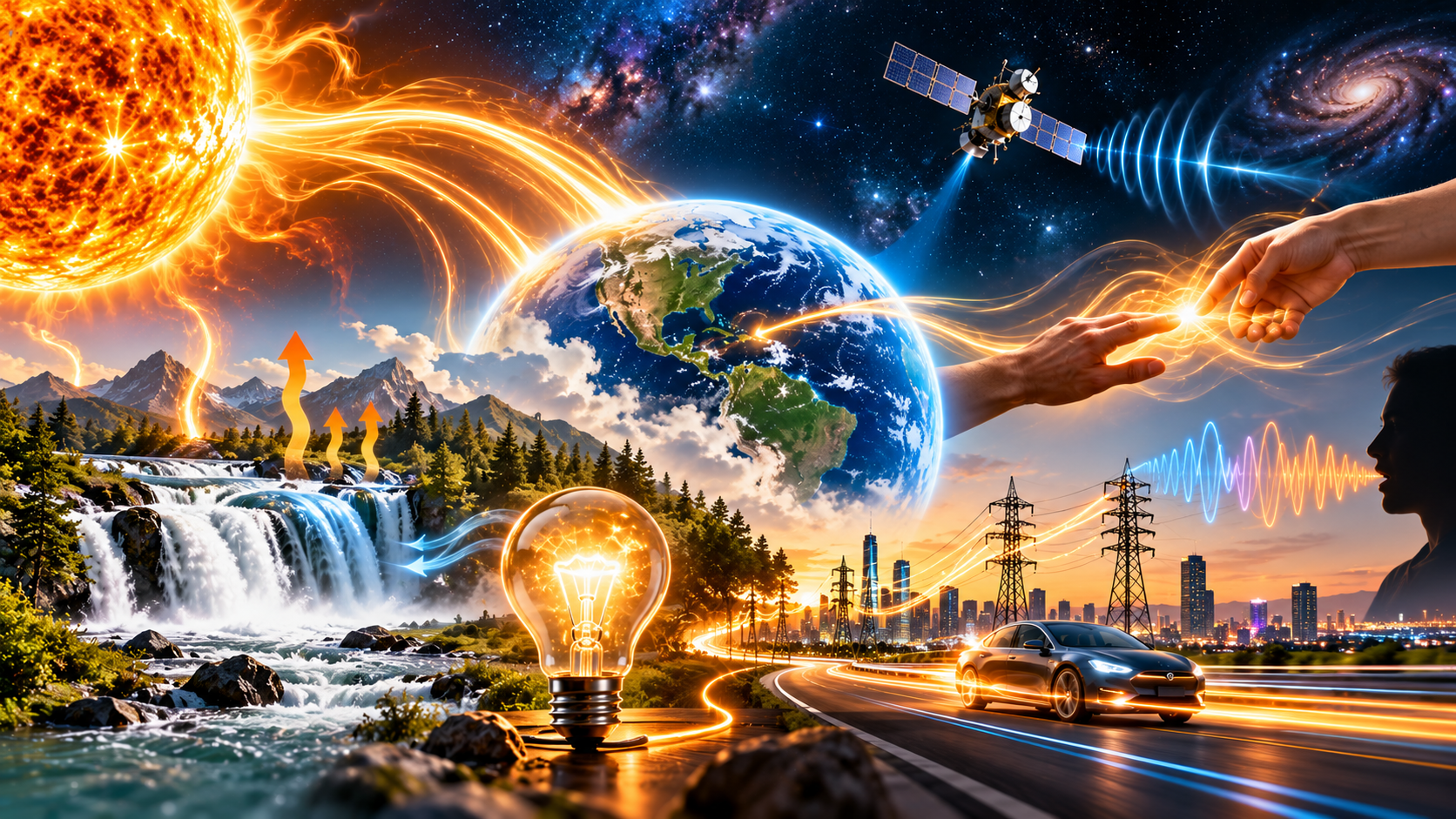
How Energy Travels: The Science of Movement and Speed
Everything that happens in our universe depends on the transfer and transformation of energy across space and time. Understanding how energy travels helps explain why the Sun warms our planet, how electric grids power our cities, and how radio signals travel across the cosmos. According to fundamental physics, energy cannot be created or destroyed in an isolated system. Instead, it changes form or transfers between objects and systems, as explained by NASA’s overview of energy.
Energy moves and shifts through four main transfer methods: mechanical work, electrical transmission, heating, and electromagnetic radiation. These mechanisms transfer energy through forces, electric currents, temperature differences, and waves. They help explain everything from moving vehicles and household appliances to sunlight reaching Earth.
In this guide, we explore each energy transfer method step by step. You will discover how energy passes between people and objects, how electromagnetic waves travel through a vacuum, and what causes objects to move. We will also examine cosmic speed limits, calculate how far light travels in one hour, and investigate whether spacecraft could realistically reach half the speed of light.
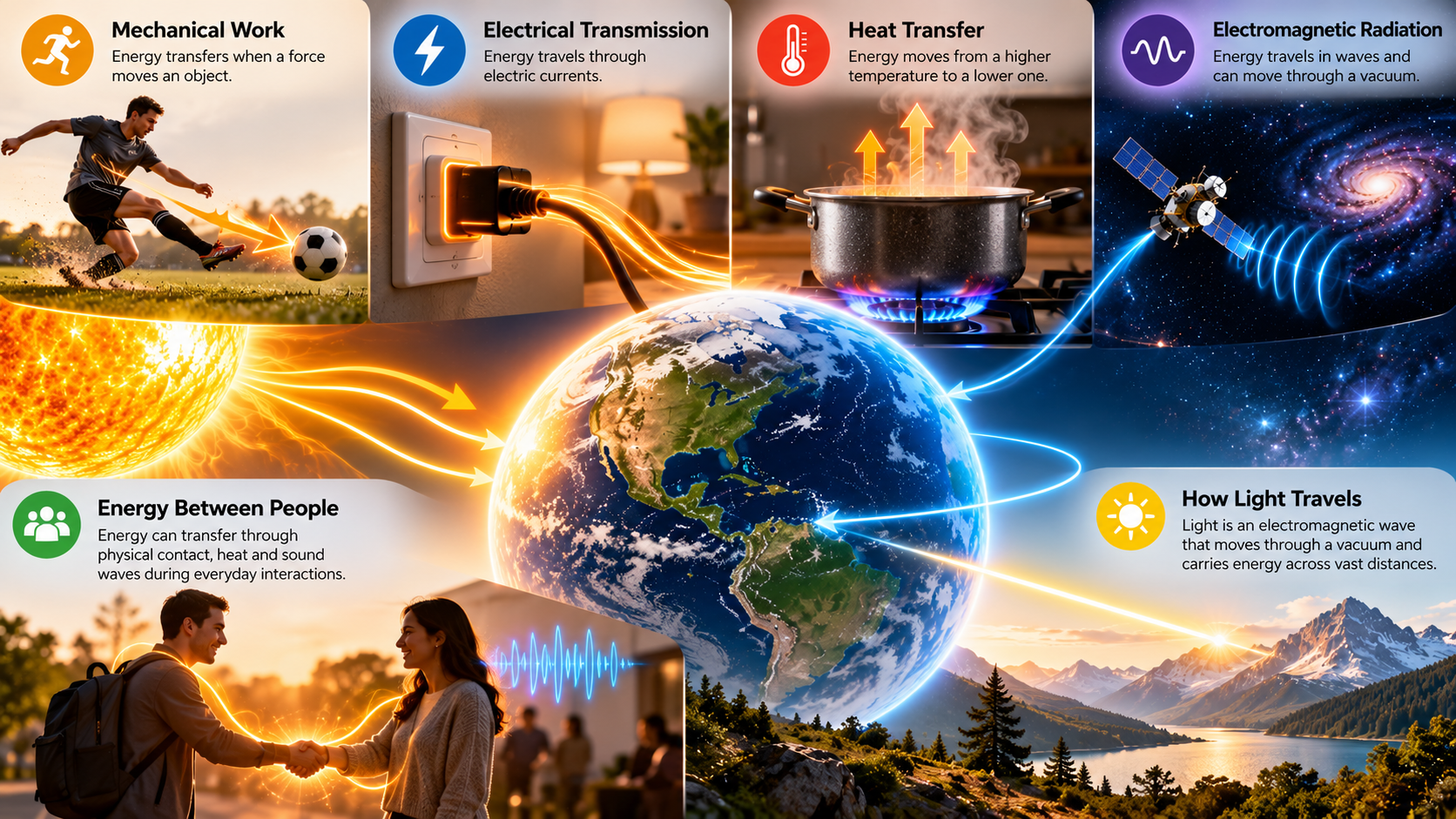
Energy moves and shifts through four main transfer methods:
– Mechanical work: Energy transfers when a force acts on an object and moves it. Examples include kicking a soccer ball, pushing a heavy box, and lifting a weight. The amount of energy transferred depends on the force and the distance moved in the force’s direction.
– Electrical transmission: Energy transfers through electric currents in circuits and wires. For example, electricity travels through a household circuit to power a lamp. Moving electric charges carry energy, which electrical devices convert into light, heat, sound, or motion.
– Heating (thermal energy transfer): Energy transfers as heat from a higher-temperature region to a lower-temperature region. Heat moves through three main processes:
-
Conduction: Energy transfers through direct contact between particles, such as a metal spoon becoming hot in a pot of soup.
-
Convection: Energy transfers through the movement of fluids, including liquids and gases. Boiling water and rising warm air demonstrate this process.
-
Radiation: Energy transfers through electromagnetic waves, such as sunlight warming Earth’s surface.
– Electromagnetic radiation: Energy travels through electromagnetic waves, including visible light, infrared radiation, and radio waves. Unlike conduction and convection, electromagnetic radiation can travel through a vacuum without requiring matter. For example, sunlight crosses space before reaching Earth, while radio signals can carry information between spacecraft and ground stations.
Can energy be transferred from person to person?
Understanding how energy travels between people starts with measurable physical processes, including mechanical work, heat, and sound. These exchanges happen during everyday interactions, such as shaking hands, hugging, or speaking with someone. They do not require mystical fields or invisible personal energy.
When you shake hands or brush shoulders with another person, your muscles perform mechanical work. Physical contact transfers forces and may transfer kinetic energy between the two bodies. Heat also flows between people when their skin temperatures differ. Meanwhile, conversations transmit acoustic energy through air as sound waves. These waves travel to another person’s ears, where they cause vibrations that the auditory system detects.
These examples show how energy travels through several physical pathways during ordinary human interactions. Understanding these processes helps distinguish measurable energy exchanges from popular claims about human auras or other unverified energy fields.
Thermal Conduction and Radiative Body Heat
The human body converts chemical energy from food into movement and other biological processes. Some of this energy eventually dissipates as heat. Your body continuously exchanges thermal energy with its surroundings through conduction, convection, and radiation. These processes explain how energy travels between your body and the environment. Understanding how the body processes nutrients also helps explain the stages of the digestive system and how food provides energy.
When you sit beside someone, your body emits infrared radiation that can be absorbed by theirs. If you touch, conduction transfers heat directly between your skin and theirs. Heat generally flows from the warmer surface toward the cooler one until their temperatures become more balanced. However, complete thermal equilibrium rarely occurs between living people because their bodies continuously generate heat and exchange energy with their surroundings.
How does light travel?
To understand how energy travels across space, consider light, which moves through a vacuum as an electromagnetic wave. These waves consist of oscillating electric and magnetic fields. Unlike sound waves or water ripples, light does not require matter to carry its energy. This property allows sunlight to cross space and reach Earth.
Changing electric and magnetic fields are coupled through Maxwell’s equations. These equations describe how electromagnetic waves propagate through space. Light also consists of quantum particles called photons, which carry energy and momentum. In a vacuum, electromagnetic radiation travels at approximately 299,792 kilometers per second.
This mechanism explains how energy travels across enormous cosmic distances. Light from distant stars can cross millions or billions of kilometers before reaching a telescope or planetary surface. When light encounters matter, it may be reflected, absorbed, transmitted, or scattered. These interactions allow radiation to transfer energy to objects, warming surfaces or triggering chemical and biological processes. Atmospheric scattering also explains why the sky appears blue during the day.
Wave-Particle Duality and Photon Momentum
Light exhibits both wave-like and particle-like properties, a fundamental concept in quantum physics known as wave-particle duality. Its wave behavior explains phenomena such as interference, diffraction, and polarization. Its particle behavior becomes evident through interactions involving individual photons.
Photons have zero rest mass but carry energy and momentum. A photon’s energy depends on its frequency: higher-frequency radiation carries more energy per photon than lower-frequency radiation. For example, X-ray photons carry more energy than visible-light photons, while radio photons carry less.
These properties help explain how energy travels through electromagnetic radiation and interacts with matter. Photons can transfer energy to atoms and electrons through absorption and scattering. Light can also exert radiation pressure because photons carry momentum. These interactions help scientists understand everything from solar panels and medical imaging to radiation pressure on spacecraft.
What causes energy to move?
Understanding what causes energy to move is essential to explaining how energy travels through physical systems. Energy transfers occur through physical interactions and differences in conditions, such as temperature, electrical potential, and pressure. These differences are commonly called gradients. They can drive energy from one location to another or enable stored energy to produce motion.
For example, heat flows spontaneously from a warmer object toward a cooler one. Similarly, an electrical potential difference can drive electric current through a circuit. Gravity can convert gravitational potential energy into kinetic energy when an object falls. Springs and other elastic objects also store energy that can become motion when released.
Fundamental interactions, including gravity and electromagnetism, govern many of these processes. Nuclear interactions also play an essential role in processes such as nuclear reactions. However, not every energy transfer requires an obvious gradient. Mechanical work, electromagnetic interactions, and chemical reactions can all transfer or transform energy under different conditions.
Fundamental Gradients and the Second Law
The Second Law of Thermodynamics explains why many energy transfers occur spontaneously in a particular direction. In an isolated system, total entropy cannot decrease. As a result, heat naturally flows from hotter regions toward colder regions when no external work reverses that transfer. This principle helps explain how energy travels during many everyday thermal processes.
Electrical currents, fluid motion, and chemical reactions can also involve differences in potential, pressure, or chemical concentration. These differences can drive processes that redistribute energy and move systems toward equilibrium. However, energy does not always flow directly from a higher numerical value to a lower one. The relevant thermodynamic potential and the system’s constraints determine the direction of spontaneous change.
External work can maintain gradients or reverse certain transfers. Refrigerators, for instance, use electrical energy to move heat from a colder interior into a warmer room. This process does not violate the Second Law because the refrigerator consumes energy and increases the total entropy of its surroundings and the wider system.
How fast can energy travel?
The maximum speed at which energy or information can propagate through a vacuum is the speed of light, approximately 299,792 kilometers per second. This limit helps explain how energy travels across the universe and applies to electromagnetic radiation and gravitational waves traveling through empty space.
Objects with rest mass cannot accelerate to the speed of light. As their velocities approach this limit, the energy required for further acceleration increases dramatically. Reaching light speed would require infinite energy for an object with nonzero rest mass.
Energy transfer through materials can occur at different speeds. Sound, for example, travels through air at approximately 343 meters per second under typical room-temperature conditions. Light also travels more slowly through materials such as glass and water than through a vacuum. The actual speed depends on the medium and the type of wave or disturbance involved. This difference also helps explain how noise pollution travels and how to reduce its impact.
Therefore, how energy travels and how quickly it transfers depend on the physical mechanism and environment. Electromagnetic radiation in a vacuum travels at the universal speed limit, while sound and other disturbances generally propagate more slowly.
How fast does light go in 1 hour?
Light travels approximately 1.08 billion kilometers (670.6 million miles) in one hour through a vacuum. This distance can be calculated by multiplying the speed of light by the number of seconds in an hour.
Using the precise speed of light:
-
Speed: 299,792 kilometers per second
-
Time: 3,600 seconds
-
Distance: approximately 1,079,251,200 kilometers
The result is about 1.08 billion kilometers, demonstrating how quickly light crosses astronomical distances. At this speed, light could circle Earth’s equator roughly 26,900 times in one hour.
Sunlight takes approximately eight minutes and twenty seconds to reach Earth. During that time, electromagnetic radiation travels about 150 million kilometers. One light-hour is therefore a useful distance measurement for understanding the enormous scale of our solar system and the time required for signals to travel between distant objects.
Measuring Planetary Scales with Light-Hours
Astronomers use light-travel time to describe distances across space. A light-hour is the distance light travels through a vacuum in one hour, approximately 1.08 billion kilometers. This unit helps communicate the scale of astronomical distances more intuitively than very large numbers of kilometers.
For example, light from the Sun reaches Earth in about eight minutes and twenty seconds. Light takes considerably longer to reach the outer planets. Signals traveling between Earth and distant spacecraft also experience delays because electromagnetic waves require time to cross space.
These delays matter for mission planning and spacecraft communication. A command sent to a distant probe cannot arrive instantaneously, and a response requires additional travel time. Light-hours provide a useful scale for understanding these delays, although light-minutes and light-seconds are more practical for many distances within the solar system.
Can we reach 50% speed of light?
Reaching half the speed of light is theoretically possible under special relativity. However, achieving this velocity with a crewed spacecraft would require technology far beyond current capabilities. Half the speed of light is approximately 149,896 kilometers per second, an extraordinary velocity compared with today’s spacecraft.
The main obstacle is the enormous energy required for acceleration. A spacecraft must also carry or access a propulsion system capable of producing sufficient thrust. Conventional chemical rockets face severe limitations because their propellant requirements increase rapidly with the velocity they must achieve.
Interstellar dust and gas present another serious challenge. At half the speed of light, even tiny particles could release enormous amounts of energy during collisions. Shielding, navigation, braking, and protecting astronauts from radiation would all require major engineering advances.
Special relativity does not prohibit massive objects from reaching half the speed of light. The challenge is practical rather than a fundamental speed-limit violation. For now, crewed travel at this velocity remains a theoretical possibility rather than a demonstrated engineering capability.
Relativistic Energy and Interstellar Hazards
At half the speed of light, classical calculations no longer provide a fully accurate description of a spacecraft’s kinetic energy. Special relativity gives the kinetic energy as \(E_k=(\gamma-1)mc^2\), where \(m\) is the spacecraft’s rest mass and \(\gamma\) is the Lorentz factor.
At \(0.5c\), the Lorentz factor is approximately 1.155. This means the spacecraft’s kinetic energy is about 15.5% of its rest energy. For a spacecraft with a rest mass of 1,000 kilograms, accelerating it to this speed would require approximately \(1.39\times10^{19}\) joules of kinetic energy, excluding propulsion inefficiencies and other losses.
The journey would also expose the spacecraft to dangerous impacts from interstellar particles. Dust grains that seem harmless at ordinary speeds could cause severe damage at relativistic velocities. Engineers would need advanced shielding and reliable braking systems to make such missions feasible. The propulsion challenges are also central to understanding how rocket engines work, including their speed and heat limitations. Even with these solutions, the energy supply and overall mission design would remain formidable challenges.
Conclusion
Understanding how energy travels illuminates the foundational rules governing everything from daily human interactions to the motion of distant galaxies. Power shifts across our world through four main transfer methods: mechanical forces, electrical currents, thermal conduction, and electromagnetic radiation. Each method dictates the exact rate and manner in which physical change occurs across matter and empty space.
While everyday heat and sound creep along via physical molecular collisions, electromagnetic waves race unimpeded at the cosmic speed limit of 300,000 kilometers per second. Although reaching relativistic speeds like 50% of the speed of light remains an engineering challenge, our grasp of thermodynamic and optical principles continues to advance modern technology. By recognizing how gradients, forces, and atomic structures guide the flow of power, you gain a deeper appreciation for the dynamic, interconnected universe we inhabit. Keep exploring physical science to see how these invisible forces shape our technology, environment, and daily existence, including the history of the Saturn V rocket and its role in NASA’s Moon missions.