

Ultimate Guide to the Computer Based Aptitude Test (CBAT)
Understanding how the Computer Based Aptitude Test (CBAT) works can help you prepare confidently for competitive recruitment exams. These assessments are especially relevant for positions that require concentration, quick reactions, accurate decisions, and strong cognitive abilities. The National Career Service also provides career guidance and employment-related resources for job seekers.
Unlike conventional written examinations, a CBAT may evaluate skills such as spatial awareness, visual perception, memory, and information processing. The exact test format depends on the recruiting organization and the position. For example, railway recruitment may use specialized aptitude assessments for certain safety-critical roles. Candidates can consult the official Railway Recruitment Boards (RRB) website for recruitment notifications and examination requirements.
Understanding CBAT Preparation and Exam Requirements
Preparing for a CBAT requires more than studying theoretical concepts. You also need regular practice, familiarity with the digital interface, and effective time management. Understanding the question patterns can help you identify weaknesses and improve your performance. You can also explore free career assessment tests to find your ideal path to better understand your strengths and career interests.
This guide explains how to prepare for the CBAT exam, how difficult it can be, and how it differs from a standard Computer Based Test (CBT). You’ll also learn practical test-taking techniques and the potential disadvantages of aptitude assessments.
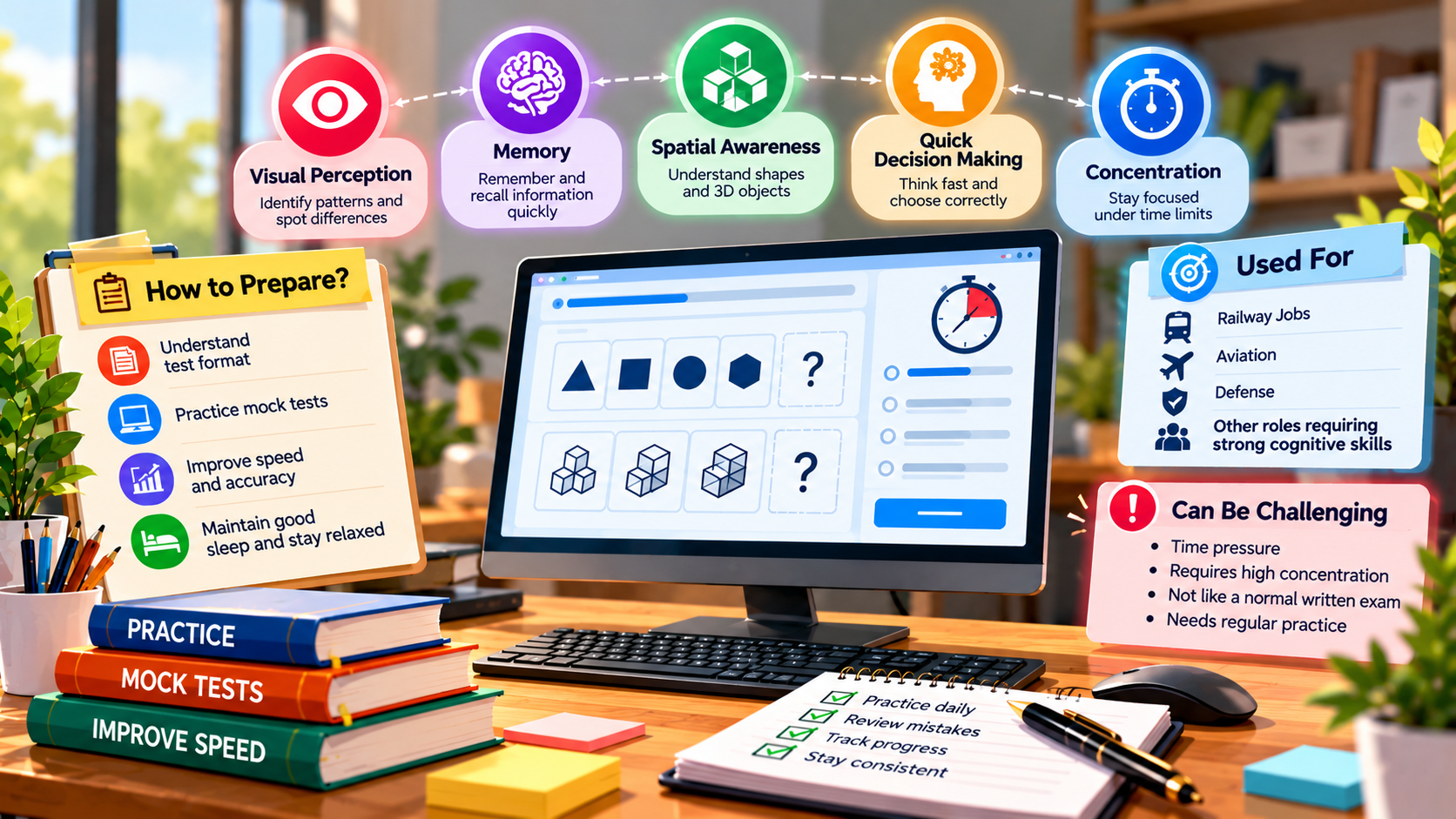
Prepare for the CBAT exam?
Preparing for a Computer Based Aptitude Test requires consistent practice, concentration, and effective time management. Unlike knowledge-based examinations, many aptitude tests focus on how quickly and accurately you process information. Your preparation should therefore match the specific skills measured by your examination.
Start by checking the official recruitment notification and understanding the test format. Identify the relevant sections, instructions, scoring rules, and qualifying requirements. Depending on the assessment, you may encounter memory exercises, visual comparisons, spatial reasoning, or other cognitive tasks.
Next, establish a daily practice routine. Spend time solving sample questions under realistic time limits. Review your mistakes after every session to understand whether they result from poor concentration, slow responses, or misunderstanding the instructions.
You should also practise using a computer rather than relying exclusively on printed materials. This helps you become comfortable with on-screen questions and digital controls. Finally, maintain a regular sleep schedule and use simple relaxation techniques to manage exam stress.
Consistent Practice with Mock Test Batteries
Consistent practice with CBAT mock test batteries helps you become familiar with different question formats and improve your response accuracy. These practice exercises can include visual comparisons, pattern recognition, memory tasks, and other activities relevant to your particular examination.
Begin with untimed exercises to understand the instructions and identify the skills each task measures. Once you feel comfortable, introduce time limits that resemble the actual examination. Gradually increase the difficulty instead of immediately attempting the fastest possible pace.
During each practice session, focus on both speed and accuracy. Completing questions quickly is not useful if you repeatedly select incorrect answers. Record your results and identify the task types that cause the most difficulty.
Use this information to plan your next session. For example, if you struggle with spatial reasoning, dedicate additional practice time to matching shapes and recognizing visual patterns. If concentration is your main weakness, try shorter sessions with gradually increasing durations.
Remember that mock tests are preparation tools, not guarantees of success. Choose practice materials that match the official examination format, and avoid relying on unofficial claims about guaranteed questions or shortcuts.
What is a CBAT computer-based aptitude test?
A Computer Based Aptitude Test (CBAT) is a digital assessment designed to evaluate abilities relevant to particular tasks or job responsibilities. Depending on the examination, it may measure logical reasoning, spatial awareness, visual attention, memory, or response accuracy.
Candidates typically complete the assessment using a computer terminal. They read instructions, respond to questions, and interact with on-screen information within specified time limits. Some assessments emphasize rapid responses, while others focus on careful observation and consistent accuracy. Graduates exploring career options in the public sector can also review these top government jobs after graduation to learn about potential career paths.
CBATs are used in recruitment processes where employers need to assess whether candidates possess particular cognitive abilities. Specialized aptitude assessments may be relevant to railway operations, aviation, defense, and other roles requiring sustained attention or accurate decision-making. Candidates interested in railway recruitment can also explore this railway jobs eligibility and salary guide for 2026. However, the exact format and purpose of aptitude assessments vary between organizations.
Unlike a conventional subject examination, a cognitive aptitude assessment may require little knowledge of a specific academic syllabus. Nevertheless, candidates must understand the instructions and follow the assessment rules carefully.
Before preparing, check which abilities your target examination evaluates. This will help you select relevant practice exercises instead of spending time on unrelated question types.
Measuring Cognitive Reflexes and Mental Agility
One purpose of specialized aptitude assessments is to measure cognitive abilities that support effective performance in demanding situations. These abilities may include attention, reaction speed, visual processing, memory, and mental agility. The specific skills measured depend on the test design and the role being assessed. If you’re still exploring suitable career options, free career assessment tests can help you identify your interests and strengths.
For example, a visual attention exercise may require you to identify matching symbols quickly. A spatial reasoning task might ask you to compare shapes or determine how objects relate to one another. Other assessments may measure how consistently you respond to repeated instructions.
Employers can use these results alongside other recruitment criteria to evaluate candidates. However, an aptitude score does not provide a complete picture of someone’s professional potential. Practical experience, communication, judgment, and other job-related abilities may also matter.
To improve your performance, practise the skills that appear in your official test format. Focus on making accurate decisions before increasing your speed. With repeated practice, you may become more familiar with the tasks and better able to manage time pressure.
Avoid assuming that every CBAT measures reflexes or mental speed in the same way. Always use the recruiting organization’s published guidelines to understand what your particular assessment requires.
Is cbat tough?
Many candidates wonder whether a Computer Based Aptitude Test is tough to clear. The difficulty of any typical Computer Based Aptitude Test (CBAT) largely stems from the intense time pressure and the unfamiliar nature of the questions rather than complex academic theories. Since the test evaluates speed, accuracy, and multi-tasking abilities simultaneously, many test-takers find it challenging to complete all sections within the allotted minutes. However, with systematic preparation and familiarity with the question patterns, the perceived difficulty drops significantly. Understanding how to let go of difficult questions and move forward without hesitation is the primary key to overcoming the tough nature of these cognitive evaluations.
Overcoming Strict Time Constraints Through Strategy
Overcoming strict time constraints requires developing a strategic mindset during your preparation phase. Learning to triage questions, skip difficult prompts quickly, and maintain a steady rhythm prevents panic and ensures maximum overall score accumulation.
What is the difference between CBT and CBAT?
Although their names sound similar, CBT and CBAT serve different purposes. A Computer Based Test (CBT) describes an examination delivered electronically. It can assess academic knowledge, technical expertise, general awareness, or other subjects through a computer interface.
A Computer Based Aptitude Test (CBAT), by contrast, refers to an assessment focused on aptitude or abilities relevant to particular tasks. Depending on its design, it may measure spatial reasoning, attention, memory, visual processing, or decision-making speed.
The distinction is important when preparing for recruitment examinations. A knowledge-based CBT may require studying mathematics, general awareness, technical subjects, or other syllabus topics. A specialized CBAT may require practising visual tasks, cognitive exercises, and time-sensitive activities instead. Candidates preparing for Staff Selection Commission examinations can also consult these SSC exam guides for beginners to understand the broader exam preparation process.
However, the two categories are not mutually exclusive. A CBAT is also computer-based, so it can technically be considered a type of CBT in the broader sense. Recruitment organizations may use these terms differently in their official notifications.
| Feature | CBT | CBAT |
|---|---|---|
| Full form | Computer Based Test | Computer Based Aptitude Test |
| Main purpose | Assess knowledge or other specified skills | Assess aptitude and job-related abilities |
| Typical content | Subject questions, reasoning, or general awareness | May include spatial, visual, memory, or cognitive tasks |
| Preparation | Study the syllabus and practise sample papers | Practise the specific aptitude tasks and timing |
| Format | Delivered through a computer | Delivered through a computer |
Always follow the official examination guidelines when deciding what to study.
What are some tricks to pass an aptitude test?
Passing an aptitude test requires a combination of preparation, concentration, and sensible decision-making. There is no guaranteed shortcut, but several techniques can help you use your time more effectively. Start by reading the instructions carefully before answering any questions. Misunderstanding a simple rule can lead to avoidable mistakes.
Next, identify the response method required for each task. Some tests reward speed and accuracy, while others use specific scoring rules or qualifying standards. Do not assume that guessing is beneficial or that negative marking applies. Check the official instructions before choosing your strategy.
During practice, learn to recognize common patterns and eliminate clearly incorrect options when the question format permits it. Avoid repeatedly checking answers you already understand, especially when time is limited.
Your concentration also matters. If a question seems difficult, remain calm and follow the permitted navigation rules. Some assessments allow you to skip questions, while others require continuous responses or restrict movement between sections.
Finally, track your performance across multiple practice sessions. Identify recurring mistakes and work on those areas before attempting another timed test. This approach is more dependable than memorizing supposed shortcuts that may not match your actual examination.
Mastering Elimination and Rapid Visual Scanning
Rapid visual scanning can help you process information efficiently during aptitude assessments that involve symbols, shapes, numbers, or visual patterns. However, scanning faster is useful only when you can still identify the correct details.
Begin by practising short exercises that require you to compare two groups of symbols or identify a matching pattern. Focus on the features that distinguish the options, such as shape, orientation, position, or sequence. With repeated practice, you may become more familiar with common visual patterns.
Elimination techniques can also help with multiple-choice questions. Remove options that clearly contradict the instructions or fail to match the displayed pattern. This reduces the number of possibilities you need to consider, provided the test format allows you to select among multiple options.
Do not rush through every question simply to increase your completion count. Careless responses can reduce accuracy and undermine your overall performance. Instead, practise finding an appropriate balance between speed and precision.
Use a timer during mock tests and record both your completion time and errors. If your speed improves but your accuracy declines, slow down and focus on recognizing the relevant details. Adjust your practice routine according to your results.
How to prepare for a computer-based test?
Preparing for a computer-based test involves understanding the examination format, reviewing the required material, and becoming comfortable with the digital interface. Start by reading the official instructions and identifying the subjects, question types, time limits, and scoring rules. This helps you build a preparation plan that reflects the actual examination. If you’re preparing for competitive recruitment exams, this government job preparation guide for beginners can also help you organize your overall study approach.
If the test assesses academic or technical knowledge, divide the syllabus into manageable topics. Review the most important concepts and solve practice questions regularly. For an aptitude-focused assessment, prioritize the cognitive tasks and response methods used in that examination.
You should also practise on a computer whenever possible. Become familiar with clicking, selecting answers, navigating between questions, and using any permitted tools. Check whether the actual test allows you to revisit questions or change previously submitted answers.
Create a quiet study environment that minimizes interruptions. Take full-length mock tests when suitable practice materials are available, and review your mistakes after each attempt.
Pay attention to practical details before exam day. Confirm the test location or online access requirements, reporting time, identification documents, and permitted items. Arrive prepared and well-rested so that avoidable technical or logistical problems do not distract you.
What are the disadvantages of taking aptitude tests?
Although aptitude tests can help employers assess candidates consistently, they also have limitations. One common concern is test anxiety. A candidate may possess the required abilities but perform poorly under strict time limits or unfamiliar testing conditions. The resulting score may not fully reflect their potential in a real working environment.
Another limitation is that aptitude tests measure only the abilities included in their design. They may not adequately capture creativity, emotional intelligence, teamwork, leadership, or practical experience. Employers may therefore need additional interviews, work samples, or other assessments to evaluate candidates fairly.
Access to technology can also affect preparation. Candidates with limited computer experience may feel less comfortable navigating digital examinations, even when they understand the underlying questions. Differences in language familiarity, accessibility, and testing conditions can create further challenges if the assessment does not accommodate them appropriately.
Test design matters as well. Poorly constructed questions or scoring systems may produce results that do not accurately represent the abilities required for a job.
For these reasons, aptitude tests are most useful when they measure relevant skills and form part of a broader selection process. Candidates should understand their limitations while preparing seriously for the specific requirements of their examination. Beyond recruitment assessments, understanding why education is important in our life can provide a broader perspective on learning and personal development.
Conclusion
Mastering the Computer Based Aptitude Test (CBAT) is entirely achievable with the right combination of structured practice, mental resilience, and strategic time management. Throughout this guide, we explored essential preparation techniques, the core definition of CBAT evaluations, and critical distinctions between standard academic tests and cognitive assessments. By understanding what examiners look for and addressing potential challenges like test anxiety, you can approach your exam with confidence. Remember to prioritize accuracy, practice consistently on digital mock platforms, and maintain steady focus throughout your preparation journey. Apply these proven insights today, stay disciplined, and unlock your true potential to succeed in your upcoming career milestones.