

AI Prompt Injection: Why Hackers No Longer Need Code to Steal Your Data
Cybersecurity has traditionally focused on malicious software, buffer overflows, and programming exploits. Today, large language models introduce another serious threat: AI prompt injection. Attackers can manipulate AI systems using ordinary language, without necessarily writing sophisticated exploit code.
The risk increases when businesses connect AI assistants to private databases, internal documents, customer records, and external tools. A carefully crafted instruction can trick a model into ignoring its intended task or misusing its available capabilities. However, successful data theft depends on the system’s permissions, architecture, and security controls.
The OWASP Foundation identifies prompt injection as a major security concern for large language model applications. Organizations must therefore treat AI inputs as potentially untrusted.
Understanding these attacks is essential for developers, security teams, and business leaders. This guide explains how AI prompt injection works, how attackers may exploit connected systems, and how organizations can reduce their exposure. It also compares prompt injection with jailbreaks and traditional code injection while examining the business risks of insecure AI deployments.
How Can a Hacker Steal Your Data?
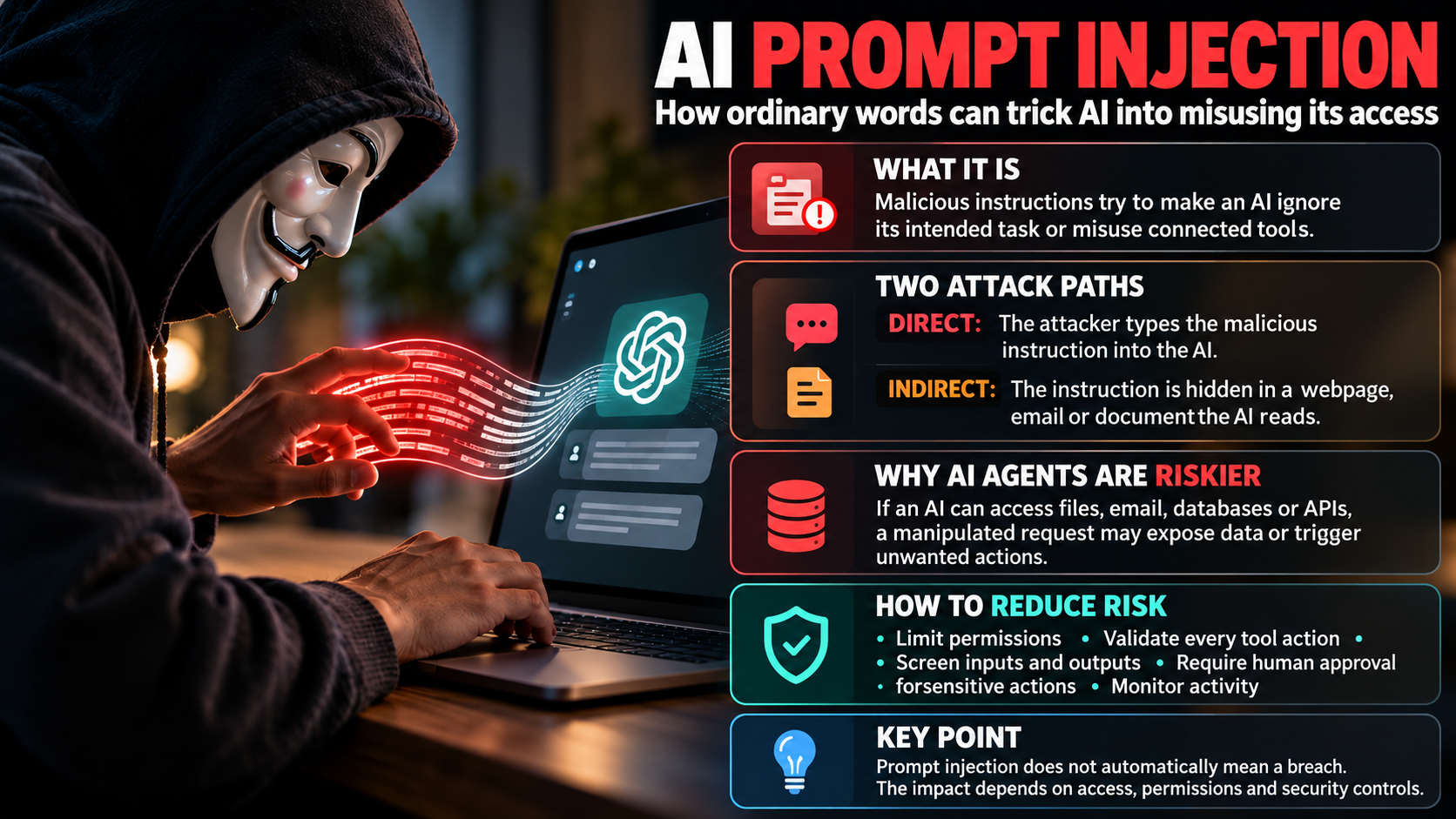
Hackers may steal data by exploiting AI applications connected to private databases, enterprise APIs, or internal company tools. An attacker crafts instructions designed to manipulate the model into performing actions outside its intended purpose. These instructions may appear in a user message, an uploaded document, or content retrieved from an external website.
For example, a company might use an AI assistant to summarize documents and retrieve customer information. A malicious document could contain hidden instructions telling the assistant to search for confidential records. If the application allows the model to access those records and transmit information externally, the attacker may exploit that access.
However, prompt injection alone does not automatically grant access to protected resources. The outcome depends on the application’s permissions, tool integrations, and security architecture.
The Mechanism of Indirect Exfiltration
Indirect prompt injection occurs when malicious instructions enter an AI system through external content rather than a direct user message. Attackers may hide instructions in documents, emails, web pages, or customer feedback.
When an AI assistant processes this content, it may interpret the embedded instructions as commands. If the assistant has access to sensitive information or external tools, it could perform unintended actions. Attackers may also exploit stolen authentication cookies to access active sessions, making it important to understand how long web cookies last and how session security works.
Consider an AI assistant that summarizes emails and can also access company files. A malicious email might instruct it to locate confidential documents and include their contents in a response. If the application lacks effective safeguards, the assistant could disclose information to an unauthorized recipient.
Possible consequences include:
- Exposure of confidential documents or customer records.
- Unauthorized use of connected tools and APIs.
- Leakage of sensitive information through responses or external requests.
- Misuse of permissions granted to an AI agent.
These attacks do not necessarily bypass traditional network defenses. Instead, they may exploit the trust placed in an AI application that already has legitimate access to internal resources.
How to Prevent AI Prompt Injection?
You cannot eliminate AI prompt injection simply by writing stronger system instructions. Language models can struggle to distinguish legitimate instructions from malicious content, especially when both appear in the same context. Effective protection requires multiple security controls working together.
Start by limiting the permissions granted to AI assistants. Give each application access only to the information and tools required for its specific task. Use read-only access whenever possible, and require approval before sensitive or irreversible actions. For connected accounts, multi-factor authentication adds another layer of protection if login credentials are compromised.
Next, separate untrusted external content from trusted application instructions. Validate tool requests and enforce access controls outside the language model. Monitor unusual activity and restrict outbound data transfers.
Important defensive measures include:
- Least-privilege access: Limit access to databases, files, and APIs.
- Input and output screening: Detect suspicious instructions and sensitive information.
- Tool authorization: Check every requested action against independent security rules.
- Human approval: Require confirmation for high-impact operations.
- Monitoring and logging: Track unusual requests, access patterns, and data transfers.
These controls reduce risk but cannot guarantee complete protection. Security teams should test AI applications regularly and assume that some malicious instructions may evade detection.
Implementing Dual-LLM Guardrail Architectures
A dual-LLM architecture uses one language model to inspect content before another model processes it. The first model acts as a security reviewer, identifying suspicious instructions and potentially unsafe requests.
For example, a screening model could examine uploaded documents for attempts to redirect an AI assistant toward unauthorized actions. It could flag suspicious content for additional review before the main model continues.
However, a second language model is not a complete security boundary. It can also misclassify malicious content or overlook subtle attacks. Using two models does not automatically make an application secure.
A stronger implementation combines model-based screening with deterministic controls. These include access permissions, strict tool schemas, server-side authorization, and restrictions on external network requests.
For sensitive workflows, the application should verify every proposed action independently. A model must never be allowed to override access policies simply because its request appears legitimate.
Use a secondary model as one layer of defense, not as the only protection. Independent security controls remain essential, particularly when an AI assistant can access confidential data or perform actions on behalf of users.
What Is the Difference Between Jailbreak and Prompt Injection?
Jailbreaking and prompt injection are related but distinct AI security threats. Both involve manipulating a model through instructions, but they differ in their typical goals and attack paths.
A jailbreak attempts to bypass a model’s intended behavioral restrictions. An attacker might ask the model to ignore its safety guidelines and generate content it would normally refuse. The immediate target is usually the model’s response.
Prompt injection targets how an AI application interprets instructions and uses its connected capabilities. An attacker may place malicious instructions in a user prompt, an uploaded file, or external content retrieved by an AI agent.
For example, a jailbreak might attempt to make a chatbot produce prohibited instructions. A prompt injection attack might attempt to make an AI assistant disclose confidential documents through an authorized integration.
The distinction is not absolute. Some attacks combine both techniques, and neither category guarantees a successful compromise. The actual impact depends on the model, the application design, and the permissions available.
Distinct Objectives Define the Threat
The main difference becomes clearer when examining what the attacker wants to achieve.
A jailbreak generally seeks to change the model’s response by bypassing its behavioral safeguards. It might attempt to generate restricted content, ignore safety requirements, or follow instructions the model should reject.
Prompt injection, meanwhile, can target the wider application workflow. The attacker attempts to influence how the model processes information, selects tools, or handles connected resources.
Consider these examples:
- Jailbreak: A user tells a chatbot to disregard its safety rules and provide restricted content.
- Direct prompt injection: A user instructs an AI assistant to ignore its assigned task and reveal information it should not disclose.
- Indirect prompt injection: A malicious document contains instructions that manipulate an AI assistant when it summarizes the document.
The second and third examples become more dangerous when the application grants access to sensitive tools or information.
A jailbreak does not necessarily expose private data, and prompt injection does not always involve data theft. Both require appropriate safeguards, but prompt injection deserves particular attention in AI systems connected to business applications.
What Is a Code Injection Example?
A classic code injection example is SQL injection, a vulnerability that occurs when an application handles untrusted input unsafely. Attackers exploit this weakness to manipulate database queries and potentially access or modify information without authorization.
Imagine a website that builds a database query by directly combining a user’s input with SQL commands. An attacker may enter specially crafted text into a login field. If the application inserts that text into the query without proper protections, the database may interpret it as part of the command.
A common illustrative payload is ' OR '1'='1. Depending on the query structure, this expression can make a condition evaluate as true. It does not bypass every login system, but it demonstrates how unsafe query construction can create vulnerabilities.
Developers can prevent SQL injection by using parameterized queries, appropriate database permissions, and secure coding practices.
How Traditional Injection Mirrors Linguistic Attacks
SQL injection and AI prompt injection share a broad security challenge: untrusted input can influence how a system interprets instructions. However, they operate differently and require different technical defenses.
In SQL injection, an application may mistakenly treat user-supplied text as executable database syntax. The attacker exploits the way the application constructs or executes a query.
In prompt injection, malicious text attempts to influence a language model’s interpretation of instructions. The model may then produce an unintended response or request an unauthorized tool action.
For example, a vulnerable database application might execute a manipulated query. An AI assistant might instead interpret a malicious document as an instruction to retrieve confidential files.
The comparison highlights the importance of separating trusted instructions from untrusted data. However, prompt injection is not simply SQL injection expressed in natural language. Language models interpret context probabilistically, while databases follow defined query and execution rules.
Therefore, developers should use different protections for each vulnerability. Parameterized queries address SQL injection, while AI prompt injection requires layered controls, restricted permissions, and independent authorization checks.
What Are the Risks of Prompt Injection?
The risks of AI prompt injection depend on the system’s capabilities and the resources it can access. A chatbot with no external integrations may produce an inappropriate response. An AI agent connected to company email, financial systems, or customer databases can create more serious security concerns.
Attackers may attempt to expose confidential information, misuse connected tools, alter business records, or trigger unauthorized actions. The consequences can include financial losses, operational disruption, privacy violations, and damage to customer trust. These risks also highlight the importance of understanding why using an AI chatbot to pick your password is a security risk, especially when protecting sensitive accounts and login credentials.
Organizations handling personal information may also face legal or regulatory consequences if an incident results in a reportable data breach. Applicable obligations depend on the organization’s location, industry, data, and circumstances.
Common business risks include:
- Data exposure: Disclosure of customer records, credentials, or proprietary documents.
- Unauthorized actions: Improper use of connected applications or business tools.
- Financial losses: Fraudulent activity or costly operational mistakes.
- Privacy violations: Improper handling or disclosure of personal information.
- Reputational damage: Reduced customer confidence following a security incident.
Prompt injection is not automatically a successful breach. Nevertheless, organizations should assess the potential impact before connecting AI models to sensitive resources.
Systemic Contamination of Business Data
Prompt injection can threaten data integrity as well as confidentiality. If an AI application can modify records, update knowledge bases, or write to business systems, malicious instructions may cause unintended changes.
For example, an AI assistant responsible for processing customer feedback could encounter a document containing instructions to alter stored records. If the application accepts those instructions without independent authorization, it might modify information incorrectly.
Similar risks arise when AI agents update analytics datasets, summarize operational reports, or write content to shared knowledge repositories. Incorrect changes can spread through downstream workflows and reduce confidence in business information.
Potential consequences include:
- Inaccurate customer records and transaction details.
- Contaminated internal knowledge bases.
- Misleading reports and analytics.
- Unreliable AI-generated recommendations.
- Additional investigation and data-recovery costs.
Organizations should validate AI-generated changes before committing them to important systems. Maintain audit logs, restrict write permissions, and preserve recoverable backups of critical information.
Most importantly, treat AI-generated content as untrusted until verified. Independent validation and clear authorization rules help prevent manipulated instructions from becoming persistent business data errors.
Conclusion
AI prompt injection is an emerging security challenge that businesses cannot afford to ignore. Attackers can use ordinary language to manipulate AI systems, potentially exposing sensitive information or triggering unauthorized actions. The risks become greater when AI assistants connect to private databases, company files, and external tools.
However, prompt injection does not automatically lead to a data breach. The actual impact depends on the application’s design, permissions, and security controls. Organizations can reduce these risks by limiting access, validating tool requests, monitoring suspicious activity, and requiring human approval for sensitive actions.
As AI adoption grows, security must be built into AI applications from the beginning. Strong safeguards, regular testing, and responsible access management help protect confidential data while allowing businesses to benefit from AI technology.