
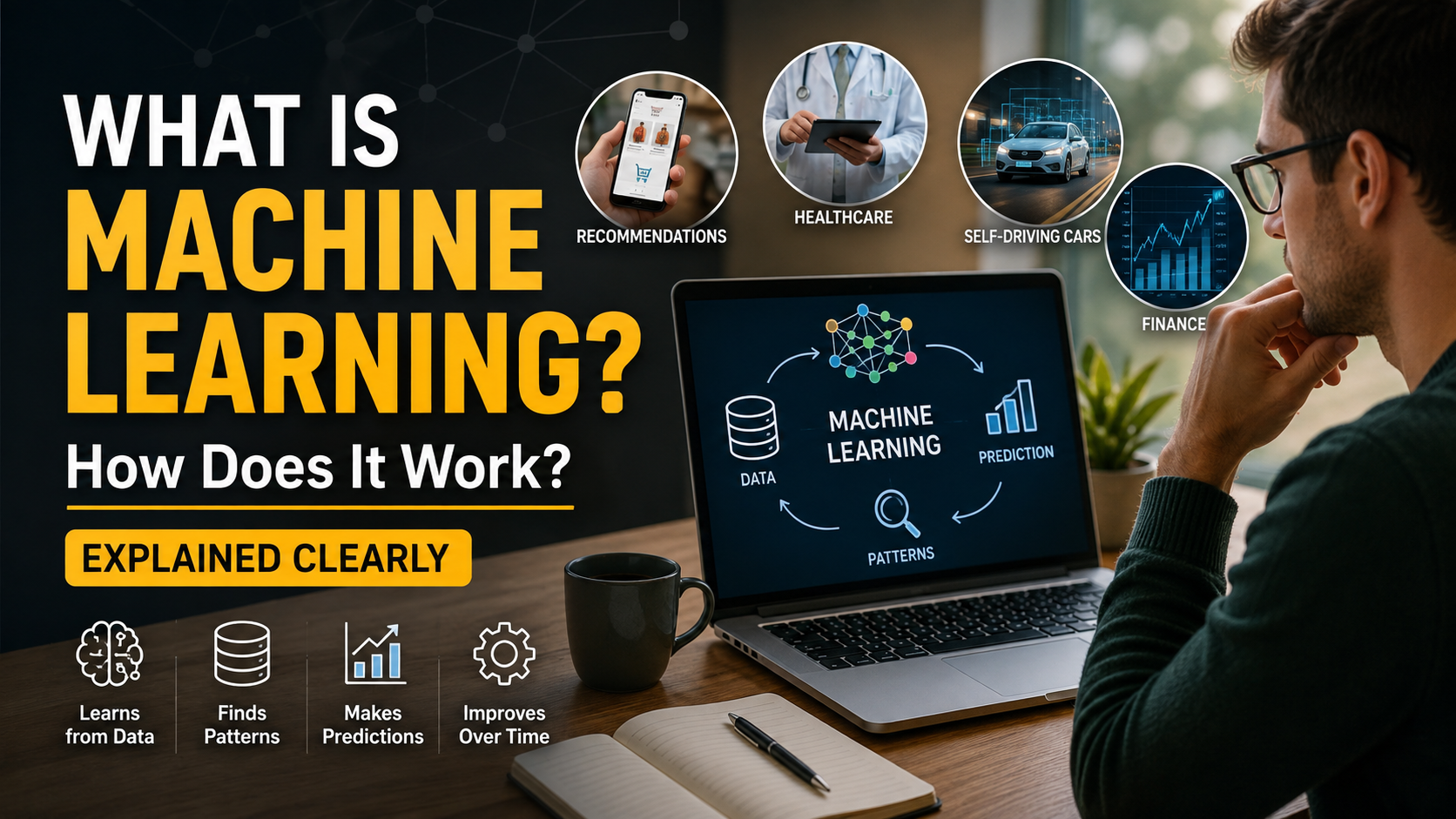
What Is Machine Learning? How Does It Work? Explained Clearly
Understanding machine learning is essential in today’s digital world. Algorithms now influence entertainment, healthcare, finance, shopping, and many other areas. At its core, machine learning lets computer systems learn from data. They can then improve their performance without receiving explicit instructions for every task.
You may wonder how a computer learns from past experiences. You may also wonder why businesses rely on this technology so heavily. Machine learning helps systems process large datasets, identify patterns, and make useful predictions. According to research and industry work from NVIDIA, adaptive computing is transforming many industries.
This guide explains how machine learning works in simple terms. It also covers how to explain it to a child and where it is used. Finally, you will learn why organizations use it and how it relates to artificial intelligence and ChatGPT.
How exactly does machine learning work?
Machine learning works by giving algorithms data and asking them to find useful patterns. Instead of programming every rule manually, developers provide training data. The algorithm studies this information and identifies relationships between different variables. For a broader foundation, you can also explore 4 Pillars of ML: Core Foundations of Machine Learning.
During training, the model compares its predictions with known results. It then adjusts internal parameters to reduce errors. This process repeats until the model reaches an acceptable performance level. The trained model can then analyze new data it has not seen before.
For example, a model can learn to identify spam emails. Developers provide examples of spam and legitimate messages. The model studies patterns such as words, sender details, and message structure. It then uses those patterns to classify future messages.
This process resembles learning through experience. More relevant data and useful feedback can improve results. However, machine learning models do not guarantee perfect predictions. Their performance depends on data quality, model design, and the task itself.
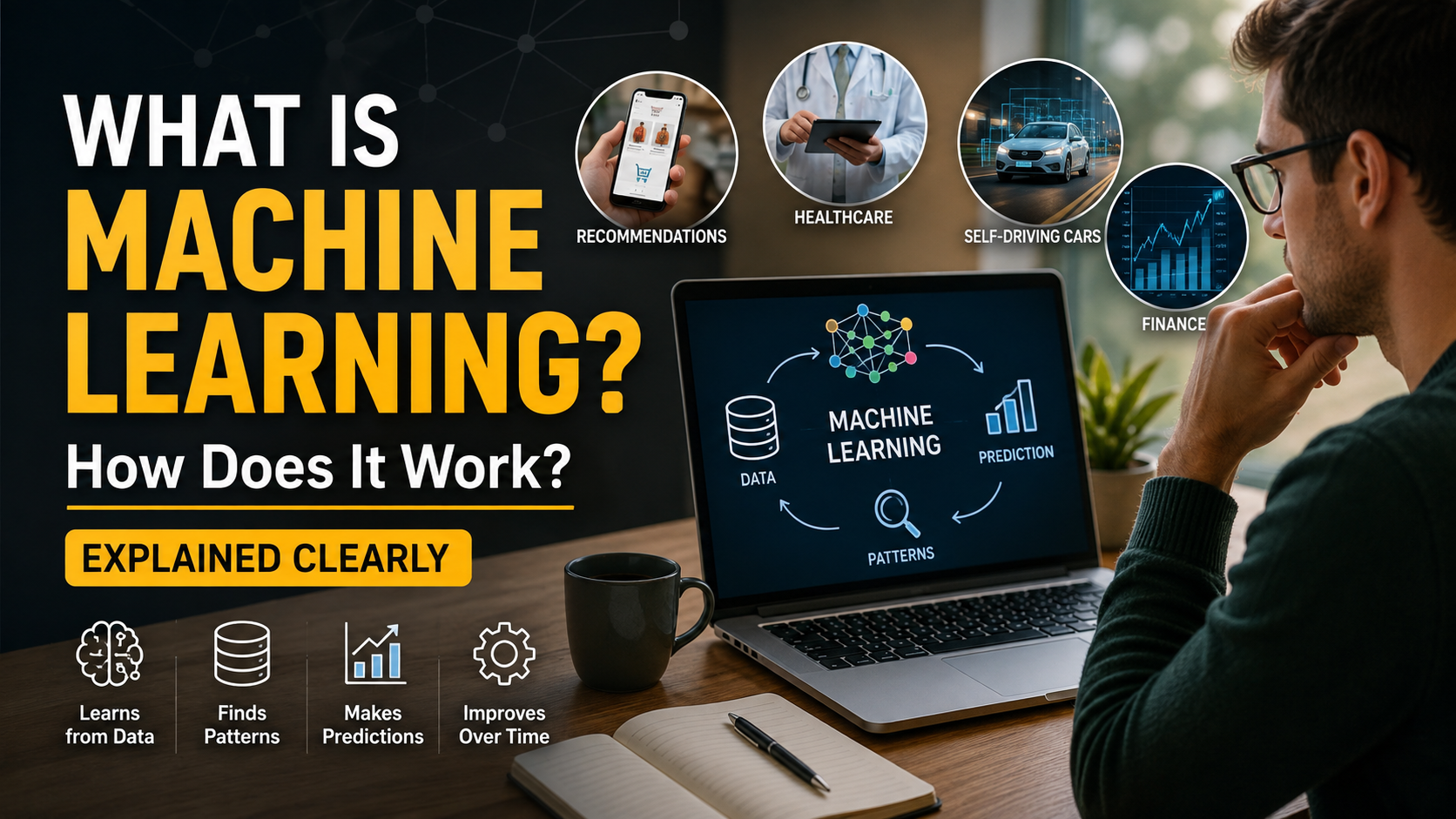
The Training Process and Model Optimization
During training, developers use loss functions to measure prediction errors. A loss function shows how far a model’s output is from the expected result. The model uses this information to improve future predictions.
One common optimization method is gradient descent. It adjusts the model’s weights to reduce the calculated loss. The system repeats this process across many training examples.
Training continues until the model reaches a suitable performance level. Developers then test it with separate data. This helps determine whether the model can generalize beyond its training examples.
Good optimization requires more than simply running an algorithm. Developers must choose suitable data, model settings, and evaluation methods. They also monitor issues such as overfitting. Overfitting occurs when a model performs well on training data but poorly on new data.
Careful testing helps ensure reliable performance after deployment. Regular monitoring can also identify changes as real-world data evolves. These steps help keep predictions useful and consistent over time.
How to explain machine learning to a kid?
The easiest way to explain machine learning for kids is through a familiar example. Imagine teaching a child to recognize dogs and cats. You show the child many pictures of both animals. At first, the child may confuse them.
After seeing enough examples, the child begins noticing useful features. Dogs may have certain shapes, ears, or body patterns. Cats may have different features. The child gradually learns which patterns usually match each animal.
A computer can learn in a similar way. Instead of a human brain, it uses mathematical models. The computer studies many examples and searches for patterns in the information.
The computer does not understand the world exactly like humans do. It calculates relationships within the data it receives. Its predictions depend heavily on the quality and relevance of its training examples.
This example makes the concept easier to understand. Computers learn patterns from examples and use those patterns to make predictions about new information. That simple idea explains the foundation of many modern intelligent systems.
Teaching Computers Like Pets
You can also compare an algorithm to an eager digital pet. The pet learns through repeated practice and feedback. Each successful result provides information about what works.
Imagine teaching a digital pet to recognize a specific command. You provide examples and indicate which responses are correct. The system gradually adjusts its behavior based on that feedback.
This comparison highlights the importance of practice. A model needs relevant examples before it can perform many tasks effectively. Better examples can usually support better results.
However, a computer is more mathematical than a real pet. It does not think, feel, or understand experiences like an animal. Instead, it calculates patterns and adjusts numerical parameters.
The analogy still explains an important concept. Learning systems improve through data, training, and feedback. This makes technical ideas easier for beginners and children to understand.
It also shows why training quality matters. If the examples are confusing or incomplete, the system may learn poor patterns. Clear examples give the model a stronger foundation for future predictions.
How can machine learning be used?
Machine learning supports many industries and everyday activities. Businesses use it to automate tasks, personalize services, and identify patterns in large datasets. Healthcare organizations can analyze medical images and patient information to support diagnosis and research. These applications are part of the broader development of artificial intelligence, which combines multiple approaches to building intelligent systems.
Financial institutions use these systems to monitor transactions. Models can identify unusual patterns that may indicate fraud. Retail companies also use predictive systems to recommend products based on customer behavior.
Transportation is another important area. Advanced vehicles can recognize objects and interpret their surroundings. These systems can support navigation and other driving functions.
The technology also appears in many tools people use every day. Machine learning applications include spam filters, recommendation systems, voice assistants, translation tools, and search engines.
Common applications include:
- Fraud detection and transaction monitoring
- Product and content recommendations
- Medical image analysis
- Spam and malware detection
- Speech and language processing
- Predictive maintenance
- Customer behavior analysis
The results depend on the data, model, and task. These systems can be powerful, but they still require careful development, testing, and evaluation.
Real World Applications in Daily Life
Machine learning already influences many parts of daily digital life. You may encounter it without realizing an algorithm is working in the background. One increasingly visible example is AI camera technology in smartphones, which uses intelligent processing for photography and other features.
Streaming platforms use recommendation models to suggest movies, shows, or music. Email services use classification models to identify unwanted messages. Smartphone assistants can use similar technology to understand speech and respond to requests.
Translation applications also rely on these techniques to process language. Search engines use related methods to understand queries and rank useful results.
Other examples include:
- Personalized shopping recommendations
- Voice recognition on smartphones
- Automatic photo organization
- Predictive text and typing suggestions
- Online fraud alerts
- Content recommendations on digital platforms
These systems process large amounts of information quickly. They can automate repetitive decisions that would otherwise require human effort.
The technology has therefore become part of many digital services. Its value comes from improving speed, personalization, and automation across everyday experiences. Most users benefit from these systems without needing to understand how the underlying models operate.
Why use machine learning?
Organizations use machine learning because traditional software cannot easily handle every complex situation. Conventional programs often depend on rules written by developers. Those rules may not cover every possible scenario. As organizations expand their use of AI, Optimizing Enterprise AI Pipelines can help explain how these systems are managed at scale.
Modern businesses generate enormous amounts of data. Manually analyzing that information can be slow, expensive, and difficult. Data-driven models help organizations identify patterns and make predictions at scale.
For example, a company may use a model to predict customer demand. Another organization may use one to detect unusual transactions. These systems can analyze information much faster than manual processes.
Models can also be retrained when patterns change. This helps organizations respond to evolving customer behavior and market conditions. However, retraining requires suitable new data and careful evaluation.
Key benefits can include:
- Automation of repetitive analytical tasks
- Faster processing of large datasets
- Improved prediction and classification
- Personalized customer experiences
- Detection of hidden patterns
- Support for data-driven decisions
However, this approach is not automatically better than traditional software. The right choice depends on the problem, available data, technical requirements, and business goals.
Unlocking Scalability and Deeper Insights
One major advantage of machine learning is its ability to work with large datasets. Organizations can analyze millions of records without reviewing every item manually.
Models can identify relationships that are difficult for people to detect. These insights may help businesses understand customers, predict demand, or identify operational problems.
The technology also supports scalable automation. Once a suitable model is deployed, it can process many new inputs quickly. This can reduce repetitive workloads and allow employees to focus on higher-value tasks.
Predictive systems can also support decision-making. They provide estimates that help teams evaluate possible outcomes. However, these predictions should support human judgment rather than replace it in every situation.
Successful implementation requires reliable data and proper testing. Organizations must also monitor models after deployment. Data patterns can change over time, causing performance to decline.
When used responsibly, these systems combine speed, scale, and analytical power. They help organizations turn large amounts of information into practical insights. This can improve efficiency while supporting more informed business decisions.
Is ChatGPT AI or ML?
ChatGPT is an artificial intelligence system that uses machine learning. Artificial intelligence is the broader field focused on creating systems that perform tasks associated with human intelligence. To understand the technology behind systems such as ChatGPT, it is useful to explore Large Language Models: ChatGPT, GPT, and Top Models.
Machine learning is one important approach within artificial intelligence. It allows systems to learn patterns from data instead of relying only on manually written rules.
ChatGPT uses deep learning, which is a specialized area of this field. Its underlying models are trained on large amounts of data. They learn statistical patterns that help generate responses based on conversations and instructions.
The relationship can be understood as a hierarchy:
- Artificial intelligence (AI): The broader field of intelligent computer systems.
- Machine learning (ML): An approach that learns patterns from data.
- Deep learning: An approach using multi-layer neural networks.
- ChatGPT: An AI application built using advanced learning techniques.
This distinction explains why AI and ML are related but not identical. Machine learning is a method used within AI. ChatGPT is an AI application that uses machine learning and deep learning.
Understanding these terms provides a clearer view of modern AI technology. It also helps explain why not every AI system uses the same methods or architecture.
Understanding the Hierarchy of Technology
A simple analogy can make the relationship easier to understand. Think of artificial intelligence as a large category of technologies. Machine learning is one important category within it.
Deep learning sits within machine learning. It uses neural networks with multiple layers to process complex patterns. These networks can support tasks involving language, images, audio, and other forms of data. Similar AI techniques are also used in How Does AI Generate Images to explain how systems create visual content.
ChatGPT uses advanced deep learning techniques to process and generate language. Its capabilities come from model architecture, training data, optimization, and additional development methods.
The hierarchy can therefore be summarized as:
Artificial Intelligence → Machine Learning → Deep Learning → Systems such as ChatGPT
This structure prevents a common misunderstanding. AI and machine learning are not interchangeable terms. AI describes a broad field, while machine learning describes a specific family of techniques.
Understanding this distinction also makes technical discussions easier. It helps beginners recognize how different technologies fit together. It prevents every intelligent application from being treated as the same thing.
This hierarchy also provides useful context when learning AI. Starting with broad concepts before exploring specific techniques makes the subject easier to understand. Once these foundations are clear, How Do AI Agents Work? offers another example of how modern AI systems apply these underlying concepts.
FAQ SECTION
What is the difference between supervised and unsupervised learning?
Supervised learning uses labeled datasets where algorithms learn from explicit input-output pairs to predict known outcomes accurately. Unsupervised learning analyzes unlabeled data independently to discover hidden structures, natural groupings, or anomalies without human guidance. Both approaches serve distinct purposes depending on available data.
How much data is required to train a model?
The amount of data required depends heavily on problem complexity, algorithm type, and desired accuracy levels. Simple linear models might perform well with hundreds of samples, while deep neural networks require millions of records. High-quality data always matters more than sheer volume.
Can machine learning models make mistakes?
Yes, machine learning models frequently make mistakes when faced with biased training data, noisy inputs, or entirely unfamiliar scenarios. Because these systems rely on probabilistic calculations rather than absolute certainty, edge cases can easily trigger incorrect predictions. Continuous monitoring helps minimize these operational risks.
Do I need to know advanced math to start learning machine learning?
A basic understanding of linear algebra, calculus, probability, and statistics helps significantly when building advanced models from scratch. However, modern high-level libraries allow beginners to start building functional applications with basic programming skills. Practical coding experience often matters most initially.
Conclusion
Machine learning has become an important part of modern technology. It allows computer systems to learn patterns from data and use those patterns to make predictions or decisions.
Throughout this guide, we explored how machine learning works and how models learn through training and optimization. We also explained the concept using simple examples. These examples show why data and feedback play such important roles.
Machine learning supports many real-world applications. These include fraud detection, recommendations, healthcare analysis, language processing, and automation. It also operates behind many digital tools people use every day.
We also clarified the relationship between AI, machine learning, deep learning, and ChatGPT. Understanding these terms helps create a stronger foundation for exploring artificial intelligence.
As the technology continues to develop, learning its fundamentals can create valuable opportunities. Start with practical projects and reliable datasets. Build your knowledge gradually and focus on understanding how each technique solves a real problem.
With consistent practice, machine learning becomes far easier to understand and apply.