
YouTube Premium vs. Spotify Premium: Which Is Right for You?
Choosing between YouTube Premium vs. Spotify Premium depends on how you use digital entertainment each day. Both services offer extensive music libraries, personalized recommendations, and offline listening. However, their strengths are quite different.
Spotify focuses primarily on music, podcasts, playlists, and audio discovery. YouTube Premium combines ad-free video viewing with access to YouTube Music. That combination can make it especially useful for people who regularly watch YouTube content.
The right choice also depends on your listening habits. Some users want powerful music discovery and organized playlists. Others want music, videos, live performances, remixes, and creator content in one subscription.
This guide compares Spotify Premium and YouTube Premium across features, audio quality, pricing, and everyday value. It also explains whether YouTube Premium can replace Spotify and which service may suit different types of users.
Is It Better to Use Spotify or YouTube?
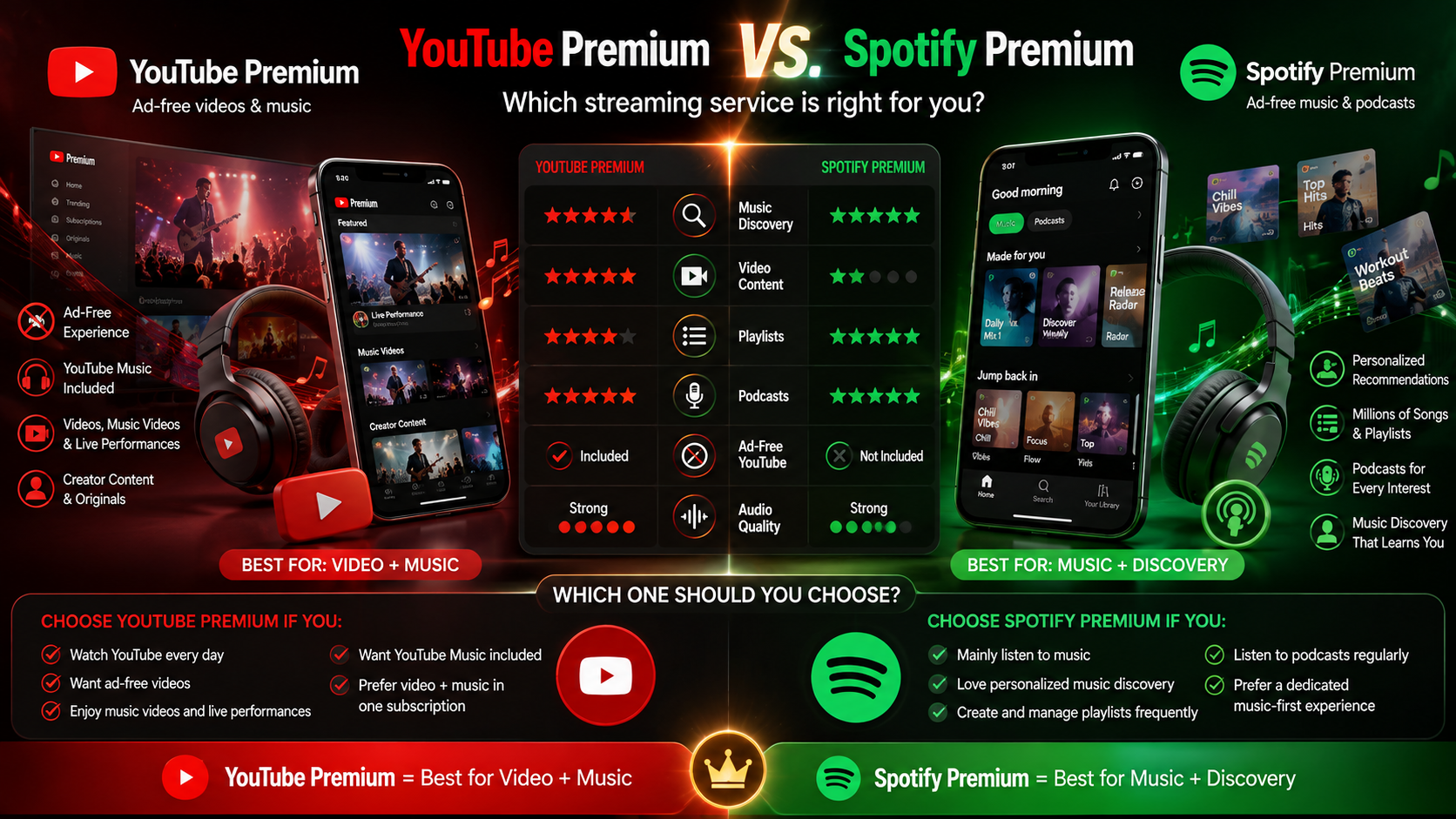
Whether Spotify or YouTube is better depends on your daily content habits. Spotify remains a strong choice for music discovery, curated playlists, podcasts, and personalized recommendations. Its recommendation system learns from your listening behavior and helps introduce you to new artists and songs.
YouTube offers a much broader content library. Users can access official music videos, live performances, remixes, covers, interviews, and user-created content. Some recordings are difficult or impossible to find on traditional music streaming platforms.
YouTube also becomes more valuable if you already spend significant time watching videos. YouTube Premium removes video advertisements while providing access to YouTube Music. That makes it a practical option for people who want both video and audio entertainment.
Spotify may suit users who primarily want a dedicated music experience. YouTube Premium may be better for people who regularly switch between music and video content.
Ultimately, your preferred platform should match your habits rather than simply having the longest feature list.
The Power of Music Discovery Algorithms
Spotify has built a strong reputation around personalized music discovery. Features such as Discover Weekly and Release Radar help users find new songs based on their listening patterns. Why You Should Switch To YouTube Music Today can also help you explore the benefits of YouTube Music as an alternative.
These recommendations can make Spotify feel like a personal DJ. The service also organizes music around moods, genres, artists, and listening history.
YouTube uses a broader recommendation system. Its suggestions can connect music with videos, creators, searches, and viewing history. This approach can uncover unusual performances, remixes, covers, and niche content.
Spotify generally feels more focused when your goal is discovering music. YouTube provides broader discovery across both music and video.
For dedicated music listeners, Spotify’s focused approach can be a major advantage. For multimedia users, YouTube’s broader recommendations may offer more variety.
Can YouTube Premium Replace Spotify Premium?
YouTube Premium can replace Spotify for many casual and moderate music listeners. A subscription includes access to YouTube Music, which provides official albums, singles, playlists, and background playback. You also receive an ad-free YouTube experience across supported content.
This combination can simplify your subscriptions. If you already spend most of your entertainment time on YouTube, adding a separate music service may not be necessary.
However, Spotify still offers advantages for dedicated music listeners. Its music-focused interface, playlist tools, recommendations, and cross-device experience can feel more polished for audio-first users.
Your decision should therefore depend on how you consume content. YouTube Premium makes sense if music and video are equally important. Spotify may remain the better choice if music is your primary form of entertainment.
Before switching, consider your favorite playlists, listening habits, devices, and podcast usage. A platform that fits your routine will provide more value than one with features you rarely use.
Assessing Your Daily App Usage
Before canceling Spotify, review how much time you actually spend on each platform. Your daily habits can reveal which subscription provides greater value.
If most of your entertainment already happens on YouTube, Premium can consolidate several activities under one subscription. You can watch creators, listen to music, and access music videos without switching between services.
If Spotify is your main music app, switching may feel less convenient. Consider how often you create playlists, discover new artists, listen to podcasts, or move playback between devices.
A simple usage audit can help. Ask yourself:
- Which app do you open most often?
- Do you mainly listen to music or watch videos?
- How important are personalized playlists?
- Do you regularly use YouTube for creator content?
- Would one subscription replace another service?
These answers can make the YouTube Premium vs. Spotify Premium decision much easier.
Is YouTube Audio Quality Better Than Spotify?
Audio quality is important when comparing streaming services. However, bitrate alone does not determine which platform sounds better. Your device, headphones, connection, audio settings, and listening environment also affect the experience.
Spotify Premium has traditionally offered higher maximum streaming bitrates than YouTube Music. Spotify’s highest-quality setting can reach up to 320 kbps, while YouTube Music’s highest setting has generally reached lower maximum bitrates.
That difference can give Spotify a technical advantage on paper. Still, many listeners may not notice a meaningful difference on standard earbuds or smartphone speakers.
YouTube offers another advantage through its broader content library. Users can find live recordings, remixes, covers, and music videos that may have different mixes or performances.
For casual listening, both services can provide good everyday sound. Audiophiles should compare actual listening results on their preferred hardware rather than relying only on bitrate specifications.
The best option depends on whether you prioritize technical audio settings or broader content availability.
Evaluating Bitrates and Hardware Limits
Higher audio quality matters most when your equipment can reproduce those differences. Good wired headphones, capable speakers, and suitable audio hardware can reveal more detail than basic speakers. For a broader look at how music can affect attention and mental performance, see Music and the Brain: How Rhythm Improves Memory & Focus.
Bluetooth devices can also introduce their own limitations. As a result, a higher streaming bitrate does not automatically guarantee noticeably better sound.
Your listening environment matters too. Differences are harder to notice during commuting, exercise, or other noisy activities.
If you use premium headphones in a quiet room, Spotify’s higher maximum bitrate may matter more. If you mainly use wireless earbuds, the practical difference may be smaller.
You should also consider whether your internet connection supports consistent high-quality streaming. Downloading music for offline listening can help when connectivity is unreliable.
In short, audio quality should be one factor rather than the only deciding factor. Content selection, recommendations, playback features, and subscription value may matter more for everyday users.
Which Is Cheaper, Spotify or YouTube Premium?
Price is an important part of the YouTube Premium vs. Spotify Premium comparison. However, comparing the monthly subscription price alone can be misleading because the services provide different combinations of features.
Spotify Premium focuses mainly on music and podcasts. Depending on your market and plan, Spotify also offers options designed for students, families, and individual users.
YouTube Premium combines ad-free YouTube with YouTube Music. This means one subscription covers both video and music streaming. For someone who watches YouTube regularly, that bundled value can be significant.
The best deal therefore depends on what you would otherwise pay for separately. If you only want music, Spotify may provide the more focused service. If you want ad-free YouTube as well, Premium can offer greater overall utility.
Prices and plan availability can change by country and over time. Always check the current official pricing before subscribing.
Rather than choosing the cheapest monthly fee, compare what you actually use each day. The subscription that replaces more of your existing entertainment services may deliver better value.
Factoring in Bundled Video Value
YouTube Premium’s biggest financial advantage is its bundled video benefit. The subscription removes ads from YouTube while also providing access to YouTube Music.
This matters if YouTube is already part of your daily entertainment routine. You can watch tutorials, creator videos, music videos, and other content without standard video advertisements. If you’re also interested in building an audience on the platform, Grow Your YouTube Channel with These Tips offers additional YouTube-focused guidance.
Spotify does not provide the same video-focused subscription benefit. Its value comes primarily from music, podcasts, recommendations, and audio-focused features.
Consider the services you currently pay for. If YouTube Premium could replace a separate music subscription, its higher price may be easier to justify.
However, the bundle only provides extra value when you actually use it. Paying more for features you rarely access does not necessarily make a subscription better.
A practical comparison should therefore include:
- Monthly subscription cost
- Music and podcast usage
- YouTube viewing habits
- Family or student eligibility
- Offline listening needs
- Playlist and discovery preferences
Looking at the complete package gives you a more realistic picture of each service’s value.
Should I Buy YouTube Premium or Spotify Premium?
The choice between YouTube Premium vs. Spotify Premium comes down to your entertainment priorities. Neither service is universally better, because each one targets a slightly different type of user.
Choose YouTube Premium if you spend significant time watching YouTube. It is also a strong option if you enjoy music videos, remixes, live performances, and creator content. You get ad-free YouTube and YouTube Music within one subscription.
Choose Spotify Premium if music is your main priority. Spotify provides a dedicated audio experience with strong discovery features, curated playlists, and podcast support.
Your existing subscriptions should also influence the decision. If YouTube already dominates your entertainment habits, Premium can simplify your setup. If Spotify is already your primary music platform, switching may offer fewer practical benefits.
Think about your budget, devices, listening habits, and favorite features. Then choose the service that you will use most frequently.
The best subscription is not necessarily the one with the most features. It is the one that provides the most useful features for your everyday routine.
Taking Advantage of Free Trials
A free trial can help you make a more confident decision when one is available. Use the trial period to test both services on the devices you use most.
Listen to your regular playlists and search for your favorite artists. Then explore each platform’s recommendations and discovery features.
You should also test playback controls, downloads, background listening, and device switching. These everyday features can affect your experience more than a comparison chart suggests.
During testing, pay attention to:
- Recommendation quality
- Playlist organization
- Search results
- Audio settings
- Offline playback
- Cross-device controls
- App usability
A trial also gives you time to determine whether YouTube Music can genuinely replace Spotify. If you continue missing Spotify features, the switch may not be worthwhile.
Likewise, Spotify may not justify its separate subscription if YouTube Premium already covers everything you need.
Test the services with your normal listening routine rather than relying only on advertised features. Your actual experience will provide the clearest answer.
Frequently Asked Questions
Can I download music for offline listening on both platforms?
Yes, both services allow you to download tracks, albums, and playlists directly to your mobile device for offline playback. This feature is essential for traveling, commuting through areas with poor cellular coverage, or saving mobile data while on the go. Both apps manage offline storage efficiently within their settings menus.
Do both services offer family and student discount plans?
Both platforms provide heavily discounted student tiers and shared family plans for multiple household accounts. These options significantly reduce the monthly cost per person when shared among trusted family members or college roommates. Be sure to check official eligibility requirements for student verifications before signing up.
How do their podcast libraries compare?
Spotify has invested heavily in exclusive podcasts and robust hosting tools, making it a premier destination for spoken-word audio fans. YouTube has also integrated podcasts directly into its main app and YouTube Music, allowing seamless switching between audio and video podcast formats easily.
Will my playlists transfer easily if I switch services?
Playlists do not transfer automatically between platforms natively, but third-party transfer tools make migration relatively simple. Services like FreeYourMusic or TuneMyWay can move your favorite songs and albums across platforms within a few minutes with minimal hassle.
Conclusion
Choosing between YouTube Premium and Spotify Premium depends on what you value most. Spotify remains an excellent choice for dedicated music listeners who prioritize discovery, playlists, and a focused audio experience.
YouTube Premium offers a broader package. It combines YouTube’s ad-free video experience with YouTube Music, making it particularly useful for people who regularly watch videos and listen to music.
Audio quality can also influence the decision. Spotify’s higher maximum bitrate may appeal to listeners with capable audio equipment. However, many casual listeners may notice little practical difference.
Price should be evaluated alongside the features you actually use. A slightly more expensive subscription can provide better value when it replaces multiple services.
Before making your decision, consider your music habits, YouTube usage, budget, devices, and favorite features. If a free trial is available, use it to test the experience with your normal routine.
Ultimately, the better service is the one that fits naturally into your everyday entertainment habits. For more troubleshooting help, see our guide on YouTube PiP Not Working on iPhone.