

Retail Management Career Paths: What to Expect in Your First Year
Stepping into store leadership opens up diverse retail management career paths. These roles offer fast environments, team leadership opportunities, and real business oversight. According to insights from the National Retail Federation, the retail sector offers unmatched operational experience. Consequently, this hands-on background prepares ambitious professionals for executive positions across many industries.
Whether you start as an assistant manager or a supervisor, your first twelve months are critical. Furthermore, you will learn to guide teams, control budgets, and drive customer satisfaction. This guide outlines what to expect during year one. Ultimately, it also explains how to navigate retail management career paths for long-term promotion.
Daily Responsibilities on Retail Management Career Paths
Your daily duties change quickly based on foot traffic and sales goals. However, core operational tasks remain steady during your first year.
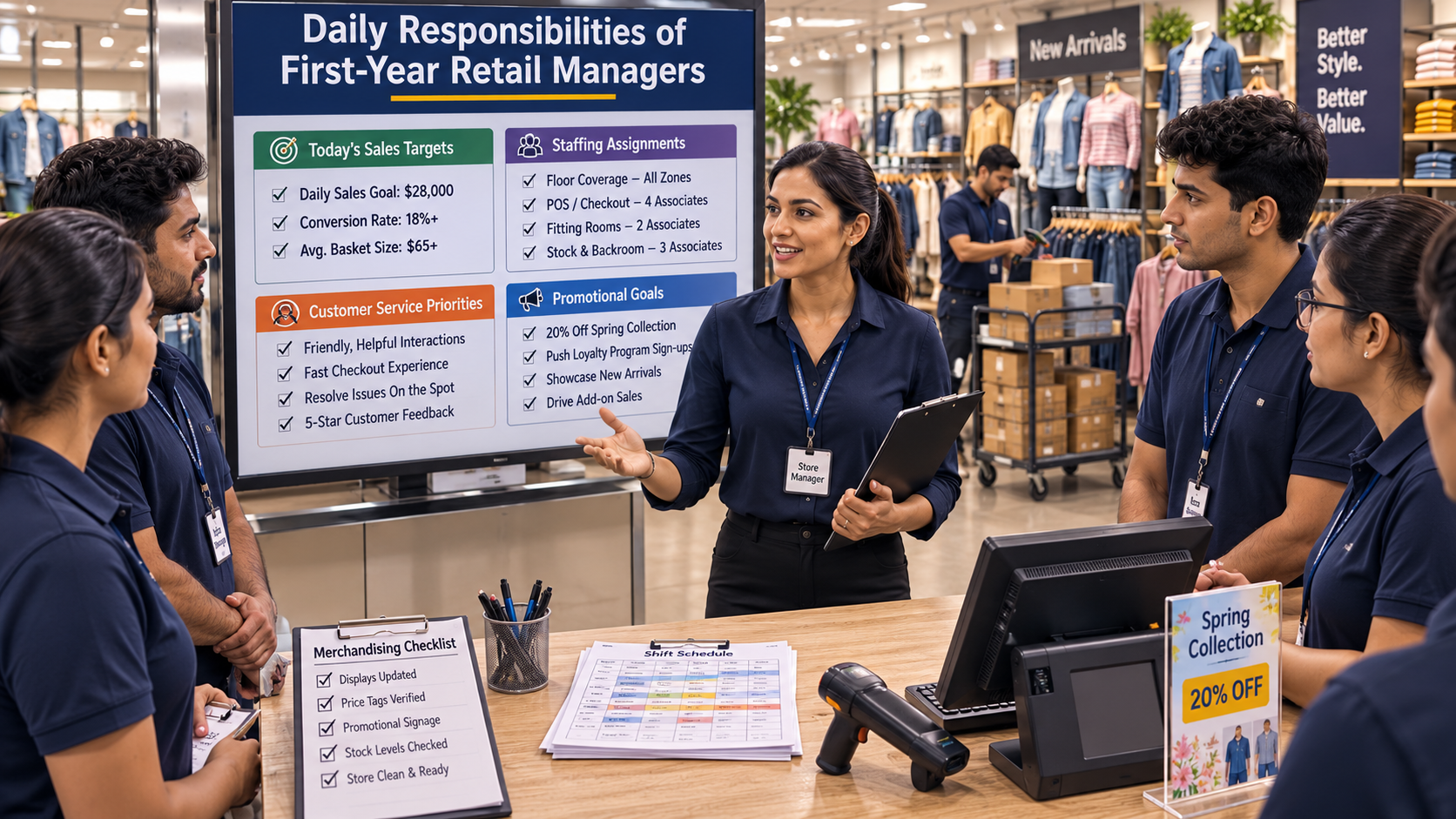
Daily Sales Floor Execution and Staff Guidance
During your initial months, you spend most of your time on the sales floor. Managers start shifts by leading quick morning team huddles. In these meetings, team leads share daily sales targets and key store goals.
Throughout the shift, you direct floor coverage and manage employee breaks. Supporting your team during peak hours builds deep trust. As a result, active floor presence helps you fix customer service issues quickly. You see how customers shop and where bottlenecks happen daily.
Inventory, Merchandising, and Financial Tracking
Behind the scenes, you manage backroom stock and product displays. Supervisors direct delivery processing while maintaining corporate visual standards.
In addition, managers track store performance metrics daily. Key metrics include sales conversion rates, basket sizes, and labor hours. Learning to analyze these financial reports lets you control costs and lower stock loss. Moreover, mastering store analytics builds confidence to pitch bigger operational ideas.
Typical First-Year Priorities:
| Timeframe | Key Operational Priorities |
| Months 1–3 | Floor Training, Systems Mastery, Team Culture |
| Months 4–6 | Performance Metrics, Scheduling, Shrinkage & Loss Prevention |
| Months 7–12 | Strategic Planning, Coaching, Promotion Preparation |
First-Year Milestones in Retail Management Career Paths
Navigating your first year requires hitting clear milestones as you learn to lead.
Here is the text format conversion of your First Year Growth Milestones chart:
First Year Growth Milestones
-
Q1: Foundation & Floor Dynamics
-
Master POS systems
-
Build rapport with staff
-
-
Q2: Metrics & Operational Control
-
Manage loss prevention
-
Optimize labor scheduling
-
-
Q3: Team Leadership & Development
-
Conduct staff reviews
-
Delegation and training
-
-
Q4: Strategic Business Planning
-
Peak season execution
-
Annual goal setting
-
Months 1–3: Mastering Store Operations and Building Team Trust
Your first quarter focuses on basic operational training and team trust. Specifically, you master checkout systems, store software, and cash handling rules.
Meanwhile, building strong relationships with your staff remains vital. Demonstrate to associates that you are willing to do hard work. For example, help unpack freight boxes and clean sales displays. Working hard alongside your team earns respect fast. Consequently, delegating daily tasks becomes much easier later on.
Months 4–6: Managing Labor Schedules and Stock Control
By mid-year, your primary focus shifts to cost control and scheduling. Therefore, you begin creating weekly shift schedules within strict payroll limits. You align labor hours directly with projected customer foot traffic.
Similarly, tackling stock loss becomes essential during this stage. You run inventory audits and enforce secure delivery rules. Balancing low labor costs with high service levels proves your business judgment to district bosses.
Months 7–12: Staff Coaching, Delegation, and Strategic Planning
The final half of year one shifts your focus toward staff development. Instead of fixing every small problem yourself, you learn to delegate tasks effectively.
Furthermore, you run staff reviews, train rising talent, and coach associates on sales goals. You also prepare the store for busy holiday sales quarters. Showing that your store runs smoothly when you step away proves you are ready for bigger retail management career paths.
Long-Term Retail Leadership Trajectories and Promotion Options
The store experience you build creates a strong base for many leadership roles.
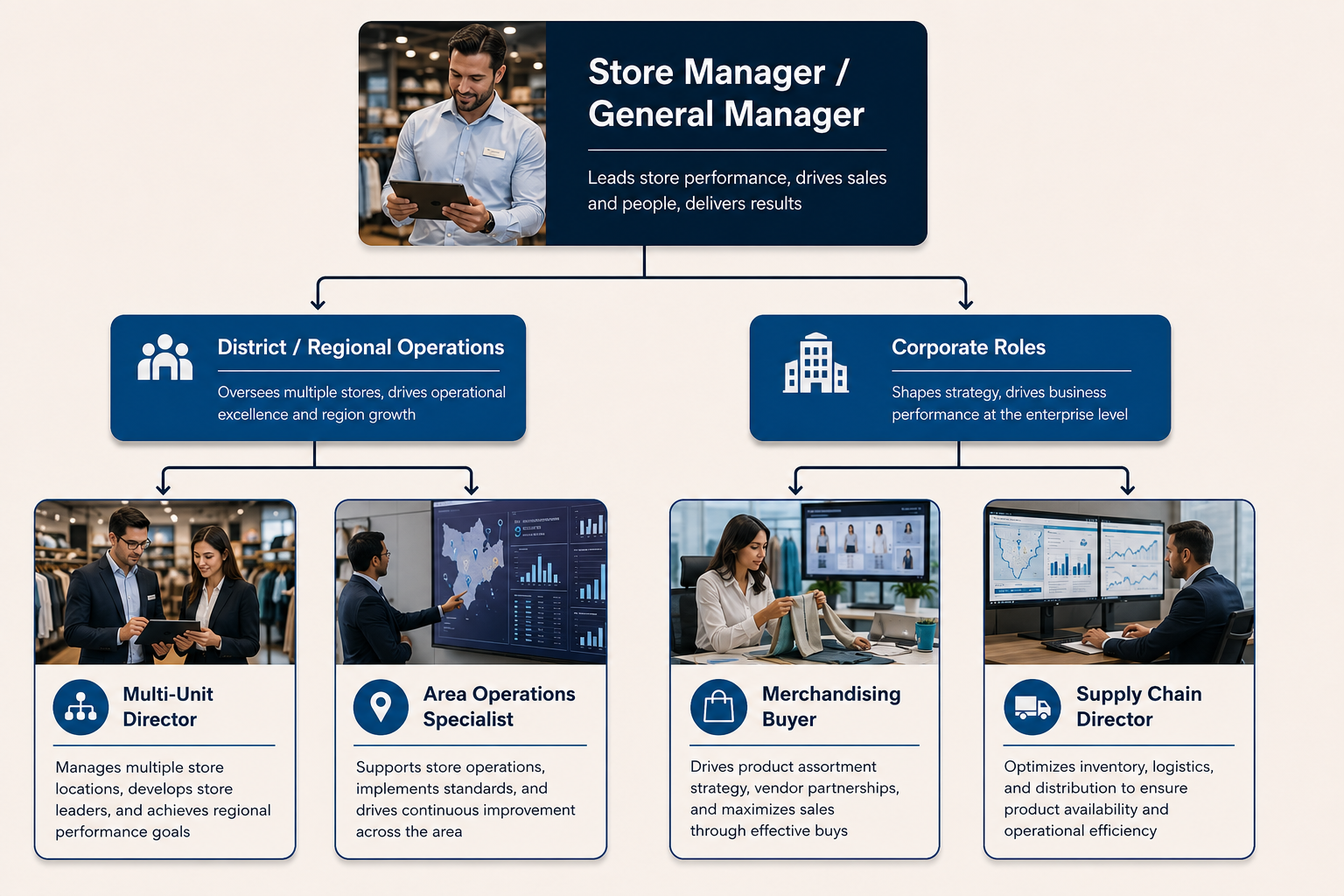
Store Operations Leadership Tracks and Multi-Unit Growth
Rising through store operations lets you expand your business impact fast. Supervisors move into Assistant Manager roles before becoming General Managers. Store Managers run multi-million dollar store budgets, hiring choices, and local marketing.
In addition, top performers can move into multi-unit district management. In these higher roles, leaders oversee dozens of store locations across whole regions. Consequently, they partner directly with corporate executives to guide brand strategy.
Transitioning to Corporate Roles from Store Positions
Hands-on experience on retail management career paths prepares you well for corporate roles. Executive recruiters love candidates who understand actual store operations firsthand.
-
Product Buyer: Select regional merchandise and negotiate vendor contracts.
-
Supply Chain Manager: Direct inventory shipments from central distribution centers to stores.
-
Corporate HR Partner: Create company training programs and manage field recruitment.
Frequently Asked Questions
What entry-level roles start retail management career paths?
Starting your leadership journey usually begins in foundational roles such as Assistant Store Manager, Department Supervisor, Floor Manager, or Management Trainee. Many national retail chains offer dedicated management development programs aimed at recent college graduates and promising internal talent. These structured corporate training programs blend classroom leadership instruction with hands-on store rotations over six to twelve months. Trainees learn inventory auditing, labor scheduling platforms, financial reporting, and employee management side-by-side with seasoned store executives. Completing a structured training trajectory provides direct exposure to full business management, helping participants rapidly move up into salaried management positions with complete operational accountability. Furthermore, working in these foundational entry points allows emerging leaders to experience frontline floor dynamics, customer conflict resolution, and logistics execution firsthand, building the practical credibility necessary to lead larger retail teams effectively.
How fast can you earn promotions on retail management career paths?
Promotions move very fast on retail management career paths because performance results are completely transparent and evaluated against objective fiscal metrics daily. High-performing assistant managers who consistently meet sales targets, manage labor costs efficiently, and maintain low employee turnover can realistically advance to full Store Manager positions within one to three years. Once you achieve store general manager status, demonstrating consistent profit growth and effective talent development across multiple financial quarters opens doors to multi-unit leadership. Advancing into district, area, or regional management roles usually takes an additional three to five years of proven results. In these executive positions, leaders scale their operational impact across dozens of store locations. Because retail organizations prioritize internal talent pipelines, professionals who take initiative and master store operations frequently experience significantly faster vertical promotion velocity compared to traditional office environments.
What core skills determine success in first-year store leadership?
Succeeding during your initial year in retail leadership requires a balanced combination of emotional intelligence, clear communication, and financial literacy. On the interpersonal side, you must build strong coaching capabilities, resolve workplace conflicts fairly, delegate daily floor tasks effectively, and maintain high team morale under high-volume pressures. On the technical side, you need a firm grasp of retail math, inventory variance metrics, point-of-sale systems, and labor optimization software. Successfully balancing these distinct management dimensions while consistently elevating the customer experience defines your long-term promotion potential. Moreover, learning how to analyze profit-and-loss (P&L) statements allows you to identify cost leaks, lower shrinkage, and pitch strategic visual merchandising tweaks. Mastering both team emotional dynamics and operational analytics early marks you as a top-tier candidate for accelerated corporate growth tracks.
Is working weekends required during your first year in retail management?
Yes, working weekends, late evenings, and peak holiday rush periods is standard practice for first-year retail managers. Retail operations generate the overwhelming majority of their customer traffic and revenue during weekend hours and seasonal shopping rushes, requiring experienced leadership directly on the sales floor. Managing during these peak traffic windows allows you to direct floor energy, address immediate checkout bottlenecks, maintain visual presentation standards, and support associates through high-stress situations. While the physical demand during initial quarters is substantial, modern corporate retailers actively focus on sustainable work-life balance initiatives. Many major brands now implement predictable scheduling platforms, fixed shift rotations, alternating weekend coverage schedules, and generous paid time off policies. This structural support helps mitigate management burnout while preserving strong store leadership presence during critical high-volume sales days.
Can store leadership experience transfer to corporate careers?
Yes, store leadership experience transfers directly into numerous corporate functional disciplines across various consumer industries. Corporate hiring executives actively seek professionals with hands-on store management backgrounds because former operational leaders deeply understand how executive strategies impact frontline associate execution and real customer buying decisions. Common vertical and lateral career transitions include stepping into product buying, inventory demand planning, supply chain logistics, visual merchandising design, store strategy analysis, and field human resources. Having practical store floor experience makes you an exceptionally strategic corporate contributor because you possess first-hand knowledge of physical inventory constraints, labor scheduling challenges, and genuine shopper behaviors. Consequently, starting on store sales floors serves as a powerful talent incubator for long-term corporate executive leadership.
How do retail managers handle store inventory loss?
Handling store inventory loss requires a systematic blend of strict process enforcement, regular financial auditing, and proactive team training. Retail managers execute routine cycle counts, reconcile shipment discrepancies against warehouse invoices, and enforce secure backroom inventory protocols to minimize internal administrative errors and organized theft. They conduct continuous staff training on customer engagement tactics, ensuring high associate visibility across high-risk store zones during busy hours. Additionally, managers work directly alongside corporate loss prevention specialists to analyze inventory variance reports, audit high-value merchandise display cases, and ensure security camera networks operate efficiently. Establishing an accountable loss prevention culture across the entire store team protects gross profit margins, stabilizes physical supply chains, and ensures accurate product availability for retail consumers.
Conclusion
Following structured retail management career paths brings an exciting mix of team leadership, customer engagement, and financial strategy. Store leadership remains one of the premier high-paying jobs that don’t require coding, offering great growth through practical business management. Although your first year requires adjusting to fast shifts, physically demanding floor coverage, and changing schedules, the practical skills you develop are invaluable. Mastering weekly labor scheduling, loss prevention controls, visual merchandising, and associate coaching sets you up for steady long-term success. Furthermore, focusing on supporting your frontline employees while hitting key performance metrics will consistently earn recognition from regional leaders. Ultimately, taking full ownership of your store floor environment transforms standard shift duties into strategic management practice. By embracing these early operational challenges with enthusiasm, you build a clear, direct track toward store general management, multi-unit district oversight, or corporate leadership positions.