

Last-Minute Revision Tips: How to Pass Your Exams
The countdown to exam day can feel incredibly overwhelming, especially when you realize time is running out. Fortunately, implementing the right last-minute revision tips can dramatically alter your academic performance and reduce your anxiety. Instead of panicking over what you have not studied, you need to optimize the remaining hours by focusing on high-impact learning strategies. Shifting your mindset from panic to focus allows you to process information efficiently without burning out before you even step foot inside the testing center.
According to educational research published on platforms like the Stanford University Center for Teaching and Learning, active retrieval and strategic review are far more effective than mindless cramming. This article breaks down actionable techniques that help your brain retain critical data when time is short. We will cover everything from prioritizing key topics to managing your mental energy effectively. Understanding how to study under pressure is a skill that benefits you far beyond the classroom. By shifting your approach from passive reading to active engagement, you can make every minute count. Here is your ultimate guide to maximizing your final study sessions and stepping into your exam room with genuine confidence.
Effective Last-Minute Revision Tips That Actually Work
When you are down to the wire, your study strategy requires a complete overhaul. You can no longer afford to read textbook chapters sequentially or highlight blocks of text aimlessly. Instead, you must become highly selective with your focus and energetic with your study methods.
The goal during a final review is not to learn an entire semester of material from scratch but to organize what you already know and patch up major gaps. By changing your methodology to suit the short timeframe, you protect your brain from cognitive overload and ensure that the most critical concepts stick when it matters most. If you want to retain information more effectively, read our guide on memory improvement techniques for exams to strengthen your recall before test day.
Prioritize with the Pareto Principle
The Pareto Principle states that 80% of your results come from 20% of your efforts. In the context of final exam preparation, this means identifying the core concepts that are most likely to appear on the test. Review your syllabus, lecture slides, and past exam papers to spot recurring themes, primary theories, and heavily weighted modules. Master these foundational elements completely before you even look at minor details or footnotes. Focusing heavily on these high-yield topics ensures you secure the bulk of the available points on the test, maximizing your score efficiently even if your study time was cut incredibly short.
Embrace Active Recall
Reading through highlighted notes gives you a false sense of security, often referred to as the illusion of competence. To ensure you actually know the material, force your brain to retrieve the information without looking at your study guides. You can hide your notes entirely and write down everything you remember about a specific topic on a blank sheet of paper. Additionally, flashcards are excellent for testing your definitions and formulas quickly while you are on the move. Another fantastic active strategy is explaining a complex concept aloud as if you were teaching it to a peer, which highlights your immediate knowledge gaps.
Smart Study Strategies for Limited Time
Time management becomes your ultimate weapon when the exam is only a day or two away. If you study haphazardly without a clear structure, you will quickly exhaust your mind without retaining the core facts. Creating a highly focused environment means eliminating notifications, setting specific targets for each hour, and understanding exactly when to push forward and when to rest. When time is working against you, structure provides the mental guardrails needed to keep anxiety at bay and prevent you from jumping erratically between completely unrelated subjects.
Use the Pomodoro Technique
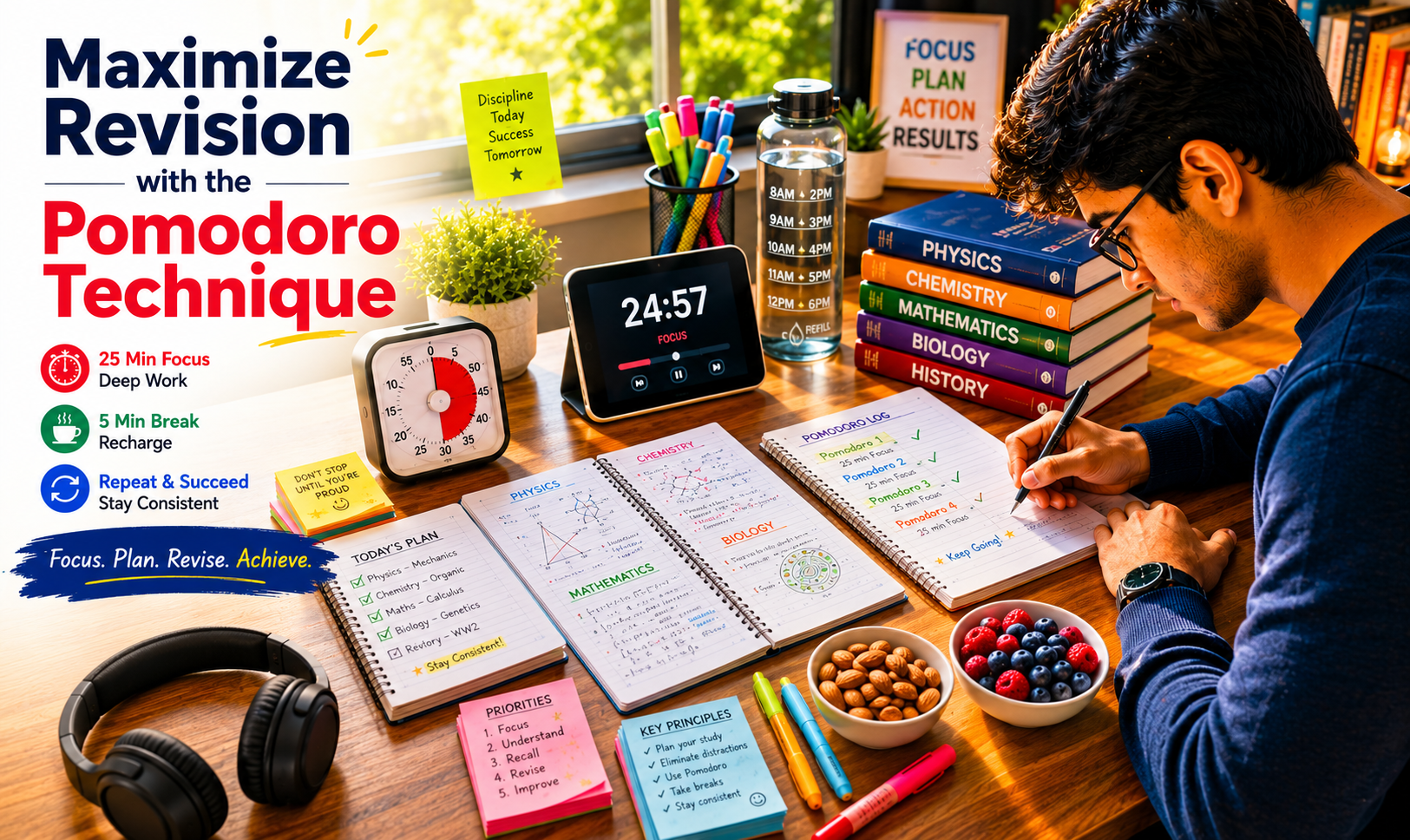
Cramming for six hours straight leads to severe cognitive fatigue, low attention spans, and incredibly poor information retention. Instead, break your study sessions into manageable intervals using a simple timer to keep your mind completely fresh. Study with absolute focus for 25 minutes, then take a refreshing 5-minute break to stretch or drink some water. After completing four of these cycles, reward yourself with a longer 20-minute rest to keep your brain sharp, motivated, and receptive to new data. This rhythmic approach prevents mental exhaustion and helps maintain a high level of performance throughout the day.
Leverage Practice Papers and Questions
Nothing prepares you for an exam quite like replicating the actual test environment. Instead of studying abstract theory for hours, jump straight into past question papers and sample tests. Even if you do not know all the answers initially, attempting the questions highlights your immediate knowledge gaps and familiarizes you with the formatting. Consequently, you can dedicate your remaining time to fixing those specific weaknesses rather than wasting time on things you have already mastered. This targeted approach transforms your passive review into a highly diagnostic, efficient preparation session.
Psychological Hacks to Boost Memory Retention
Your mental state heavily influences how well your brain stores and recalls information during high-stress periods. If your stress hormones are constantly spiking, your prefrontal cortex struggles to access stored data efficiently during the exam. Therefore, managing your psychological health is just as critical as reviewing the academic content itself. Implementing basic cognitive safeguards allows you to remain calm under pressure, which directly translates to clearer thinking, better problem-solving, and more accurate retrieval when you are sitting in front of the exam paper.
Avoid the All-Nighter Trap
Sleep is not a luxury; it is a critical, irreplaceable part of the human learning process. While pulling an all-nighter to cram seems helpful in theory, severe sleep deprivation impairs your memory, critical thinking, and reaction times. During deep sleep, your brain actively treats and consolidates memories, transferring information from short-term storage into long-term recall. Aim for at least seven hours of continuous sleep before your exam so your brain can process and organize what you studied. Walking into a test well-rested will always yield better results than walking in exhausted with a few extra hours of messy cramming.
Condense Notes into Cheat Sheets
Take your extensive study notes and aggressively condense them onto a single sheet of paper or a few small index cards. Use trigger words, acronyms, and simple diagrams to represent massive topics rather than writing out full, tedious sentences. The physical and mental process of summarizing vast amounts of information forces your brain to categorize, prioritize, and synthesize the material deeply. This creative exercise ensures that you understand the underlying connections between concepts, which significantly aids quick mental retrieval when you are facing difficult questions under a strict exam countdown.
FAQ SECTION
What are the best last-minute revision tips for essay-based exams?
The best approach for essay exams is to focus on structural frameworks and core arguments instead of memorizing full essays. Learn three or four versatile case studies, historical quotes, or statistics that can fit multiple questions. Practice creating quick essay plans with an introduction, three main arguments, and a clear conclusion. This helps you organize your ideas under exam conditions. A flexible structure also allows you to adapt your knowledge to different questions without panicking.
Focus on transitional phrases that connect your ideas smoothly because examiners value clear organization and logical flow. Memorize key definitions and thematic headings that demonstrate a solid understanding of the subject. When you understand the main themes of your course, you can apply your knowledge to a wide range of essay questions. This makes it easier to write clear, well-supported, and high-scoring answers.
Is it a good idea to learn new topics the night before an exam?
Generally, learning entirely new topics the night before an exam is counterproductive. Last-minute learning often causes panic and increases stress. It also takes attention away from material you already know well. Your brain needs time and sleep to understand new concepts and store them effectively. Instead of starting a major topic, reinforce what you already know. Review your notes and focus on your strongest areas. It is better to secure marks on familiar topics than risk confusion across the whole syllabus. Protect what you have already learned instead of spreading your attention too thin.
How can I reduce exam anxiety during last-minute studying?
Break your revision into small, achievable tasks. This makes the workload feel more manageable. Take slow, deep breaths whenever you feel overwhelmed. They can help calm your body and reduce stress. Study in a clean, quiet space without digital distractions. Remember that some nervousness is normal. Use that energy to stay alert and focused. Take a five-minute break every hour to refresh your mind. Avoid discussing the exam with anxious classmates because stress can spread quickly. Finally, remind yourself of your preparation and concentrate on the task in front of you.
How do I use past papers when I am short on time?
If time is limited, avoid writing full answers. That approach takes too long. Instead, use bullet-point answers. Read each question and list the key formulas, definitions, or arguments. Then compare your points with the official marking scheme. This method lets you review an entire paper in about 15 minutes instead of two hours. It also exposes you to many question styles in a short time. You will quickly notice common patterns and examiner expectations. Completing three or four papers this way can make the real exam feel much more familiar.
What should I eat and drink during final revision sessions?
One of the most important last-minute revision tips is to choose foods that provide slow-release energy. They help prevent sugar crashes and keep you focused. Good options include almonds, walnuts, berries, oatmeal, eggs, and whole grains.
Another of the best last-minute revision tips is to drink plenty of water throughout the day. Even mild dehydration can reduce concentration and slow thinking. Limit your caffeine intake. One coffee or tea may improve alertness, but too much can increase anxiety and disturb sleep. Among the most effective last-minute revision tips is avoiding heavy, greasy meals because they can make you feel tired. Following these last-minute revision tips by staying hydrated and eating balanced meals will help you perform at your best during your last-minute revision tips routine before an exam.
CONCLUSION
Navigating upcoming exams can feel incredibly daunting, but utilizing strategic last-minute revision tips can turn the tide in your favor and dramatically improve your final results. True academic success in the final hours does not come from chaotic cramming, panicking, or sacrificing your precious sleep. Instead, it relies heavily on smart prioritization, active recall techniques, and maintaining your overall mental well-being. By focusing your energy on the highest-yielding topics and protecting your cognitive health, you maximize your chances of success. Do not let the pressure paralyze your progress; even a single focused hour of active studying is vastly superior to hours spent staring blankly at a textbook in a state of exhaustion.
Trust the preparation strategies you have implemented, take a deep breath, and approach your test with a calm, deliberate, and focused mindset. Remember that an exam is simply an opportunity to showcase what you know, not a reflection of your worth. Sleep well, feed your brain the right nutrients, and step into the testing hall with genuine confidence. You have the tools, the structure, and the mindset required to succeed, so go out there and execute your plan efficiently.