
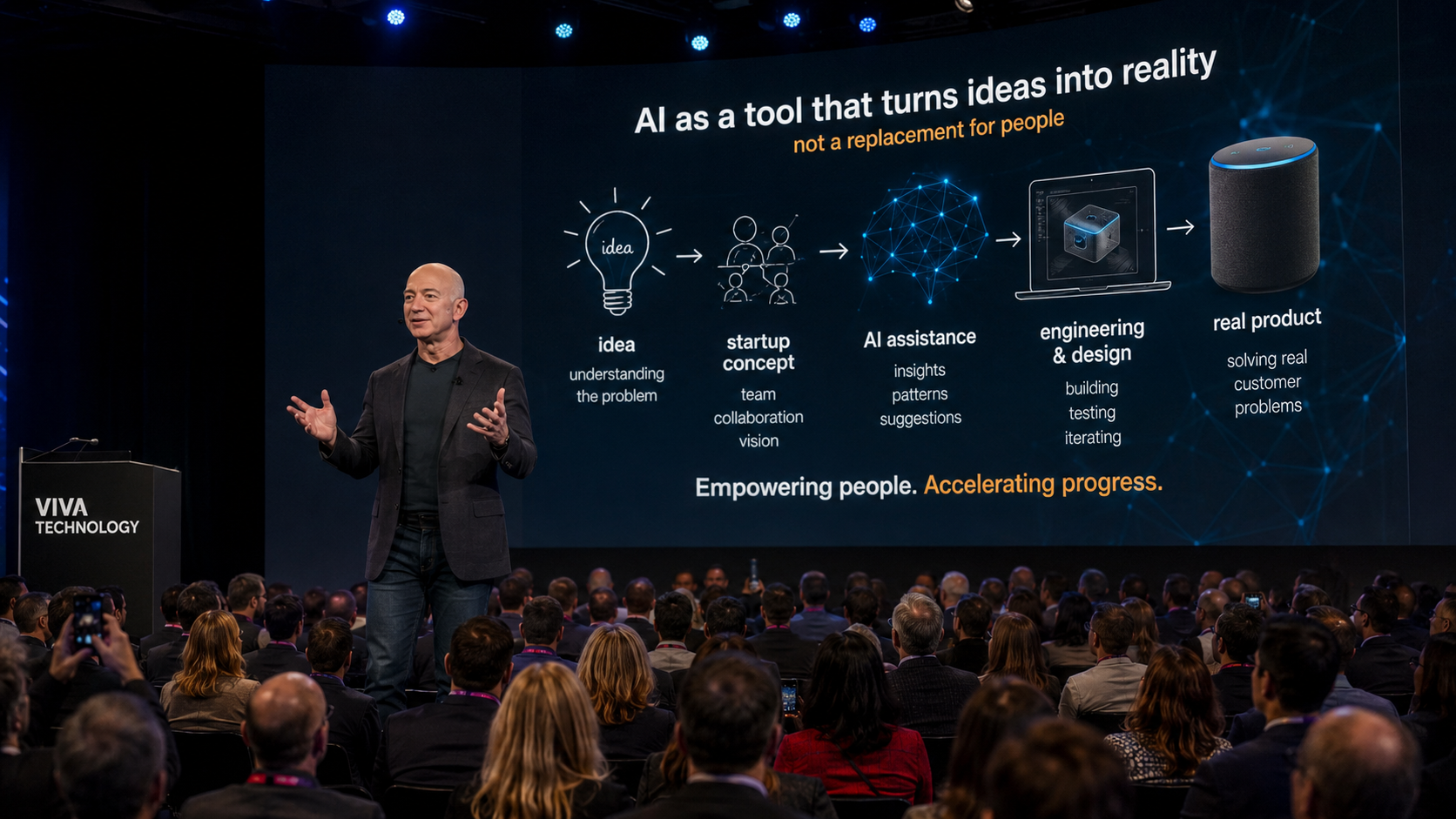
AI Will Create More Jobs: Bezos’ Vision for the Future
The future of work is changing rapidly, and many experts believe artificial intelligence (AI) will create more jobs instead of causing permanent unemployment. Discussions about artificial intelligence often focus on job losses and economic disruption. However, at the VivaTech technology conference in Paris, Amazon founder Jeff Bezos presented a more optimistic perspective. According to a recent BBC report on the debate around AI and employment, Bezos argued that AI could expand opportunities by increasing productivity, reducing barriers to innovation, and helping people build new businesses. BBC report on Jeff Bezos and AI creating jobs
Bezos challenged the idea that automation will make human workers unnecessary. Instead, he believes AI will become a powerful tool that allows people to achieve more. When AI manages repetitive tasks and complex data processing, humans can focus on creativity, leadership, strategic thinking, and innovation.
This article explores how AI will create more jobs through economic growth, emerging industries, and rising demand for human skills. It examines Jeff Bezos’ labor shortage theory, the growth of AI-powered careers, and the ways professionals can prepare for an AI-driven economy.
The discussion also looks at the broader economic impact of AI adoption. It explores how corporate AI tools are reshaping employment, creating new industries, and changing the skills companies value most. While some businesses may reduce certain roles in the short term, AI-driven growth can create new opportunities across technology, healthcare, entrepreneurship, and creative industries.
The Core of Bezos’ Argument at VivaTech Paris
During a highly anticipated headline session at VivaTech Paris, Jeff Bezos addressed the growing public anxiety regarding automated systems taking over human roles. He openly acknowledged that many highly intelligent individuals are deeply worried about automation making workers redundant. However, he made his stance perfectly clear by stating that he completely disagrees with that pessimistic worldview. According to reporting from Reuters, Bezos emphasized that the real future challenge for global markets will be a lack of available labor rather than a lack of available work.
"I know there's a lot of concern that many people have, including many smart people, that AI is going to make humans redundant. I totally disagree with this point of view. And I think, in fact, AI is going to create a labor shortage." — Jeff Bezos at VivaTech Paris
The foundational premise of this argument rests on what Bezos calls the “dream-build loop.” Every professional and aspiring entrepreneur has countless innovative concepts for products, businesses, or specialized services that never leave their heads. Historically, these ideas remain stagnant because the operational barriers—such as complex manufacturing logistics, coding requirements, or regulatory compliance mapping—are too difficult and costly to overcome. By acting as an accessible execution layer, artificial intelligence drastically lowers these barriers, turning ideas into active projects that require human builders.
The Economic Paradox: Reconciling Layoffs with Job Creation
To maintain a balanced and trustworthy perspective on the market, we must look at the apparent contradiction between Bezos’ long-term optimism and current tech industry trends. Data published by global outplacement firms like Challenger, Gray & Christmas shows that technology sector layoffs have escalated, with companies explicitly attributing a portion of corporate downsizing to artificial intelligence efficiencies. Even Amazon has adjusted its corporate headcount in certain departments while heavily investing in machine learning infrastructure.
However, historical data from the International Monetary Fund shows that technological transitions almost always feature localized disruption before triggering broad-based employment growth. When a company automates a specific back-office process, it experiences an immediate surge in productivity and financial margin. These optimized resources are subsequently reinvested into expanding the business, building new product lines, and establishing new departments. Consequently, while a routine clerical position might disappear, multiple collaborative, analytical, and customer-facing roles are created to manage the organization’s expanded scale.
How AI Will Create More Jobs Across Global Industries

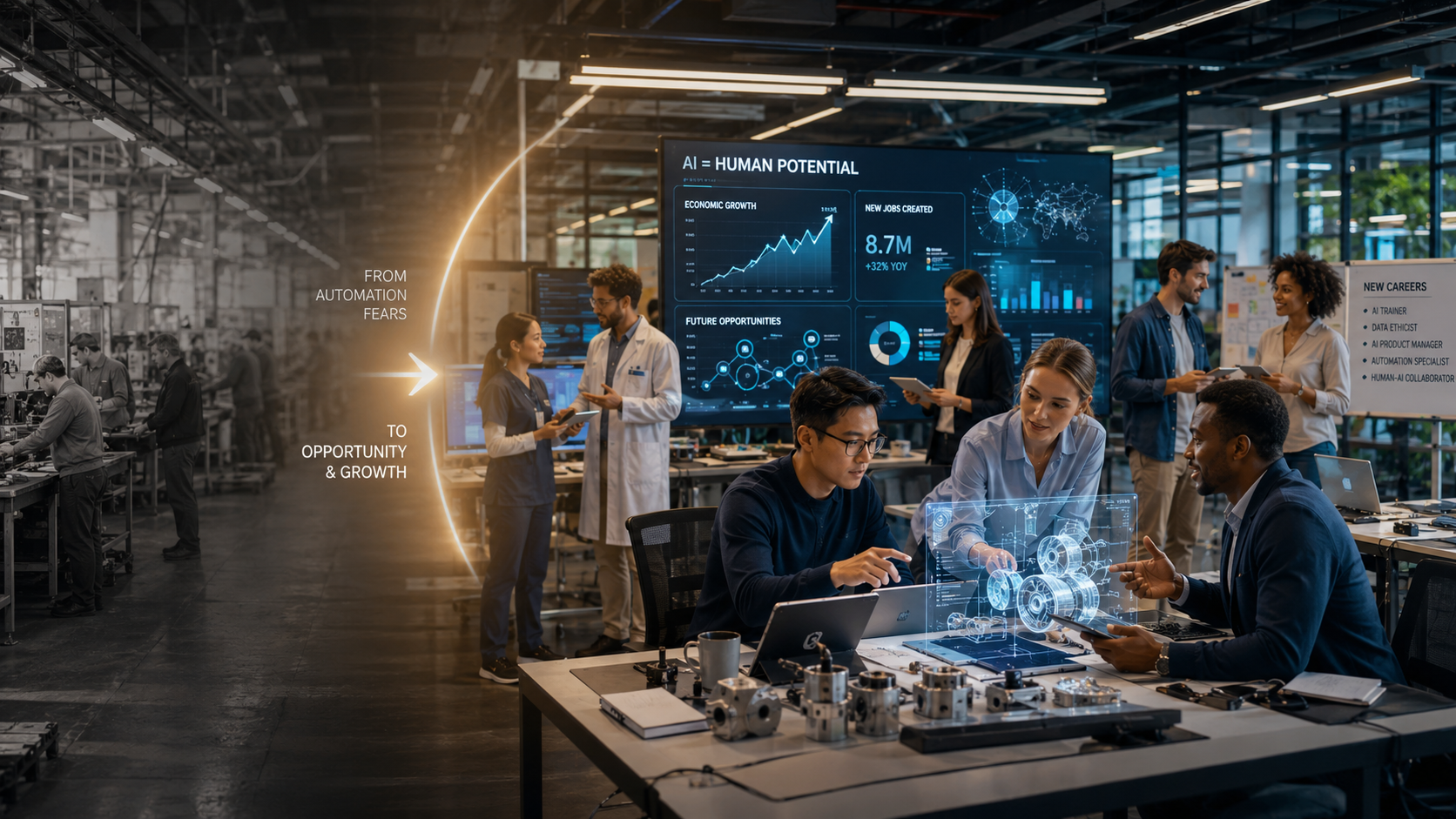
The economic engine behind automated systems is driven by workforce augmentation rather than human replacement. When advanced software tools take over the predictable, repetitive, and calculation-heavy segments of a job, human workers transition into higher-value strategic functions. Studies conducted by the World Economic Forum reinforce this trajectory, estimating that while automation will displace tens of millions of traditional roles, it is on track to create a significantly larger number of new employment opportunities globally.
This massive net-positive job creation manifests in several distinct ways across the corporate landscape:
1. The Rise of Technical Infrastructure Roles
The deployment of enterprise-grade machine learning models requires a vast network of skilled professionals to build, maintain, monitor, and refine the underlying systems. Organizations are aggressively recruiting data engineers, algorithm auditors, AI safety compliance managers, and prompt optimization specialists. These positions did not exist a decade ago but have quickly become vital to ensuring corporate algorithms remain accurate, safe, and legally compliant.
2. The Expansion of the “Dream-Build” Economy
As Bezos highlighted at VivaTech, when artificial intelligence simplifies complex development processes, the volume of new business creation accelerates. A single creator can now use generative software to manage initial software engineering, basic marketing collateral, and financial forecasting. This democratization of tools allows an explosion of boutique firms, niche manufacturing startups, and localized service providers to enter the market, all of whom will eventually hire human teams as they scale.
3. Hyper-Personalization of Consumer Services
In sectors like education, healthcare, and financial advising, smart algorithms can instantly analyze an individual’s background data to map out custom profiles. This efficiency allows human professionals to abandon generic, one-size-fits-all programs. Instead, teachers become personalized learning mentors, and medical professionals transition into proactive wellness coaches. Because delivering truly customized care is highly time-intensive, companies must expand their human workforces to meet consumer expectations.
Real-World Case Study: Bezos’ Prometheus Initiative
Jeff Bezos is not simply predicting this collaborative future; he is actively funding it. At VivaTech Paris, he discussed his new artificial intelligence venture, Prometheus, which he co-founded alongside veteran tech scientists. The primary objective of Prometheus is to develop what Bezos terms an “artificial general engineer.” This specialized platform focuses on accelerating physical product design, automotive development, aerospace engineering, and advanced pharmaceutical manufacturing.
Interestingly, Bezos clarified that Prometheus is entirely decoupled from robotics; it is strictly a cognitive acceleration tool for human engineers. By running millions of physical and structural simulations in a fraction of the time a human would require, the platform eliminates the tedious trial-and-error phases of heavy industry. This development speed allows manufacturing firms to move prototypes into physical production rapidly. Far from reducing headcount, this acceleration creates an immediate need for factory floor technicians, supply chain coordinators, quality assurance inspectors, and logistics managers to handle the increased output of real-world goods.
The Irreplaceable Value of Human-Centric Skills
The reason why AI will create more jobs rather than causing permanent unemployment is rooted in the inherent cognitive and emotional limits of software code.
AI systems operate through historical datasets, statistical patterns, and mathematical probabilities. They do not possess genuine consciousness, authentic empathy, or a moral compass. As automation increases, uniquely human qualities become a major competitive advantage for organizations.
The core human advantages in the AI-driven workplace include:
Contextual Understanding and Negotiation
Important business decisions often require understanding emotions, cultural factors, and complex human relationships. High-level negotiations and leadership situations depend on trust, communication, and the ability to adapt to unpredictable human behavior.
Ethical Judgment and Governance
Organizations need human oversight to ensure decisions align with social values, sustainability goals, and ethical responsibilities. These choices cannot be reduced to mathematical calculations alone.
Compassionate Problem Solving
Many challenges involve empathy, emotional intelligence, and understanding individual experiences. Human-centered problem solving remains essential in areas where trust and care matter.
AI can help create strategies, analyze information, and improve efficiency, but it cannot fully replace the human ability to build relationships, make moral decisions, and navigate complex social situations. As AI becomes more powerful, human creativity, judgment, and emotional intelligence will become even more valuable in the future economy.
Preparing For the Augmented Labor Market
While the macro-economic perspective indicates a prosperous future for employment, the transitional phase requires active adaptation from individual professionals. To stay resilient against shifting corporate requirements, workers must move away from memorization-based or purely repetitive tasks. The modern professional must learn to view smart software as a highly capable assistant rather than an existential threat.
According to workforce transformation reports from the OECD, successful career longevity in the modern era requires a commitment to continuous upskilling. Professionals should strive to master the specific software platforms shaping their respective fields. By combining your deep domain expertise with an advanced ability to direct and refine algorithmic outputs, you position yourself as a highly productive leader that companies will actively compete to hire.
Frequently Asked Questions
Will AI create more jobs than it replaces?
Yes. History shows that new technologies often replace some tasks while creating new opportunities. Artificial intelligence can automate routine work, including data entry, administration, and repetitive processes. However, AI also improves productivity, lowers costs, and helps businesses expand.
As companies use AI tools, new career opportunities will grow. These jobs may include managing AI systems, developing new technologies, analyzing data, and providing specialized services. Future professionals will need technical skills, creativity, problem-solving abilities, and strong human communication skills.
Will AI help humans or replace human jobs?
Artificial intelligence helps human workers improve productivity and efficiency. It can process large amounts of data, find patterns, and complete repetitive tasks quickly. By handling routine work, AI allows people to focus on creativity, critical thinking, and human interaction.
AI will change the way people work instead of replacing every job. Employees can use AI tools to make better decisions, create new ideas, and solve difficult problems. Human skills will remain important in areas like leadership, teamwork, innovation, and customer relationships.
AI works best as a tool that strengthens human abilities. When businesses combine AI technology with human creativity and judgment, they can create more productive and meaningful work opportunities.
What jobs will AI never replace?
AI is unlikely to replace careers that depend heavily on human connection, empathy, and ethical decision-making. Jobs involving creativity, emotional understanding, and personal experiences are harder to automate.
Fields such as artistic creation, leadership, counseling, and storytelling require a human perspective. Skilled trades like electrical work, plumbing, and emergency repairs also remain difficult to automate because they require physical adaptability and real-world problem-solving.
Will AI create 97 million jobs?
According to the World Economic Forum’s Future of Jobs Report, artificial intelligence and automation will significantly transform the global job market. The report suggests that AI may affect around 85 million existing roles while creating about 97 million new opportunities.
These new careers will focus on areas such as AI management, software development, data analysis, green technology, healthcare innovation, and digital content creation. As companies adopt AI, they will need professionals who can manage intelligent systems, solve complex problems, and combine technical knowledge with human creativity.
What did Jeff Bezos say about AI and labor shortages at VivaTech Paris?
At the VivaTech Paris conference, Amazon founder Jeff Bezos challenged the belief that AI will remove the need for human workers. He explained that AI can improve human productivity instead of simply replacing people. According to Bezos, AI can reduce barriers to innovation and help individuals and businesses achieve more.
He believes human creativity, ambition, and problem-solving skills will continue to support economic growth. As AI manages more technical and repetitive tasks, people can focus on creating businesses, developing products, and solving complex challenges. Bezos suggested that AI-driven productivity could create new opportunities and increase the demand for human talent.
Conclusion
The discussion around AI and jobs shows that technology often changes the way people work rather than eliminating work completely. AI can increase productivity, reduce barriers, and create new industries.
Human skills remain essential. Creativity, empathy, leadership, and ethical judgment continue to drive economic value. AI can process information quickly, but humans provide the vision and direction needed to apply that information effectively.
The future belongs to professionals who learn to work alongside AI. Instead of viewing automation as a replacement, individuals can use these tools to improve their skills and increase their impact.
By learning modern AI tools and applying them in your industry, you can become an augmented professional. This combination of human ability and AI technology will shape the future of work. To explore some of the latest AI tools that can help professionals improve productivity and adapt to the changing digital landscape, check out this guide on the best AI tools in 2026.