
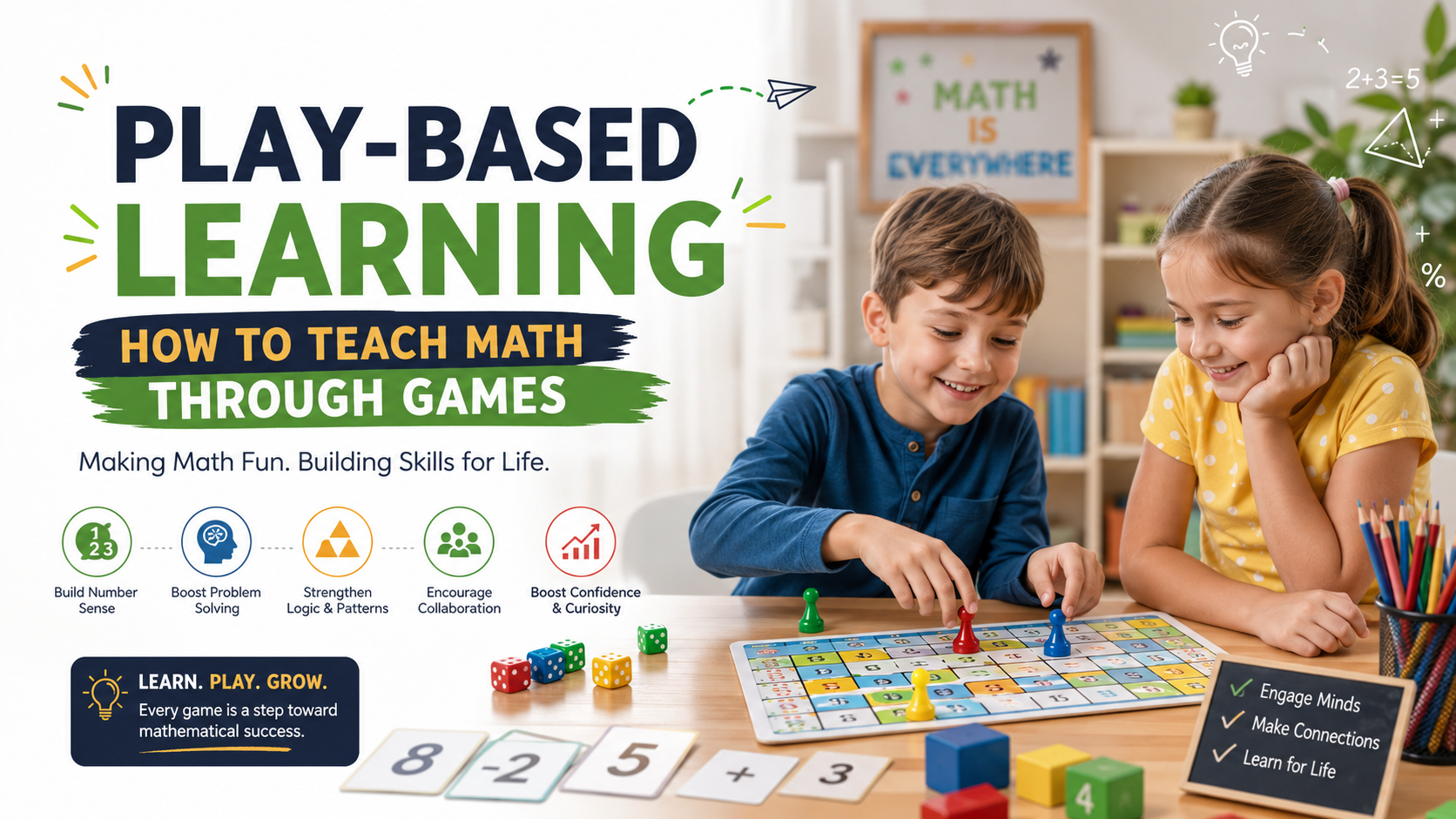
Play-Based Learning: How to Teach Math Through Games
Math often carries an unfair reputation among young learners. Many kids view it as a subject filled with abstract rules, memorization, and stressful worksheets. However, adopting a play-based approach transforms abstract numbers into hands-on experiences. When parents and educators learn how to teach math through games, children naturally develop foundational numeracy skills through active engagement. Research from early childhood experts at the National Council of Teachers of Mathematics shows that structured play builds critical thinking skills while fostering a positive relationship with STEM learning.
Play-based learning turns repetitive arithmetic drills into dynamic, interactive challenges. Instead of staring at flashcards, children manipulate physical objects, negotiate game rules, roll dice, and solve visual puzzles. This active involvement reduces math anxiety and helps kids retain tricky concepts far more effectively. By shifting the focus from rote memorization to creative exploration, children begin to see mathematics as a helpful tool rather than an intimidating chore.
This comprehensive guide explores the primary cognitive benefits of playful learning. You will find age-appropriate activities and actionable ways to integrate math games into your daily home or classroom routine. Whether you support toddlers or elementary students, these proven strategies will elevate your teaching practice and ignite a genuine passion for numbers in your learners.
Why Play-Based Learning Works for Early Math Skills
Traditional worksheets often fail to connect abstract mathematical concepts to real-world experiences. Young children process information through touch, movement, social interaction, and visual observation. Interactive play provides the ideal context for developmental growth. By grounding mathematical principles in physical actions, children build an intuitive foundation that supports advanced logical thinking later in life.

The Science of Play and Cognitive Development
When children engage in interactive games, their brains release dopamine. This key neurotransmitter is closely linked to motivation, focus, and memory formation. Dopamine sharpens attention spans and reinforces neural connections created during active problem-solving moments. This neurochemical boost turns learning into a self-reinforcing, enjoyable cycle that encourages continuous curiosity and deep focus.
Furthermore, game-based learning naturally cultivates a resilient growth mindset. In a game scenario, losing a turn is viewed as a natural part of the process rather than a personal failure. Children willingly retry different strategies without feeling inadequate. Over time, this emotional safety transforms into persistent problem-solving skills that serve students across all academic disciplines.
Key Mathematical Concepts Taught Through Play
Interactive games help young learners master a wide variety of foundational mathematical concepts without feeling overburdened. Through structured play, children develop a deep understanding of core principles that traditional instruction often struggles to make engaging:
-
Counting and Cardinality: Recognizing digit values, understanding one-to-one correspondence, and measuring magnitude through tactile counters.
-
Spatial Reasoning: Visualizing 2D and 3D shapes, understanding spatial relationships, and predicting geometry through building blocks and tangrams.
-
Pattern Recognition: Predicting numerical sequences, identifying symmetry, and organizing complex visual data logically.
-
Operations and Strategy: Practicing mental addition, subtraction, estimation, and multi-step tactical planning during turns.
Core Strategies to Teach Math Through Games at Every Age
Children require distinct types of game-based learning activities as their cognitive abilities and attention spans mature. Tailoring your educational approach to specific developmental stages ensures that activities remain challenging and fun rather than overly simplistic or frustrating.
Simple Board Games for Toddlers and Preschoolers
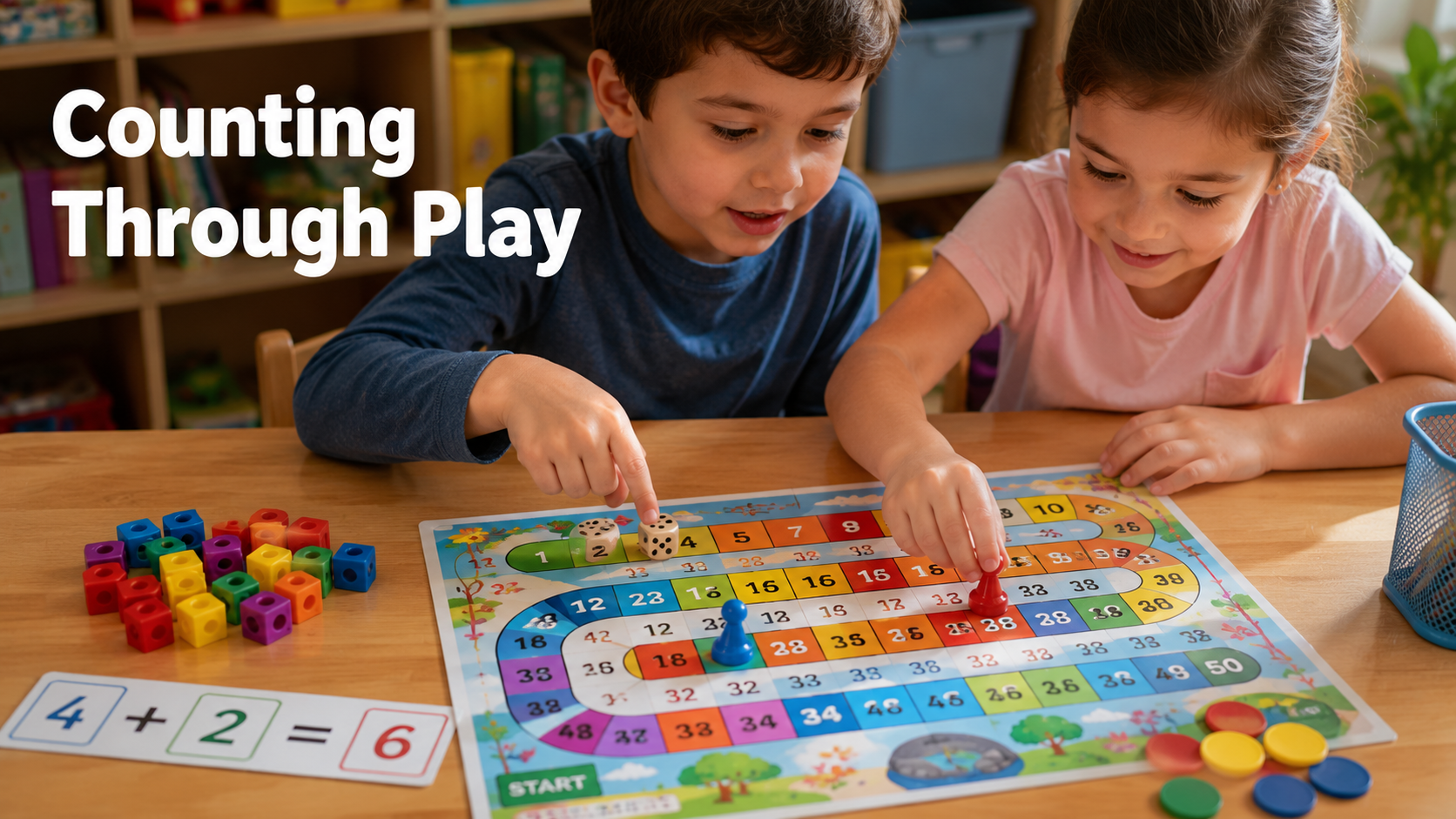
For toddlers and preschoolers, simple board games featuring physical dice, colorful spinners, and linear tracks build essential number sense. Board games offer one of the most effective ways to teach math through games in early childhood education. Moving tokens across numbered squares helps young kids connect spoken number words directly to physical distance and spatial movement.
Practical Example: Classic track-based board games like Chutes and Ladders teach count-on skills seamlessly. When a child rolls a four, they physically move their game piece four spaces forward. This action visually reinforces numerical sequence, counting order, and distance relationships.
As children gain confidence, you can modify basic board games to include simple addition or subtraction. For instance, using two dice instead of one encourages young learners to sum the dots before moving their piece. This subtle adjustment seamlessly bridges the gap between basic counting and early arithmetic operations.
Card Games and Dice Challenges for Elementary Students
As children transition into elementary school, card and dice games offer a portable, low-cost way to practice mental math and strategic thinking. Educational research highlighted by Edutopia demonstrates that quick mental math games significantly boost student engagement and computational fluency. A standard deck of playing cards can be adapted into dozens of versatile activities that target specific learning goals:
-
Math War: Two players flip cards simultaneously. The first student to correctly add, subtract, or multiply the two values wins the round.
-
Make Ten: Lay ten cards face up in a grid. Players search for pairs that add up to ten, collecting matching sets until the board clears.
-
Target Number: Set a target number like 24. Players use four cards from their hand along with basic operations to match that exact total.
Using dice also introduces elementary students to probability, place value, and rapid recall of math facts. Rolling multi-sided dice or combining several standard dice allows teachers to differentiate difficulty levels instantly for varying skill tiers in a single classroom.
Integrating Digital Math Games Responsibly
While hands-on games offer rich sensory input, high-quality digital applications can serve as a valuable supplement to physical play. Digital math platforms utilize gamification mechanics to deliver adaptive practice tailored to each child’s unique learning pace and performance data.
To maximize learning outcomes, choose digital platforms that feature clear educational objectives rather than endless visual distractions or passive entertainment. Always limit screen time and encourage kids to explain their digital strategy out loud to a peer or teacher. This verbalization bridges the gap between screen-based interactions and deep conceptual comprehension.
Frequently Asked Questions
How does play-based learning improve long-term math retention?
Play-based learning improves long-term retention because it actively engages multiple senses and stimulates the brain’s natural reward pathways. When children manipulate physical game pieces, roll dice, or visualize spatial arrangements, they form multi-sensory memory anchors rather than relying on temporary visual memorization. Games connect abstract mathematical symbols directly to concrete, meaningful experiences. Furthermore, the positive emotions experienced during gameplay reduce stress hormones like cortisol, which are known to hinder memory consolidation. As a result, children retrieve mathematical facts and procedural knowledge far more efficiently when faced with complex problem-solving scenarios in future academic settings.
Can games replace traditional math worksheets completely?
While games are exceptionally effective for introducing concepts and building deep conceptual understanding, they work best when integrated into a balanced curriculum alongside light direct instruction. Worksheets and written exercises help students practice standardized formatting, develop silent computation fluency, and demonstrate individual accountability. However, starting with interactive games gives children the intuitive context needed to make sense of written symbols on a page. Rather than replacing traditional practice entirely, educators should use games as the primary engine for conceptual exploration and skill reinforcement, using short written activities to solidify independent mastery and assess individual student progress.
What are the best math games to practice without buying extra toys?
You can easily practice meaningful math using basic household items without purchasing expensive commercial kits. A simple deck of playing cards can be used for addition races, fraction comparisons, or place value challenges. Household dice allow children to practice rapid multiplication, probability, and mental arithmetic. Furthermore, everyday routines offer endless possibilities: turn snack time into a division game by asking children to share items equally among family members, or use baking measuring cups to explore fractional equivalencies. Counting cutlery, sorting laundry by patterns, or measuring room dimensions with a tape measure provide powerful, zero-cost learning experiences.
How do I prevent competitive games from creating frustration?
To keep game-based math activities positive and inclusive, shift the focus toward cooperative gameplay where students work together toward a shared objective. For example, design challenges where players combine their scores to beat a timer or solve a collective mystery puzzle. If you choose to run competitive games, pair students with similar skill levels or introduce handicap systems that equalize opportunities for success. Emphasize effort, strategic thinking, and teamwork over winning. Encouraging students to analyze their choices aloud shifts their mindset from outcome-focused anxiety to process-oriented reflection, keeping the atmosphere supportive and fun.
How much time should families spend playing educational math games daily?
Dedicating just 15 to 20 minutes a day to focused math games yields significant cognitive and emotional benefits for young learners. Short, consistent play sessions keep children enthusiastically engaged without causing mental fatigue or frustration. You can easily integrate these brief activities into existing family routines, such as playing a quick card game after dinner or solving mental math riddles during the morning commute. Consistency matters far more than duration; brief daily interactions build positive habits, reinforce classroom concepts, and cultivate an enduring enthusiasm for mathematics without feeling like an extra homework burden.
Conclusion
Integrating play into your educational routine fundamentally transforms how children view and experience mathematics. When you learn how to teach math through games, you replace test anxiety with genuine curiosity. You turn routine practice into interactive play and help young minds grasp complex numerical relationships with confidence and ease. Exploring top math learning platforms can give you even more tools to blend interactive play with structured progress.
Every rolled die, dealt card, and placed building block helps children construct a solid foundation in logic, spatial reasoning, and creative problem-solving. These playful learning experiences build academic self-esteem that pays dividends throughout a child’s entire educational journey. Start small by introducing just one simple card game or counting activity this week. By keeping math interactive, practical, and fun, you will empower the next generation of confident, enthusiastic problem solvers.