
Physical vs Chemical Change: Shocking Differences
Have you ever wondered what happens when an ice cube melts or why a silver spoon turns dark over time? Have you ever wondered what happens when an ice cube melts or why a silver spoon turns dark over time? Understanding physical vs chemical change helps explain everyday transformations around us. These processes affect everything from cooking breakfast to industrial manufacturing. Yet, they are often confused because both can change how matter looks or behaves. The American Chemical Society highlights the importance of understanding how matter changes as part of basic scientific literacy.
Knowing the difference also has practical value. It helps you predict how materials may behave and recognize chemical reactions. It can also improve your understanding of natural and household processes.
This guide explains how to identify physical and chemical changes. It covers common examples and what happens at the molecular level. You will also learn whether cooking an egg is a chemical change and what happens when boiling reverses. By the end, you will have a clearer understanding of these fundamental changes in matter.

What are 5 differences between physical and chemical changes?
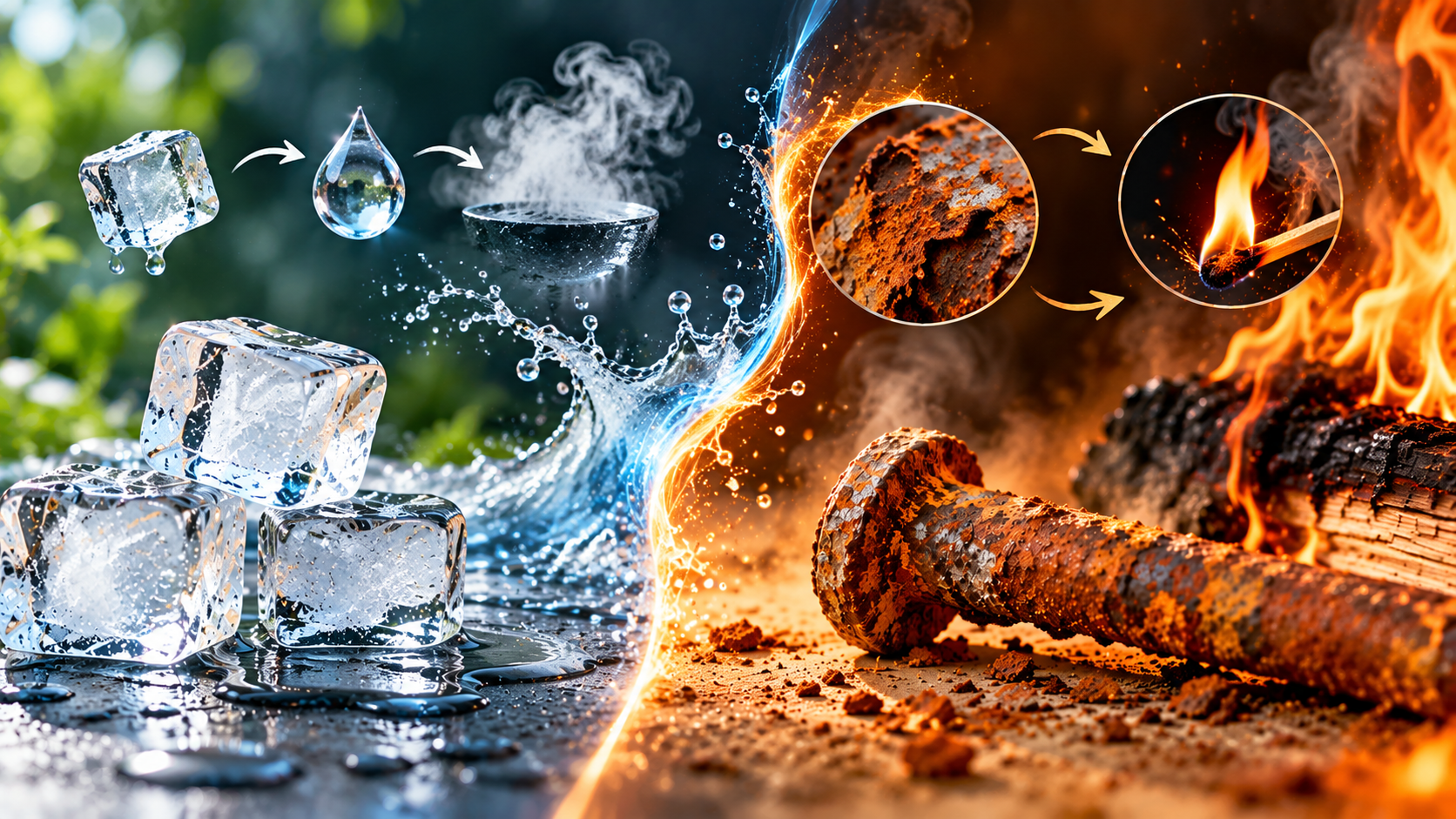
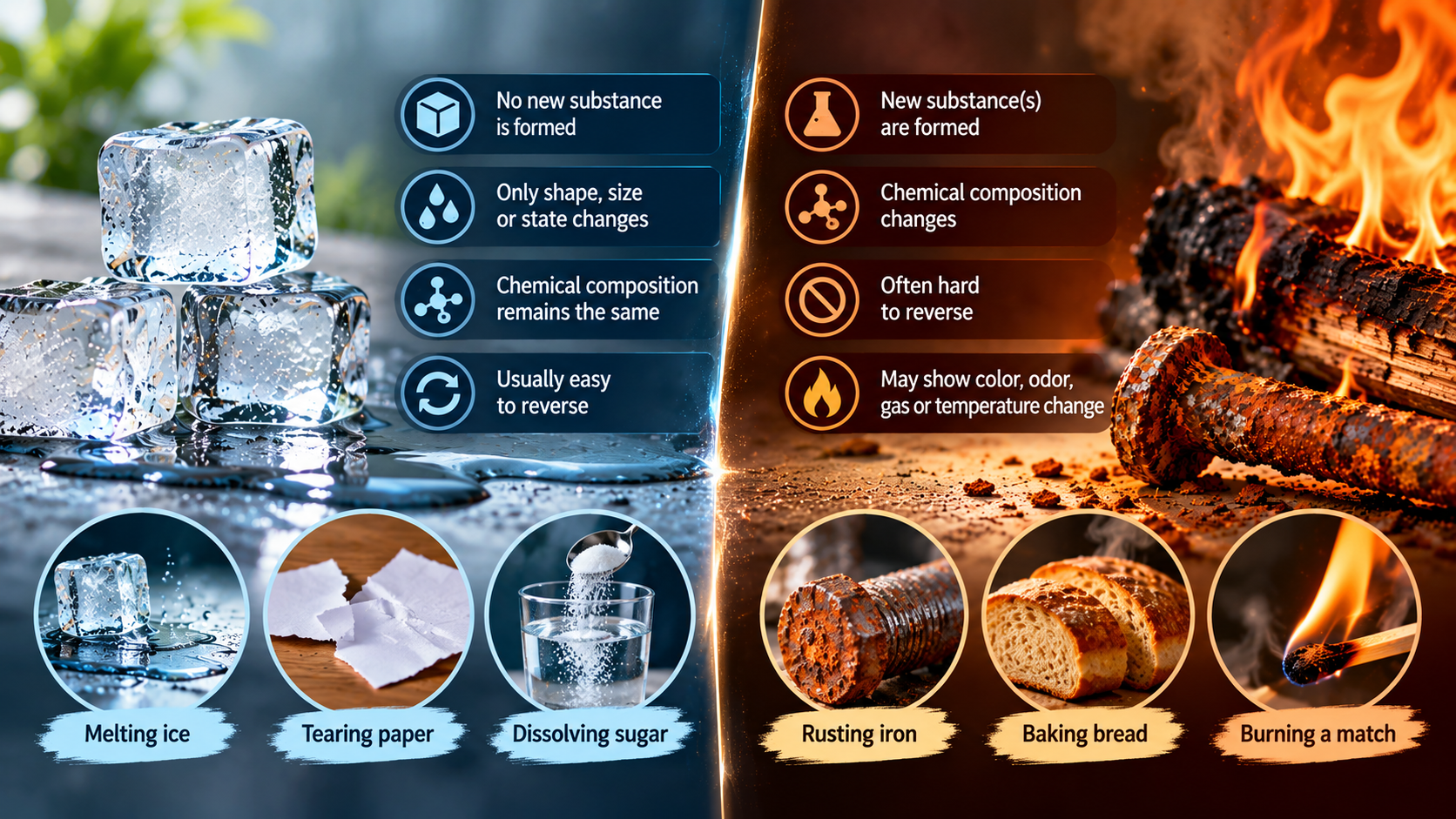
The key difference between physical and chemical changes is whether the substance’s chemical identity changes. A physical change affects properties such as shape, size, or state. However, the substance remains chemically the same. Melting ice, for example, produces liquid water without creating a new substance.
A chemical change produces one or more substances with different chemical identities. Rusting iron and burning wood are common examples. The atoms are rearranged as chemical bonds break and form.
Here are five useful differences:
- Chemical identity: Physical changes preserve identity, while chemical changes create new substances.
- Composition: Physical changes do not alter chemical composition. Chemical changes do.
- Bonds: Physical changes generally do not rearrange chemical bonds. Chemical reactions involve bond breaking, forming, or both.
- Reversibility: Many physical changes can be reversed easily. Chemical changes are often harder to reverse.
- Properties: Chemical changes can produce different reactivity, color, odor, or other chemical properties.
Can you give me 6 examples of physical and chemical changes?
Everyday examples make physical vs chemical change easier to understand. A physical change alters the form, size, or state of matter without creating a new substance. Chemical changes, however, produce substances with different chemical identities.
Here are six simple examples that show the difference:
- Melting ice — Physical change: Solid water changes into liquid water, but it remains H₂O.
- Tearing paper — Physical change: The paper changes in size and shape. Its chemical composition remains the same.
- Dissolving sugar in water — Physical change: Sugar spreads throughout the water, but its molecules remain chemically unchanged.
- Rusting iron — Chemical change: Iron reacts with oxygen and moisture to form iron oxide, commonly called rust.
- Baking bread — Chemical change: Heat triggers chemical reactions that change the bread’s texture, color, and aroma.
- Burning a wooden match — Chemical change: Combustion produces new substances, including ash and gases.
These examples show the key difference in physical vs chemical change. Physical changes affect form or state, while chemical changes alter chemical identity.
How to tell if it’s a chemical or physical change?
Identifying a chemical or physical change starts by asking whether a new substance has formed. If the substance only changes its shape, size, or state, the change is usually physical. Cutting paper, crushing a can, and freezing water are familiar examples.
Chemical changes are harder to reverse because they produce substances with different chemical identities. Several observations can provide clues. These include an unexpected color change, formation of a gas, production of a precipitate, or an unusual energy change. A new smell can also indicate a reaction, although smell alone does not prove a chemical change.
It is important not to treat every visible sign as conclusive. For example, bubbles can appear during boiling, which is a physical change. Instead, consider what caused the bubbles and whether a new substance formed.
A useful test is simple: Did the chemical composition change? If yes, it is a chemical change. If not, it is physical.
Watching for Precipitates and Temperature
A precipitate is a solid that forms when substances in a solution react and produce a material that cannot remain dissolved. For example, mixing certain solutions can create a cloudy solid. This can provide strong evidence that a chemical reaction has occurred.
Temperature changes can also provide useful clues. Some chemical reactions release heat, while others absorb heat from their surroundings. If a mixture becomes noticeably warmer or cooler without direct heating or cooling, a chemical reaction may be responsible. However, temperature change alone does not prove that a chemical change occurred. Physical processes can also involve energy transfers. Similar energy-related principles are important when understanding how solar panels work and how long they last with proper maintenance.
The same caution applies to bubbles. Gas production during a chemical reaction can indicate that a new substance has formed. However, boiling water also creates bubbles without changing water’s chemical identity.
Therefore, look for several clues together. Most importantly, determine whether the chemical composition has changed. A change in texture, size, shape, or state alone usually indicates a physical change rather than a chemical one.
What happens in a chemical change but not a physical change?
Understanding physical vs chemical change starts with what happens to a substance’s chemical identity. A chemical change forms substances with different chemical identities. At the atomic level, atoms are rearranged into new combinations. This often involves breaking existing chemical bonds, forming new bonds, or changing how electrons are shared between atoms.
A physical change does not normally rearrange the atoms within a substance’s molecules. Instead, it can change how molecules are arranged or how closely they are packed. When ice melts, for example, water molecules remain H₂O. Their movement and arrangement change, but their chemical identity does not.
The key difference in physical vs chemical change is that chemical reactions can produce properties that were not present before. These properties may include different reactivity, acidity, color, odor, or melting and boiling behavior.
The reaction between sodium and chlorine demonstrates this principle. Sodium is a highly reactive metal, while chlorine is a toxic gas. Their reaction produces sodium chloride, commonly known as table salt.
This atomic rearrangement is what distinguishes a chemical change from a physical one.
Atomic Rearrangement and Bond Reorganization
During a chemical reaction, atoms can become connected in different ways. The atoms themselves are not destroyed. Instead, their existing arrangements change as chemical bonds break, form, or reorganize. This process creates substances with different chemical properties.
A physical change works differently. It may separate particles, compress them, or change their movement. However, it does not normally create a new chemical substance. For example, crushing a piece of salt changes its size but does not change sodium chloride into another compound.
The reaction between sodium and chlorine illustrates chemical rearrangement. Sodium atoms and chlorine atoms react and form sodium chloride. The resulting compound has properties very different from those of the original substances.
Chemical reactions can also involve changes in electron arrangements. These changes determine how atoms bond and interact with other substances. The result may be a compound with different stability, reactivity, or physical properties.
Understanding atomic rearrangement makes the distinction between physical and chemical change much clearer. Physical changes modify the form or arrangement of matter. Chemical changes alter its chemical identity through new atomic relationships.
Is cooking an egg a chemical change?
Yes, cooking an egg is a chemical change because heat causes lasting changes in the proteins within the egg. Raw egg whites contain proteins folded into specific three-dimensional structures. When heated, these proteins undergo denaturation, meaning their original structures unfold.
This example also helps explain physical vs chemical change in everyday life. As the proteins unfold, they interact with one another and form a network. This changes the egg white from a clear, runny material into an opaque and firmer substance. The process also changes its texture and appearance.
Cooking cannot normally be reversed simply by cooling the egg. You cannot return a fully cooked egg to its original raw state. This lack of easy reversibility supports its classification as a chemical change.
It is worth noting that cooking involves more than one process. Water within the egg can undergo physical changes as it heats. However, the structural changes occurring in the proteins are chemical in nature.
Therefore, when comparing physical vs chemical change, cooking an egg is classified as a chemical change. Heat causes molecular-level changes that permanently alter the egg’s structure and properties.
What is the opposite of boiling?
The process that most directly reverses boiling is condensation. Boiling changes a liquid into a gas when the liquid reaches conditions that allow vapor formation throughout the liquid. Condensation moves in the opposite direction by changing a gas into a liquid. For a broader explanation of these processes, see the water cycle process and Earth’s hydrology.
During condensation, gas molecules lose thermal energy. Their average kinetic energy decreases, allowing intermolecular attractions to bring them closer together. The gas then becomes a liquid.
You can observe condensation around your home. For example, water vapor in the air can contact the cold surface of a glass containing an iced drink. The vapor cools and forms small liquid water droplets on the outside of the glass.
Boiling and condensation are both physical changes because the chemical identity of the substance remains unchanged. Water remains H₂O before, during, and after these phase changes.
The processes can be summarized simply:
- Boiling: liquid → gas
- Condensation: gas → liquid
Evaporation is also a liquid-to-gas change, but it differs from boiling. Evaporation can occur at the surface of a liquid below its boiling point.
Conclusion
Understanding the dynamic distinctions of a physical vs chemical change transforms how you observe everyday materials. Physical transformations alter external characteristics like state, shape, or texture while keeping molecular bonds intact. In sharp contrast, chemical reactions rearrange atoms, break chemical bonds, and generate entirely new substances with distinct identities and behaviors.
By learning to spot critical indicators—such as unexpected temperature fluctuations, gas emission, precipitates, and irreversible structural changes—you can quickly identify what is happening in any reaction. Whether you are boiling water on the stove, watching iron rust in the garden, or frying an egg for breakfast, these core scientific principles are continuously in motion. Use this knowledge to interpret material transformations accurately in daily life, classroom science experiments, and household projects.