

Introduction: Why Most Retail Traders Struggle in Options
The derivatives market attracts traders with the promise of quick money, but data shows that most retail traders lose money in options. The biggest reason is not lack of intelligence — it is lack of structure, risk control, and probability-based thinking.
One of the most debated questions is:
Option buying or option selling — which is better?
In a detailed Hindi–English discussion, professional trader Kundan Prajapati explains why option selling with hedging offers a more sustainable and scalable approach compared to naked option buying.
Reference Video
This article is based on insights and strategies discussed in the following Hindi–English video on option selling and hedging:
Video Title: Hedging Strategy in Option Selling – Probability-Based Trading
YouTube Link: https://youtu.be/6el9Jqnrdz8
Option Buying vs Option Selling: Understanding the Core Difference
The difference between option buying and option selling lies in probability.
-
Option buyers depend on strong directional moves within limited time.
-
Option sellers benefit from time decay and market range behavior.
Markets remain sideways or mildly directional most of the time, which naturally favors option sellers. According to Kundan:
“Option buyer plays on profitability, option seller plays on probability.”
This is why professional traders focus on high-probability setups with controlled risk, not jackpot trades.
Why Professional Traders Prefer Option Selling with Hedging
Large traders and institutions rarely do naked option buying. The reason is simple:
-
High volatility in MTM
-
Emotional stress
-
Poor scalability with large capital
Instead, professionals use hedged option selling strategies that:
-
Define maximum loss
-
Reduce margin requirement
-
Protect against sudden market crashes
Hedging transforms option selling from speculation into a risk-managed trading system.
Hedging Explained: Risk Management, Not Profit Reduction
Hedging is often misunderstood as “reducing profit.” In reality, hedging is about survival.
Just like car insurance protects against accidents, hedging protects traders from:
-
Market crashes
-
Gap-up or gap-down openings
-
Black swan events
A hedged strategy may slightly reduce profits, but it prevents catastrophic losses, which is crucial for long-term success.
Common Problems in Option Selling (And How Hedging Solves Them)
1. High Margin Requirement
Naked option selling requires heavy margin.
Hedged option selling reduces margin drastically, improving capital efficiency.
2. Unlimited Risk
Without hedging, option selling can lead to unlimited losses.
With hedging, risk becomes defined and predictable.
3. Skill & Time Requirement
Options trading demands learning. Retail traders compete with institutions, so education and backtesting are non-negotiable.
Option Selling Strategy Discussed: Hedged Call Ratio Spread (NIFTY)
This is the exact option selling strategy explained in the session. It is rule-based, backtested, hedged, and requires no chart analysis or adjustments.

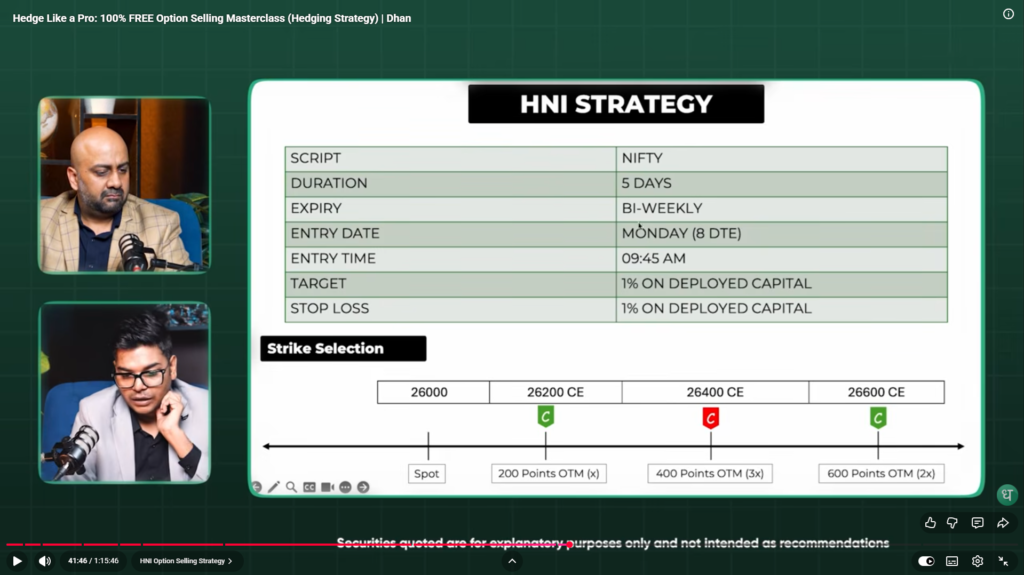
Strategy Overview
-
Underlying: NIFTY
-
Strategy Type: Weekly positional option selling
-
Entry Day & Time: Monday at 9:45 AM
-
Exit Rules:
-
Target: +1% on deployed capital
-
Stop-Loss: −1%
-
Time Exit: Friday around 3:15 PM
-
Expiry Selection Rule
-
Use the next Tuesday expiry
-
Avoid ultra-short expiries to reduce gamma risk
Strike Selection (Example)
Assume NIFTY Spot = 26,000
Hedged Call Ratio Spread (1:3:2):
-
Buy 1 Call @ 26,200
-
Sell 3 Calls @ 26,400
-
Buy 2 Calls @ 26,600
This creates:
-
Defined risk
-
High probability zone
-
Protection against sharp upside moves
If NIFTY is near a “50” strike (e.g., 26,350), treat the next 100 strike as the base.
Volatility & Risk Rules
-
Avoid selling aggressively when VIX > 20
-
Prefer shifting strikes further OTM during high volatility
-
Maintain controlled credit (around 0.5–0.6%)
Capital & Performance Expectations
-
Margin requirement: ₹1.3–₹1.6 lakh per lot
-
Average weekly profit: ₹1,300–₹1,500 per lot
-
Back tested win rate shared: ~76%
This makes it a low-stress, probability-based option selling strategy.
Why This Strategy Is Scalable
A good strategy must work with higher capital. This approach:
-
Uses defined risk
-
Avoids emotional adjustments
-
Works systematically week after week
Kundan advises gradual scaling only after:
-
Back testing
-
Forward testing
-
Psychological comfort
Realistic Returns: Why Consistency Beats Greed
Instead of unrealistic expectations, the focus is on:
-
2% per month
-
24–30% annually
These numbers already outperform many professional funds. Chasing quick riches usually ends in account wipeouts.
Conclusion: Option Selling Works When Done Professionally
Option selling is not dangerous — unhedged option selling is.
When combined with:
-
Proper hedging
-
Probability-based setups
-
Discipline and patience
Option selling becomes a business, not gambling.
The goal is simple:
Survive first. Earn consistently. Scale slowly.
❓ Frequently Asked Questions (SEO Boost)
Is option selling better than option buying?
For most retail traders, option selling with hedging offers higher probability and consistency compared to option buying.
Is this NIFTY option selling strategy safe?
No strategy is risk-free, but hedging ensures defined risk, making it significantly safer than naked selling.
Can beginners use this strategy?
Yes, after proper learning and backtesting. Beginners should start with 1 lot only.
What is the biggest risk in option selling?
Selling without hedging and trading during high volatility without rules.