
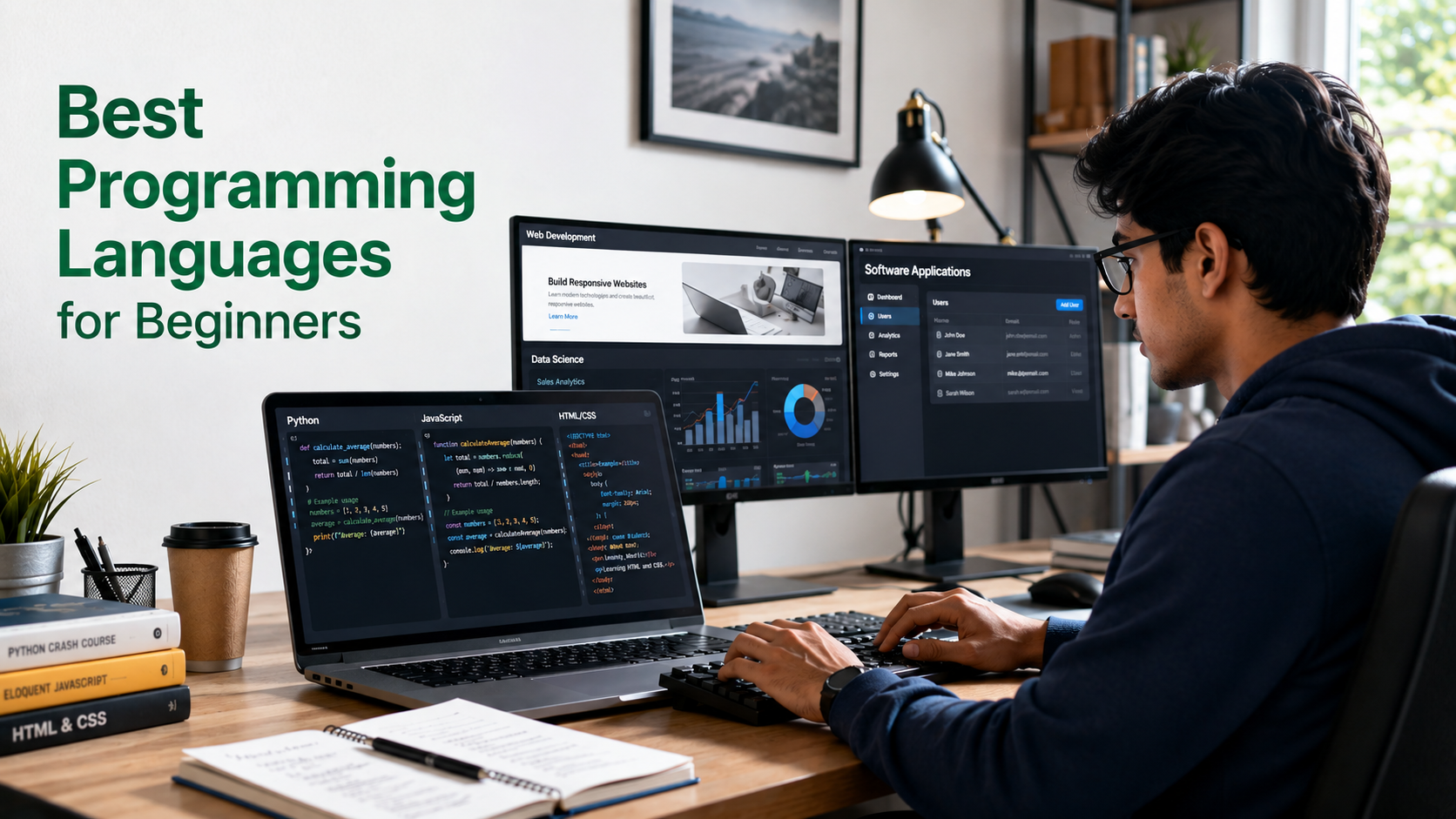
Best Programming Languages? Complete Beginner’s Guide
Learning how to code is one of the most transformative decisions you can make for your career. However, stepping into the tech world can feel overwhelming when you are staring at dozens of different coding dialects. Choosing the best programming languages for beginners is crucial because your first language shapes your fundamental understanding of logic and software architecture. According to digital learning studies published by Harvard University, selecting a language with a gentle learning curve and high market demand ensures long-term learner retention and success.
This guide will demystify the coding landscape for you. We will break down the best programming languages for beginners, analyze their real-world applications, and help you choose the perfect starting point based on your personal goals. Whether you want to build mobile apps, design beautiful websites, or dive into data science, we have you covered. If your goal is a career in web development, check out our guide on how to become a web developer in 2026 for a complete roadmap.
Why Choosing the Right First Language Matters
Your initial experience with coding can make or break your tech journey. If you start with a language that has a notoriously complex syntax, you might get discouraged quickly. Conversely, starting with a beginner-friendly language builds your confidence early on. Many students drop out of computer science courses simply because their initial exposure feels dry, overly mathematical, or intensely confusing.
The goal isn’t just to memorize syntax. You need to learn how to think like a programmer. Once you master core concepts like loops, variables, and functions in an accessible language, transitioning to more complex systems later becomes surprisingly easy. The logic remains the same across almost all platforms; only the punctuation and spelling change. Therefore, giving yourself an easy win at the start of your journey ensures that you maintain the momentum required to tackle complex engineering concepts later down the road.
Top Entry-Level Coding Languages to Learn First
Python: The Undisputed King for Beginners
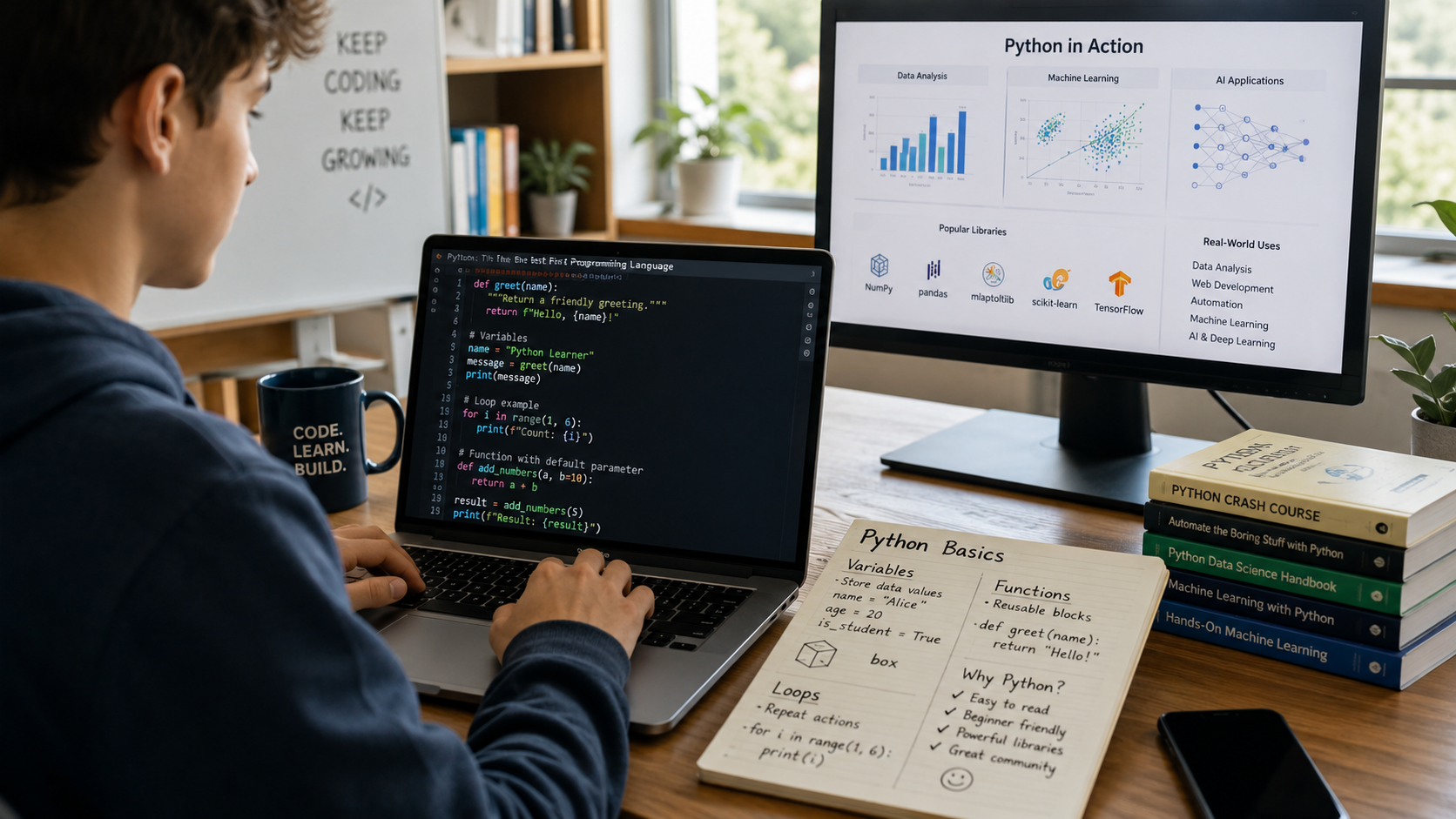

Python is almost universally recommended as the absolute best starting point for modern novices. Its syntax reads remarkably like standard English, which removes a massive layer of frustration for newcomers. Instead of worrying about missing semicolons or complex bracket arrangements, you can focus entirely on learning core programming logic. This clean layout reduces the cognitive load on a student, allowing for much faster progression through foundational programming theories.
Furthermore, Python is incredibly versatile. It serves as the backbone for data science, machine learning, and web backends. Tech giants like Google and Netflix rely heavily on Python to power their algorithms, ensuring that your skills will remain in high demand for years to come. Consequently, learning Python does not just give you an easy start; it also equips you with a highly marketable skill set that spans multiple industries worldwide.
JavaScript: The Language of the Internet
If you want to build things that people can see and interact with immediately, JavaScript is your best bet. It is the native language of the web. Every interactive element, animated pop-up, and dynamic web page you encounter relies on JavaScript to function properly. Without it, the internet would consist of static documents without any real utility or modern user engagement.
Similarly, JavaScript offers instant gratification because you only need a standard web browser to run your code. With the rise of modern frameworks like Node.js, you can now use JavaScript for backend server development too. This makes it a powerful, versatile tool for aspiring full-stack developers who want to manage both user interfaces and database management systems. By choosing this path, you quickly learn how data flows through the entire modern internet architecture.
HTML & CSS: The Essential Building Blocks
While technically not programming languages—HTML is a markup language and CSS is a style sheet language—they are mandatory foundations for anyone entering the tech space. They dictate the structure and visual layout of every website on the internet today. Skipping them to learn advanced programming languages often leaves severe gaps in your practical development knowledge.
Learning HTML and CSS gives you an immediate understanding of how the web functions at a structural level. They provide an excellent visual feedback loop, allowing you to see your visual changes instantly in real-time. Think of them as the gateway layout tools before jumping into heavy, logic-driven programming languages. Mastering these layout tools builds the tactile confidence needed to handle complex data structures later on.
- Python is widely used for data science, artificial intelligence (AI), and web development. It has a very gentle learning curve, making it one of the best programming languages for beginners.
- JavaScript is primarily used for web development, allowing developers to create interactive and dynamic websites. Its learning curve is generally considered gentle to medium.
- HTML & CSS are essential technologies for web design and page layouts. They are very easy to learn, making them an excellent starting point for beginners interested in building websites.
How to Align Your Coding Choice with Career Goals
Landing a Job in Web Development
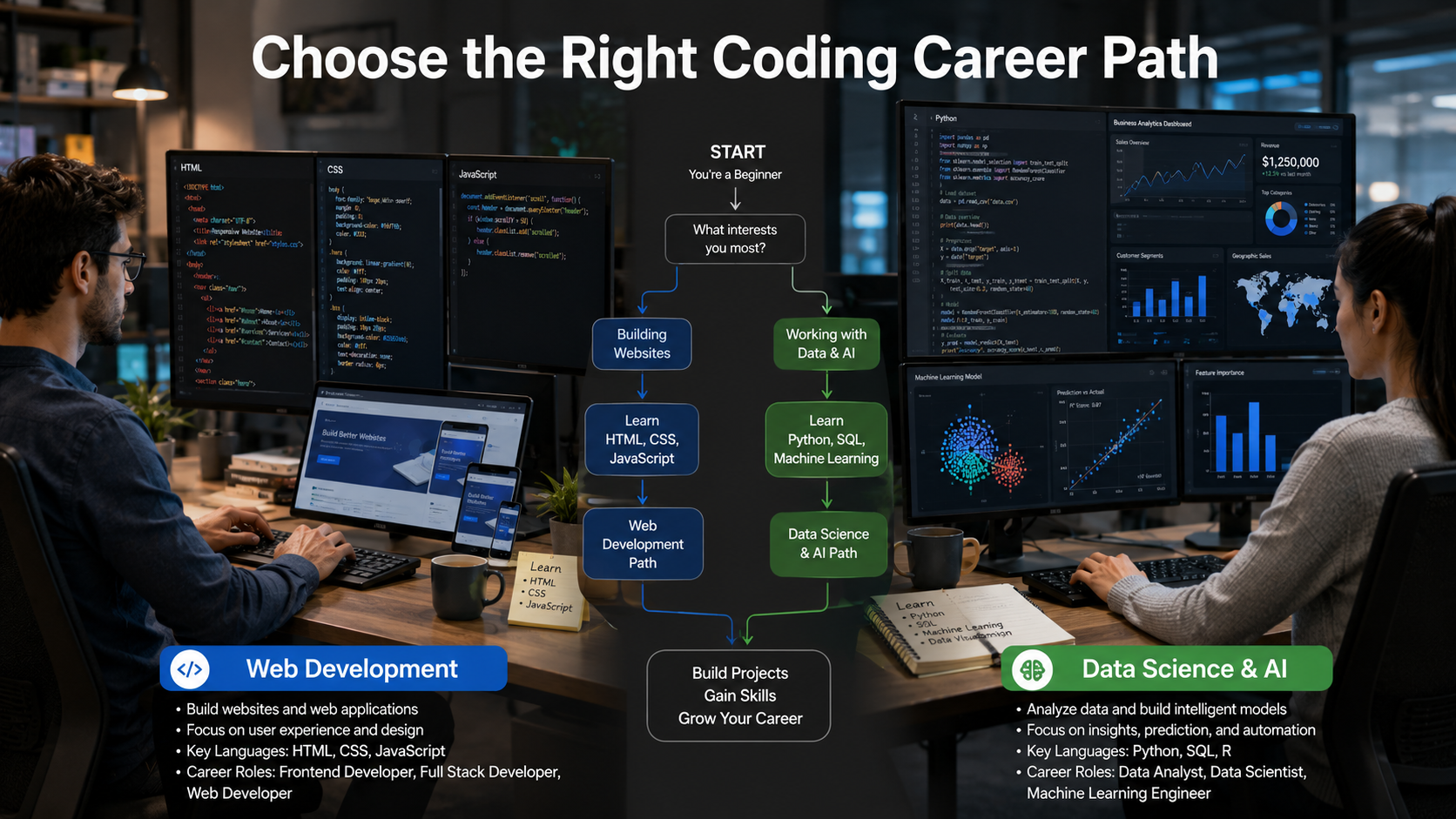
If your ultimate goal is web development, you should follow a clear path: master HTML and CSS first, then immediately dive into JavaScript. This trio forms the core foundation of front-end engineering, opening up thousands of global job opportunities. Software agencies constantly look for developers who can quickly translate design mockups into functional, interactive websites.
Moreover, the web development ecosystem is incredibly supportive of newcomers. There are millions of active forums, open-source repositories, and pre-built code libraries available to help you troubleshoot your errors. By focusing your efforts on web development languages, you put yourself on a fast track toward freelance opportunities and entry-level agency roles.
Entering the World of Data and Artificial Intelligence
For those fascinated by big data, automation, or machine learning, Python is the non-negotiable standard. The Organization for Economic Co-operation and Development (OECD) frequently highlights data literacy and automation skills as critical drivers for the future global workforce. Python’s rich ecosystem of pre-built libraries makes it the perfect tool to secure these highly future-proof career roles.
Furthermore, fields like financial modeling, scientific research, and predictive analytics rely completely on backend data processing. Python simplifies data manipulation, allowing you to clean messy spreadsheets and generate visual charts with just a few lines of code. If you enjoy analytical thinking, focusing on data-centric languages will yield incredible professional dividends.
Frequently Asked Questions
Is ChatGPT an agentic AI?
No, standard ChatGPT is not natively a fully autonomous agentic AI by default, but it represents the definitive stepping stone toward it. Historically, traditional generative AI systems operated as strictly reactive chatbots. They waited for user prompts, generated text answers, and lacked the power to complete workflows outside their window. However, the ecosystem changed drastically when OpenAI integrated dedicated “agent mode” capabilities natively into the application. Equipped with tools like virtual computers, text browsers, and direct terminal execution, modern iterations can browse the web and interact with complex browser user interfaces independently. True agentic AI requires complete multi-step execution, planning, and self-correction to solve abstract problems with minimal human intervention. While standard chatting feels conversational, modern backend updates have successfully pushed the app straight into the agentic era.
How long does it take to learn the basics of programming?
For most complete beginners, it takes roughly three to six months to grasp the foundational concepts of programming. This specific timeline assumes you dedicate approximately ten to fifteen hours per week to focused instruction and hands-on practice. Naturally, mastering an engineering discipline takes years of industry experience, but you can build simple, functioning tools much faster than you think. The key to accelerated learning is prioritizing daily coding exercises rather than cramming massive amounts of information over the weekend. Consistent exposure creates permanent neural pathways, cementing abstract syntax structures into your long-term memory. Over time, writing functional syntax transforms from a difficult conscious effort into a seamless mechanical habit.
Do I need a strong math background to learn how to code?
No, you do not need an advanced mathematical background or a genius intellect to excel at general software development. Most day-to-day software engineering consists of logical problem-solving, structural organization, pattern matching, and systemic data routing rather than complex calculus. If you fundamentally comprehend basic arithmetic and high school algebra, you possess plenty of mathematical foundation to build web apps and business databases. Specialized development fields like modern game engine physics, complex cryptography, 3D graphics rendering, and quantum machine learning models certainly require advanced mathematical training. Fortunately, mainstream engineering, mobile design, and enterprise cloud applications do not demand those niche skills. Focus your energy on developing clear logical workflows instead of stressing over complex formulas.
Can I learn programming on my own for free?
Absolutely, you can easily teach yourself software engineering without spending a single dollar on traditional tuition. The internet contains an abundance of incredible, high-quality educational material available completely for free to global citizens. Open education platforms like FreeCodeCamp, Coursera, Harvard’s CS50, and official framework documentations offer highly structured learning tracks for ambitious novices. The true challenge of self-guided software education is never a lack of information; rather, it is maintaining personal discipline and engineering a structured habit. Establishing a firm, unyielding daily study schedule allows you to navigate massive resource repositories efficiently. Thousands of elite enterprise developers globally launched their engineering careers utilizing nothing but free open-source tutorials, personal drive, and raw determination.
Should I learn multiple programming languages at the same time?
No. When exploring the best programming languages for beginners, it is usually better to focus on one language at a time. Trying to learn Python, JavaScript, and C++ simultaneously can create confusion because each language follows different syntax rules and programming approaches.
Many experts recommend choosing one of the best programming languages for beginners and building a solid foundation before moving on to another language. Focus on core concepts such as loops, conditional statements, functions, data structures, and problem-solving techniques. These skills transfer across most programming languages.
The reason the best programming languages for beginners are often recommended first is that they help new developers understand programming fundamentals without unnecessary complexity. Once you become comfortable with one language, learning additional languages becomes much easier.
If your goal is long-term success, start with one of the best programming languages for beginners, master the basics, and then gradually expand your skill set based on your career goals.
Conclusion
Choosing from the best programming languages for beginners does not have to be a stressful endeavor. The secret of the tech industry is that your first language is simply a vehicle to learn computational thinking. Python offers an unmatched entry point for data and AI, while JavaScript rules supreme for web interactivity. Focus entirely on your immediate career goals, pick one path, and stay consistent.
True mastery comes from building real projects, making mistakes, and writing code every single day. Do not worry about mastering every single tool available on the market right now. Start small, stay patient, and watch your digital toolset grow as you build real-world applications.