Systemic Barriers in Education: Overcoming Hidden Obstacles to Student Success
Every student deserves a fair chance to learn, grow, and graduate. However, hidden obstacles within policies, funding models, and school cultures can limit that opportunity. Addressing systemic barriers in education matters because these structures influence who receives quality instruction, resources, and support. Data from the National Center for Education Statistics also shows persistent differences in educational resources and outcomes across communities.
When institutional policies favor certain groups, disadvantaged learners may struggle to reach their academic potential. These challenges are rarely caused by one teacher or one decision. They often develop through policies and practices that operate across entire schools or districts.
True educational equity requires more than good intentions. It requires leaders to examine how institutions allocate resources, design curricula, assess students, and respond to different needs.
This guide explains the meaning, examples, and effects of systemic barriers in education. It also examines five major barriers to learning, distinguishes systemic from systematic obstacles, and explores communication barriers that affect diverse classrooms. Understanding these mechanisms can help educators create more accessible, fair, and supportive learning environments.
What are examples of systemic barriers?
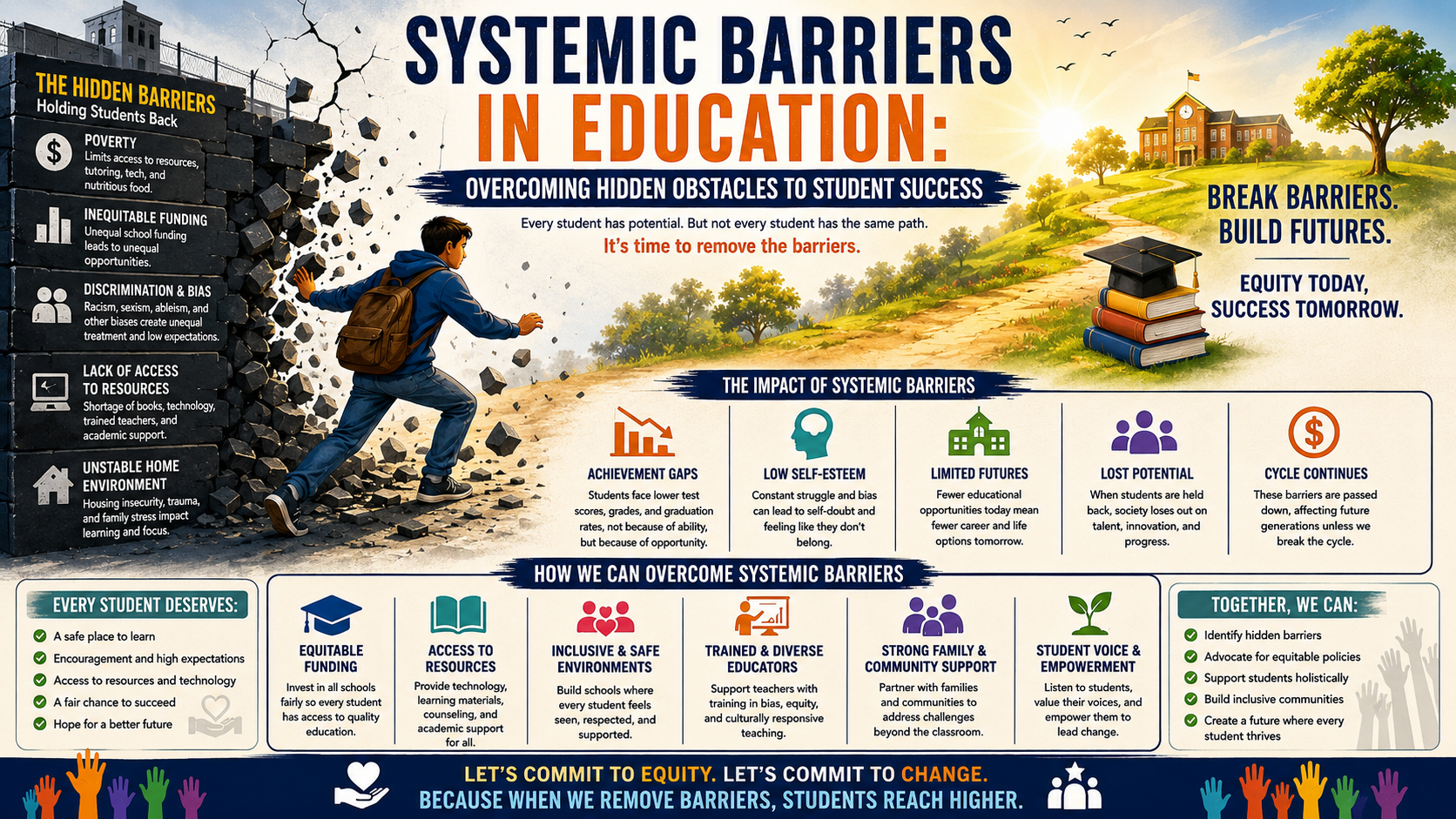
Systemic barriers in education appear through institutional practices that repeatedly disadvantage certain groups of students. These barriers can affect funding, discipline, testing, curriculum design, admissions, and access to advanced learning opportunities.
One major example is school funding based heavily on local property taxes. Wealthier communities may have greater access to technology, experienced teachers, advanced courses, and extracurricular programs. Under-resourced schools may struggle to provide the same opportunities, making modern student success harder to achieve across unequal school environments.
Another example involves culturally biased standardized testing. Certain testing formats may not fully reflect the abilities of students from different linguistic or cultural backgrounds. Disciplinary policies can create similar concerns when strict rules affect some student groups more heavily than others.
Other examples include rigid academic tracking and curricula that provide limited representation of different cultures and histories. These practices can influence expectations and opportunities over many years.
Recognizing these patterns is an important first step toward reducing systemic inequality. Schools must examine whether their established practices provide fair opportunities for every learner.
Inequitable Resource Allocation Across Public Districts
Unequal resource allocation can create major differences in educational quality between neighboring school districts. Schools in wealthier communities may have larger budgets and greater access to modern technology, well-maintained facilities, experienced teachers, and enrichment programs.
Meanwhile, underfunded schools may face aging buildings, limited instructional materials, larger class sizes, and difficulty retaining qualified educators. These differences can influence student experiences long before academic performance is measured.
Resource inequality also affects opportunities outside the standard classroom. Students may have unequal access to advanced courses, libraries, laboratories, sports programs, arts activities, and technology. Such differences can shape college preparation and future career opportunities.
The problem is not simply that one school has more resources than another. The deeper issue is how funding systems distribute educational opportunities across communities.
Addressing this form of systemic barriers in education requires careful examination of funding formulas and local needs. Policymakers and education leaders can then identify where additional support is necessary and create more equitable conditions for student success.
What are 5 barriers to learning in education?
Five major barriers can consistently interfere with meaningful learning. The first is socioeconomic hardship, which can limit access to food, study materials, technology, transportation, and stable housing. Students facing these challenges may find it difficult to focus on schoolwork, highlighting the importance of student success beyond academic instruction alone.
The second barrier is emotional and psychological difficulty. Anxiety, stress, trauma, and other challenges can affect concentration and classroom participation, especially when schools have limited counseling resources.
The third barrier is inflexible teaching. A single instructional approach may not meet the needs of neurodivergent students or learners who benefit from different methods.
The fourth barrier is physical inaccessibility. Buildings, classrooms, transportation, or learning materials may create difficulties for students with physical disabilities.
The fifth barrier is cultural and linguistic difference. Students who are still developing proficiency in the primary classroom language may struggle to understand lessons or demonstrate their knowledge.
Identifying these barriers helps schools develop targeted support instead of treating every learning difficulty as an individual problem.
The Overlooked Impact of Socioeconomic Hardship
Socioeconomic hardship can affect a student’s ability to concentrate, participate, and complete academic work. A child experiencing food insecurity, unstable housing, or limited access to technology may have challenges that extend far beyond the classroom.
For example, completing homework becomes more difficult without a quiet place to study. Limited internet access can also prevent students from completing digital assignments or researching important topics. These practical challenges can gradually contribute to lower academic performance.
Financial hardship may also affect attendance. Transportation problems, frequent moves, family responsibilities, or unstable living conditions can interrupt a student’s education.
Schools can reduce some of these effects by connecting families with appropriate support services. Access to meals, technology, counseling, transportation assistance, and community programs can remove practical obstacles that interfere with learning.
The key issue is that academic outcomes are influenced by conditions outside the classroom. Treating socioeconomic hardship as a personal failure overlooks the structural circumstances affecting the student’s ability to learn and succeed.
What does systemic mean in education?
In education, systemic describes rules, values, structures, and procedures that are embedded within an institution or broader educational system. These factors extend beyond isolated incidents or individual decisions and can shape modern student success across an entire educational environment.
A systemic issue can exist within school districts, state education departments, colleges, or universities. It may influence how institutions distribute funding, establish curriculum standards, evaluate students, enforce discipline, or provide support services.
The important distinction is that systemic barriers can continue even when individual educators have positive intentions. A teacher may treat students fairly while still working within policies that create unequal opportunities.
Understanding the term therefore requires looking beyond individual classroom interactions. Educators and policymakers must examine how historical decisions, institutional rules, administrative structures, and resource systems affect current outcomes.
This broader perspective is essential when addressing systemic barriers in education. Changing individual behavior can help students, but long-term improvement often requires changes to the structures producing unequal outcomes.
The goal is not simply to identify unfair results. It is to understand which institutional processes contribute to those results and determine how they can be improved.
Institutional Design Versus Individual Teacher Actions
Systemic structures can influence student outcomes independently of individual teacher intentions. A dedicated educator may provide strong support while still operating within institutional rules that determine curriculum requirements, testing standards, class placement, discipline, and resource distribution.
This distinction matters because individual effort cannot always overcome structural limitations. A teacher can offer additional help, for example, but may have little control over school funding or admissions policies.
Focusing only on individual actions can therefore obscure deeper institutional problems. It may also place unrealistic responsibility on teachers to solve issues created by broader systems.
Meaningful reform requires both levels of action. Teachers can improve classroom practices through inclusive instruction, clear communication, and differentiated support. At the same time, school and district leaders must examine policies that affect students across the institution.
Addressing systemic barriers in education means connecting these efforts. Individual educators can make immediate differences, while institutional reforms can create lasting improvements across larger groups of students.
What is meant by systematic barriers?
Systematic barriers are obstacles produced through organized, methodical, and repeatable processes. They occur when a specific procedure consistently creates difficulty or exclusion for certain people.
For example, an admissions system may require expensive entrance examinations, preparation courses, or application materials. The process may appear neutral, but students from low-income families can face greater difficulty meeting these requirements.
The distinction between systematic and systemic is important. Systematic describes the way something operates, particularly when a process follows an established pattern. Systemic describes a broader issue embedded within an entire system or institution.
A systematic barrier can therefore exist within a larger systemic problem. An admissions procedure may be one specific process contributing to unequal access across an educational institution.
Identifying systematic barriers requires schools to examine their daily procedures carefully. Leaders can review admissions criteria, evaluation rubrics, placement processes, disciplinary procedures, and application requirements.
The goal is to determine whether established processes unintentionally create unequal outcomes. Institutions can then redesign procedures that create unnecessary obstacles while preserving legitimate academic standards.
Methodical Procedures That Filter Out Talent
Systematic obstacles often develop through rigid procedures that appear objective or consistent. Because every applicant or student goes through the same process, institutions may assume the process is automatically fair.
However, equal treatment does not always produce equal opportunity. Standardized evaluation methods may favor students who have greater access to tutoring, preparation programs, technology, or other forms of support.
Admissions requirements can create similar challenges. An expensive examination, complicated application process, or narrow evaluation criterion may discourage qualified students who lack financial or institutional support.
These procedures can unintentionally filter out capable learners. The problem may not involve deliberate discrimination by an individual decision-maker. Instead, the structure of the process itself can create predictable disadvantages.
Schools should therefore evaluate not only whether procedures are consistent, but also whether they measure the qualities they are intended to measure.
Regular audits of admissions, assessment, placement, and disciplinary processes can reveal patterns that deserve attention. This approach helps institutions identify systemic barriers in education before they become deeply entrenched.
What are systemic barriers?
Systemic barriers are policies, institutional practices, cultural norms, and structural conditions that create ongoing disadvantages for particular groups of students. They differ from temporary difficulties because they can persist across years and influence many learners.
These barriers can appear throughout the educational system. Examples include unequal resource allocation, limited curriculum representation, unequal access to advanced courses, disciplinary disparities, inaccessible facilities, and institutional practices that overlook different learning needs, particularly those affecting women and minorities’ participation and significance.
Systemic barriers can also become difficult to recognize because established practices may appear normal. A policy that has existed for decades may continue simply because people are accustomed to it.
That does not mean every unequal outcome automatically proves discrimination. Schools must examine evidence, policies, implementation, and patterns before drawing conclusions.
However, persistent differences deserve careful investigation. Leaders should ask whether institutional structures contribute to those differences and whether alternative approaches could provide fairer opportunities.
Reducing systemic barriers in education requires sustained institutional attention. Policy changes, better resource distribution, inclusive teaching practices, and regular evaluation can help schools create conditions where students have stronger opportunities to succeed.
Entrenched Norms That Resist Institutional Change
Long-standing academic traditions can make institutional change difficult. Schools often continue using familiar approaches because they are established, widely accepted, or already integrated into administrative systems.
For example, traditional ideas about intelligence can influence how schools design assessments or identify high-achieving students. Historical approaches to funding, curriculum design, and academic tracking can also remain in place even when student populations and educational needs change.
The challenge is not simply replacing old policies with new ones. Institutions must understand why existing practices developed and evaluate whether they still serve their intended purpose.
Change can also face resistance from people who believe established procedures provide stability or fairness. For this reason, reform should rely on evidence, transparent evaluation, and clear educational goals.
Schools can begin by reviewing policies that affect access, achievement, discipline, and participation. They can then identify practices that create unnecessary disadvantages and test more inclusive alternatives.
Addressing entrenched norms is a long-term process. It requires leadership, regular evaluation, stakeholder participation, and a willingness to revise practices when evidence shows that improvement is needed.
What are the 5 barriers of communication and explain each barrier.?
Communication barriers can prevent teachers, students, and families from exchanging information effectively. Five common barriers are physical, psychological, semantic, cultural, and physiological.
Physical barriers include classroom noise, poor acoustics, overcrowded spaces, and inadequate learning environments. These conditions can make it difficult to hear or concentrate.
Psychological barriers include anxiety, stress, trauma, fear, and defensiveness. These experiences can make students less willing or able to communicate openly.
Semantic barriers occur when language, terminology, jargon, or complicated explanations create confusion. Students may understand the subject but struggle with the way information is presented.
Cultural barriers can develop when people have different communication styles, values, expectations, or interpretations of nonverbal behavior. These differences may lead to misunderstandings without deliberate intent.
Physiological barriers involve conditions such as hearing or vision difficulties, fatigue, or other factors that affect information processing.
Reducing these barriers requires clear language, accessible environments, cultural awareness, and appropriate support. Effective communication can strengthen classroom participation and help reduce the effects of systemic barriers in education.
Bridging Cultural and Linguistic Class Disconnects
Cultural and linguistic differences can create communication challenges in diverse classrooms. Students may understand academic concepts but struggle to express their ideas in the dominant classroom language, which can contribute to prejudices shaped by cultural and social differences.
Teachers may also misinterpret communication styles. Differences in eye contact, gestures, classroom participation, or approaches to authority can sometimes be mistaken for disengagement or disrespect.
These misunderstandings can reduce participation and weaken relationships between educators, students, and families. They may also cause students to feel that their home language or cultural background has little value within the classroom.
Culturally responsive teaching can help address these challenges. Teachers can use clear explanations, provide appropriate language support, encourage multiple ways of participating, and recognize the knowledge students bring from their homes and communities.
Schools can also improve communication with families by offering accessible information and language support when needed. This approach helps create stronger connections between home and school.
Reducing cultural and linguistic disconnects does not require lowering academic expectations. Instead, it means removing unnecessary communication obstacles so students have a fair opportunity to understand instruction, participate, and demonstrate what they know.
Frequently Asked Questions
How do systemic barriers impact early childhood education?
Systemic barriers heavily restrict early learning access through high childcare costs and uneven public pre-K funding. Low-income families frequently live in areas lacking certified early childhood centers. This early divide deprives children of foundational literacy, cognitive stimulation, and socialization, creating early development gaps that widen as students advance through elementary school.
Can technology help remove systemic educational barriers?
Technology can reduce barriers only when paired with universal internet access and modern digital devices. While online platforms offer personalized learning and open-access materials, the digital divide deepens inequality if underfunded districts cannot provide hardware or high-speed connectivity to all enrolled students at home.
How do school disciplinary policies create systemic exclusion?
Zero-tolerance policies and subjective behavioral criteria disproportionately trigger suspensions and expulsions for minority students. Removing children from the classroom disrupts learning continuity, fosters academic disengagement, and significantly increases dropout rates, effectively funneling vulnerable youth into the criminal justice system.
What role do teachers play in addressing systemic barriers?
Teachers address systemic barriers by adopting culturally responsive teaching methods, diversifying curriculum materials, and utilizing trauma-informed classroom management. Furthermore, educators act as vital internal advocates by challenging unfair school policies, tracking inequitable student outcomes, and promoting inclusive evaluation methods within their academic departments.
Conclusion
Dismantling systemic barriers in education is essential for building a just, thriving society where every learner can succeed. Throughout this article, we examined how institutional funding models, rigid learning barriers, and procedural systems combine to disadvantage vulnerable student populations. We also analyzed the distinct difference between systemic and systematic hurdles, while outlining how communication breakdowns limit classroom engagement.
Solving these deep-seated challenges requires more than passive awareness; it calls for decisive policy overhauls, equitable resource redistribution, and inclusive pedagogy. Educational leaders, policymakers, and communities must collaborate to audit institutional workflows, revise biased disciplinary systems, and invest heavily in under-resourced schools. When we remove institutional obstacles, schools transform into empowering environments that cultivate the unique talents of all students.