
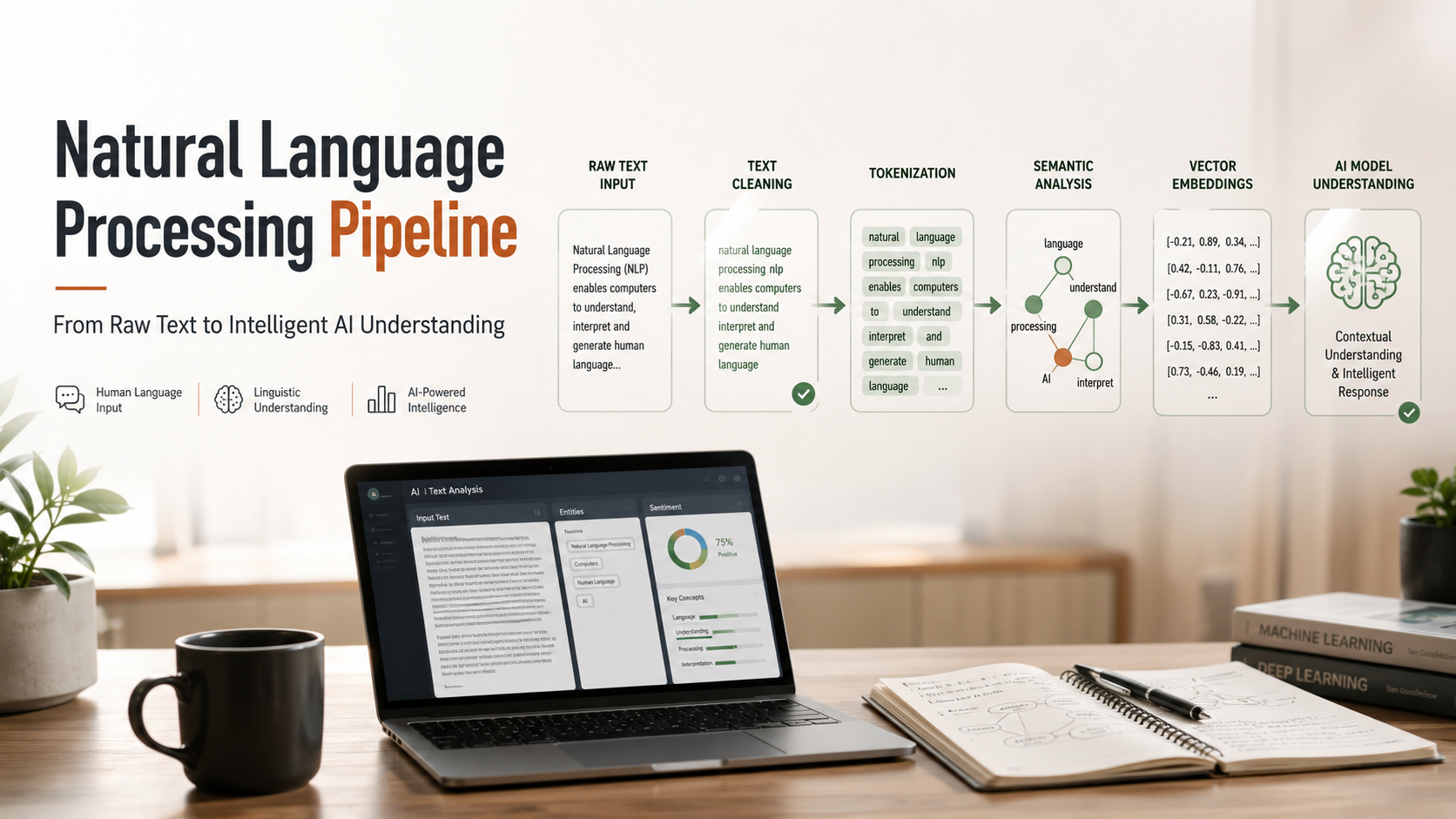
Understanding the Natural Language Processing Pipeline: A Complete Guide
Modern artificial intelligence applications depend on machines that can understand human language. However, human text is complex, inconsistent, and often unstructured. A natural language processing pipeline provides a systematic method for converting raw text into structured information that machine learning models can analyze.
Without a proper text processing workflow, computers only see text as a sequence of characters. They cannot understand context, meaning, or relationships between words. An NLP pipeline solves this problem by applying multiple processing stages, from cleaning and tokenization to feature extraction and semantic analysis.
Developers use advanced frameworks such as Hugging Face NLP tools and transformer models to build, train, and deploy modern language models efficiently. These tools simplify many complex steps involved in preparing text data for artificial intelligence systems.
Understanding how information moves through an NLP pipeline helps developers create more accurate AI solutions. Whether you are building a sentiment analysis system, chatbot, translation platform, or document classifier, a well-designed pipeline improves performance and reliability.
What Is a Natural Language Processing Pipeline?
A natural language processing pipeline is a sequence of automated steps that transforms raw human language into structured data. Each stage performs a specific task and prepares the output for the next processing layer.
Raw text often contains spelling mistakes, formatting issues, unnecessary symbols, and inconsistent language patterns. A pipeline removes these problems and converts text into a format that machine learning algorithms can understand.
The main goal of an NLP pipeline is to bridge the gap between human communication and computer processing. Instead of analyzing unorganized text directly, systems break language into smaller components and extract meaningful patterns.
A typical NLP workflow includes several important stages:
- Text ingestion and cleaning to remove unwanted data.
- Tokenization and normalization to organize language units.
- Syntactic and semantic analysis to understand structure and meaning.
- Vectorization and embedding generation to convert text into numerical representations.
Modern text pipelines are designed to process large amounts of data efficiently. They help developers create scalable AI applications while making testing, debugging, and optimization easier.
Key Stages of a Natural Language Processing Pipeline
A natural language processing pipeline follows a structured workflow. Each stage prepares text for advanced machine learning models. The exact steps may vary depending on the application, but most pipelines follow a similar foundation.
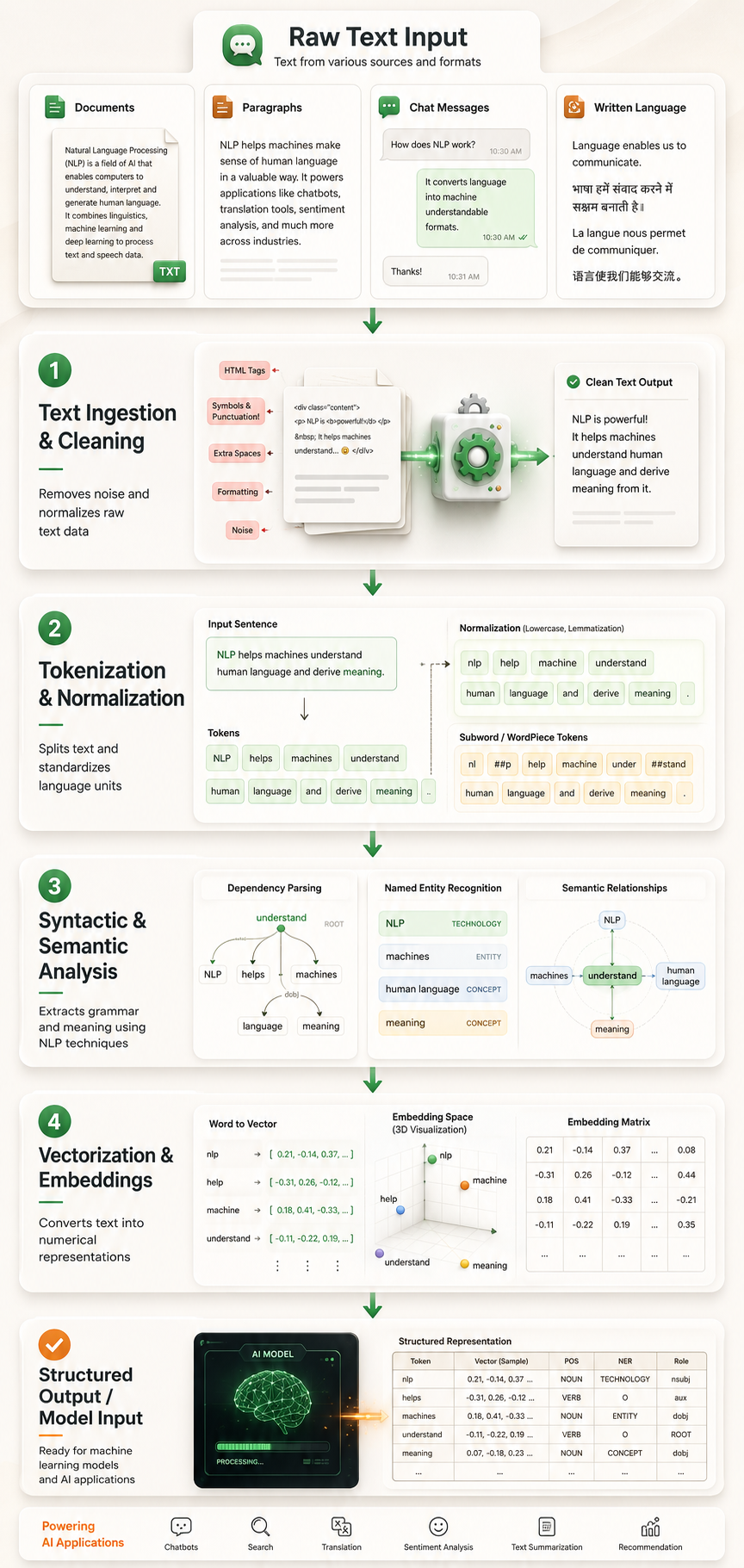
Each stage contributes to the overall quality of the final AI system. Poor preprocessing can reduce model accuracy, while a carefully designed pipeline improves consistency and prediction results.
For example, a customer review analysis system may first remove unnecessary symbols, identify important words, detect sentiment-related patterns, and finally convert the review into numerical data for classification.
Stage 1: Text Ingestion and Preprocessing
The first stage of an NLP pipeline focuses on collecting and preparing raw text data. This process is known as text ingestion and preprocessing. It ensures that incoming information is clean, consistent, and ready for further analysis.
Raw text usually contains unwanted elements. Websites may include HTML tags, documents may contain formatting errors, and user-generated content may include spelling variations or unnecessary symbols.
The preprocessing stage improves data quality through several important techniques:
- HTML and special character removal: Removes web code, unwanted symbols, and formatting elements that do not contribute useful meaning.
- Case folding: Converts text into lowercase to maintain consistency. For example, “Apple” and “apple” become the same representation.
- Noise reduction: Eliminates extra spaces, repeated characters, system logs, and unnecessary formatting.
Effective preprocessing improves the performance of later NLP tasks. However, the level of cleaning depends on the model being used. Traditional machine learning systems often require heavier preprocessing, while modern transformer models may preserve more original text information.
A balanced preprocessing approach helps maintain important context while removing unnecessary noise from the dataset.
Stage 2: Tokenization and Text Normalization
After the initial cleaning process, the natural language processing pipeline moves to tokenization and text normalization. This stage breaks large pieces of text into smaller units called tokens. These tokens become the basic building blocks for further language analysis.
Tokenization helps machines understand text structure. A document can be divided into sentences, and sentences can be separated into individual words or subword units. Modern NLP systems often use subword tokenization because it handles uncommon words and complex language patterns more effectively.
For example:
Input:
“The running dogs barked loudly.”
Tokenization:
[“The”, “running”, “dogs”, “barked”, “loudly”]
Lemmatization:
[“the”, “run”, “dog”, “bark”, “loudly”]
After tokenization, normalization makes language more consistent. This step reduces variations between similar words and improves the quality of machine learning input.
Common normalization techniques include:
- Stop word removal: Removes frequently used words such as “is,” “at,” and “which” when they provide limited value for a specific task.
- Stemming: Uses simple rules to remove word endings. For example, “studying” may become “studi” or “study.”
- Lemmatization: Uses linguistic analysis to convert words into their proper dictionary forms. For example, “better” can become “good.”
The choice between stemming and lemmatization depends on the application. Stemming is faster but less accurate. Lemmatization provides better linguistic accuracy but requires more processing.
Modern transformer-based systems often use specialized tokenizers instead of traditional word-level methods. These tokenizers divide text into smaller subword units while preserving important context.
A well-designed tokenization process improves model understanding and ensures that language data is represented consistently throughout the pipeline.
Stage 3: Syntactic and Semantic Analysis
Once text has been cleaned and normalized, the NLP pipeline begins analyzing language structure and meaning. This stage focuses on understanding how words relate to each other and what information they represent.
Syntactic analysis examines the grammatical structure of sentences. It helps machines identify relationships between different language elements. Semantic analysis focuses on extracting meaning from text and understanding the context behind words.
Several important NLP techniques are used during this stage:
- Part-of-Speech (POS) tagging: Identifies whether a word functions as a noun, verb, adjective, or another grammatical category.
- Named Entity Recognition (NER): Detects important entities such as people, organizations, locations, dates, and financial values.
- Dependency parsing: Maps relationships between words to understand sentence structure and identify actions and their subjects.
For example, in the sentence “Tesla opened a new factory in Berlin,” an NLP system can identify Tesla as an organization and Berlin as a location. It can also understand that Tesla performed the action of opening a factory.
This analysis helps AI systems move beyond simple word matching. Instead of only counting terms, models begin to understand relationships and context.
Semantic analysis is especially important for applications such as:
- Search engines
- Question-answering systems
- Chatbots
- Sentiment analysis tools
- Document classification platforms
Modern transformer models have improved semantic understanding significantly. Models such as BERT use contextual representations to understand how word meanings change depending on surrounding text.
By combining syntactic and semantic analysis, an NLP pipeline extracts deeper insights from human language and prepares information for advanced machine learning tasks.
Stage 4: Feature Extraction and Vectorization
Machine learning models cannot directly process text strings. They require numerical input that represents language patterns mathematically. The feature extraction and vectorization stage converts processed text into numerical formats.
This transformation allows algorithms to identify relationships, similarities, and patterns within large datasets. The quality of these numerical representations directly affects model performance.
Several popular vectorization methods are used in NLP pipelines:
- Bag-of-Words (BoW): Counts how frequently words appear in documents. It is simple but does not understand word order or context.
- TF-IDF (Term Frequency-Inverse Document Frequency): Measures the importance of words by comparing their frequency within one document against their frequency across a larger collection.
- Word embeddings: Represent words as dense numerical vectors that capture semantic relationships.
Traditional approaches such as TF-IDF work well for many basic text classification tasks. However, modern AI applications increasingly rely on deep learning-based embeddings.
Techniques such as Word2Vec, transformer embeddings, and large language model representations create richer numerical meanings. They allow systems to recognize that words like “car” and “vehicle” are related even when they are not identical.
Vectorization is a critical stage because it connects human language with machine learning algorithms. A strong representation method helps models perform better in tasks like translation, recommendation systems, text generation, and classification.
As NLP technology advances, vectorization methods continue evolving. Modern pipelines increasingly use contextual embeddings that understand meaning based on the entire sentence rather than isolated words.
Best Practices for Building a Scalable Natural Language Processing Pipeline
Building a reliable natural language processing pipeline requires careful planning. A production-ready system must balance accuracy, speed, scalability, and resource efficiency. A pipeline that works well during testing may require additional improvements before handling real-world data.
One important principle is to keep every processing stage modular. Independent components make it easier to update, test, and replace individual parts. For example, developers can change a tokenizer or embedding model without rebuilding the entire system.
Another important practice is avoiding unnecessary preprocessing. Older machine learning methods often depended on aggressive cleaning techniques. However, modern transformer models can understand punctuation, capitalization, and sentence structure. Removing too much information may reduce model performance.
Key practices for efficient NLP pipelines include:
- Keep pipelines modular: Build separate components for cleaning, tokenization, analysis, and vectorization.
- Avoid over-preprocessing: Preserve useful context when working with transformer-based models.
- Cache intermediate outputs: Save processed data to reduce repeated computation during experiments.
- Monitor data drift: Track changes in language patterns to maintain model accuracy over time.
Data quality monitoring is especially important for applications that process continuous user input. Language changes frequently because of new trends, slang, and industry-specific terms.
A scalable pipeline should also include proper testing and evaluation. Developers need to measure how preprocessing decisions affect final model results.
By following these practices, teams can create NLP systems that are easier to maintain and more reliable in production environments.
Tools for Building Natural Language Processing Pipelines
Developers use different libraries and frameworks depending on their project requirements. Some tools focus on research and experimentation, while others are designed for large-scale production systems.
Popular NLP tools provide ready-made solutions for common pipeline tasks. These include tokenization, part-of-speech tagging, entity recognition, and text embedding generation.
Some widely used tools include:
- spaCy: A high-performance NLP library designed for production applications. It provides efficient tokenization, POS tagging, dependency parsing, and named entity recognition.
- Natural Language Toolkit (NLTK): A popular toolkit used for learning, research, and experimenting with traditional NLP methods.
- Hugging Face Tokenizers: Provides fast tokenization solutions optimized for transformer models and deep learning workflows.
- Apache Spark NLP solutions: Support large-scale text processing across distributed computing environments.
The best tool depends on the project goal. Research projects may require flexibility, while production systems often prioritize speed and reliability.
For transformer-based applications, developers commonly use specialized libraries that simplify model integration. These tools help manage tokenization, model loading, and deployment workflows.
Choosing the right framework improves development efficiency and reduces the complexity of building advanced language applications.
Frequently Asked Questions About Natural Language Processing Pipelines
What is a natural language processing pipeline?
A natural language processing pipeline is a structured sequence of automated steps that converts raw text into useful information for machine learning systems.
The pipeline usually includes text collection, cleaning, tokenization, linguistic analysis, and vectorization. Each stage prepares data for the next step.
By organizing text processing into separate stages, developers can improve consistency and model performance. A well-designed pipeline helps AI systems handle tasks such as sentiment analysis, translation, classification, and information extraction.
The pipeline transforms unstructured human language into numerical representations that algorithms can process effectively. Without this process, machine learning models cannot easily understand the complexity of human communication.
Modern NLP pipelines may differ depending on the model architecture. Traditional systems relied heavily on manual feature engineering, while modern transformer systems focus more on efficient tokenization and contextual embeddings.
What is the difference between stemming and lemmatization?
Stemming and lemmatization are both text normalization techniques, but they work differently.
Stemming uses simple rules to remove word endings. It is fast but may create incorrect word forms. For example, the word “troubling” may become “troubl,” which is not a valid dictionary word.
Lemmatization uses vocabulary rules and language analysis to find the correct base form of a word. For example, “drove” becomes “drive,” and “better” becomes “good.”
The main difference is accuracy. Stemming focuses on speed, while lemmatization focuses on linguistic correctness.
Stemming may work well for simple search applications where processing speed matters. Lemmatization is often better for tasks that require deeper language understanding.
Modern transformer models often reduce the need for traditional normalization because they use contextual token representations.
Why is tokenization necessary in text processing?
Tokenization is essential because computers cannot effectively analyze large blocks of raw text. It divides language into smaller units that algorithms can process.
These units may include:
- Words
- Sentences
- Characters
- Subword components
Tokenization creates a structured representation of language. It allows later pipeline stages to analyze patterns, identify relationships, and generate numerical embeddings.
For example, a sentiment analysis model needs to understand individual words and phrases before determining whether a review is positive or negative.
Modern NLP systems use advanced tokenization methods to handle complex language. Subword tokenization helps models process unfamiliar words, technical terms, and multiple languages more effectively.
Without tokenization, machine learning models would struggle to understand text structure and meaning.
Do modern transformer models still require traditional pipelines?
Yes, transformer models still require NLP pipelines, but the processing steps have changed.
Traditional pipelines often depended on heavy preprocessing. Developers frequently removed stop words, applied stemming, and manually created features.
Modern transformer pipelines focus more on preparing data for model input. Important steps include:
- Subword tokenization
- Sequence padding
- Text truncation
- Attention mask generation
Models such as BERT and other transformer architectures learn contextual relationships directly from text. Because of this, excessive cleaning can remove useful information.
The pipeline remains essential, but its purpose has shifted. Instead of manually creating language features, it prepares text so advanced models can generate meaningful representations.
Which tools are best for building text pipelines?
Choosing the right tools is important when developing a natural language processing pipeline. Different libraries provide different features depending on whether the goal is research, education, or production deployment.
For traditional NLP tasks, Natural Language Toolkit is widely used because it provides extensive learning resources and supports many classic text processing methods.
For production applications, spaCy is a popular choice. It offers fast processing capabilities and includes features such as tokenization, part-of-speech tagging, dependency parsing, and named entity recognition.
For modern deep learning applications, Hugging Face provides tools for transformer-based models. Its tokenizers and model libraries support advanced workflows involving large language models and contextual embeddings.
For organizations handling massive datasets, Apache Spark-based NLP solutions can process text across distributed computing systems.
The best tool depends on project requirements. Developers should consider factors such as:
- Processing speed
- Dataset size
- Model complexity
- Deployment requirements
- Available computing resources
A carefully selected toolkit improves development efficiency and helps teams build reliable text processing systems.
Conclusion: Building Better AI Systems With NLP Pipelines
A natural language processing pipeline is the foundation behind many modern language-based artificial intelligence applications. It transforms raw human communication into structured information that machine learning models can understand and analyze.
The process begins with text ingestion and cleaning. It continues through tokenization, normalization, syntactic analysis, semantic understanding, and vectorization. Each stage plays an important role in improving data quality and model performance.
A well-designed NLP pipeline helps developers build applications such as:
- Sentiment analysis systems
- Chatbots and virtual assistants
- Machine translation platforms
- Search and recommendation systems
- Automated document processing tools
As artificial intelligence continues to advance, pipeline design is evolving. Modern transformer models and large language models reduce the need for manual feature engineering. However, the importance of structured data preparation remains unchanged.
Today’s pipelines focus more on efficient token management, contextual embeddings, and optimized model input preparation. Developers must still ensure that data is clean, consistent, and suitable for the chosen model.
The core principle remains simple: better data processing leads to better AI performance. A modular, scalable, and carefully optimized NLP pipeline allows organizations to create more accurate and reliable language applications.
By understanding each stage of the pipeline, developers can make smarter design decisions and build AI systems that perform effectively in real-world environments.
For a deeper understanding of AI technologies, models, and practical applications, explore our complete guide on open-source AI and modern AI development.