

4 Pillars of ML: The Foundation of Modern Machine Learning
Understanding the 4 pillars of ML provides a practical framework for developing effective machine learning solutions. These pillars include data preprocessing, algorithm selection, model evaluation, and deployment with MLOps. Together, they guide every stage of the machine learning lifecycle. For readers who want to deepen their understanding, the Google AI Learning Resources offer official documentation, tutorials, and research covering many of these concepts.
Understanding the 4 pillars of ML provides a practical framework for developing effective machine learning solutions. These pillars include data preprocessing, algorithm selection, model evaluation, and deployment with MLOps. Together, they guide every stage of the machine learning lifecycle.
Whether you are a developer, data scientist, product manager, or AI enthusiast, mastering these foundations will improve your projects. Instead of relying on trial and error, you can build models with greater confidence and consistency. This guide explores each pillar in detail and explains how they work together to create production-ready machine learning systems.
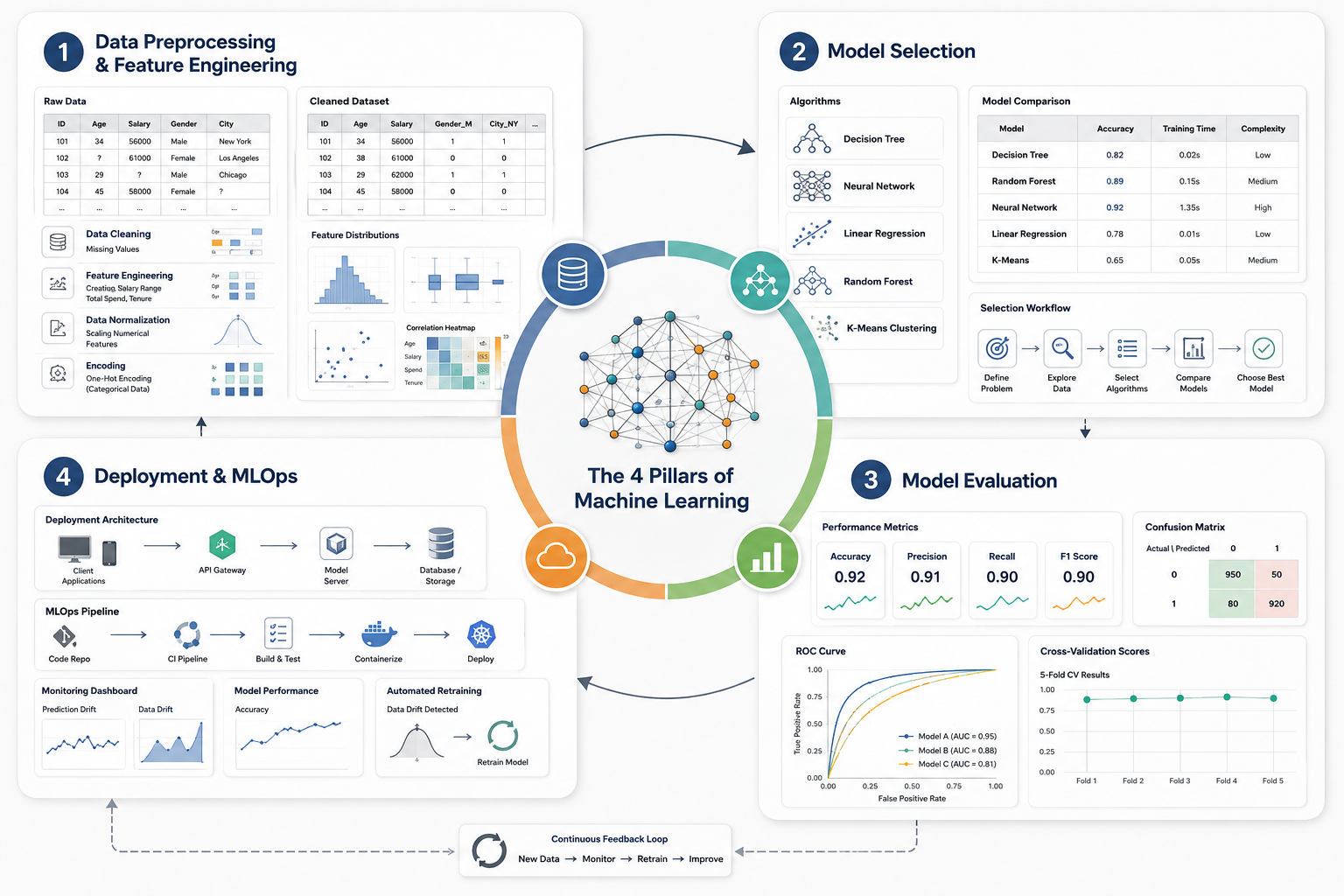
Pillar 1: Data Preprocessing and Feature Engineering
Every successful machine learning project begins with high-quality data. Even the most advanced algorithms cannot compensate for incomplete, inconsistent, or noisy datasets. Data preprocessing prepares raw information by cleaning errors, removing duplicates, handling missing values, and standardizing formats before training begins.
Another critical step is feature engineering, which transforms raw variables into meaningful inputs that help models recognize patterns more effectively. Well-designed features often improve model performance more than switching to a more complex algorithm.
Common preprocessing tasks include:
- Normalizing numerical data to keep features on a similar scale.
- Handling missing values using the mean, median, or predictive imputation.
- Encoding categorical variables with methods such as one-hot encoding.
- Selecting relevant features to reduce noise and improve efficiency.
Investing time in data preparation improves training stability, reduces bias, and creates a stronger foundation for every stage that follows.
Pillar 2: Model Architecture and Algorithm Selection
After preparing the data, the next step is selecting the right machine learning algorithm. The best choice depends on your objectives, available data, computing resources, and desired level of model interpretability. Choosing an unsuitable model can reduce accuracy, increase training time, and create unnecessary complexity.
Machine learning generally includes three primary learning approaches:
- Supervised learning uses labeled data for classification and regression tasks.
- Unsupervised learning identifies hidden patterns or clusters in unlabeled datasets.
- Reinforcement learning trains agents through rewards and penalties while interacting with an environment.
Simple algorithms such as logistic regression, decision trees, and random forests often perform exceptionally well for structured data. Deep learning models are better suited for complex tasks involving images, speech, and natural language processing.
The goal is to balance prediction accuracy with computational efficiency. Oversized models often overfit training data, while overly simple models may fail to capture meaningful patterns.
Pillar 3: Model Evaluation and Validation Strategies
Building a machine learning model is only part of the process. You must also verify that it performs well on unseen data. Relying solely on accuracy can produce misleading results, especially when working with imbalanced datasets. A broader set of evaluation metrics provides a more realistic picture of model performance.
Important evaluation metrics include:
- Precision measures how many predicted positives are actually correct.
- Recall measures how many actual positives the model identifies.
- F1 Score balances precision and recall into a single metric.
- Mean Squared Error (MSE) evaluates prediction error for regression problems.
Cross-validation further improves reliability. Techniques such as K-fold cross-validation repeatedly split the dataset into training and testing subsets to measure consistency. This process helps detect overfitting and underfitting, allowing developers to refine models before deployment. Careful evaluation ensures machine learning systems remain dependable in real-world environments.
Pillar 4: Deployment, Monitoring, and MLOps
A trained model creates value only after deployment into a production environment. Deployment connects machine learning models with applications through APIs, cloud platforms, or web services. Modern workflows commonly package models with Docker containers, ensuring consistent execution across development and production systems.
Deployment is only the beginning. Machine learning models require continuous monitoring because real-world data changes over time. This process, known as data drift or concept drift, gradually reduces prediction accuracy if left unmanaged.
Key deployment practices include:
- Automated retraining pipelines using fresh production data.
- Latency monitoring to maintain fast response times.
- Performance logging to detect declining accuracy.
- Version control for tracking model updates and rollbacks.
These practices form the foundation of MLOps, which combines machine learning, DevOps, and automation. Continuous monitoring helps maintain reliable performance throughout the model’s lifecycle.
Best Practices for Implementing the 4 Pillars of ML
Following the 4 pillars of ML is only the beginning. Applying best practices throughout the machine learning lifecycle helps teams improve model quality, reduce development time, and maintain reliable performance in production.
Start with high-quality data and document every preprocessing step. Experiment with multiple algorithms instead of relying on a single approach. Evaluate models using several performance metrics rather than accuracy alone. Before deployment, perform extensive testing to ensure the model behaves consistently under different conditions.
Some recommended best practices include:
- Maintain clean and well-documented datasets.
- Automate repetitive preprocessing tasks.
- Compare multiple algorithms before choosing one.
- Use cross-validation for reliable evaluation.
- Monitor deployed models continuously.
- Retrain models when performance begins to decline.
- Track model versions for easier maintenance.
These practices improve collaboration between developers, data scientists, and operations teams while supporting long-term project success.
Common Challenges When Building Machine Learning Models
Even experienced teams encounter obstacles when developing machine learning solutions. Understanding these challenges helps reduce risks and improves the chances of building successful AI systems.
Poor data quality remains one of the biggest problems. Missing values, duplicate records, and inconsistent formatting can significantly reduce model performance. Another common issue is overfitting, where models perform well on training data but fail to generalize to new information.
Additional challenges include:
- Limited or imbalanced datasets.
- Selecting the wrong algorithm.
- High computational costs.
- Model bias and fairness concerns.
- Data drift after deployment.
- Difficulty integrating models into existing software.
Addressing these issues requires continuous testing, monitoring, and collaboration across teams. By following the 4 pillars of ML and adopting proven best practices, organizations can overcome these challenges and build machine learning systems that remain reliable as business requirements evolve.
Frequently Asked Questions
What are the 4 pillars of ML in simple terms?
The 4 pillars of ML are data preprocessing, model selection, model evaluation, and deployment with monitoring. Each pillar represents a critical stage in the machine learning lifecycle. Data preprocessing prepares clean and structured datasets, while model selection identifies the most suitable algorithm for the task. Evaluation measures how well the model performs using reliable metrics, and deployment integrates the model into production systems. Continuous monitoring ensures that the model remains accurate as new data becomes available. Together, these pillars provide a structured approach for developing reliable machine learning solutions.
Why is feature engineering so important in machine learning?
Feature engineering improves the quality of the information presented to machine learning algorithms. Raw datasets often contain inconsistencies, missing values, redundant variables, or irrelevant information that can reduce model accuracy. Creating meaningful features helps algorithms identify useful relationships within the data more effectively.
Feature engineering may include scaling numerical variables, encoding categorical values, creating interaction features, extracting information from dates, or combining multiple variables into new features. Well-designed features simplify learning, reduce noise, and often improve prediction accuracy more than changing algorithms. Because of this, many experienced data scientists spend a significant portion of project time preparing and engineering features before model training begins.
How do you choose between supervised and unsupervised learning?
The choice depends on the type of data available and the business objective. Supervised learning works best when historical data includes known labels or target values. It is commonly used for classification and regression tasks such as spam detection, customer churn prediction, and price forecasting.
Unsupervised learning is appropriate when datasets contain no predefined labels. These algorithms discover hidden relationships, customer segments, unusual patterns, or natural groupings within the data. Before selecting either approach, teams should clearly define project goals, evaluate data quality, and consider how model outputs will be used in production.
What is data drift, and why does it matter?
Data drift occurs when production data gradually changes compared to the dataset used during model training. Customer preferences, seasonal demand, economic conditions, and market trends can all influence these changes. As the input data evolves, model predictions often become less accurate because the original training patterns no longer represent current conditions.
Continuous monitoring helps detect these changes early. When drift reaches unacceptable levels, organizations can retrain models using fresh datasets to restore performance. Monitoring data drift is one of the most important responsibilities within modern MLOps because it helps maintain reliable predictions over the long term
What tools are commonly used for MLOps?
Several tools support different stages of the MLOps lifecycle. MLflow manages experiments, model versioning, and deployment tracking. Weights & Biases provides experiment visualization and collaboration features. Docker packages machine learning applications into portable containers, while Kubernetes automates deployment and scaling across cloud infrastructure.
Platforms such as Kubeflow, TensorFlow Extended (TFX), and cloud services from AWS, Microsoft Azure, and Google Cloud simplify pipeline automation, monitoring, and retraining. Selecting the right tools depends on project size, infrastructure, budget, and team expertise.
Conclusion
Understanding the 4 pillars of ML gives you a practical roadmap for building reliable and scalable machine learning systems. Each pillar supports the next, creating a complete workflow from raw data to production deployment. Ignoring any stage can reduce model accuracy, reliability, and long-term business value.
As machine learning continues to evolve, these core principles remain essential. Focus on building clean datasets, selecting suitable algorithms, evaluating models thoroughly, and monitoring production performance. Following this structured approach helps create AI solutions that remain accurate, adaptable, and valuable over time while supporting continuous improvement throughout the machine learning lifecycle.
As AI systems become more advanced, machine learning is also expanding beyond single data types. To explore how modern AI models can understand and combine text, images, audio, and other forms of information, read our detailed guide on What Is Multimodal AI? A Complete Guide to the Future of AI Systems.