
How to Answer “Tell Me About Yourself” in an Interview
The open-ended nature of the very first interview question can make candidates anxious. Fortunately, learning how to answer tell me about yourself effectively sets a confident tone for the whole conversation. Interviewers ask this prompt to gauge your communication style. In addition, they want to see how your background fits the role. According to official career guides from LinkedIn, a great elevator pitch builds quick rapport. Therefore, it helps you control your professional narrative right from the start.
Many candidates try to read their whole resume out loud. Meanwhile, others overshare personal details. However, neither strategy works well. Instead, the goal is to deliver a quick, compelling pitch. Specifically, you must highlight relevant skills and career goals. When you focus on what the employer needs, you turn a tough question into your biggest advantage. Consequently, this guide shows you how to answer tell me about yourself using a simple formula. In fact, you will see sample scripts for every career stage. Furthermore, you will learn common traps to avoid.
Why Interviewers Ask How to Answer Tell Me About Yourself
Hiring managers do not ask this question just to break the ice. Rather, they use it to test your communication skills. Ultimately, they want to see if you can summarize a complex background into a short story.
When you know how to answer tell me about yourself, you show high self-awareness. Furthermore, you show respect for the employer’s time. Above all, interviewers want to see if you understand the job needs. As a result, connecting your wins to their challenges makes you stand out right away.
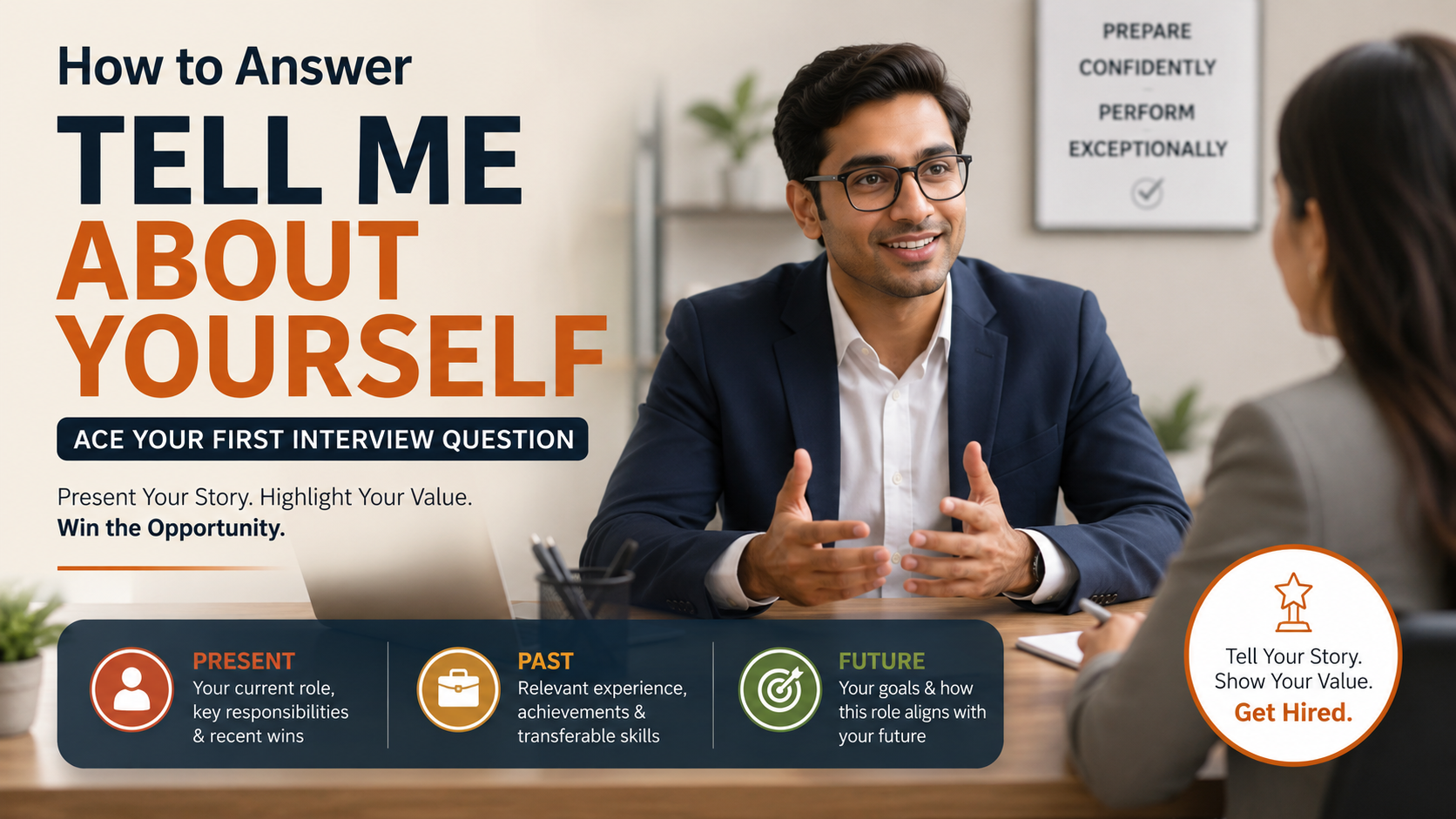
| Phase | Core Focus & Components |
| 1. Present | Current role, key scope of responsibilities, and main recent wins |
| 2. Past | Relevant past background, previous achievements, and transferable skills |
| 3. Future | Why this target role aligns directly with your long-term career goals |
The Present-Past-Future Formula for Answering Tell Me About Yourself
To avoid rambling, rely on the Present-Past-Future framework. Indeed, this simple tool keeps your thoughts organized and clear. Moreover, it breaks your response into three simple parts.
First, discuss your current job and a recent win. Next, mention past work that built your core skills. Finally, explain why this position fits your future goals. Thus, this formula removes fluff and keeps your pitch focused.
Step 1: Start with the Present Role
Begin your response with your current position. Specifically, share your main duties and a recent success. Frame your daily work to highlight your top skills. Consequently, avoid listing routine tasks. Instead, focus on major wins.
State your title and company clearly. Then, share a metric-driven result. For instance, do not just say you manage projects. Rather, explain how you delivered projects on time and under budget. As a result, this focus on results builds instant trust.
Step 2: Transition into Past Experience
After sharing your present role, highlight your past work. However, focus only on past jobs that relate to the target role. Naturally, the goal is not to list every job. Instead, you want to show clear career growth.
For example, highlight transferable skills like team leadership or project management. Furthermore, explain how past challenges built your expertise. Indeed, showing continuous learning proves that your background is strong.
Step 3: Conclude with Future Aspirations
End your pitch by stating why you want this job. Specifically, show real excitement for the company mission. Furthermore, prove that you researched the role before the interview.
In addition, explain how this job matches your career path. Finally, finish with a clear statement that invites the next question. Thus, this clean ending hands control back to the hiring manager.
Sample Scripts: How to Respond to Tell Me About Yourself
Reviewing real-world scripts helps you adapt the formula to your situation. Furthermore, customizing your response shows high self-awareness during the conversation.
For instance, entry-level candidates should highlight drive. Meanwhile, mid-career pros should focus on wins. Conversely, career changers must highlight transferable skills.
| Career Level | Core Pitch Focus |
| Entry-Level | Academic wins, internship achievements, and proactive drive |
| Mid-Career | Proven technical skills, quantifiable metrics, and project leadership |
| Career Change | Transferable skills, relevant past wins, and passion for the new field |
Script for Mid-Career Professionals
“I serve as a Senior Marketing Specialist at Apex Digital. Currently, I lead our content team of four specialists. Over three years, my team boosted search traffic by 140%. Moreover, we generated 500 leads every year. Before this, I worked as an agency copywriter. Therefore, that role built my brand messaging skills. I enjoy agency growth, but I want an in-house role. That is why I am eager to know how to answer tell me about yourself for a fast-growing SaaS team like yours.”
This response balances leadership, metrics, and career growth. In short, the candidate shares current wins and explains why they want this new role.
Script for Entry-Level Applicants
“I recently graduated from State University with a Computer Science degree. Specifically, I focused on software engineering and web development. During my final year, I led a four-person capstone project. As a result, we built an open-source budget app with 1,000 monthly users. That project taught me clean coding and agile teamwork. Furthermore, I completed a web dev internship last summer. Thus, I am excited to apply my coding skills as a Junior Developer on your team.”
This answer overcomes a lack of work history. Indeed, it highlights initiative, real projects, and teamwork skills.
Script for Career Switchers
“For six years, I worked in client management in hospitality. During that time, I managed key accounts and solved client issues quickly. While managing accounts, I learned Python to automate team reports. Later, to switch careers, I earned a Data Analytics Certification in SQL and statistical modeling. Therefore, I want to combine my client skills with data analysis as a Business Intelligence Analyst on your team.”
This answer turns a career pivot into a strength. Consequently, it shows how past experience enhances new technical skills.
Master How to Answer Tell Me About Yourself in Any Interview
Focus on natural delivery rather than memorizing every word. After all, hiring managers notice when candidates sound like robots. Instead, practice your pitch using simple bullet points rather than full sentences.
Speak your answer out loud in front of a mirror. Meanwhile, keep your pace steady and your tone energetic. In addition, keep your total answer between 60 and 90 seconds. Ultimately, adding numbers and metrics builds natural authority.
Mistakes to Avoid When Answering Tell Me About Yourself
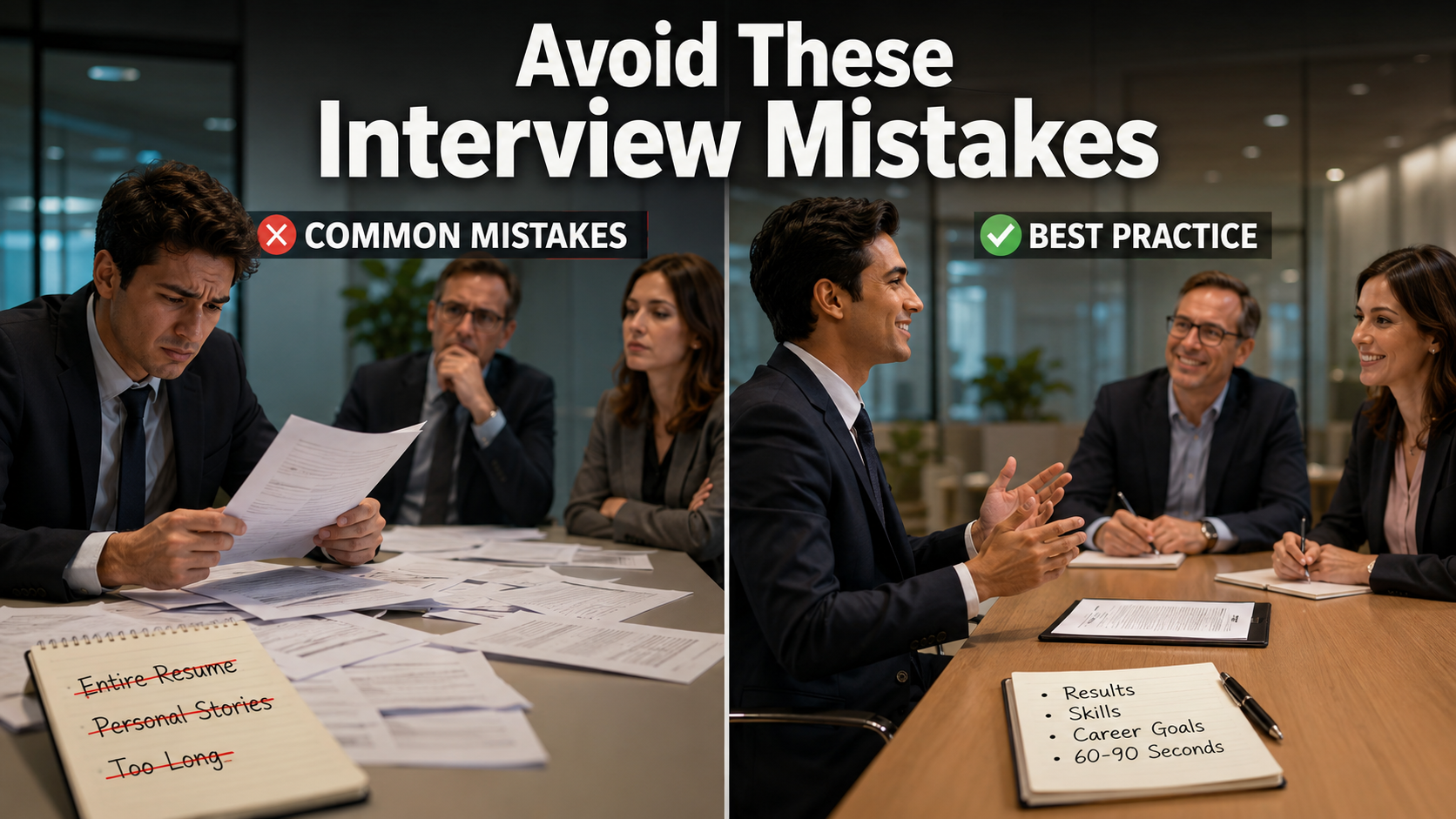
Many candidates make basic errors during their opening response. Therefore, avoid these mistakes to keep your intro sharp and professional.
| What to Avoid | What to Do Instead |
| Reciting your entire CV | Highlight 2–3 key wins |
| Sharing personal life details | Focus purely on professional growth |
| Apologizing for employment gaps | Reframe gaps as skill-building opportunities |
| Winging it without prep | Practice structured bullet points |
First, do not recite your entire resume from start to finish. Otherwise, you waste time on details the interviewer already read. Second, avoid sharing personal details about your family or hobbies. Finally, never talk trash about past bosses or toxic workplaces.
FAQ SECTION
How long should your answer be when learning how to answer tell me about yourself?
Your response should ideally last between 60 and 90 seconds in a standard interview. Indeed, this timeframe provides adequate space to outline your present responsibilities, highlight past wins, and state your long-term career goals clearly. Consequently, keeping your pitch short forces you to focus heavily on high-impact metrics rather than fluff. Furthermore, if the hiring manager wants additional context regarding a project, they will ask follow-up questions later in the conversation. Therefore, delivering a crisp opening demonstrates strong self-awareness, exceptional communication discipline, and respect for the interviewer’s schedule.
Should you talk about personal life when figuring out how to answer tell me about yourself?
You should keep your answer almost entirely focused on your professional career path and key job skills. However, only mention personal details or background hobbies if they directly relate to the job description or reflect positively on the company culture. For example, discussing personal open-source coding projects makes total sense when interviewing for tech roles, but talking about unrelated hobbies wastes precious time. Therefore, always evaluate every piece of information against one central filter: does this specific detail prove to the hiring manager that you are the absolute best candidate for this position?
How to answer tell me about yourself with no work experience?
If you lack formal corporate experience, center your response on academic accomplishments, specialized coursework, capstone projects, student leadership roles, or volunteer experience. Specifically, utilize the standard Present-Past-Future framework by launching into your current field of study, highlighting a significant project outcome, and explaining how your educational journey prepared you for this entry-level opening. Furthermore, emphasize transferable skills like problem-solving, team collaboration, adaptability, and an eager work ethic. As a result, showing genuine enthusiasm and a proactive approach to continuous learning will heavily offset your lack of traditional workplace longevity.
What is the biggest mistake when learning how to answer tell me about yourself?
The single biggest mistake candidates make is giving an unfiltered, minute-by-minute chronological recap of their entire resume. After all, hiring managers already possess your resume document; thus, they do not need you to read it back to them line by line. Instead, they ask this prompt to see if you can curate a targeted story that links your best wins directly to their operational needs. Another major mistake is winging your answer without prior practice, which inevitably leads to awkward pauses, excessive filler words, tangential stories, and a total lack of clear structural direction.
How to answer tell me about yourself with a career gap?
Address career gaps briefly, transparently, and with total confidence without over-explaining or sounding defensive. For instance, frame the gap around proactive growth, dedicated caregiving, freelance work, skill building, or personal enrichment, then instantly pivot right back to your current job readiness. Specifically, state clearly that you took intentional time off to complete a specialized professional certification or manage family responsibilities. Immediately follow up by emphasizing how excited, refreshed, and fully prepared you are to bring those newly honed skills and dedicated focus into this new role today.
CONCLUSION
Mastering how to answer tell me about yourself gives you a massive strategic advantage at the very start of any job interview process. By structuring your narrative around the simple Present-Past-Future framework, you can transform what could be an overwhelming prompt into a clear, compelling pitch that highlights your true professional value. In addition, you can explore essential topics you should educate yourself on to further expand your career knowledge and personal growth. Ultimately, always focus on measurable results, keep your answer under 90 seconds, and address what the prospective employer needs most from an ideal candidate.
Furthermore, dedicated preparation and active verbal practice are the real secrets to delivering a smooth, effortless response during high-stakes hiring conversations. Therefore, take time to draft your main points, refine your core story, and carefully match your pitch to the exact job description requirements. When you walk into the interview room with a clear structure, proven metrics, and a confident delivery, you will consistently make a great first impression every single time and build lasting momentum for the rest of your conversation.